
The allure of the professional gambler - the mathematical wizard who walks into a casino, spots a weakness in the blackjack shoe, and walks out with a fortune - has captivated players for decades. From the MIT Blackjack Team to the pages of Beat the Dealer, card counting represents the ultimate triumph of skill over luck.
With the rise of cryptocurrency casinos, a new generation of players is asking the same question: Can I apply these advantage play techniques to the digital tables?
The answer is complex. While the fundamental mathematics of Blackjack remain unchanged whether you are betting Bitcoin or fiat currency, the operational mechanics of online casinos create significant hurdles. This guide provides an honest, advanced analysis of card counting in the digital age, separating the Hollywood myths from the statistical realities of deck penetration and RNG algorithms.
The Mechanics of Card Counting: A Refresher
Before dissecting the online environment, it is crucial to understand why card counting works. It is not about memorizing every card played. Instead, it is a heuristic system used to track the ratio of high-value cards (10s, Face Cards, Aces) to low-value cards (2-6) remaining in the deck.
The Hi-Lo System
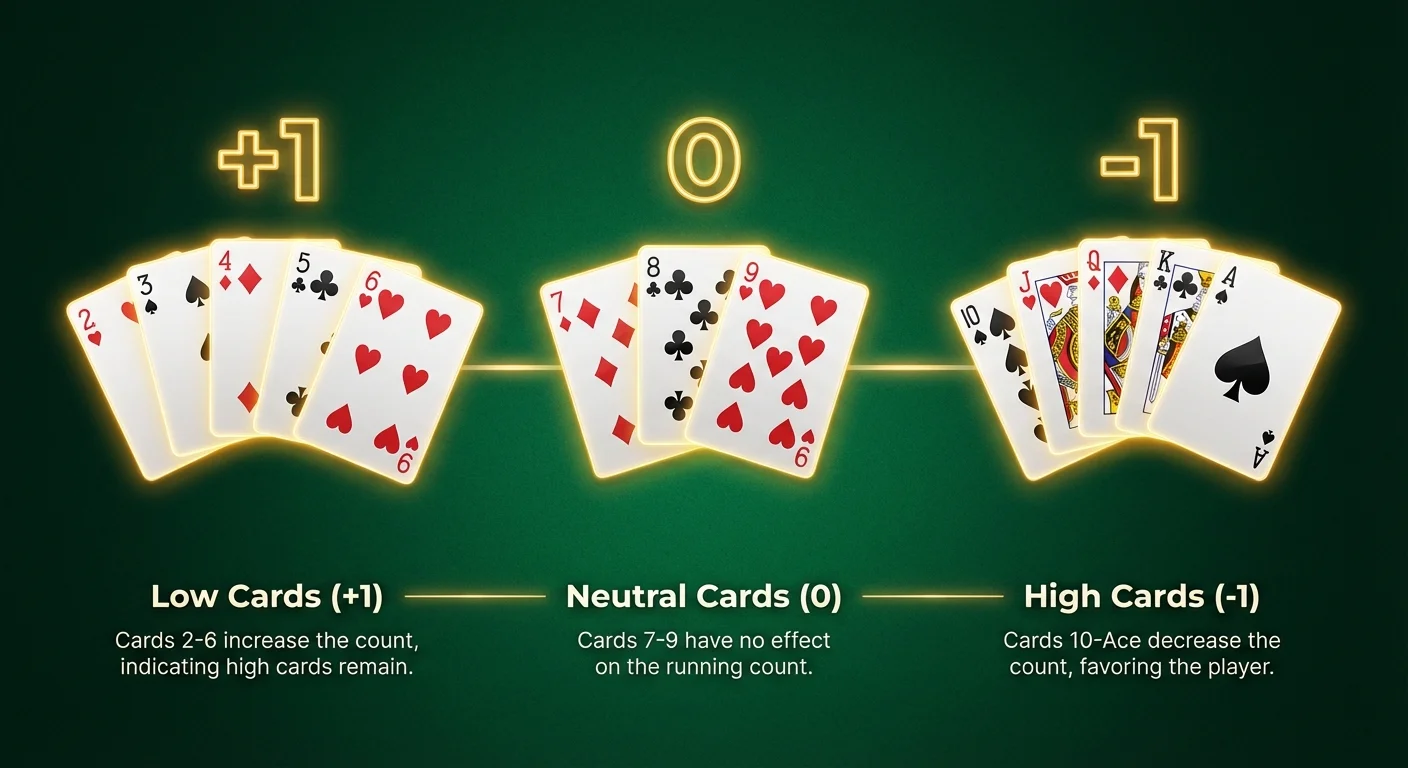
The most common method is the Hi-Lo count.
- Low Cards (2-6): +1
- Neutral Cards (7-9): 0
- High Cards (10-A): -1
When the "Running Count" is positive, it means more low cards have been played, leaving a deck rich in high cards. A deck rich in 10s and Aces favors the player for several reasons:
- Blackjacks are more frequent: Players get paid 3:2 (ideally), while dealers only get even money.
- Dealer Busts: The dealer must hit until 17. In a high-count shoe, the dealer is statistically more likely to bust on stiff hands (12-16).
- Successful Double Downs: You are more likely to land a strong total when doubling on 10 or 11.
However, a raw Running Count is useless without context. You must convert it to a True Count by dividing the Running Count by the estimated number of decks remaining. This is where the online environment begins to crumble the strategy.
The RNG Wall: Why You Can't Count Software Blackjack
The vast majority of blackjack games in crypto casinos are powered by Random Number Generators (RNG). For a deep dive into the underlying mechanics, see our comparison of RNG software vs. live dealer games. These are the digital versions of the game where you play against a computer, often with instant dealing speeds.
The "Infinite Shuffle" Problem
In a physical casino, the cards are dealt from a shoe until a "cut card" is reached, usually towards the end of the deck. This allows the count to develop over time.
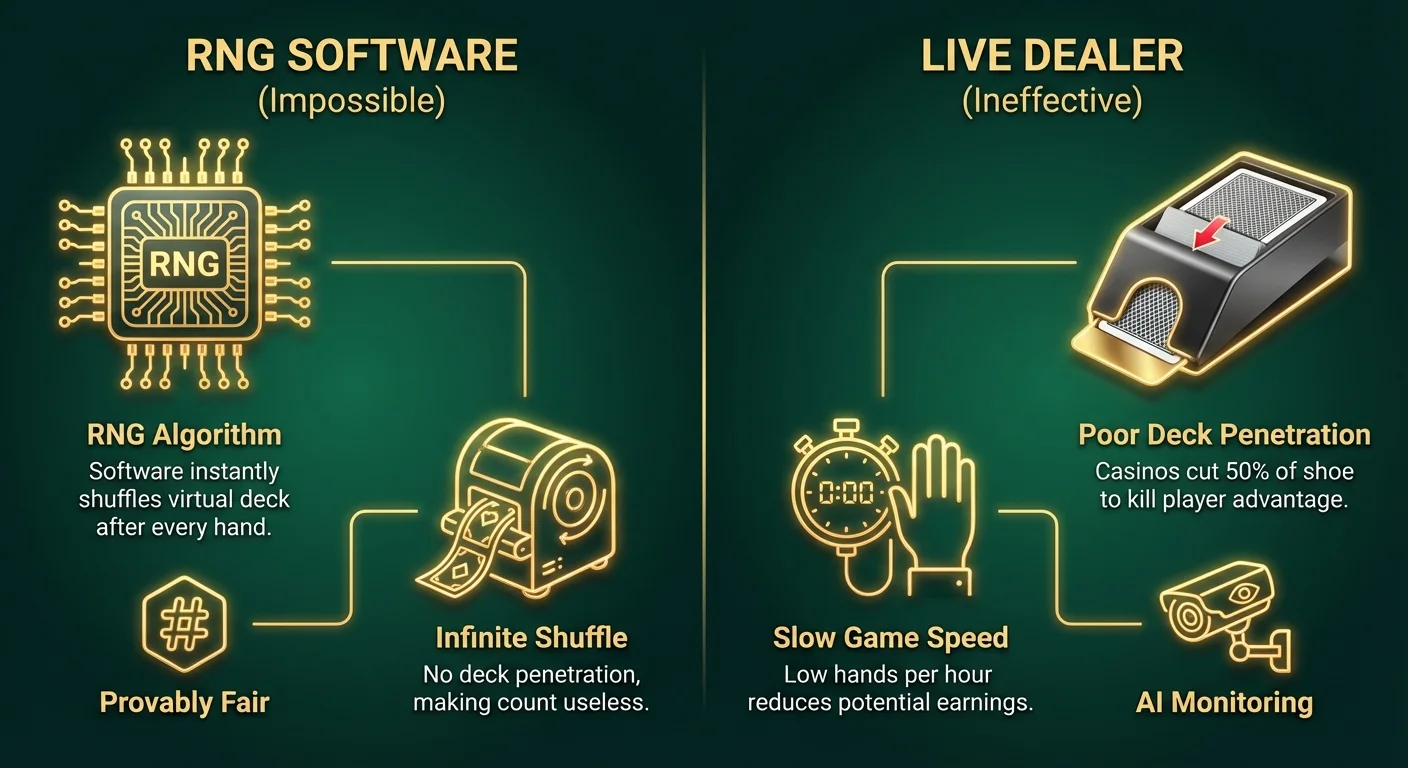
In RNG-based blackjack, the software effectively shuffles the entire virtual shoe after every single hand.
- Scenario: You play a hand and see four Aces and four Kings appear on the screen.
- The Myth: "The deck is now poor in high cards, so I should bet low."
- The Reality: The RNG algorithm resets the deck instantly. The probability of drawing an Ace in the next hand is exactly the same as it was in the first hand.
Provably Fair Technology
Crypto casinos often boast "Provably Fair" games. This technology allows players to verify the randomness of the outcome using cryptographic hashes. While this guarantees the casino isn't cheating you by manipulating the cards to force a loss, it also confirms that card counting is impossible. The "seed" used to generate the hand is independent of the previous hand's seed.
Verdict: Card counting in RNG/Software Blackjack is mathematically impossible.
Live Dealer Blackjack: The Gray Area
The debate gets interesting when we look at Live Dealer streams. These games feature real human dealers, real physical cards, and real shoes, streamed in HD from studios in Riga, Manila, or Costa Rica.
At first glance, this seems vulnerable to advantage play. However, casino operators are well aware of this vulnerability and have implemented countermeasures that make counting extremely difficult, though not necessarily impossible.
The Problem of Deck Penetration
The single most important factor in card counting is Deck Penetration (Pen). This refers to how deep into the shoe the dealer deals before shuffling.
- Physical Casino Standard: A good game offers 75% to 85% penetration. In a 6-deck shoe, they might deal out 4.5 to 5 decks. This allows variance to swing and the True Count to climb high enough to justify large bets.
- Live Dealer Standard: Most online studios, including those hosting tables for major crypto casinos, enforce a 50% penetration rule. In an 8-deck shoe, they will place the cut card right in the middle.
Why Poor Penetration Kills EV (Expected Value)
When 4 decks are cut out of an 8-deck shoe, the variance is suffocated. A True Count of +3 or +4 (where the player gains a significant edge) becomes a statistical rarity. You might play for hours without seeing a playable count. Since you are fighting a house edge (typically 0.5%) the rest of the time, the brief moments of advantage aren't enough to overcome the cost of waiting.
Game Speed and Rounds Per Hour (RPH)
Card counting is a volume game. A professional needs to play hundreds of hands to let the math play out.
- Physical Table: ~100 hands per hour (heads up) or ~60 with other players.
- Live Dealer Online: ~30 to 50 hands per hour.
Online dealers are instructed to scan every card. Players have digital timers to make decisions. The pace is glacial. Combining a low RPH with terrible deck penetration makes the hourly earning potential often drop below minimum wage, even for perfect counters.
Strategy Variations: Crypto Casino Rules
If you are attempting to play optimally at a crypto casino, you must analyze the rules before you sit down. The rules dictate the House Edge and whether the game is even beatable in theory. For a full analysis of RTP, check out our guide on deconstructing the odds and house edge.
6:5 Payouts vs. 3:2 Payouts
This is the most dangerous trend in modern blackjack.
- 3:2 Payout: A $10 bet wins $15 on Blackjack.
- 6:5 Payout: A $10 bet wins $12 on Blackjack.
As noted in industry analysis, switching from 3:2 to 6:5 increases the House Edge by roughly 1.39%. In a game where the standard edge is only ~0.5%, this nearly triples the casino's advantage. Never play a 6:5 table, regardless of whether you are counting or using basic strategy. It is an insurmountable mathematical disadvantage.
American vs. European Rules
Many crypto casinos utilize European-style rules for their live tables.
- American: Dealer takes a "hole card" (face down). If the up-card is an Ace or 10, they check for Blackjack immediately.
- European: Dealer takes only one card. They do not take a second card until all players have acted.
The Risk: In European Blackjack, if you double down or split, and the dealer ends up drawing a Blackjack at the end of the round, you lose your entire total bet (including the split/double). In American rules, you usually only lose your original bet (Original Bets Only rule). This increases the variance and requires adjustments to your Basic Strategy.
The Surrender Option
Look for crypto casinos offering "Late Surrender." This allows you to forfeit half your bet after seeing the dealer's up-card (and checking for BJ). This is a powerful tool for the player, specifically when holding:
- Hard 16 vs. Dealer 9, 10, or Ace.
- Hard 15 vs. Dealer 10.
Correct use of Surrender can shave roughly 0.08% off the House Edge.
The Crypto Advantage: Anonymity and Bonuses
While the game conditions (penetration and speed) are worse online, crypto casinos offer unique advantages that physical casinos cannot match. Smart players pivot from "card counting" to "bonus whoring" and "rakeback farming."
1. Identity and Bans
In a Las Vegas casino, if you are suspected of counting, you are backed off. Your photo is taken and shared via facial recognition databases (like OSN).
In a crypto casino, you are often playing under a pseudonym with a VPN. While they can ban your account for "irregular play" (which is often buried in the Terms of Service), your biometric identity is generally safer. However, nearly all online casinos use AI to track betting patterns. If you bet $10 for fifty hands and suddenly bet $500 when the deck is hot, their algorithms will flag you instantly.
2. The Power of Rakeback
Advantage play in crypto casinos isn't about counting cards; it's about reducing the house edge to zero via incentives.
- Deposit Bonuses: If a casino matches your deposit, you are playing with free equity.
- Rakeback: Many crypto casinos return a percentage of the House Edge to you.
- VIP Rewards: High-volume play generates comp points.
If you play perfect Basic Strategy (0.5% disadvantage) but receive 0.6% back in combined rewards and rakeback, you have effectively created a positive expectation (+EV) game without counting a single card.
Myth vs. Reality: A Summary
Below is a breakdown of what works and what doesn't in the crypto gambling sphere.
| Feature | Physical Casino | Crypto Live Dealer | Crypto RNG (Software) |
|---|---|---|---|
| Card Counting | Possible (if conditions allow) | Theoretically possible, practically useless | Impossible |
| Deck Penetration | 75% - 85% | ~50% (Standard) | N/A (Shuffles every hand) |
| Game Speed | Fast | Slow | Instant |
| Bet Spreads | scrutinized by Pit Boss | Flagged by AI Algorithms | Allowed (but useless) |
| Comps/Rakeback | Difficult to calculate exact value | Transparent and instant | Transparent and instant |
| Anonymity | Low (Cameras/ID) | High (Crypto/VPN) | High (Crypto/VPN) |
Practical Tips for the Crypto Blackjack Player
Since card counting is largely ineffective online due to deck penetration, how do you maximize your win rate?
1. Master "Perfect" Basic Strategy
Basic Strategy is not a suggestion; it is a mathematical requirement. It reduces the house edge to the lowest possible floor. For detailed guidance, read our guide on mastering basic strategy charts. You should never deviate from it based on "gut feeling."
- Hard Totals: Always double down on 11. Double on 10 vs Dealer 2-9.
- Soft Totals: Know when to hit your Soft 17 vs. Stand.
- Splits: Always split Aces and 8s. Never split 10s or 5s.
Because you are playing online, you can legally keep a strategy chart open in another browser tab. There is no excuse for making a mathematical error in an oCrypto casinos load their Blackjack interfaces with side bets like "Perfect Pairs," "21+3," or "Insurance."erfect Pairs," "21+3," or "Insurance."
- Insurance: This is a bet that the dealer has a 10 in the hole. The payout is 2:1, but the odds of winning are worse. Unless you are counting (which we've established is hard), Insurance has a house edge of roughly 6%.
- Side Bets: These often carry a house edge between 3% and 10%. They are volatility traps designed to drain your bankroll.
3. Scout the Tables
Not all live dealer providers are the same. Before depositing, open the streams and observe:
- Where is the dealer placing the cut card? (Look for deep penetration).
- Is it an 8-deck or 6-deck shoe? (Fewer decks are better).
- Does the dealer hit or stand on Soft 17? (Standing benefits the player).
4. Manage Your Bankroll with Crypto Volatility in Mind
Remember that in a crypto casino, your bankroll is subject to two types of variance, making bankroll management for volatile assets essential:
- Game Variance: The swings of winning/losing hands.
- Asset Variance: The price fluctuation of Bitcoin, Ethereum, or SOL.
If you are playing professionally, consider using Stablecoins (USDT/USDC) to eliminate the risk of your bankroll losing value while you sit at the table.
Conclusion: The Honest Verdict
Can you count cards in a crypto casino?
- In RNG games: No.
- In Live Dealer games: Yes, you can count, but you probably won't win.
The combination of 50% deck penetration, slow game speeds, and aggressive AI monitoring makes traditional card counting a poor use of time for the online gambler. The edge gained is infinitesimal compared to the variance you will endure.
The true "Advantage Play" in crypto casinos lies in strict adherence to Basic Strategy, disciplined bankroll management, and the intelligent exploitation of bonuses and rakeback programs. By treating blackjack as a game of math rather than a game of luck, you can stretch your crypto further and enjoy one of the lowest house edges in the gambling world - even if you can't bring down the house like the MIT team.