
If you have spent any time in the sports betting trenches, you have likely heard the mantra: "Parlays are sucker bets." Generally speaking, this is true. The compounded vigorish (house edge) on independent events makes it mathematically difficult to beat the book over the long haul.
However, there is a massive exception to this rule - an exception so powerful that sportsbooks spend millions of dollars on algorithms to detect and block it. That exception is correlation.
When used correctly, correlated parlays are not just "lottery tickets"; they are sophisticated tools for generating positive Expected Value (+EV). While the average bettor throws together a random 6-leg parlay based on gut feeling, the sharp bettor looks for outcomes that are inextricably linked, where the occurrence of one event drastically increases the probability of the other.
This guide explores the advanced mechanics of correlation betting, why sportsbooks restrict these combinations, and how you - using the flexibility of crypto sportsbooks - can identify the edges the house might miss.

The Mathematics of Independence vs. Correlation
To understand why correlation is profitable, you must first understand how sportsbooks calculate standard parlay odds.
In a standard parlay, the book assumes that every leg of the bet is an independent event. This means the result of Game A has zero impact on the result of Game B.
The Standard Calculation
If you bet on two coin flips (50/50 probability) parlayed together:
- Leg 1: 50% (0.50)
- Leg 2: 50% (0.50)
- Combined Probability: (25%)
- Fair Odds: +300 (4.00 decimal)
Sportsbooks pay you slightly less than +300 to keep their edge.
The Correlation Glitch
Now, imagine a scenario where the events are dependent. Let's say you are betting on the NFL.
- Leg 1: Kansas City Chiefs to Win (-110)
- Leg 2: Patrick Mahomes Over 2.5 Passing Touchdowns (-110)
If Patrick Mahomes throws 3+ touchdowns, the likelihood of the Chiefs winning the game is no longer 50/50. It might jump to 80%. However, if the sportsbook's software treats these as independent events, it will calculate the parlay payout based on the 50% math, offering you odds that imply a much lower probability of winning than reality dictates.
This discrepancy between the "Implied Probability" (what the odds say) and the "True Probability" (based on correlation) is your edge.
Why Sportsbooks Restrict Correlation
If you try to bet "Team A to win 3-0" and "Team A to win the match" in a parlay on a traditional slip, you will get an error message: "Selection not allowed" or "Outcomes are correlated."
Sportsbooks restrict these bets because they break the mathematical model of the sportsbook. If they allowed full correlation betting at standard parlay odds, they would go bankrupt.
The Evolution: From Restrictions to Same Game Parlays (SGP)
In the past, books simply blocked any bets from the same game. Today, they offer Same Game Parlays (SGPs).
Warning: Do not mistake SGPs for an automatic edge.When you place an SGP, the sportsbook's algorithm recognizes the correlation and adjusts the payout downward.
| Bet Type | Scenario | Calculation Method | Payout (Example) |
|---|---|---|---|
| Standard Parlay | Two different games | Independent Probability | +260 |
| Correlated SGP | QB Yards + WR Yards | Adjusted Probability | +180 |
| True Correlated Parlay | If allowed (The Glitch) | Independent Probability | +260 |
The goal of the advanced bettor is to find "Soft Correlation" - links between events that are strong enough to give you an edge, but subtle enough that the sportsbook (or the specific crypto book you are using) hasn't priced down the payout aggressively.
Identifying Positive Correlation
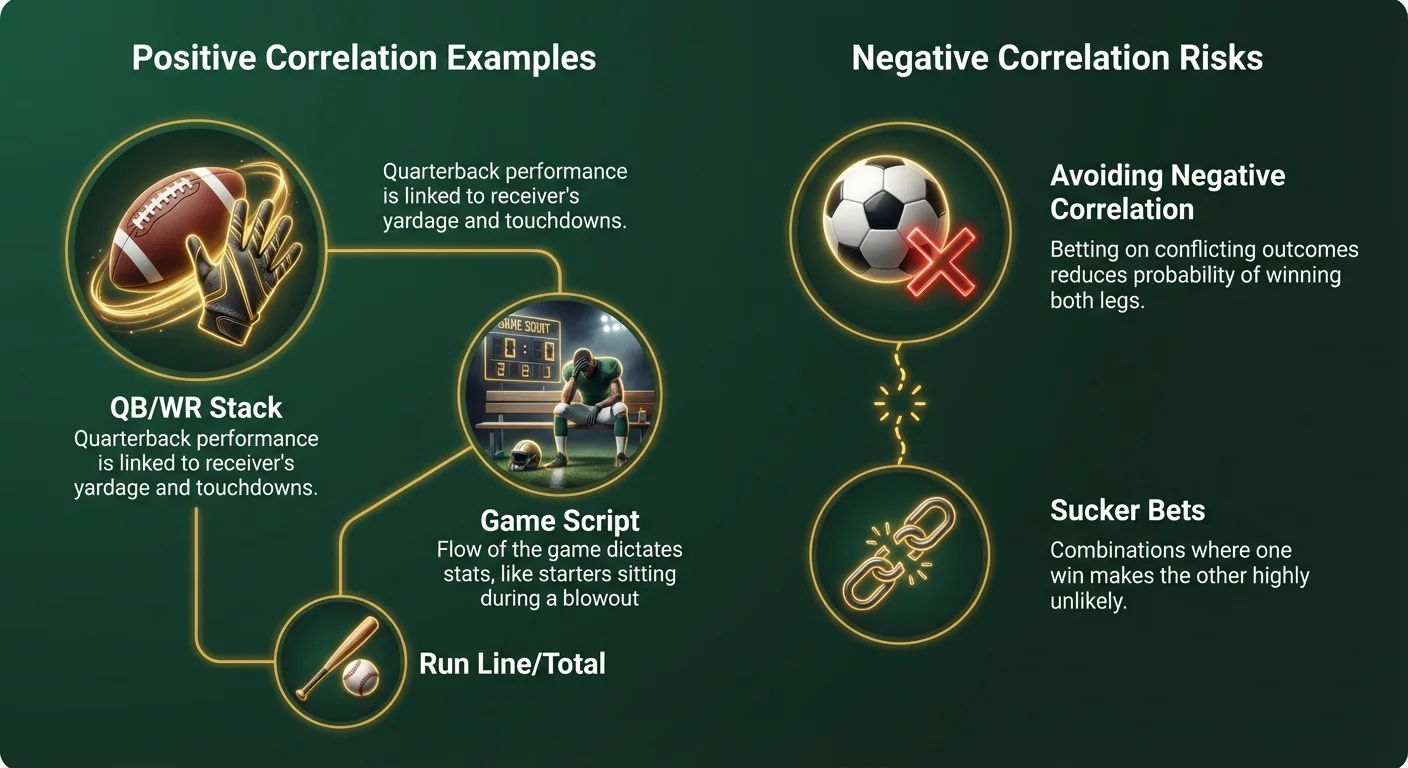
Positive correlation exists when Leg A winning makes Leg B more likely to win. Here are the classic structures used by sharps.
1. The Quarterback/Receiver Stack (NFL)
This is the most obvious form of correlation. If a Wide Receiver has 150+ yards and 2 TDs, it is mathematically impossible for the Quarterback to have a bad game.
- The Play: Over Passing Yards (QB) + Over Receiving Yards (WR1).
- The Nuance: Look for deep-threat receivers. A slot receiver catching 10 passes for 80 yards doesn't necessarily correlate to an "Over" on QB yardage as strongly as a receiver who catches 2 passes for 90 yards.
2. The Game Script Correlation (NBA/NFL)
This relies on how the flow of the game dictates stats.
- The Blowout Script: If you like a heavy favorite to cover a large spread (e.g., -14.5), correlate it with the Under on the star player's minutes or points. If they blow the team out, the starters sit the 4th quarter.
- The Catch-Up Script: If you like a heavy underdog to cover or the game to go Over the total, look for passing props on the underdog. Teams that are trailing throw the ball to stop the clock.
3. Run Line and Total Correlation (MLB)
In baseball, correlation is heavily tied to scoring environments.
- Favoring the Favorite (-1.5 Run Line): It is very hard to cover a -1.5 run line in a 2-1 game. To cover -1.5, a team usually needs to score 4+ runs. Therefore, betting the Favorite -1.5 correlates positively with the Over.
- Favoring the Underdog (+1.5 Run Line): In low-scoring games, variance is lower, and tight scores are more common. The Underdog +1.5 correlates positively with the Under.
The Danger of Negative Correlation
Novice bettors often destroy their own value by betting negatively correlated events just to boost the odds. This is the definition of a "sucker bet."
Examples to Avoid:
- Over 2.5 Goals (Soccer) + Draw: While 2-2 draws happen, 0-0 and 1-1 draws are far more common. By needing 3 goals and a tie, you are threading a needle.
- NFL Favorite -7 + Under 38: While possible (a 21-10 win), it is difficult. Favorites usually cover spreads by scoring points. If the game is low scoring, the variance favors the underdog.
Pro Tip: Occasionally, contrarian sharps will bet negative correlations intentionally if the payout is astronomical and they believe the specific matchup defies the standard logic (e.g., two elite defenses where one team relies entirely on a running game). However, this is highly advanced and risky.
Exploiting Soft Correlation in Crypto Sportsbooks
This is where playing on CryptoGambling.com recommended sites offers a distinct advantage.
Traditional fiat sportsbooks (DraftKings, FanDuel, Bet365) have incredibly tight SGP algorithms. However, many crypto-native sportsbooks and decentralized betting platforms use different odds providers or offer "Build Your Own Bet" features that are less sensitive to soft correlation.
1. Second-Half Derivatives
Lines for the full game are sharp. Lines for the second half (2H) are often softer.
- The Strategy: If a heavy favorite is leading at halftime, books often inflate the 2H total. However, if the game is already decided, teams run the clock.
- The Bet: 2H Under + Losing Team 2H Spread (Garbage time points).
2. Cross-Sport Correlation
This is a frontier rarely checked by algorithms.
- Scenario: A city is hosting a massive double-header (e.g., Philadelphia Eagles play at 1 PM, Phillies play at 7 PM). The crowd energy and "city vibes" are intangible, but historical data suggests that when a city's NFL team wins big, the crowd energy carries over to the evening event.
- The Edge: Parlaying outcomes across different sports is almost never "taxed" by SGP algorithms because the events are technically independent. If you find an external factor (weather, travel issues affecting a specific city) that impacts both, you have un-priced correlation.
3. High Limits and Instant Payouts
When you hit a correlated parlay, the payouts can be massive. Fiat books often limit successful parlay bettors quickly ("limiting your account"). Crypto sportsbooks generally offer:
- Higher Limits: VIP tiers in crypto books often allow larger wagers on exotic combinations.
- Anonymity: It is harder for books to "profile" your betting style across different platforms if you are using distinct wallet addresses.
- Instant Settlement: Variance in parlay betting is high. Getting your winnings out instantly via Bitcoin or USDT allows you to manage your bankroll more effectively than waiting 3-5 days for a bank wire.
Strategy: The "Omitted Variable" Approach
To beat the book, you need to identify a variable that affects both legs of your parlay, which the book hasn't accounted for.
The Weather Factor
Sportsbooks adjust totals for weather, but they often forget to adjust player props fully.
- Scenario: 30mph winds in an NFL game.
- The Public: Bets the Under. The book adjusts the total down.
- The Sharp Parlay: Under Total Points + Running Back Rushing Attempts Over.
- Why: If they can't pass due to wind, they must run. The book might lower the RB's yardage, but they often leave the attempts line static.
The Foul Trouble Factor (NBA)
- Scenario: Team A's center is prone to fouls and is facing Joel Embiid (who draws many fouls).
- The Correlation: If the starting Center gets in foul trouble, the backup comes in. The backup is usually a worse defender.
- The Bet: Joel Embiid Over Points + Opposing Center Under Minutes.
Practical Tips for Betting Correlated Parlays
Shop the SGP Price:Build the exact same correlated parlay (e.g., Lakers Win + LeBron Over 25 Points) at three different crypto sportsbooks. You will be shocked at the price difference. Some algorithms punish the correlation heavily (offering +150), while others might be looser (offering +175).
Keep it Small (2-3 Legs):
The more legs you add, the more the "vig" (house edge) compounds. A 2-leg correlated parlay is a sniper shot; a 6-leg parlay is a shotgun blast in the dark. The sweet spot for correlation is usually 2 or 3 legs.Check "Alternative" Lines:
Sometimes the main line doesn't correlate well.- Instead of: Buffalo Bills -7 + Over 48.
- Try: Buffalo Bills -2.5 (Alt Line) + Over 52 (Alt Line).
- By moving the spread through key numbers (3 and 7), you increase your win rate on the correlation of "Bills winning a shootout."
Avoid "Double Dipping" on Price:
If you bet a heavy favorite (-400) and their QB to throw 3 TDs, you aren't getting much value. The book already assumes the QB plays well for the team to be -400. Look for correlation in games with tighter spreads (Pick'ems or -3/+3), where the outcome is less certain and the correlation pays better.
Conclusion
Correlation is one of the few areas in sports betting where 1 + 1 can equal 3. By understanding that events on the field are rarely independent, you can construct parlays that possess a true probability higher than the odds imply.
While sportsbooks try to mitigate this with "Same Game Parlay" pricing algorithms, they cannot price in every variable. Weather, game scripts, and coaching tendencies provide "soft correlation" opportunities that automated lines miss.
Utilize the advantages of crypto sportsbooks - speed, liquidity, and varied odds providers - to shop for these spots. Remember: don't just bet on what you think will happen; bet on how one event causes the other to happen. That is the difference between gambling and investing.