
Every seasoned gambler knows that while slots are a game of pure volatility and poker is a game of incomplete information, Bingo occupies a unique statistical middle ground. It is mathematically transparent, yet deceptively complex when you move beyond the casual "buy one strip and hope" approach. The most agonizing question for the serious player isn't which pattern to hope for - it is a question of volume.
How many bingo cards should you actually play?
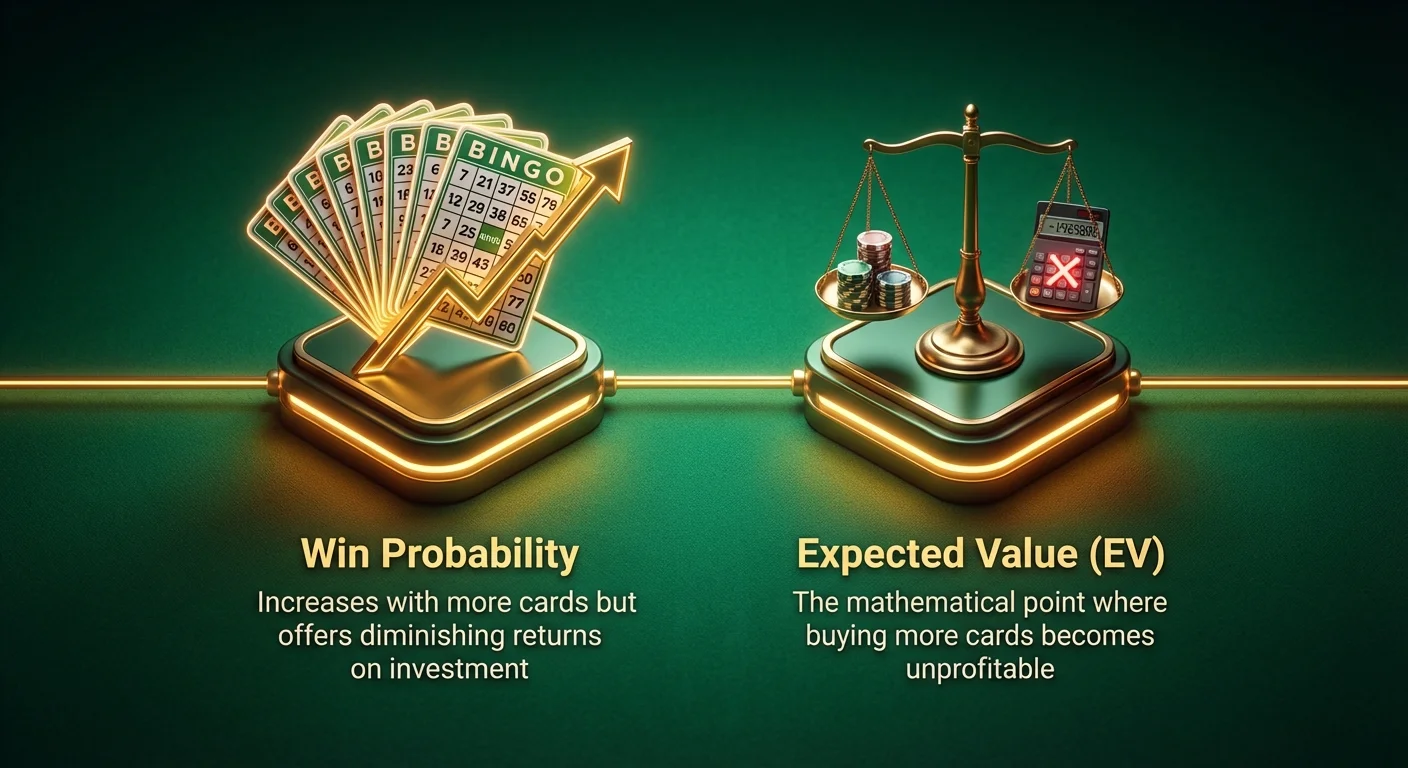
There is a pervasive myth in the online gambling community that "more is always better." While buying more cards undeniably increases your probability of winning a single game, it does not necessarily increase your Expected Value (EV). In fact, aggressive ticket acquisition can rapidly deplete a bankroll, turning a session with a slight house edge into a mathematical disaster for the player.
This guide moves beyond the basic rules. We are looking at the advanced mathematics of ticket volume, bingo bankroll management, and the law of diminishing returns. We will help you calculate the exact "Sweet Spot" - the optimal number of cards to purchase based on player count, prize pools, and game variance.
The Mathematics of Probability: Odds Per Ticket
To understand how many cards to buy, you must first understand what you are actually purchasing. You are not buying a "chance" in the abstract sense; you are purchasing a percentage of the total equity in the game.
In a standard game of crypto bingo - whether it is 75-ball or 90-ball - the odds are calculated based on the total number of cards in play, not the number of players.
The Base Formula:
If you hold 1 card and there are 99 other cards in play (100 total), your chance of winning is 1%. If you buy 9 more cards (holding 10 total), and the total cards in play rises to 109, your chance increases to roughly 9.1%.
The Concentration of Risk
In a physical bingo hall, players are limited by physics - human hands can only daub so many numbers per second. In the era of online crypto gambling, the software "auto-daubs" for you. This allows players to buy the maximum allowance (often 50 to 100 cards).
However, buying bingo cards is an exercise in concentrating risk.
- Scenario A: You play 100 games with 1 card each. You are spreading your variance over time.
- Scenario B: You play 1 game with 100 cards. You are staking your entire session budget on a single random number generator (RNG) seed.
While Scenario B gives you a high chance to win that specific game, if you lose, your session is over. Scenario A keeps you in the game longer, allowing statistical averages to play out.
The Law of Diminishing Returns
This is where the strategy shifts from "beginner" to "advanced." There is a tipping point where the cost of purchasing an additional ticket outweighs the incremental increase in win probability. This is heavily influenced by the Pot Odds.
In many crypto bingo rooms, the prize pool is either fixed (guaranteed jackpot) or progressive (based on ticket sales).
Case Study: The Fixed Pot Paradox
Imagine a game with a guaranteed prize of 100 USDT. Tickets cost 1 USDT.
There are currently 90 cards purchased by other players.
| Your Action | Your Cost | Total Cards | Your Win % | Expected Value (EV) Calculation |
|---|---|---|---|---|
| Buy 1 Card | 1 USDT | 91 | 1.09% | |
| Buy 10 Cards | 10 USDT | 100 | 10.00% | |
| Buy 50 Cards | 50 USDT | 140 | 35.71% |
The Analysis:
In this specific scenario, buying 1 card was actually a positive expected value play (rare in gambling). Buying 10 cards was the break-even point. Buying 50 cards resulted in a massive negative expected value.
Why? Because as you buy more cards, you are diluting the value of your own equity. You are competing against yourself. When you hold 35% of the cards, you are paying for 35% of the pot, but the house rake (often built into the prize structure) ensures that high-volume buying eventually leads to a loss.
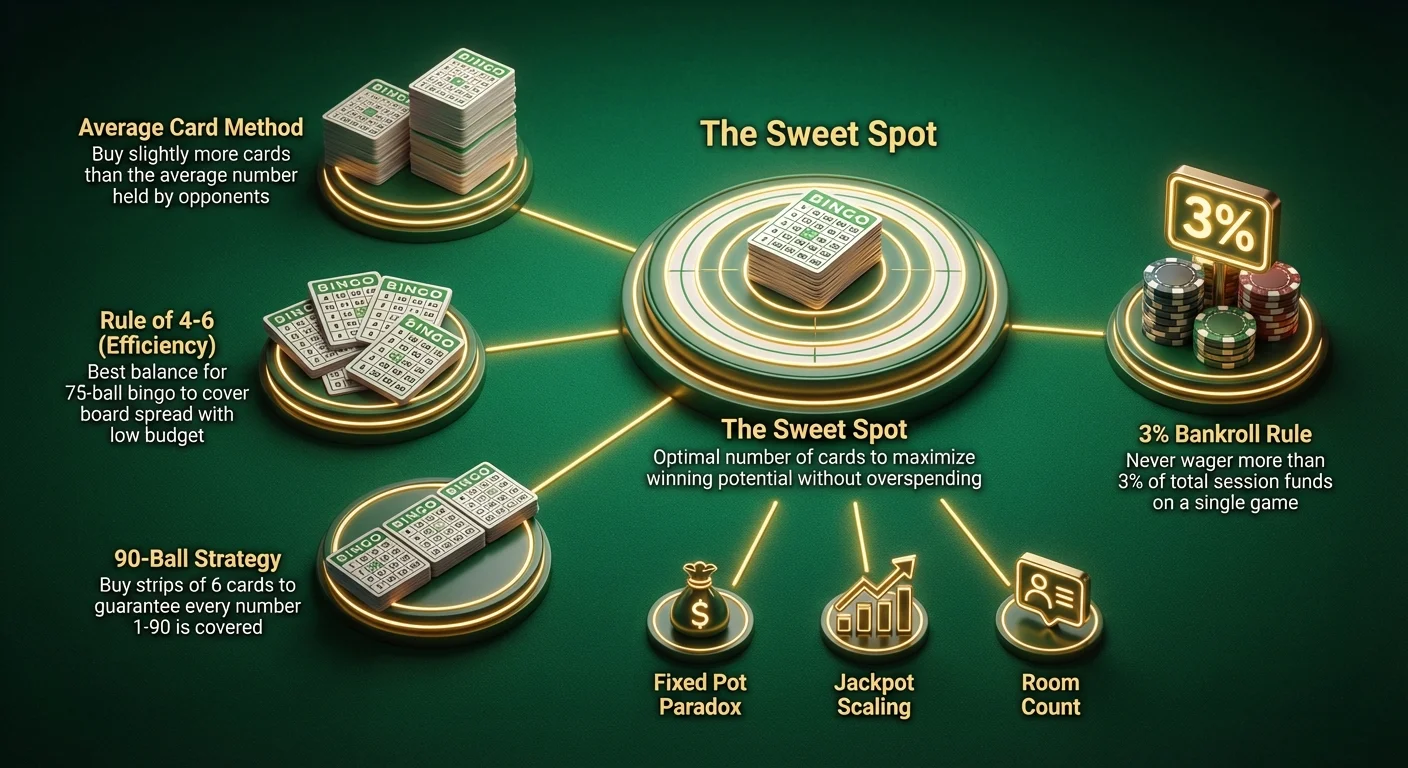
The Sweet Spot Rule: Never buy so many cards that your cost of entry exceeds the theoretical value of the prize multiplied by your win percentage.
Calculating the Optimal Number (The Sweet Spot)
So, how do you determine the magic number? It requires a quick assessment of the room before the game starts. Most crypto bingo sites display the "Total Players" or "Total Cards Bought" counter.
1. The "Average Card" Method
A solid baseline strategy is to match or slightly exceed the average number of cards held by opponents.
- If there are 20 players and 100 cards sold, the average player holds 5 cards.
- Your Move: Buying 6 to 8 cards puts you above the average, giving you a statistical edge over the majority of the field without over-committing your bankroll.
2. The Rule of 4-6 (The Efficiency Zone)
Mathematical simulations of 75-ball bingo suggest that purchasing between 4 and 6 cards offers the best balance between covering the board's spread and maintaining a low budget.
- Number Spread: With 4 cards, you are likely to cover a vast majority of the numbers from 1-75.
- Diminishing Utility: The numbers on card #20 likely duplicate the coverage you already have on cards #1-4. You aren't covering new numbers; you are just doubling up on existing ones. While this helps for "pattern" games, it yields diminishing returns for standard line wins.
3. Scaling for Jackpots
The logic changes when a massive Progressive Jackpot is on the line. If a crypto bingo room has a rollover jackpot of 5 BTC, the "Implied Odds" are massive.
- In this scenario, EV matters less than "Life-Changing Potential."
- Strategy: This is the only time "Max Buying" is recommended, provided your bingo bankroll management can sustain the loss. The goal here isn't to grind a profit; it's to hold as many "lottery tickets" as possible for the big draw.
Bingo Bankroll Management: The 3% Rule
Even the best odds per ticket strategy will fail without strict financial discipline. Bingo moves fast. In online crypto rooms, a new game can start every 2 minutes.
To survive the variance, adopt the 3% Rule:
Never wager more than 3% of your total session bankroll on a single game.
If you deposit 100 USDT for a Sunday session:
- Max spend per game: 3 USDT.
- If tickets are 0.10 USDT, you can buy 30 cards (High Volume).
- If tickets are 1.00 USDT, you can buy 3 cards (Low Volume).
This forces you to adjust your volume based on the stake levels. If you play high-stakes games, you must be comfortable playing fewer cards to preserve your longevity.
Strategies Based on Game Type
Not all bingo games are created equal. The optimal number of cards changes based on the winning criteria.
75-Ball Pattern Games
In 75-ball bingo, you are often looking for complex patterns (e.g., "Blackout", "Arrow", "Four Corners").
- Sweet Spot: Higher Volume (10+ cards).
- Reasoning: You need number diversity. Complex patterns are hard to hit. Having more cards increases the likelihood that one of your cards has the specific distribution of numbers required for a difficult pattern like a "W" or a "Z".
90-Ball (UK Style)
This game usually rewards 1 Line, 2 Lines, and Full House.
- Sweet Spot: Multiple of 6.
- Reasoning: A standard 90-ball strip contains 6 cards. Buying a full strip of 6 ensures that every single number from 1 to 90 appears exactly once across your strip.
- Tactical Advantage: Every time a number is called, you are guaranteed to mark it off somewhere. This is the most efficient way to play 90-ball. Buying 7 cards is inefficient (you have one card with duplicate numbers). Buying 5 cards is inefficient (you are missing numbers). Always buy in sets of 6.
The Crypto Advantage: Provably Fair and Auto-Play
One distinct factor in calculating your card volume on sites like CryptoGambling.com is the technology platform.
Provably Fair Algorithms
In traditional online bingo, you trust the server. In crypto bingo, the "Provably Fair" system allows you to verify the randomness of the ball draw.
- Impact on Strategy: You can play with confidence that the game isn't rigged against high-volume players. The algorithm doesn't "know" you bought 50 cards and punish you; it is pure math. This makes statistical strategies (like the ones in this guide) reliable.
Instant Payouts and Re-buys
Crypto transactions are near-instant. If you hit a win, that liquidity is immediately available for the next round.
- The Compounding Trap: Be careful not to immediately plow all winnings into buying more cards for the next round. This is how winners go broke. Stick to your fixed unit size regardless of the previous game's result.
Tips for Optimizing Your Ticket Volume
Here is a practical checklist to run through before buying your tickets for the next round:
Scout the Room Count:
- < 10 Players: Aggressive. Buy 10+ cards. You have a genuine chance to dominate the lobby.
- 10-50 Players: Moderate. Buy 4-6 cards. Stick to the "Sweet Spot."
- > 100 Players: Conservative. Buy 1-3 cards. The variance is too high to invest heavily; play for fun or wait for a quieter room.
Check the Ticket Price vs. Prize Pool:
- If the ticket price is high (e.g., $5) and the prize is low (e.g., $50), play 1 card or skip. The Risk-to-Reward ratio is terrible.
Time Your Sessions:
- The "Sweet Spot" is easier to hit during off-peak hours (early mornings or weekdays). Fewer players mean your cards represent a larger percentage of the total equity.
Avoid "Side Bet" Drains:
- Many bingo games offer side games (slots on the side, scratch cards). These drain the budget you should be using to optimize your bingo card count. Focus your funds on the main game where you can control the volume.
Summary: Quality Over Quantity
The answer to "How many bingo cards should I play?" is rarely "as many as possible."
For the astute crypto gambler, the answer is dynamic. It is a calculation of the total field size, the cost of entry, and the type of game being played.
- In 90-ball: Buy strips of 6 to cover all numbers.
- In 75-ball: Buy enough to exceed the average player (usually 4-8 cards).
- In huge fields: Play conservatively to protect your bankroll.
The Sweet Spot is that delicate balance where you hold enough cards to make the game exciting and statistically viable, but few enough that a loss doesn't cripple your ability to play the next round. Bingo is a marathon, not a sprint. Manage your cards, manage your crypto, and let the math work in your favor.