
If Jacks or Better is the steady, reliable blue-chip stock of the video poker world, Double Double Bonus (DDB) is the volatile, high-flying crypto altcoin. It is a game defined by extreme highs and crushing lows, designed for the gambler who isn't satisfied with simply grinding out a small profit.
Double Double Bonus is one of the most popular video poker variants in both land-based and crypto casinos because it offers the tantalizing possibility of jackpot-sized wins without hitting a Royal Flush. However, this potential comes at a cost: variance. To master this game, you cannot simply apply standard strategy. You must learn to embrace the volatility, understand the power of the "kicker," and make counter-intuitive moves that would be considered mistakes in other games.
This advanced guide will dissect the mathematics of Double Double Bonus, outline the necessary strategy adjustments, and show you how to leverage crypto casino features to manage your bankroll against the game's notorious swings.
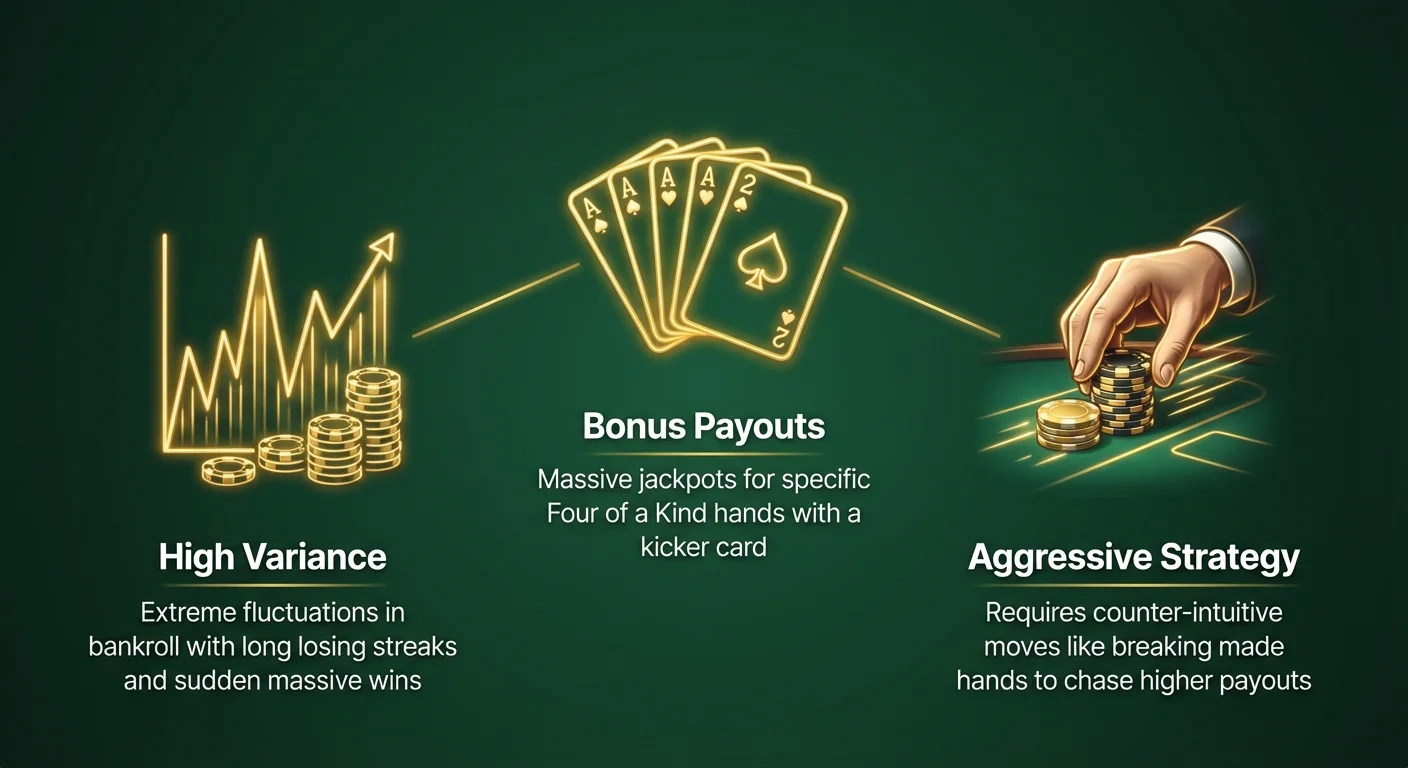
What is Double Double Bonus?
Double Double Bonus is a derivative of Jacks or Better and Double Bonus Poker. The core mechanic remains the same: you are dealt five cards, you choose which to hold, and you draw replacements to make the best five-card hand.
However, the paytable structure is radically different. The game takes money away from the common hands (specifically Two Pair) and funnels that equity into specific Four of a Kind (Quad) combinations.
The "Kicker" Concept
The name "Double Double" refers to the extra bonuses applied to Quads. In standard Double Bonus, you get a bonus for four Aces, 2s, 3s, or 4s. in Double Double Bonus, the payout spikes even higher if those Quads are accompanied by a specific fifth card, known as the kicker.
Here is the hierarchy of power in DDB:
- Royal Flush: The standard jackpot.
- Four Aces with a 2, 3, or 4 kicker: This pays 2,000 coins (or 400 coin-per-coin), often half the value of a Royal Flush.
- Four 2s, 3s, or 4s with an Ace, 2, 3, or 4 kicker: Massive payouts compared to standard poker.
- Four Aces (any other kicker): Still a massive premium payout.
The Price of Volatility
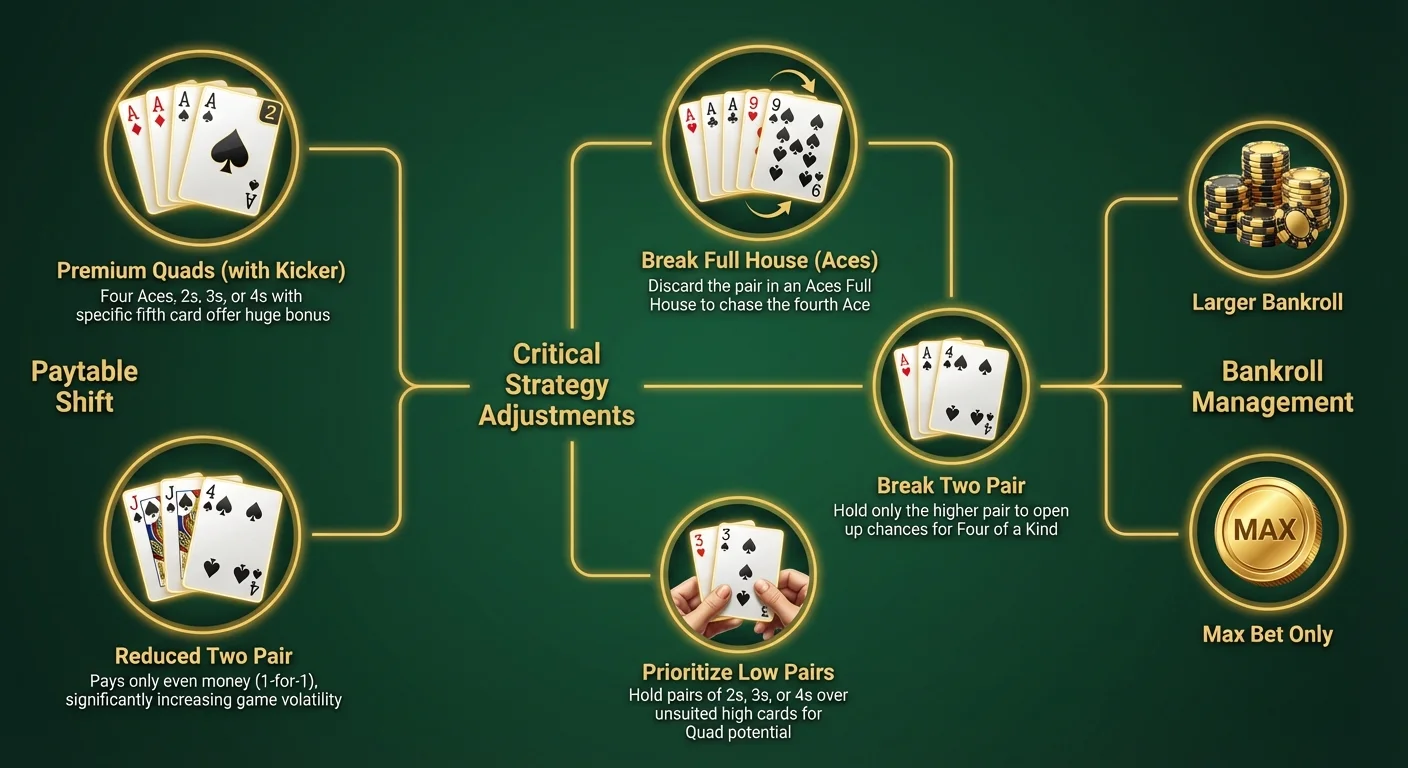
To fund these massive payouts, the house reduces the payout for Two Pair. In Jacks or Better, Two Pair pays 2-for-1. In Double Double Bonus, Two Pair typically pays 1-for-1 (Even Money).
This change sounds minor, but it is mathematically devastating to your bankroll stability. Two Pair is a frequent hand (occurring roughly every 13 hands). Losing half the payout on such a frequent occurrence increases the game's variance significantly. You will find your balance dwindling faster, requiring you to hit those premium Quads to stay afloat.
Analyzing the Paytable: 9/6 vs. Short Pay
Before depositing your Bitcoin or Ethereum, you must identify the machine you are playing. Just like Jacks or Better, DDB helps savvy players by displaying the payout for a Full House and a Flush per coin bet.
| Hand | 9/6 (Full Pay) | 9/5 | 8/5 |
|---|---|---|---|
| Royal Flush | 800 | 800 | 800 |
| Straight Flush | 50 | 50 | 50 |
| 4 Aces + 2,3,4 | 400 | 400 | 400 |
| 4 2s, 3s, 4s + A,2,3,4 | 160 | 160 | 160 |
| 4 Aces | 160 | 160 | 160 |
| 4 2s, 3s, 4s | 80 | 80 | 80 |
| 4 5s thru Ks | 50 | 50 | 50 |
| Full House | 9 | 9 | 8 |
| Flush | 6 | 5 | 5 |
| Straight | 4 | 4 | 4 |
| 3 of a Kind | 3 | 3 | 3 |
| Two Pair | 1 | 1 | 1 |
| Jacks or Better | 1 | 1 | 1 |
- 9/6 DDB: The theoretical Return to Player (RTP) is approx 98.98%.
- 9/5 DDB: The RTP drops to approx 97.87%.
- 8/5 DDB: The RTP plummets to approx 96.79%.
Expert Tip: In the world of crypto gambling, you have the luxury of choice. If a specific crypto casino offers an 8/5 table, move to a different provider. Always hunt for the 9/6 version to give yourself a fighting chance against the variance.
High Variance Strategy: The "Unnatural" Plays
If you play Double Double Bonus like you play Jacks or Better, you will lose. The strategy for DDB requires aggressive moves that prioritize chasing Aces and low cards over safer, made hands.
Here are the critical strategy adjustments required for DDB.
1. Breaking a Full House
This is the hardest mental hurdle for players transitioning from Jacks or Better.
- Scenario: You are dealt a Full House consisting of three Aces and two 9s (
A-A-A-9-9). - JoB Strategy: Hold all five cards. Take the guaranteed 9 payouts.
- DDB Strategy: Discard the nines. Hold only the three Aces.
The Math: The potential payout for hitting the fourth Ace (and potentially the kicker) outweighs the guaranteed payout of the Full House. The payoff for 4 Aces (160 or 400 coins) is so high that it is worth sacrificing the sure thing.
Note: You generally do not break a Full House for Kings through 5s. Only break it for Aces.
2. Breaking Two Pair
Because Two Pair only pays even money (same as a single pair of Jacks), its value is significantly diminished.
- Scenario: You hold
A-A-4-4-J. - JoB Strategy: Hold Two Pair (
A-A-4-4). - DDB Strategy: Hold the Pair of Aces (
A-A) only.
By holding only the Aces, you open the door to drawing the third or fourth Ace. Since Two Pair pays the same as a High Pair, you lose nothing in "current value" but gain immense "potential value."
3. The Kicker Dilemma (Don't Over-Hold)
A common mistake beginners make is holding a "kicker" too early.
- Scenario: You are dealt
A-A-A-2-8. - The Mistake: Holding
A-A-A-2hoping to catch the fourth Ace and have the kicker ready. - The Correct Play: Hold
A-A-Aonly.
Why? If you hold the 2, you are reducing your chances of drawing the fourth Ace because you are only drawing one card. If you discard the 2 and 8, you draw two cards. This doubles your chances of finding the fourth Ace. If you do hit the fourth Ace, you still have a decent statistical chance that the other card drawn will be a 2, 3, or 4.
Exception: If you are dealt A-A-A-A-2, obviously, you hold all five cards for the 2000 coin payout.
4. Prioritizing Low Pairs
In Jacks or Better, a pair of 3s is essentially useless unless it becomes Three of a Kind. In DDB, a pair of 3s is the seed for a massive payout.
- Scenario: You have
3-3-K-J-9. - Strategy: Hold
3-3. Discard the high cards. The potential for Four 3s (80 or 160 payout) makes the low pair more valuable than holding unmatched high cards.
The Strategy Hierarchy
When evaluating a hand, find the highest entry on this list that matches your dealt cards. Ignore everything lower on the list.
- Royal Flush
- Four of a Kind (All types)
- Four to a Royal Flush
- Three Aces (Discard the other two cards, even if they make a Full House)
- Straight Flush
- Three of a Kind (2s through Ks)
- Four to a Straight Flush
- Full House (If not containing 3 Aces)
- Flush
- Straight
- Three to a Royal Flush
- Two Aces
- Two Pair
- Pair of Jacks or Better (Kings, Queens, Jacks)
- Pair of 2s, 3s, or 4s (Note: These are prioritized over 4-card flushes or straights usually)
- Four to a Flush
- Pair of 5s through 10s
- Four to an Outside Straight
Managing Bankroll and Variance with Crypto
Double Double Bonus is a "rollercoaster" game. You will endure long stretches of losing hands (droughts) where your balance bleeds due to the 1-for-1 Two Pair payout. Then, suddenly, you hit Quad Aces with a Kicker and skyrocket back into profit.
Because of this, standard bankroll management rules do not apply.
Bankroll Sizing
For standard Jacks or Better, a bankroll of 40-50 max bets might last a session. For Double Double Bonus, you should aim for 80 to 100 max bets for a single session to withstand the swings.
If you are playing at $1 per coin ($5 per hand):
- JoB Recommended Session Bankroll: $200 - $250.
- DDB Recommended Session Bankroll: $400 - $500.
The Crypto Advantage
Playing DDB at crypto casinos offers distinct advantages for the high-variance player:
- Instant Withdrawals: One of the biggest dangers in high-variance games is "giving it back." You hit a massive 2,000-coin hand, feel invincible, and play until it's gone. With crypto, you can hit a designated win cap (e.g., doubling your money) and withdraw the profit to your private wallet instantly. The friction of depositing prevents you from impulsively chasing losses immediately after a win.
- Provably Fair Technology: DDB requires trust. When you need that fourth Ace, you need to know the RNG isn't rigged. Many crypto video poker games utilize "Provably Fair" algorithms (using hashed seeds) that allow you to verify that the deal was truly random and determined before you hit "draw."
- High Limits: Crypto casinos often support higher denomination betting than traditional online fiat casinos. For high rollers who understand the math, this allows for massive scalability on wins.
Practical Tips for Success
To summarize the path to mastering this volatile variant, keep these practical tips in mind during your gameplay:
- Always Bet Max Coins: This is non-negotiable. The Royal Flush bonus for 5 coins is massive. If you cannot afford the max bet at a $1 machine, move down to a $0.25 machine. Never play 1-4 coins.
- Ignore the "Kicker" on the Draw: Do not hold a single kicker card with a Triple. If you have
Q-Q-Q-2-9, toss the2and9. The goal is Quads, and drawing two cards is mathematically superior to holding a "helper" card. - Don't Fall in Love with Straights: Breaking a straight draw to keep a pair of Aces is common. In DDB, holding the Aces is almost always the right move because the ceiling of the hand is higher.
- Patience is Key: You will lose more hands than you win. The nature of DDB is that you are paying a premium for the chance at a jackpot. Do not tilt when you see your balance drop by 20% quickly; this is normal behavior for the machine.
- Use Strategy Charts: Because DDB has complex edge cases (like when to hold a High Card vs. a 10-J-Q suited), keep a strategy chart open in another tab. There is no shame in checking the math before clicking "Hold."
Summary: Is DDB Right For You?
Double Double Bonus is not for the faint of heart. It is designed for the thrill-seeker who understands that risk and reward are positively correlated.
If you prefer a slow, steady gaming experience where your money lasts a long time, stick to Jacks or Better. But, if you are willing to weather the storm of variance for the chance to turn a generic Four of a Kind into a payout that rivals a Royal Flush, Double Double Bonus is the game for you.
By mastering the art of breaking Full Houses, valuing Aces above all else, and managing your crypto bankroll with discipline, you can turn the high variance of DDB from a threat into a weapon.