Blackjack is often touted as the casino game with the lowest house edge. It is the one game where skill, mathematics, and discipline can whittle the casino's advantage down to less than 0.5%. However, this statistic relies on a crucial assumption: that the player is playing perfectly.
At the virtual felt of a crypto casino, where hands are dealt at lightning speed and Bitcoin or Ethereum balances can fluctuate rapidly, small errors compound into massive losses. Whether you are a complete novice or a seasoned regular who thinks they have "a system," strategy leaks are likely draining your bankroll.
In the world of online gambling, knowledge is your most valuable currency. By identifying and eliminating common errors, you move from a gambler relying on luck to an advantage player relying on logic. Below, we dissect the 10 most costly blackjack mistakes, explaining the mathematics behind them and how to correct your gameplay immediately.
1. The Payout Trap: Playing 6:5 Tables
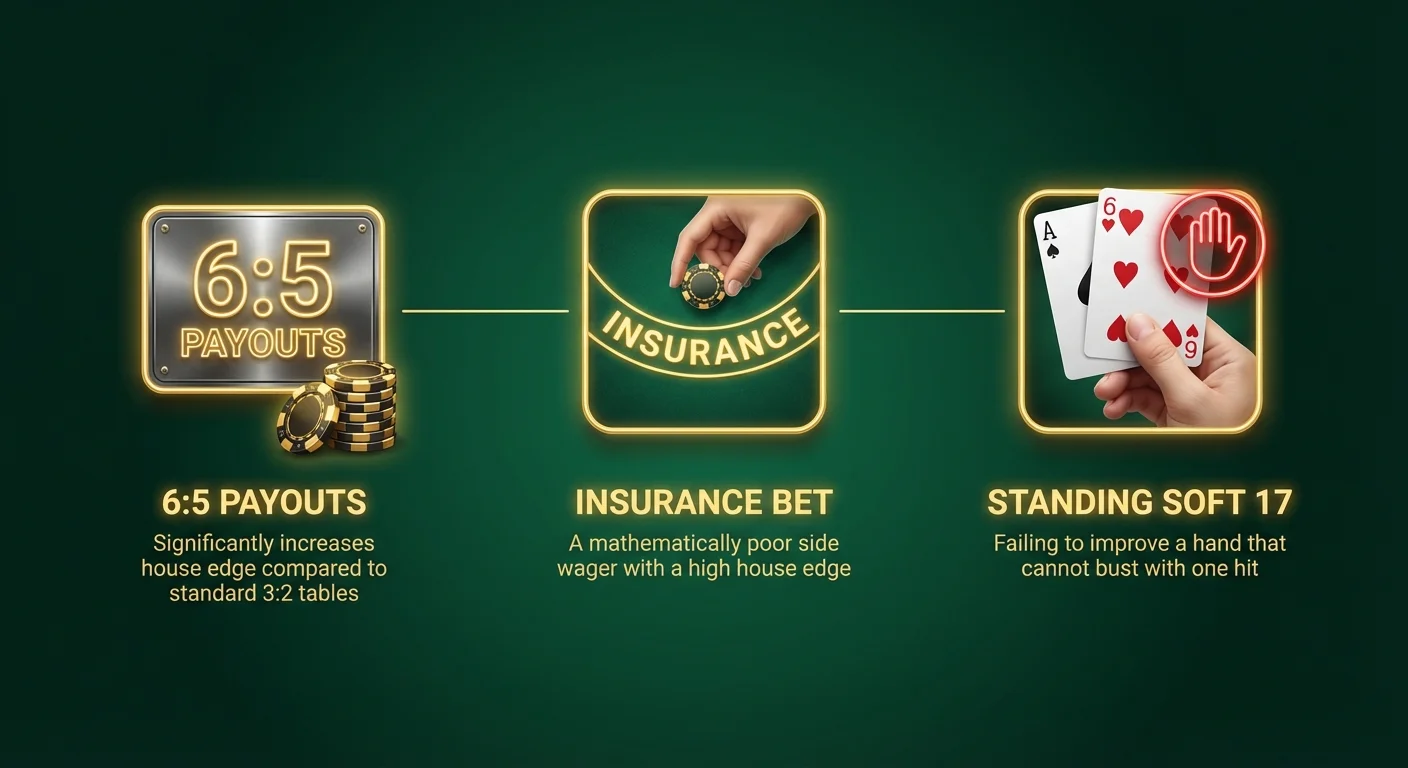
One of the most insidious changes in modern blackjack is the shift in payouts for a "natural" blackjack (an Ace and a 10-value card). Traditionally, this hand pays 3:2. This means if you bet 10 mBTC, you win 15 mBTC.
However, many casinos - both land-based and online - have introduced 6:5 tables. On the surface, it looks similar, but the math is brutal. On a 6:5 table, that same 10 mBTC bet pays only 12 mBTC.
Why it's a mistake:You might think a small reduction doesn't matter, but it drastically alters the house edge. A 3:2 game typically has a house edge of around 0.5%. Changing the payout to 6:5 adds approximately 1.39% to the house advantage, nearly quadrupling the casino's edge.
| Bet Amount | 3:2 Payout | 6:5 Payout | Loss per Blackjack |
|---|---|---|---|
| $10 | $15 | $12 | -$3 |
| $50 | $75 | $60 | -$15 |
| $100 | $150 | $120 | -$30 |
The Fix: Always check the table rules before sitting down. If the felt says "Blackjack pays 6 to 5," close the window and find a standard table. In the vast ecosystem of crypto gambling, you are never forced to accept bad odds.
2. Taking the Insurance Bet
When the dealer shows an Ace, they will offer you "Insurance." This is a side bet that pays 2:1 if the dealer has a blackjack (a 10-value card in the hole). The dealer will ask if you want to protect your hand. It sounds prudent, but mathematically, it is a sucker bet.
Why it's a mistake:
You aren't actually insuring your hand; you are simply betting on whether the dealer has a 10.
- There are 13 card ranks in a deck.
- Only 4 of them are worth 10 (10, J, Q, K).
- This means the probability of the dealer having a blackjack is roughly 30.8%.
- The insurance bet pays 2:1, but the odds against winning are closer to 9:4.
This discrepancy creates a house edge on the insurance bet of nearly 6% (or higher depending on the number of decks). That is worse than playing Roulette or Slots.
The Fix: Never take insurance. Even if you have a blackjack yourself (taking "even money"), you will make more money in the long run by declining the offer and playing out the hand naturally.
3. Standing on Soft 17
A "Soft 17" is a hand totaling 17 that contains an Ace counted as 11 (e.g., Ace + 6). Many players see the 17, think "that's a decent total," and stand because they are afraid of busting.
Why it's a mistake:
A Soft 17 is a hand you cannot bust by taking one hit (since the Ace can revert to a 1). Furthermore, 17 is a weak hand; it only beats a dealer bust. It pushes with a dealer 17 and loses to 18, 19, 20, and 21. By standing, you surrender the opportunity to improve your hand without any risk of immediate failure.
The dealer, conversely, must hit Soft 17 in many rule variations because the math favors improving that total. If the casino knows 17 is weak enough to hit, you should know it too.
The Fix: Always Hit or Double Down on Soft 17.
- Dealer shows 3, 4, 5, 6: Double Down.
- Dealer shows any other card: Hit.
4. The Greed of Splitting Tens
You are dealt two Kings. You have a hard 20. This is the second-best starting hand in the game. However, you look at the dealer's up-card - a 6. The temptation strikes: "If I split these, I could have two winning hands and double my profit."
Why it's a mistake:
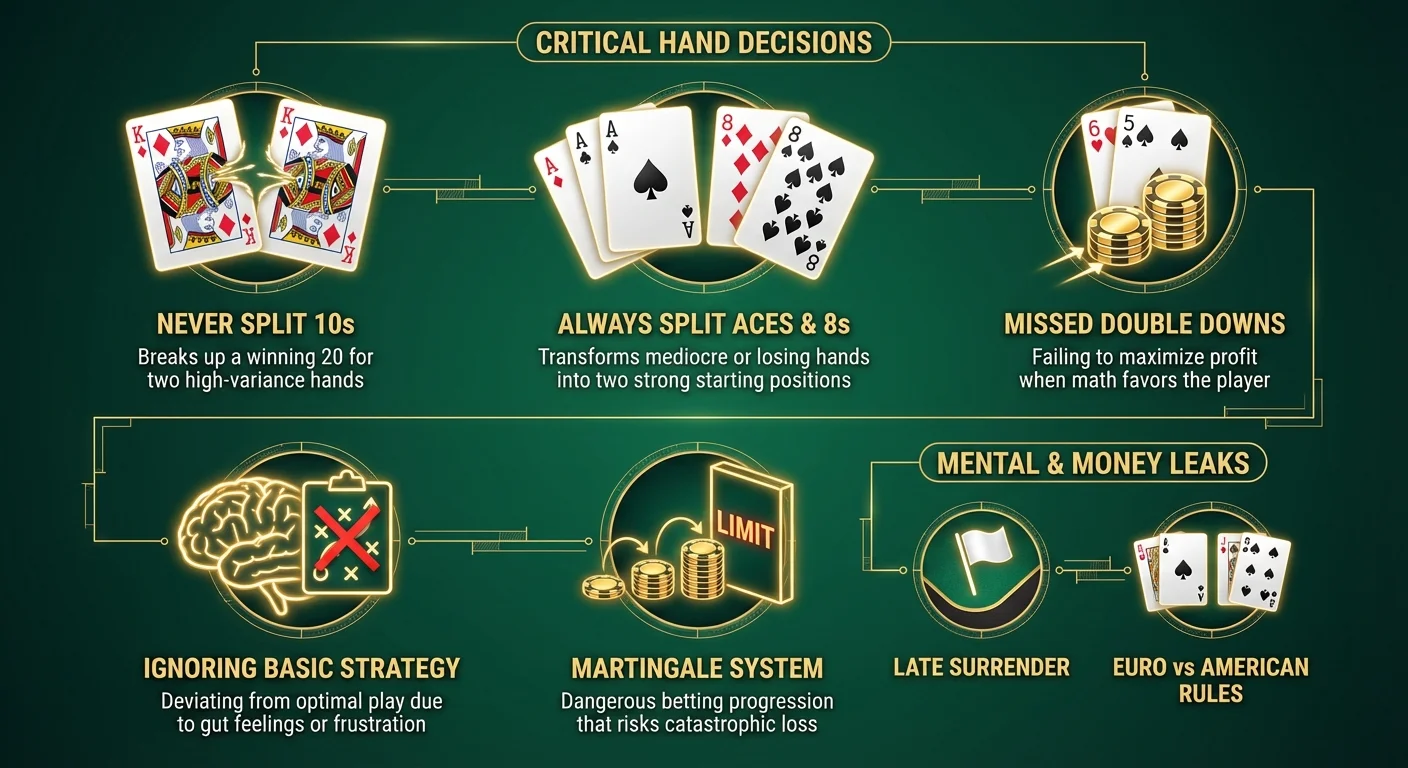
A hard 20 is an overwhelming favorite to win. You have roughly a 90% chance of winning or pushing. By splitting, you are breaking up a nearly guaranteed winner to start two hands with 10s. While starting with a 10 is good, it is not as good as already having a 20.
Splitting 10s greatly increases variance. You might end up with a 15 on one hand and a 13 on the other, losing both bets when you had a lock on the first one.
The Fix: Never split 10s. Take the win, bank the crypto, and move to the next hand.
5. Failing to Split Aces and Eights
On the opposite end of the spectrum from splitting 10s is the failure to split Aces and Eights.
The Case for Aces:
Two Aces total 2 (or 12). This is a mediocre hand. However, splitting them gives you two hands starting with 11. An 11 is a powerhouse starting point because any 10-value card gives you 21.
The Case for Eights:
Two Eights total 16. In blackjack, 16 is widely considered the worst possible hand. You will likely bust if you hit, and you will likely lose if you stand. Splitting them gives you two hands starting with 8. While 8 isn't amazing, it is statistically far superior to playing a 16.
The Fix:
- Always Split Aces: No matter what the dealer shows.
- Always Split Eights: Unless you are playing a version where Surrender is allowed and the dealer shows an Ace or 10. In that specific scenario, surrendering the 16 is slightly better.
6. Ignoring Basic Strategy for "Gut Feelings"
This is the most common leak among "regulars." A player knows they should hit their 16 against a dealer's 7, but they have a "feeling" that a King is coming next. Or, they've lost three hands in a row and change their play style out of frustration.
Why it's a mistake:
Blackjack is a game of finite math. Basic Strategy is not a suggestion; it is a computer-derived set of decisions that maximizes return for every possible combination of cards. Deviating from it because of a "hunch" increases the house edge. The cards have no memory. They do not know you lost the last hand, and they do not care about your gut feeling.
The Fix:When playing online, you have a distinct advantage: nobody can see you looking at a chart. Open a Basic Strategy chart in a separate tab. Consult it for every single decision until it is memorized. Playing "perfect" strategy reduces the house edge to its absolute minimum (~0.5%).
7. Being Afraid to Double Down
Doubling down allows you to double your bet in exchange for receiving exactly one more card. It is a powerful tool to reduce the house edge, yet many beginners skip it because they are afraid of losing the extra money.
Why it's a mistake:
You generally double down when the dealer is weak (showing 2 through 6) or when you have a strong total (10 or 11). In these scenarios, the probability of you winning the hand is significantly higher than losing it.
By flat betting (just hitting) instead of doubling, you are leaving money on the table. You are winning, but you aren't winning as much as the math dictates you should. Over thousands of hands, missed double downs are a massive leak in your bankroll.
The Fix:
- Always Double 11: Against any dealer up-card (unless the dealer shows an Ace in some rule variations).
- Double 10: Against dealer 2 through 9.
- Double 9: Against dealer 3 through 6.
8. Misunderstanding the Surrender Option
"Surrender" sounds like losing, and gamblers hate losing. Surrender allows you to forfeit your hand and receive half your bet back. Many players ignore this button or play at tables that don't offer it, thinking it's better to "go down fighting."
Why it's a mistake:
There are specific situations - like having a hard 16 against a dealer's 10 - where your expected return is less than 50 cents on the dollar. If you play the hand out, on average, you will lose more than half your bet. By surrendering, you lock in a 50% loss, which is mathematically superior to playing a hand destined to lose 70% or 80% of the time.
The Fix:
Look for games that offer "Late Surrender." Use it on:
- 16 vs. Dealer 9, 10, or Ace.
- 15 vs. Dealer 10.
9. The Martingale Betting System Trap
This mistake relates to money management rather than card strategy. The Martingale system involves doubling your bet after every loss, theoretically ensuring that one win recovers all previous losses plus a small profit.
Why it's a mistake:
While mathematically sound in an infinite world, the real world has two constraints:
- Bankroll: You will eventually run out of funds during a losing streak.
- Table Limits: Crypto casinos have maximum bet limits.
If you start betting $10 and lose 7 hands in a row, your 8th bet needs to be $1,280 just to win $10. If you hit the table limit or run out of liquidity, the system collapses, and you suffer a catastrophic loss.
The Fix:Use conservative betting strategies or positive progression systems (like the Paroli, where you increase bets only after winning). Never chase losses with exponentially larger bets.
10. Ignoring Rule Variations (European vs. American)
In the crypto gambling space, you will encounter dozens of software providers offering "Blackjack," "European Blackjack," "Pontoon," and "Double Exposure." Treating them all the same is a fatal error.
The Critical Difference:
In American Blackjack, the dealer takes a "hole card" (a second card face down). If the dealer shows an Ace or 10, they check for Blackjack immediately. If they have it, the hand ends, and you only lose your initial bet.
In European Blackjack (common in many online formats), the dealer takes no hole card. They only get their second card after all players have acted.
- The Risk: If you double down or split against a dealer Ace/10, and the dealer draws a Blackjack at the end of the round, you lose everything - your original bet plus your splits and doubles.
The Fix:
If playing European Blackjack (No Hole Card), you must be much more conservative. Do not double down or split against a dealer's 10 or Ace, because the risk of the dealer revealing a Blackjack at the end is too high.
Summary: Plugging the Leaks
Blackjack is a battle of grinding out small edges. By fixing these 10 mistakes, you stop donating unnecessary funds to the casino.
- Avoid 6:5 tables like the plague.
- Ignore Insurance; it's a side bet for suckers.
- Hit Soft 17; don't be afraid to improve.
- Stand on 20; never split 10s.
- Split Aces and 8s for a mathematical rescue.
- Trust the Chart, not your gut.
- Double Down when the math says yes.
- Surrender trash hands to save bankroll.
- Bet Wisely; avoid negative progressions like Martingale.
- Know the Rules; adjust for European vs. American dealing styles.
When you play with cryptocurrency, you benefit from instant withdrawals and anonymity. Combine those perks with a leak-proof blackjack strategy, and you become the type of player casinos fear: disciplined, knowledgeable, and difficult to beat.