
Blackjack is unique in the casino ecosystem. Unlike slots, roulette, or baccarat - where you are entirely at the mercy of blind luck - Blackjack allows your decisions to directly influence the outcome of every hand. It is a game of probability, not possibility. When you sit down at a virtual table, you aren't just playing against a dealer; you are playing against a mathematical deviation.
For the uninitiated, the casino always has an advantage. However, in Blackjack, this advantage is fluid. By applying the "Mathematical Edge" known as Basic Strategy, you can shave the casino's advantage from a hefty 2% (or more for unskilled players) down to a razor-thin 0.5% or less, making it vital to understand how RTP and house edge are calculated. This guide is designed for intermediate players ready to move beyond "going with their gut" and start playing with the precision of a computer.
Whether you are betting with Bitcoin on a high-speed Provably Fair table or grinding out hands at a live dealer crypto suite, mastering the Basic Strategy chart is the single most effective way to protect your bankroll and maximize your winning sessions.
The Foundation: Why Basic Strategy Works
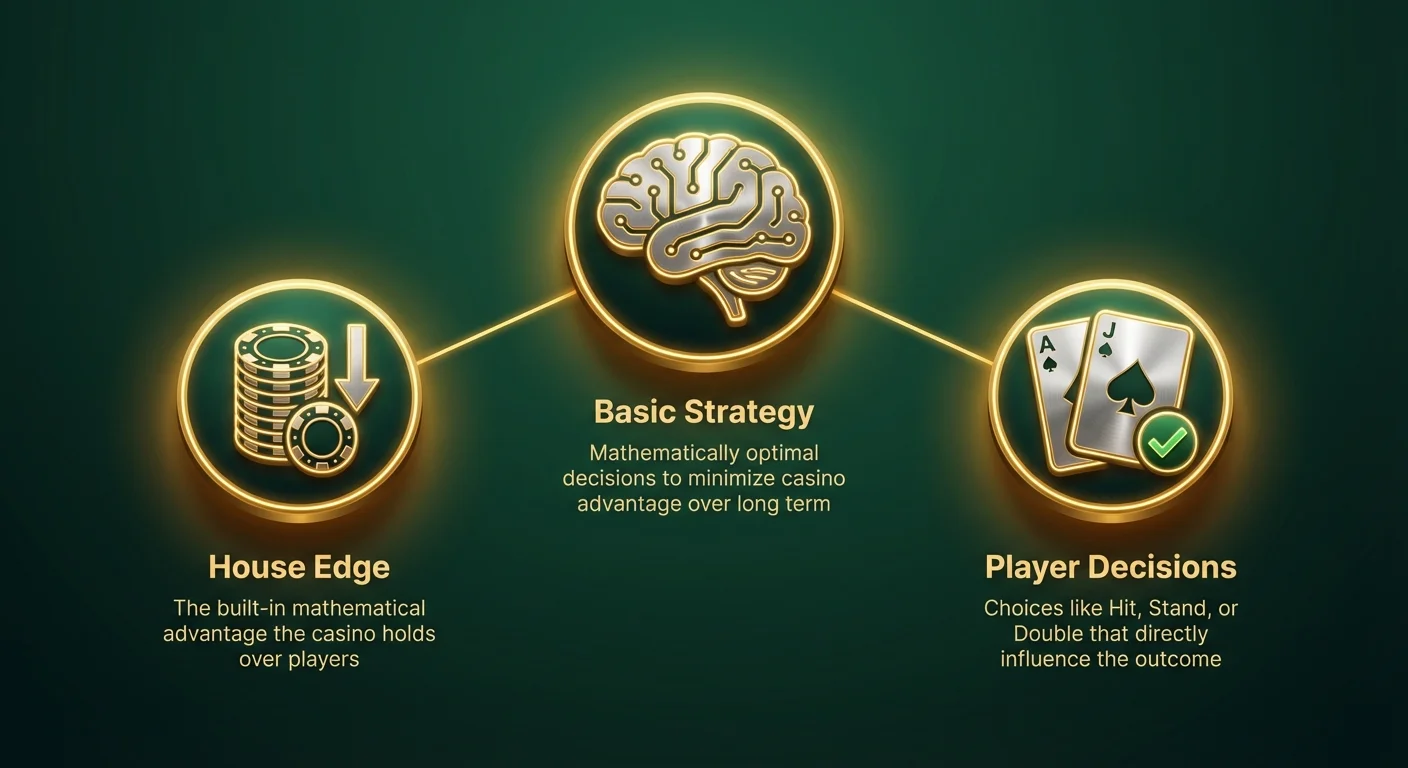
Before diving into the "Hit" and "Stand" mechanics, it is crucial to understand what Basic Strategy actually represents. It is not a magical system that guarantees a win on every hand. Instead, it is the result of billions of computer-simulated hands.
For every possible combination of cards you hold and every upcard the dealer shows, there is one mathematical play that yields the highest expected return (or minimizes the expected loss) over the long run.
The House Edge Equation
Standard casino games have a fixed house edge. In Blackjack, the edge is variable based on rules and player skill.
- The Amateur: Plays by "feeling." Hits on 16 because they feel lucky. House Edge: ~2.0% - 4.0%.
- The Strategist: Follows Basic Strategy perfectly. House Edge: ~0.5%.
In the world of crypto gambling, where transaction speeds are instant and RTP (Return to Player) is often transparent, giving up 2% to the house due to poor strategy is a leak in your bankroll you cannot afford.
Decoding the Chart: The Anatomy of a Hand
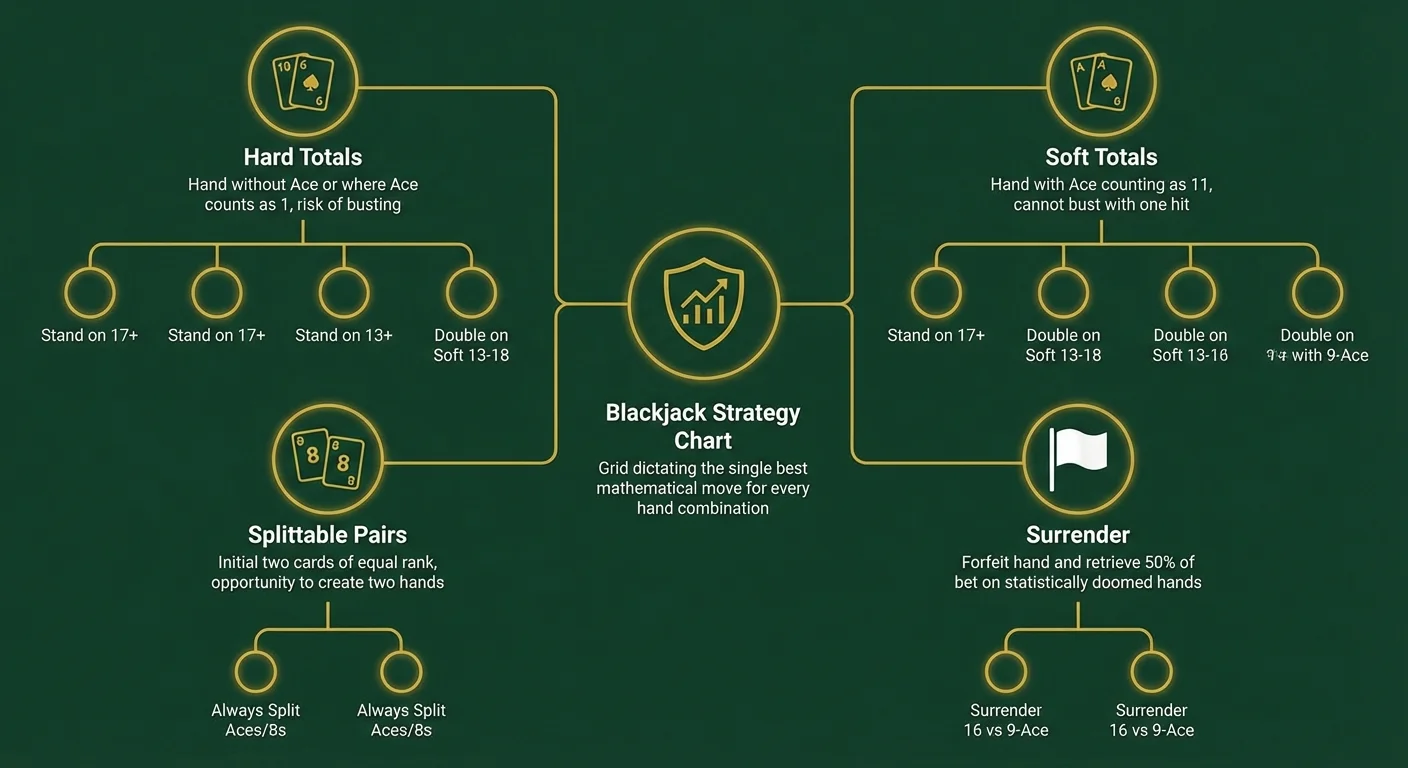
A Basic Strategy chart effectively turns the game into a grid.
- Y-Axis (Vertical): Your Hand (Hard Totals, Soft Totals, Pairs).
- X-Axis (Horizontal): The Dealer's Upcard (2 through Ace).
To master the chart, you must first categorize your hand instantly upon the deal.
1. Hard Totals
This is a hand without an Ace, or a hand where the Ace counts as 1 (e.g., 10-6-Ace = Hard 17). If you hit and go over 21, you bust immediately.
2. Soft Totals
This is a hand containing an Ace that counts as 11 (e.g., Ace-6 = Soft 17). You cannot bust by taking one card on a soft hand, which opens up aggressive doubling opportunities.
3. Splittable Pairs
Any hand where your first two cards are of equal rank (e.g., 8-8, J-K, 5-5).
The Four Pillars of Decision Making
Mastering the chart requires understanding the logic behind the four main actions: Hit/Stand, Double Down, Split, and Surrender.
1. Hit or Stand: The "Stiff" Hand Dilemma
The most common mistakes occur with "stiff" hands - hard totals of 12 through 16. These are dangerous because you can bust with a single hit, but they are likely to lose if you stand. The chart dictates your move based entirely on the dealer's "bust potential."
The Dealer's Weakness (2 through 6):
Cards 2, 3, 4, 5, and 6 are bad for the dealer. They must hit until they reach at least 17 (or Soft 17 depending on rules). Statistically, the dealer is most likely to bust when showing a 5 or 6.
The Dealer's Strength (7 through Ace):
If the dealer shows a 7 or higher, you must assume they have a hidden 10 (since 10s, Jacks, Queens, and Kings make up roughly 30% of the deck), giving them a made hand of 17+.
Strategic Rules:
- 17 and above: Always Stand. (Exception: Soft 17 in some variations).
- 12 through 16:
- Stand if the dealer shows 2 through 6. (The goal is to let the dealer bust).
- Hit if the dealer shows 7 through Ace. (You must improve your hand to win; the dealer is unlikely to bust).
- Exception: Hit a hard 12 against a dealer 2 or 3.
2. The Power of the Double Down
Doubling down is where the player makes their money. It allows you to double your initial wager in exchange for receiving exactly one more card. You generally double when you have a high probability of making a strong hand (19-21) while the dealer is weak.
Hard Double Downs:
- Total 11: Always Double Down. This is the most powerful position in Blackjack.
- Total 10: Double against Dealer 2 through 9. Hit against Dealer 10 or Ace.
- Total 9: Double against Dealer 3 through 6.
Soft Double Downs (The Intermediate Edge):
Many players miss these. If you have a Soft 13 through Soft 18, you aren't just looking to hit; you are looking to double if the dealer is weak.
- Soft 13-14 (A-2, A-3): Double against Dealer 5 or 6.
- Soft 15-16 (A-4, A-5): Double against Dealer 4, 5, or 6.
- Soft 17-18 (A-6, A-7): Double against Dealer 3 through 6.
3. Splitting Pairs: Defense and Offense
Splitting turns one bad hand into two potentially good ones, or two good hands into two great ones. However, knowing when not to split is just as vital.
| Your Pair | The Strategy | The Logic |
|---|---|---|
| Aces | ALWAYS SPLIT | A single Ace is powerful; two Aces are just a 12 (or Soft 2). Splitting gives you two high-probability shots at 21. |
| 8s | ALWAYS SPLIT | 16 is the worst hand in Blackjack. Splitting gives you two chances to start with an 8, which is statistically superior to a hard 16. |
| 10s | NEVER SPLIT | A 20 is the second-best hand in the game. Do not ruin a winning hand to chase greedy profits. |
| 5s | NEVER SPLIT | Two 5s equal 10. Treat this as a hard 10 and Double Down (usually against 2-9). Splitting leaves you with two hands starting with 5 - a terrible position. |
| 9s | SPLIT (mostly) | Split against dealer 2-6 and 8-9. Stand against dealer 7 (dealer likely has 17, you have 18), 10, or Ace. |
4. Surrender: The Tactical Retreat
Often available in European Blackjack or specific online crypto variants, "Surrender" allows you to forfeit your hand and retrieve 50% of your bet. It sounds like losing, but mathematically, it saves money on hands that are statistically doomed.
- 16 vs. Dealer 9, 10, or Ace: Surrender if allowed.
- 15 vs. Dealer 10: Surrender if allowed.
If you don't surrender these hands, you will lose significantly more than 50% of your expected value over time.
Navigating Rule Variations
Not all Blackjack tables are created equal. When playing on crypto gambling sites, you will encounter different rule sets that slightly alter the Basic Strategy.
Dealer Hits vs. Stands on Soft 17
- S17 (Dealer Stands on Soft 17): This is better for the player.
- H17 (Dealer Hits on Soft 17): This increases the house edge by roughly 0.22%.
- Strategy Adjustment: If playing H17, you should Double Down on 11 against a Dealer Ace, and Double Down on Soft 19 (A-8) against a Dealer 6.
6 to 5 Payouts: The Bankroll Killer
Traditionally, a Blackjack (Ace + 10-value card) pays 3 to 2. On a $10 bet, you win $15.
Recently, many games have switched to 6 to 5 payouts. On a $10 bet, you win $12.
- The Impact: This increases the house edge by nearly 1.4%.
- The Advice: Never play 6:5 Blackjack. In the crypto space, you have hundreds of table options. Always check the "Info" tab of the game to ensure it pays 3:2.
Practical Tips for the Crypto Blackjack Player
One of the massive advantages of playing Blackjack at an online crypto casino is the environment. You aren't in a rush, and no pit boss is staring you down. You can use this to your advantage.
1. The "Second Screen" Strategy
There is no rule against having a Basic Strategy chart open in a second browser tab while you play. In fact, we recommend it. Until you have the chart memorized, consult it for every single hand - especially the tricky soft doubles and splits.
2. Ignore the "Gambler's Fallacy"
Just because you lost three hands in a row does not mean you are "due" for a win. The cards have no memory.
- Avoid Progression Systems: Strategies like the Martingale (doubling your bet after a loss) can be disastrous. While they seem mathematically sound in theory, table limits and bankroll exhaustion will eventually wipe you out. To ensure you protect your capital, consult our guide on managing a bankroll with volatile assets or stick to flat betting or very conservative positive progressions (like the Paroli).
3. Leverage Provably Fair Technology
Crypto casinos often offer "Provably Fair" Blackjack. This utilizes cryptographic hashing to ensure the deck shuffle was randomized before the hand was dealt and wasn't altered during play. This transparency confirms that the "math" of Basic Strategy is valid - the game isn't rigged, so the probabilities hold true.
4. Speed and Volume
Online blackjack is fast. You can play 4x the number of hands per hour compared to a physical casino.
- The Pro: You can accrue winnings faster if you have an edge.
- The Con: If you are playing incorrectly, you will drain your bankroll 4x faster. Do not speed play until your strategy is perfect.
Summary: Your Cheat Sheet to Success
To transition from a gambler to an advantage player, internalize these core rules:
- Always Double Down on 11. (Unless the specific game rules restrict it).
- Split Aces and 8s. No matter what the dealer shows.
- Never Split 10s or 5s. Double the 5s; Stand on the 10s.
- Stand on Hard 12-16 against Dealer 2-6. Let the dealer bust.
- Hit on Hard 12-16 against Dealer 7-Ace. You have to fight for the win.
- Avoid Insurance. It has a house edge of nearly 6%. It is a sucker bet.
- Check the Rules. Ensure 3:2 payouts and know if the dealer hits Soft 17.
Mastering Basic Strategy charts is the first step in "counting" without actually counting cards in crypto casinos. It minimizes the casino's tax on your entertainment and, when combined with the bonuses and rakeback often found in crypto casinos, can bring you closer to a break-even or profitable game than almost any other option on the floor.
Keep the chart open, trust the math, and play smart.