
In the world of sports betting, the vast majority of strategies focus on picking a winner. You analyze stats, check injury reports, and back the team you believe will cover the spread. However, there is a tier of betting reserved for advanced handicappers that shifts the focus from "who will win" to "how can I manipulate the market." This is the realm of middling bets.
Middling is often described as the "Holy Grail" of sports wagering. It is a strategy that allows you to capitalize on line movement strategy to create a scenario where you can win your bet on the favorite, win your bet on the underdog, and walk away with a massive profit, all while risking a negligible amount of capital.
This guide will take you beyond basic handicapping. We will dissect the mathematics of the middle, identify how to spot these fleeting opportunities, and explain why using cryptocurrency sportsbooks provides the distinct speed and liquidity advantages necessary to execute this high-level maneuver.
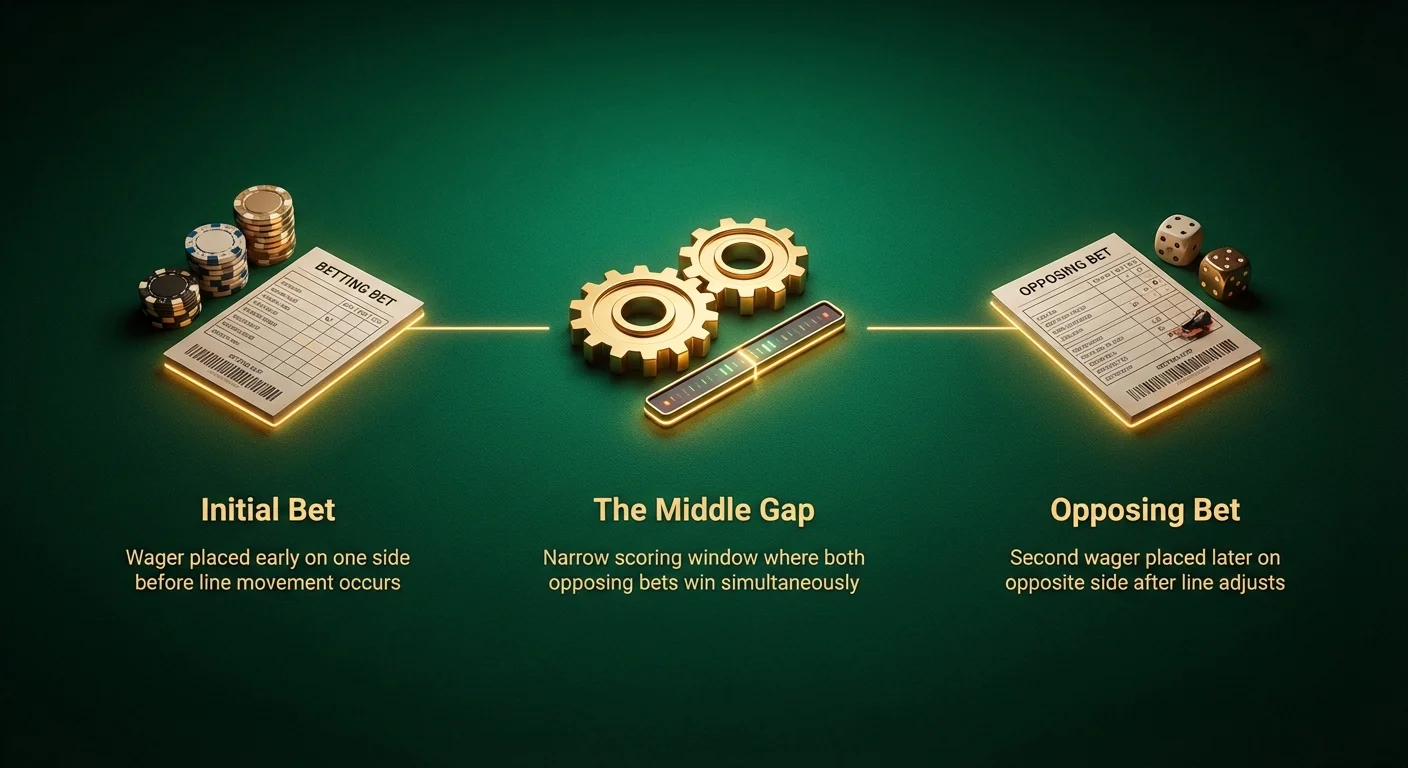
What is Middling? The Core Concept
At its simplest, a "middle" occurs when you bet on opposite sides of the same game at different lines, creating a gap (or "middle") where both bets can win.
Unlike arbitrage betting (arbing), which guarantees a small profit regardless of the outcome by exploiting odds discrepancies, middling accepts a small risk for the potential of a massive payout. You are essentially wagering that the final score will land within a specific window.
The Anatomy of a Middle
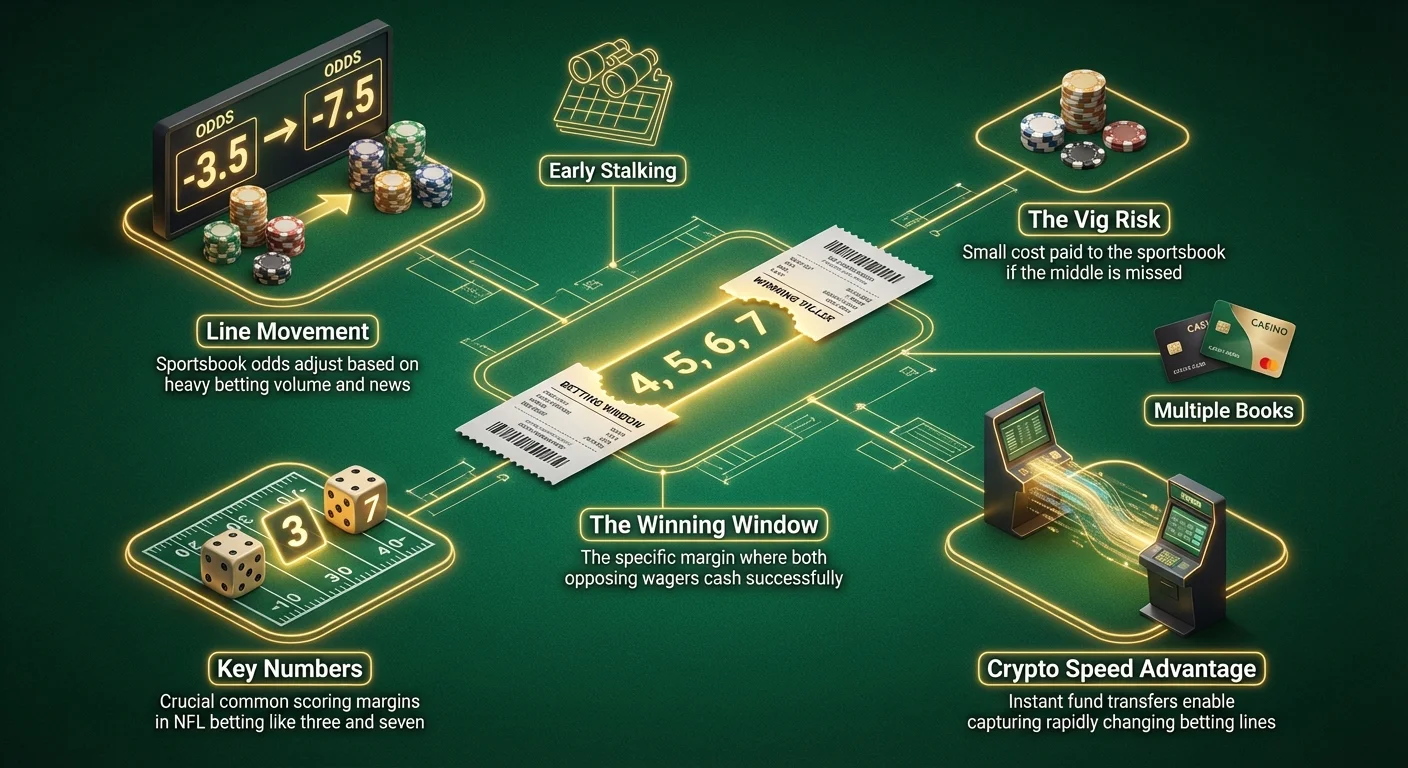
To understand middling, you must understand line movement. Sportsbooks adjust their lines based on betting volume, sharp money (professional bettors), and breaking news (injuries, weather).
The Scenario:
- Early Week: The Kansas City Chiefs open as -3.5 point favorites against the Buffalo Bills. You believe the Chiefs are strong, so you bet them at -3.5.
- Mid-Week: Patrick Mahomes is reported to be in peak condition, while the Bills' star linebacker is ruled out. Heavy money pours in on the Chiefs.
- Late Week: The sportsbooks adjust the line to balance their books. The Chiefs are now -7.5 point favorites.
- The Counter Bet: You now bet on the Buffalo Bills at +7.5.
The Resulting Position:
- You hold a ticket on Chiefs -3.5.
- You hold a ticket on Bills +7.5.
Here is the magic of winning both sides:
- If Chiefs win by 10: You win the -3.5 (Ticket 1) but lose the +7.5 (Ticket 2). You roughly break even (minus the juice).
- If Chiefs win by 3: You lose the -3.5 (Ticket 1) but win the +7.5 (Ticket 2). You roughly break even.
- If Chiefs win by 4, 5, 6, or 7: YOU WIN BOTH BETS.
This 4-point window is your "middle." If the game lands here, you double your profit. If it doesn't, you only pay the "vig" (the sportsbook's fee).
The Math: Risk vs. Reward
To be a successful middler, you cannot view betting as gambling; you must view it as trading. You are buying a probability.
Let's calculate the cost of a standard middle using standard -110 odds (wagering 1.10 to win 1.00).
| Scenario | Bet A Outcome ($110 to win $100) | Bet B Outcome ($110 to win $100) | Net Result |
|---|---|---|---|
| Middle Misses (Side A wins) | Win (+$100) | Loss (-$110) | -$10 |
| Middle Misses (Side B wins) | Loss (-$110) | Win (+$100) | -$10 |
| Middle Hits (Score falls in gap) | Win (+$100) | Win (+$100) | +$200 |
The Analysis
In this scenario, you are risking $10 to win $200. This equates to 20-to-1 odds.
The question an advanced bettor asks is not "Who will win?" but rather: "Is the probability of the final margin landing between 4 and 7 greater than 5% (1 in 20)?"
If the answer is yes, the bet has positive Expected Value (+EV). In the NFL, key margins of victory (like 3, 4, 6, and 7) happen frequently. Securing a middle through these numbers is statistically one of the most profitable plays in sports betting.
Identifying Middle Opportunities
Middles do not appear out of thin air; they are hunted. You cannot force a middle. You must wait for the market to move, and you must predict the movement before it happens.
1. Stalking the Opening Lines
The biggest line moves usually happen shortly after the opening lines are released (usually Sunday night for the NFL). Sharps hammer the "soft" lines immediately. If you can bet the opener before the market corrects, you establish the first leg of your middle.
2. Following the "Steam"
"Steam" refers to a sudden, uniform line movement across multiple sportsbooks caused by heavy betting syndicates. If you see a line moving from -3 to -4.5 rapidly, the syndicates are betting the favorite. To set up a middle, you generally want to be on the side of the steam early, or fade the move late if the public overreacts.
3. Injury News and Roster Changes
In the NBA, a star player sitting out can shift a line by 5 to 8 points instantly.
- Example: You bet the Lakers -4. News breaks that the opponent's star is resting. The line shoots to Lakers -10.
- Strategy: You now bet the opponent at +10. You have a massive 6-point middle (margins of 5, 6, 7, 8, 9).
4. Psychological Biases
The public loves favorites and "Over" bets. Often, lines will inflate closer to game time because the general public is betting the favorite.
- Strategy: Bet the favorite early in the week. Wait for the public to push the line up. Bet the underdog right before kickoff.
The Importance of Key Numbers
Not all middles are created equal. In sports spread betting, specifically the NFL, certain margins of victory are far more common than others because of the scoring system (touchdowns = 7, field goals = 3).
These are called Key Numbers.
- Primary Key Numbers: 3, 7
- Secondary Key Numbers: 6, 10, 4
A middle that captures the number 3 (e.g., -2.5 and +3.5) is infinitely more valuable than a middle that captures the number 9 (e.g., -8.5 and +9.5).
Valuing the Window
If your middle is between -3.5 and -6.5, you have captured the numbers 4, 5, and 6. While 4 and 6 are decent numbers, you missed the 3 and the 7.
However, if you have a middle of -2.5 and -3.5 (a "Polish Middle" or extremely tight window), you are banking entirely on the game ending with a margin of exactly 3. Since nearly 15% of NFL games end with a margin of 3, this is a highly valuable, albeit risky, position.
Pro Tip: Never pay extra juice to buy a middle that doesn't cross a key number. The math rarely supports it.
Middling Totals (Over/Under)
While spread middles get the glory, totals offer frequent opportunities, particularly in high-scoring sports like the NBA and NCAA Basketball.
Totals lines move rapidly. A total might open at 210 and close at 218.
- Bet: Over 210.
- Line Moves: To 218.
- Bet: Under 218.
- The Middle: If the total score is 211, 212, 213, 214, 215, 216, or 217, you win both.
The Push Factor:
If the score lands exactly on 210 or 218, you push one bet and win the other. This is also a profitable outcome (Win $100, Push $0 = Net +$100).
The Crypto Advantage in Middling
Middling is a liquidity-intensive strategy. You need to have money available on multiple books, or the ability to move money instantly to catch a line before it disappears. This is where crypto gambling platforms are superior to traditional fiat sportsbooks.
1. Speed of Execution
Line windows for middling can close in minutes.
- Fiat: Moving money from a bank to a sportsbook can take hours or days.
- Crypto: Bitcoin, Litecoin, or USDT transfers can settle in minutes (or seconds with networks like Solana or Lightning). You can withdraw winnings from Book A and deposit into Book B to hit the other side of a middle within the same hour.
2. High Limits and Liquidity
Middling often requires placing large bets to make the small "insurance cost" (the vig) worth it. Crypto-native sportsbooks typically offer higher betting limits and do not limit winning players as aggressively as soft fiat books.
3. Access to Global Odds
Crypto allows you to play on offshore sites or decentralized betting exchanges. This is vital for line shopping. One book might have the Chiefs at -7, while a crypto-exclusive book might be slow to update and still have them at -5.5. This discrepancy allows you to construct a middle that simply doesn't exist if you stay on a single platform.
4. Lower Vig (Reduced Juice)
Many crypto sportsbooks offer "reduced juice" lines (e.g., -105 instead of -110).
- Math Update: If you bet -105 on both sides, your risk drops from $10 to roughly $5 to win that same $200. This dramatically improves the EV of your middle.
Advanced Strategies: The "Polish Middle"
We mentioned this briefly, but it deserves a deeper look. A standard middle hopes for the score to land inside a window. A Polish Middle (or inverted middle) hopes for the score to land outside a window, or relies on a very narrow victory.
Usually, this involves betting the Under on a low number and the Over on a high number, or taking the underdog +2.5 and the favorite -3.5.
Example:
- Bet: Under 45.
- Line moves down.
- Bet: Over 41.
Here, you are looking to hit the window of 42, 43, 44. However, true Polish Middles often imply taking the "Plus" on both sides.
- Team A +3.5
- Team B +3.5 (Game is a pick'em or lines moved drastically).
- If the game ends with a margin of 1, 2, or 3 points for either team, you win both bets.
This is highly effective in low-scoring NFL divisional games where blowouts are rare.
Practical Steps to Execute a Middle
Ready to try this line movement strategy? Follow this workflow:
- Bankroll Management: Ensure you have enough funds to cover both sides of the bet. You are doubling your exposure to the game, even though the risk is hedged.
- Scan Early: Check lines on Sunday night (NFL) or morning of (NBA). Look for lines that seem "off" compared to the consensus.
- Take a Position: Place your initial bet on the side you think the public/sharps will move the line away from. (e.g., Bet the favorite before the line spikes).
- Monitor: Set alerts for line movements. Tools like "Don Best" or various crypto betting aggregators can help.
- Calculate the Cost: Before placing the second bet, calculate the vig. Are you willing to lose $10 to try and win the middle?
- Pull the Trigger: If the line crosses a key number or creates a wide enough corridor, place the opposing bet at a different sportsbook to get the best price.
Common Mistakes to Avoid
Even experienced bettors fall into traps when chasing middles.
- Forcing the Middle: Don't bet the other side just because the line moved 1 point. A 1-point middle (that isn't a key number) is rarely worth the juice.
- Ignoring the Vig: If you have to bet -120 or -125 to get the other side, the cost of the middle skyrockets. The math changes from risking $10 to risking $25+.
- Betting the Same Book: While possible, sportsbooks frown upon bettors wagering on both sides of the same game to clear bonuses or manipulate limits. Use different crypto sportsbooks for anonymity and safety.
- Legging Out Too Late: Waiting too long to place the second bet can result in the line moving back, destroying your opportunity.
Summary: Is Middling Right for You?
Middling is not a strategy for those looking for a sweat-free gambling experience. It requires patience, multiple sportsbook accounts, and a keen understanding of math and market psychology.
However, it is one of the few strategies in sports betting that allows you to weaponize the sportsbook's own line adjustments against them.
Key Takeaways:
- The Concept: Bet both sides at different lines to create a "win-win" window.
- The Cost: You risk the "vig" (juice) for a chance at a double win.
- Key Numbers: In the NFL, target windows that include 3 and 7.
- Crypto Edge: Use crypto for instant transfers between books to catch moving lines.
- Discipline: Only execute the middle when the probability of the gap hitting outweighs the cost of the juice.
By mastering middling bets, you stop gambling on teams and start gambling on numbers. That is the transition from a recreational bettor to a sharp. Use the speed of crypto, watch the lines, and hunt for that perfect gap.