The moment that first Ace lands on the felt - or flashes onto your screen at your favorite crypto casino - the dynamic of the blackjack hand changes instantly. For a novice, an Ace is simply a "good card." But for an intermediate player, that Ace represents a fork in the road of probability. It creates a "soft" hand, a fluid situation that requires a completely different mindset than the rigid "hard" hands that make up the majority of the game.
If you have ever stood on a Soft 17 because you "didn't want to mess up a good hand," or if you have ever hesitated to double down on an Ace-6 against a dealer's 5, this guide is for you. Mastering the distinction between soft and hard totals is the single most effective way to lower the house edge, especially when playing high-speed hands on crypto platforms.
In this guide, we will dismantle the fear of busting, explain the mathematics behind the Ace, and provide you with actionable strategies to optimize your decision-making based on hand composition.
The Anatomy of the Hand: Ace Value and Definitions
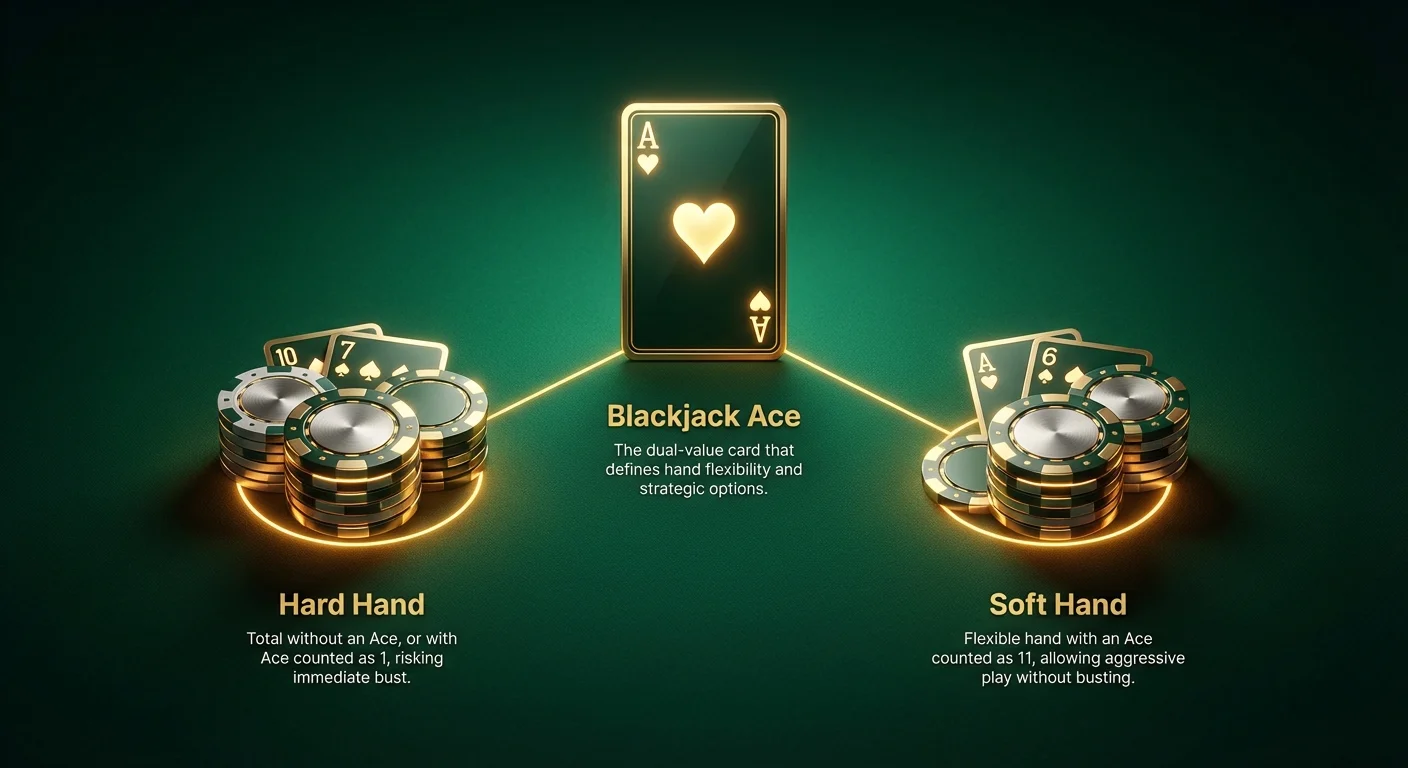
Before diving into complex strategy, we must establish the ground rules. In blackjack, the difference between a "Hard" and "Soft" hand revolves entirely around the Ace and its unique dual value.
What is a Hard Hand?
A hard hand is any total that does not contain an Ace, or contains an Ace that must be counted as 1 to avoid busting.
- Example 1: You are dealt a 10 and a 7. This is a Hard 17.
- Example 2: You are dealt a 5, an 8, and an Ace. This is a Hard 14 (5 + 8 + 1).
Hard hands are rigid. If you hit a Hard 17, there is a statistical certainty that you will likely bust. The strategy for hard hands is usually defensive; you are often trying to survive or hoping the dealer breaks.
What is a Soft Hand?
A soft hand is any hand containing an Ace that is counted as 11 without the total exceeding 21.
- Example 1: You are dealt an Ace and a 6. This is a Soft 17 (11 + 6).
- Example 2: You are dealt an Ace, a 2, and a 3. This is a Soft 16 (11 + 2 + 3).
Soft hands are flexible. They are the offensive weapons of blackjack. Because you cannot bust a soft hand with a single card (the worst case is the Ace reverts to a value of 1), you have a "free hit" opportunity. This mathematical safety net allows players to be much more aggressive.
The "Soft" Trap
The most common mistake intermediate players make is treating a soft hand like a hard hand. They see "17" on the screen and their brain says, "Stand." This is a fundamental error. A Hard 17 is a pat hand (a keeper); a Soft 17 is essentially a drawing hand that needs improvement.
Hard Hand Strategy: The Art of Survival
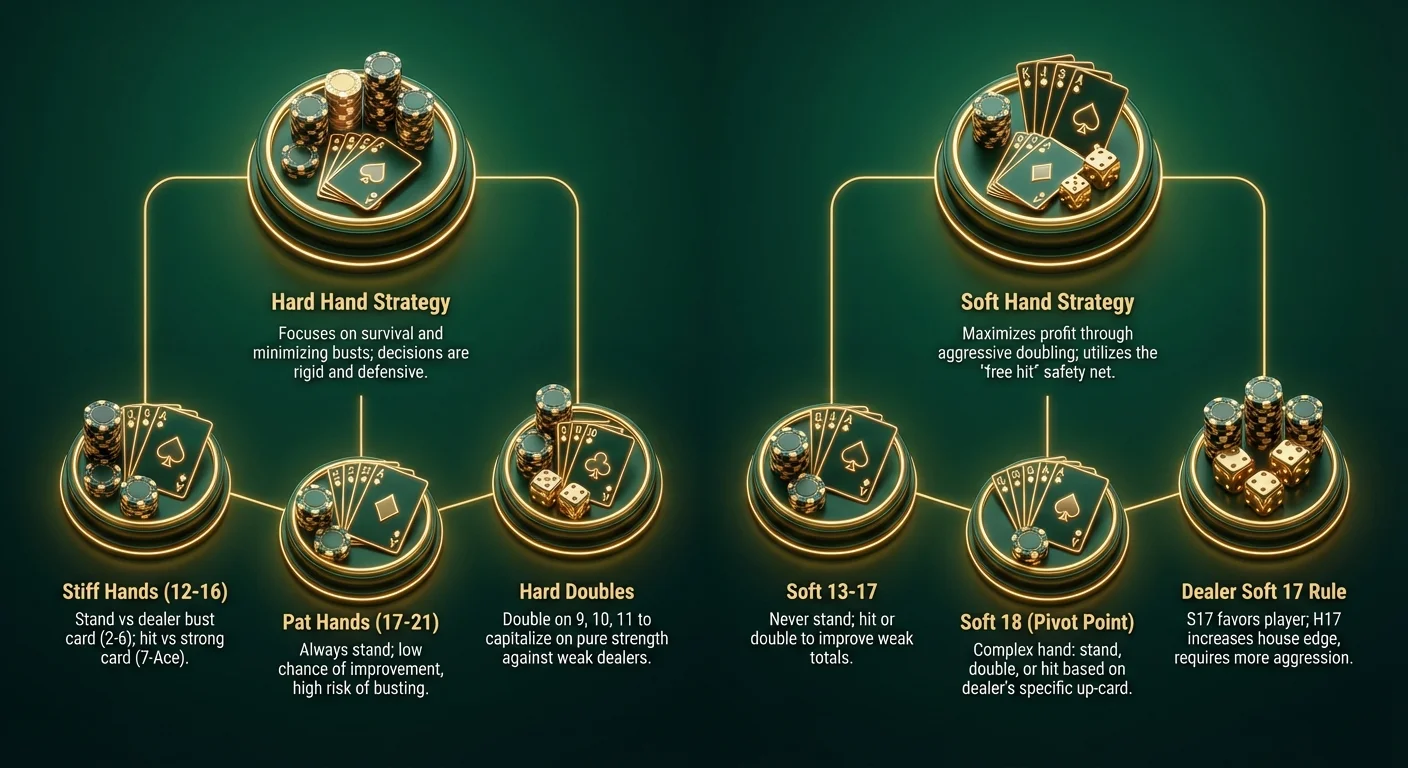
When playing hard hands, your strategy is dictated by the "stiff" vs. "pat" concept. You are constantly weighing the risk of your own bust against the probability of the dealer busting.
The Stiff Hands (Hard 12 through 16)
These are the most hated hands in blackjack. If you hit, you risk busting. If you stand, you likely lose if the dealer makes a hand.
- The Rule: Generally, you stand on Hard 12-16 if the dealer is showing a "bust card" (2 through 6). You hit if the dealer is showing a "strong card" (7 through Ace).
- The Exception: You always hit a Hard 12 against a dealer 2 or 3.
The Pat Hands (Hard 17 through 21)
These are straightforward. You stand. The probability of improving a Hard 17 or higher is so low, and the risk of busting so high, that taking a card is statistically disastrous.
Hard Double Downs
Doubling on hard hands is about capitalizing on pure strength.
- Hard 11: Always double. You are hoping for a 10-value card to land on 21.
- Hard 10: Double against dealer 2 through 9.
- Hard 9: Double against dealer 3 through 6.
Hard Hand Decision Matrix
| Player Hand | Dealer 2-6 | Dealer 7-Ace |
|---|---|---|
| Hard 17-21 | Stand | Stand |
| Hard 13-16 | Stand | Hit |
| Hard 12 | Stand (Hit vs 2,3) | Hit |
| Hard 11 | Double | Double |
| Hard 10 | Double | Hit |
| Hard 9 | Double (vs 3-6) | Hit |
Soft Hand Strategy: The Aggressive Edge
This is where the pros separate themselves from the amateurs. With soft hands, you aren't just trying to win; you are trying to maximize profit. Because you cannot bust on the first card, you can double down on totals that look weak to the untrained eye.
The Power of Soft Doubles
Why would you double on a Soft 13 (Ace-2)? It seems counterintuitive to double a total of 3 or 13.
The logic is twofold:
- Dealer Weakness: You usually do this when the dealer shows a 5 or 6. The dealer is likely to bust.
- Hand Improvement: There are many cards (8, 9, 10, J, Q, K) that turn your Soft 13 into a strong 18, 19, 20, or 21.
Soft 13 through Soft 17
These are not "made" hands. A Soft 13 through Soft 17 will lose to almost any made dealer hand. Therefore, you must hit or double to improve them.
- Strategy: Never stand on Soft 13-17.
- Double Down: Generally double these hands against a dealer 5 or 6. (Soft 17 and 18 have wider double ranges).
- The Goal: You want to get your total to a Hard 17+ or a Soft 19+.
Soft 18: The Pivot Point
Soft 18 (Ace-7) is one of the most misplayed hands. Players think 18 is good enough to win.
- Against Dealer 2, 7, 8: Stand.
- Against Dealer 3, 4, 5, 6: Double Down. (You are attacking the dealer's weakness).
- Against Dealer 9, 10, Ace: Hit. (Your 18 is likely losing to the dealer's potential 19 or 20, so you take a small risk to improve).
Soft Hand Decision Matrix
| Player Hand | Dealer 2 | Dealer 3-4 | Dealer 5-6 | Dealer 7-8 | Dealer 9-A |
|---|---|---|---|---|---|
| Soft 20 (A-9) | Stand | Stand | Stand | Stand | Stand |
| Soft 19 (A-8) | Stand | Stand | Double | Stand | Stand |
| Soft 18 (A-7) | Stand | Double | Double | Stand | Hit |
| Soft 17 (A-6) | Hit | Double | Double | Hit | Hit |
| Soft 15-16 | Hit | Hit | Double | Hit | Hit |
| Soft 13-14 | Hit | Hit | Double | Hit | Hit |
The "Soft 17" Controversy: Why It Matters
You will often see the rule written on the blackjack table felt or the digital information screen: "Dealer Must Hit Soft 17" or "Dealer Stands on All 17s."
This is the most critical rule variation in the game regarding soft hands.
Player's Soft 17
For you, the player, Soft 17 is a weak hand. If you stand, you can only push against a dealer's 17, and you lose to any dealer 18, 19, 20, or 21. You have zero chance of winning unless the dealer busts. This is why you always hit or double a player Soft 17.
Dealer's Soft 17 (H17 vs. S17)
- S17 (Dealer Stands on Soft 17): This is better for the player. When the dealer reaches A-6, they stop. This prevents them from improving a mediocre hand.
- H17 (Dealer Hits Soft 17): This increases the House Edge by about 0.22%. If the dealer has A-6, they take a hit. They might bust, but more often, they will improve to a 18, 19, 20, or 21, beating your 18s and 19s.
Crypto Strategy Tip: When browsing blackjack games on crypto sites, check the rules tab. Look for "S17" games. If you are playing an "H17" game (which is common in single-deck variations), you need to be even more aggressive with your own doubles to offset the increased house edge.
Adjusting for Hand Composition
Basic strategy charts usually assume a two-card hand. However, as the hand progresses, the "composition" changes. This is an intermediate-to-advanced concept that refines your decisions.
The "Double Down Rescue" (Forfeited)
In some variations (like Spanish 21, though rare in standard Blackjack), you can surrender after doubling. In standard blackjack, once you double, you are committed. However, hand composition affects whether you double.
If you hold a Soft 14 consisting of Ace-3, you double against a dealer 6.
But what if you hold Soft 14 consisting of Ace-2-A?
Most casinos do not allow doubling on a hand with more than two cards. In this case, your strategy shifts simply to "Hit."
The Multi-Card Soft 18
We established that you double A-7 against a dealer 6. But what if you have hit your way to a Soft 18 (e.g., A-2-5)?
Since you cannot double (usually), you must decide whether to stand or hit.
- Rule: With a multi-card Soft 18, you generally stand against a dealer 6, whereas you would have doubled with a two-card Soft 18. The opportunity to put more money on the table is gone, so you take the "safe" win probability.
Crypto Blackjack: Speed and Precision
Playing blackjack at a crypto casino offers distinct advantages, primarily centered on speed and fairness. However, these features require players to be sharp with their Soft/Hard distinctions.
1. No Card Counting (Usually)
Most crypto blackjack games use a Random Number Generator (RNG) that shuffles the "deck" after every single hand.
- Implication: You cannot count cards to know if the deck is rich in Aces or 10s.
- Strategy Adjustment: You must adhere strictly to the Basic Strategy charts for Hard vs. Soft hands. You cannot deviate based on "feeling" that a 10 is coming. The math resets every deal.
2. Provably Fair Verification
Many crypto games offer "Provably Fair" technology. This allows you to verify that the seed used to generate the cards was not tampered with. While this doesn't change your strategy, it guarantees that the Ace you needed wasn't programmed to disappear. You are playing against true odds, making the mastery of Soft hand strategy even more vital.
3. Instant Play and Error Fatigue
Crypto blackjack is incredibly fast. There is no waiting for other players or a physical dealer to shuffle (unless playing Live Dealer).
- The Risk: It is easy to misclick or play too fast, accidentally standing on a Soft 17.
- The Fix: Keep a strategy chart open in a separate window. Verify your total is "Hard" or "Soft" before clicking "Hit" or "Stand."
Common Mistakes to Avoid
Even experienced players fall into these traps regarding Ace values.
Mistake 1: Doubling Hard 12
You might see a dealer showing a 5 or 6 and think, "They are weak, I should double my Hard 12."
- Why it's wrong: A Hard 12 is a stiff hand. There are too many cards (10, J, Q, K) that will bust you immediately. Only double Soft hands (where you can't bust) or strong Hard hands (9, 10, 11).
Mistake 2: Standing on Soft 17
We cannot stress this enough. Standing on Soft 17 is a surrender of value.
- Why it's wrong: You are afraid of ruining a "17," but a 17 is a losing total in the long run. Hitting gives you a chance at 18-21, and the Ace protects you from busting.
Mistake 3: Doubling Soft Hands Against Strong Dealer Cards
You have Ace-4 (Soft 15). The dealer shows a 9. You feel lucky.
- Why it's wrong: The dealer is too strong. If you double and catch a 2 (making 17) or a 10 (making 15), you are dead in the water. Only double soft hands when the dealer is weak (showing 2-6).
Summary: The Golden Rules of Ace Strategy
Adjusting your strategy based on whether your hand is Soft or Hard is the hallmark of a disciplined player. Here are the key takeaways to take to the tables:
- Identify the Ace: Immediately determine if your hand is flexible (Soft) or rigid (Hard).
- Attack with Soft Hands: Use Soft 13-18 to double down against weak dealer cards (5s and 6s). You are capitalizing on the "free hit."
- Defend with Hard Hands: When holding Hard 12-16, your goal is to survive. Stand if the dealer is weak; hit if the dealer is strong.
- Never Stand on Soft 17: Always hit or double. It is a hand that must be improved.
- Check the Rules: Does the dealer Hit or Stand on Soft 17? If they Hit (H17), play even more aggressively.
Blackjack is a game of thin margins. The difference between the house having a 0.5% edge and a 2.0% edge is entirely in how you handle these specific situations. By respecting the math of the Ace, you protect your bankroll and give yourself the best possible chance to capitalize on those winning streaks.