
For decades, soccer betting was dominated by "eye tests" and basic statistics. Bettors looked at the league table, checked recent form (W-D-L), and perhaps glanced at possession percentages or shots on target. While these metrics tell a story, they often tell the wrong story. A team can win 1-0 despite being battered for 90 minutes, or lose 3-0 despite creating five clear-cut chances that their strikers inexplicably missed.
In the modern era of sports betting, relying solely on the final score is a one-way ticket to a depleted bankroll. To gain a genuine edge over the bookmakers, you must understand the quality of chances created and conceded. You must understand Expected Goals (xG).
This guide is for the advanced bettor ready to move beyond gut instinct and into the realm of mathematical probability. We will explore how xG works, how to interpret the data, and how to use it to identify value in the markets before the general public catches on.
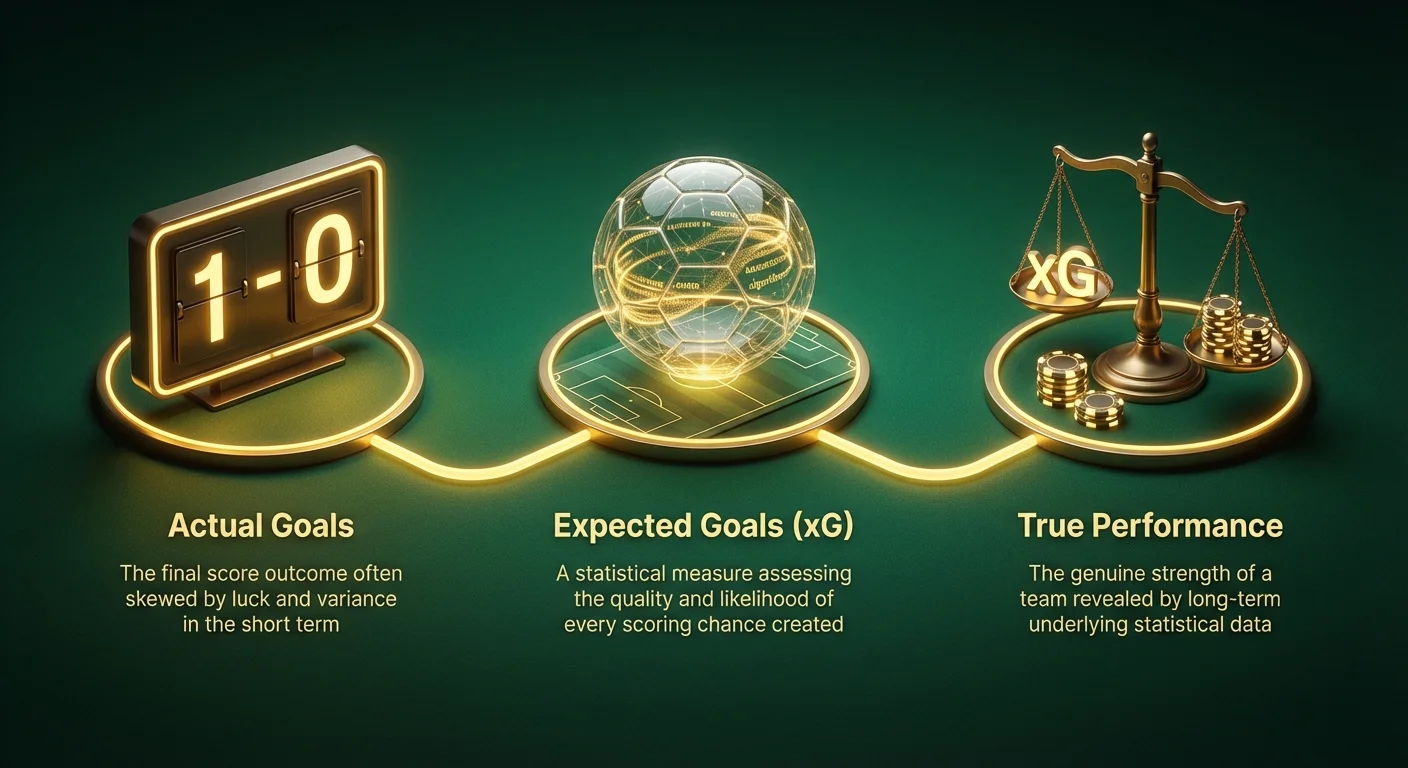
What is Expected Goals (xG)?
At its core, Expected Goals (xG) is a statistical metric used to measure the quality of a goal-scoring chance and the likelihood of it being scored.
Every time a player takes a shot, that shot is assigned a value between 0.00 and 1.00.
- 0.00 represents a shot that is theoretically impossible to score.
- 1.00 represents a certain goal (though in practice, even an open goal from one yard out might cap at 0.99 because players do miss them).
An xG of 0.35 means that, based on historical data of thousands of similar shots, an average player would score that chance 35% of the time.
How is xG Calculated?
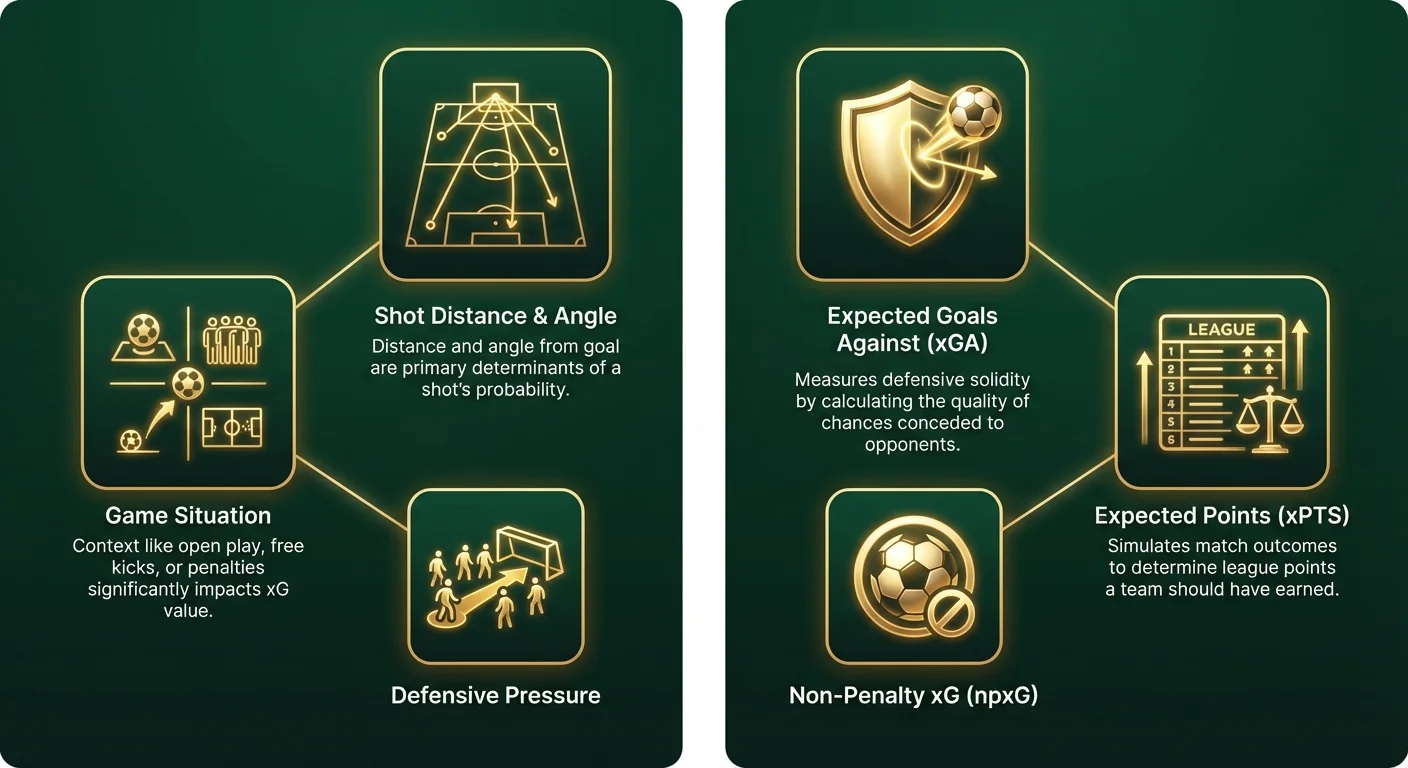
Sophisticated algorithms analyze hundreds of thousands of shots from historical matches to determine the xG value. Several variables factor into the calculation:
- Distance to Goal: Closer shots have higher xG.
- Angle to Goal: A central shot is easier than a shot from a tight angle.
- Body Part: Shots taken with the strong foot have higher xG than headers or weak-foot volleys.
- Type of Assist: A through-ball creates a better chance than a crossed ball.
- Defensive Pressure: Is the shooter open, or are there three defenders blocking the path?
- Game Situation: Was it an open play shot, a free kick, or a penalty? (Penalties generally carry a constant xG of 0.76 to 0.79).
Why Traditional Stats Fail
Consider a match where Team A has 15 shots and Team B has 3 shots.
- Team A: 15 shots, but all were from 30 yards out against a low block defense. Total xG: 0.45.
- Team B: 3 shots, but all were counter-attacks creating one-on-ones with the goalkeeper. Total xG: 1.80.
A bettor looking only at "Total Shots" would think Team A dominated. The xG bettor knows Team B created the superior chances and is actually the more dangerous side.
The Bettor's Edge: Variance vs. Performance
The "Holy Grail" of xG betting is understanding the difference between a team's actual results and their underlying performance. In the short term, soccer is a game of high variance. A lucky deflection, a refereeing error, or a goalkeeper having the game of his life can skew the final score.
However, over a long season, luck tends to even out, and results regress to the mean (the xG data).
Identifying Overperformers (The "Sell" Signal)
If a team is sitting at the top of the league with 20 goals scored, but their xG data suggests they should have only scored 12, they are "overperforming."
- The Cause: Often unsustainable finishing streaks or lucky long-range goals.
- The Betting Strategy: Fade this team. Bet against them or take the "Under" on their team totals in future matches. Their luck will run out, and the market often overvalues them based on their inflated league position.
Identifying Underperformers (The "Buy" Signal)
Conversely, a team might be near the relegation zone with 5 goals scored, despite generating an xG of 15.
- The Cause: Bad luck, hitting the woodwork, or poor variance in finishing.
- The Betting Strategy: Back this team. They are creating chances, and eventually, the ball will go in the net. The bookmakers will likely offer high odds on them because their actual results look poor.
Key xG Derivatives for Betting Markets
To effectively bet using soccer analytics, you need to look beyond the headline xG figure. Here are the specific metrics to analyze for different betting markets.
1. Expected Goals Against (xGA)
While xG measures attack, xGA measures defensive solidity. It calculates the quality of chances a team allows their opponents to have.
- Use Case: If a team has conceded very few goals (e.g., 2 goals in 10 games) but has a high xGA (e.g., 12.5), they are relying heavily on their goalkeeper or opponent misses. This defensive record is a mirage.
- Bet: Look for "Both Teams to Score" (BTTS) or bet on the opponent's "Over Team Goals."
2. Expected Points (xPTS)
This metric simulates the match thousands of times based on the xG created by both sides to determine how many points a team should have won on average.
- Use Case: This creates a "Justice Table." If the real league table shows a team in 12th, but the xPTS table ranks them 4th, that team is significantly undervalued.
- Bet: Asian Handicap or Moneyline bets on the undervalued team.
3. Non-Penalty xG (npxG)
Penalties drastically spike xG numbers (adding ~0.76 instantly). If a team's xG is high only because they received three penalties in the last five games, their data is skewed.
- Use Case: Always strip out penalties to judge a team's ability to create chances in open play.
- Bet: Essential for 1X2 and Handicap betting where you need to rely on consistent offensive flow, not referee decisions.
Advanced Strategy: The xG Comparison Matrix
When analyzing a specific matchup, do not just look at the average xG. You must compare Team A's Attack vs. Team B's Defense.
Below is a theoretical example of how to spot value using xG data:
| Metric | Home Team (Stats) | Away Team (Stats) | Analysis |
|---|---|---|---|
| Actual Goals For | 1.2 per game | 2.1 per game | Public sees Away team as heavy favorites. |
| xG For | 1.85 per game | 1.45 per game | Home team creates better chances but has finished poorly. |
| Actual Goals Against | 1.5 per game | 0.8 per game | Home team looks defensivley weak; Away team looks solid. |
| xG Against (xGA) | 0.95 per game | 1.60 per game | Home defense is actually solid (unlucky); Away defense is leaky (lucky). |
| Conclusion | Undervalued | Overvalued | Value Bet: Home Team (Draw No Bet or +0.5 Handicap) |
In this scenario, the casual bettor sees the Away team scoring more and conceding less. The smart bettor sees the Home team dominating the underlying metrics and takes the better odds on the Home side.
Player Props and xG
The revolution isn't limited to team bets. xG is perhaps the most powerful tool for Player Prop Betting, specifically for "Anytime Goalscorer" or "Over/Under Shots" markets.
xG per 90 (xG/90)
This measures a player's expected goal contribution per 90 minutes played.
- Strategy: Look for players with high xG/90 who haven't scored in 3-4 games. The public assumes they are "out of form." The math says they are getting into the right positions and a goal is imminent. This is where you find value odds (e.g., 3.50 or higher) on a striker who usually prices at 2.00.
xA (Expected Assists)
This measures the likelihood that a pass will become a goal assist.
- Strategy: Use this for "To Give an Assist" markets. A playmaker might have 0 assists for the season but an xA of 4.5. This indicates their teammates are wasting their passes. Back them to assist soon.
The Crypto Advantage in Analytics Betting
For the advanced analytics bettor, where you play is just as important as what you bet. Crypto sportsbooks offer distinct advantages for those using mathematical strategies like xG.
1. Sharp Odds and Higher Limits
Betting on xG discrepancies often involves betting against the public (contrarian betting). Soft fiat bookmakers often limit winning players quickly. Top-tier crypto sportsbooks generally operate on a "high volume, low margin" model. They welcome sharp action and offer higher limits, allowing you to maximize the profit from your analysis.
2. Immediate Liquidity for In-Play Betting
xG models are incredibly useful for live betting. If a favorite is losing 0-1 at halftime, but the xG is 1.5 vs 0.1, the favorite is likely to turn it around.
- The Friction Problem: Traditional banking can delay deposits.
- The Crypto Solution: Bitcoin, USDT, or Ethereum deposits are often instant. If you spot a live xG trend, you can move funds and place the bet within minutes, capturing the value before the odds shift.
3. Anonymity and Privacy
Serious analytics bettors treat this as a business. Crypto gambling sites often require less invasive KYC (Know Your Customer) procedures compared to traditional sportsbooks, allowing you to keep your financial strategy private.
Limitations: When xG Lies
To be a true expert, you must know the blind spots of your tools. xG is not perfect.
- Game State Effects: If a team goes up 3-0 in the first 20 minutes, they will likely sit back and defend. Their xG for the rest of the game will plummet, while the losing team's xG will rise as they chase the game. A final xG of 1.0 vs 2.5 might look like the loser was "unlucky," but in reality, the winner just took their foot off the gas. Always check the timeline of the xG.
- Finishing Skill: xG assumes an "average" player takes the shot. Lionel Messi or Erling Haaland consistently outperform their xG because they are elite finishers. Conversely, a clumsy defender will consistently underperform xG. You must adjust your expectations based on who is shooting.
- Block Density: Some xG models struggle to account for the number of defenders between the ball and the goal. A shot from 10 yards is usually high xG, but not if there are 8 defenders on the goal line.
Practical Steps to Start xG Betting
Ready to apply this to your betting slip? Follow this workflow:
- Find Your Data: Bookmark reliable sources. Understat, FBref, and Infogol are excellent free resources.
- Filter the Narrative: Before looking at the odds, look at the npxG (Non-penalty xG) and xGA tables for the league. Identify the top 3 "unlucky" teams and top 3 "lucky" teams.
- Compare with Market Odds: Check your crypto sportsbook. Is the "lucky" team a heavy favorite against a solid mid-table side? That is your potential entry point.
- Check Team News: xG is historical data. If the striker responsible for 60% of a team's xG is injured, the historical data is useless for the upcoming match.
- Place the Bet: Look for value markets like Asian Handicap, Draw No Bet, or Team Totals.
- Review: After the match, don't just look at the score. Look at the xG match report. Did your logic hold up? If you bet on a team that lost 0-1 but won the xG battle 2.5 to 0.2, you made a good bet with a bad result. Over time, that process wins.
Summary
Expected Goals is not a crystal ball, but it is the closest thing we have to a truth serum in soccer betting. It strips away the noise of luck, bad refereeing, and variance, leaving you with a clear picture of team performance.
By identifying the disconnect between a team's actual points and their expected points, you can exploit inefficiencies in the betting market. Combine this analytical approach with the speed, privacy, and high limits of crypto sports betting platforms, and you elevate your strategy from recreational gambling to calculated investing.
Stop betting on what happened. Start betting on what should have happened - because eventually, the numbers always balance out.