
Walking into a casino - whether it is the plush carpet of a Las Vegas resort or the digital interface of a premier crypto gambling site - is an exercise in confronting probability. For the uninitiated, the flashing lights and turning cards represent luck. For the intermediate player, they represent a math problem waiting to be solved.
To the casual observer, Blackjack appears to be a simple race to 21. However, beneath the felt lies a complex engine of probabilities, statistical variance, and rule-dependent variables. Understanding casino math is not just about satisfying curiosity; it is the single most important factor in preserving your crypto bankroll.
This guide moves beyond basic rules. We are going to deconstruct the mechanics of Blackjack RTP, explain exactly where the house edge comes from, and analyze how subtle rule changes can silently drain your wallet or offer you a fair fight.
The Mathematical Foundation: RTP vs. House Edge
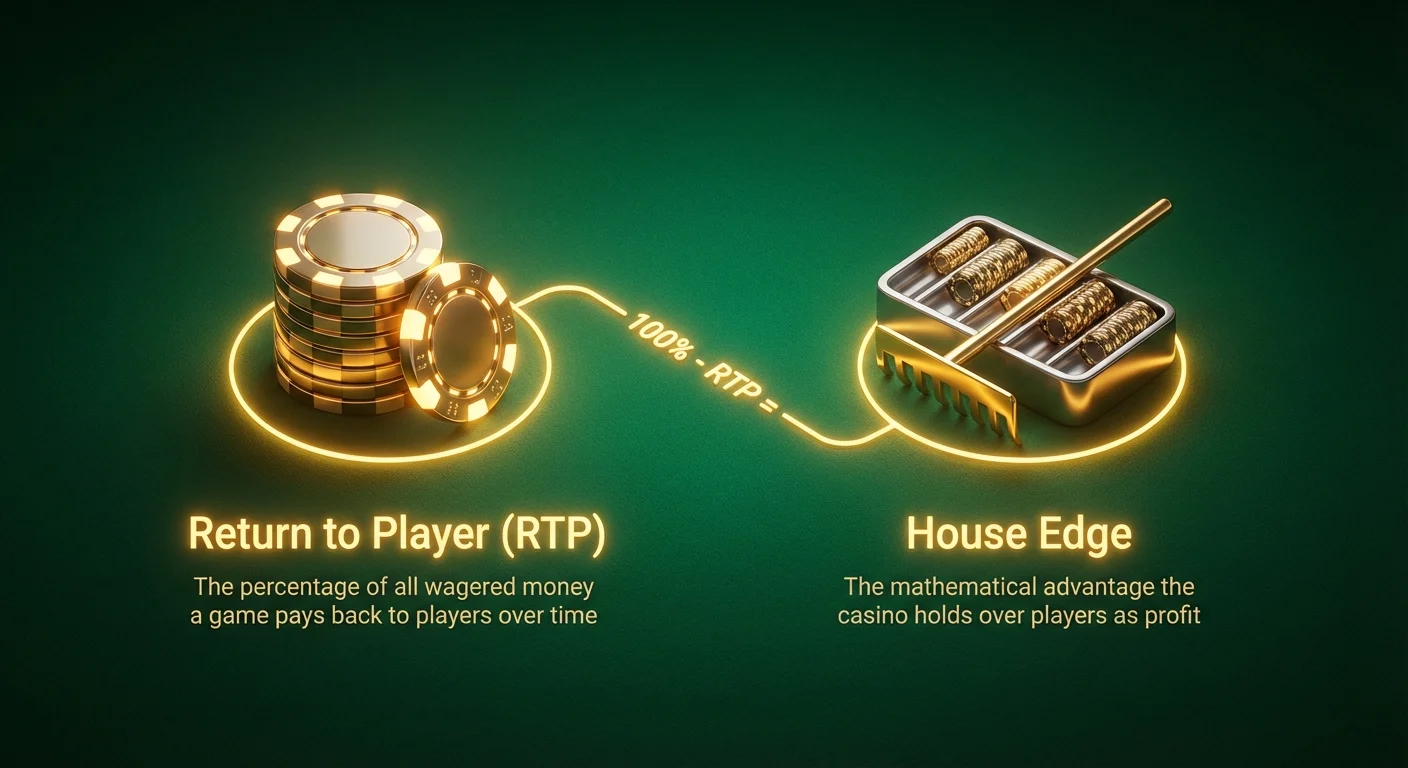
Before we dissect specific Blackjack rules, we must define the two pillars of casino math: Return to Player (RTP) and House Edge. These two terms are effectively opposite sides of the same coin.
Return to Player (RTP)
RTP is the percentage of all wagered money that a game will pay back to players over time. It is a theoretical number calculated over millions of hands.
- Example: If a game has an RTP of 99.5%, it means that for every $100 wagered, the game is programmed to return $99.50 to the players in the long run.
House Edge
The House Edge is the mathematical advantage the casino holds over the player. It is the percentage of the money wagered that the casino expects to keep as profit.
- The Formula: $100% - RTP = House Edge$
- Example: If the RTP is 99.5%, the House Edge is 0.5%.
Why Blackjack Stands Alone
In the ecosystem of gambling, Blackjack is unique.
- Slots: Typically offer an RTP between 92% and 96%. You have zero control over the outcome.
- American Roulette: Carries a fixed House Edge of 5.26% due to the double zero.
- Blackjack: With favorable rules and perfect strategy, the RTP can exceed 99.5%, creating a House Edge of less than 0.5%.
This makes Blackjack the mathematically superior choice for players looking to stretch their Bitcoin or Ethereum deposits. However, that 99.5% RTP is not a guarantee - it is a ceiling. To reach it, you must understand what drags that number down.
Deconstructing the House Edge: Where Does it Come From?
If Blackjack is a game of skill where the player and dealer have roughly equal chances of drawing high cards, why does the house have an edge at all?
The answer lies in the order of operations.
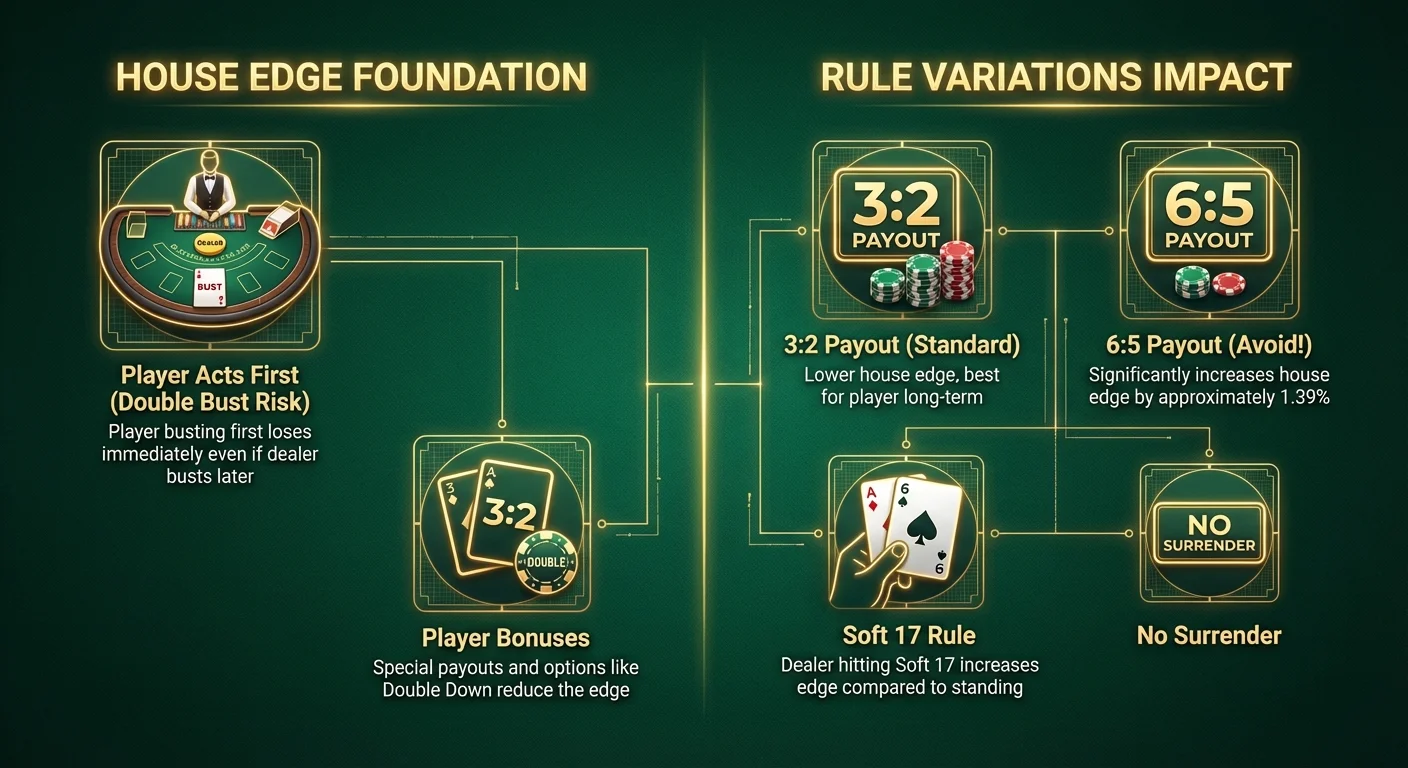
In Blackjack, the player must act first. If the player hits and busts (goes over 21), the player loses the bet immediately. This happens before the dealer plays their hand. Even if the dealer subsequently draws a card and busts as well, the player has already lost.
This "double bust" scenario is the foundation of the casino's advantage. If you mimicked the dealer exactly (hit on 16, stand on 17), the house would have an edge of roughly 5.5% because of this rule. The reason the standard House Edge is lower (around 0.5%) is that players receive special bonuses (3:2 on Blackjack) and options the dealer does not have (Double Down, Split, Surrender).
The Silent Bankroll Killers: Rule Variations Explained
When you log into a crypto casino, you will see dozens of Blackjack tables. They look identical, but the math behind them varies wildly. Choosing the wrong table can quadruple the house edge against you.
Here is a breakdown of how different rules impact the mathematics of the game.
1. The Payout: 3:2 vs. 6:5
This is the single most critical variable in Blackjack RTP.
- 3:2 Payout: If you bet 10 mBTC and hit Blackjack, you win 15 mBTC.
- 6:5 Payout: If you bet 10 mBTC and hit Blackjack, you win 12 mBTC.
It may seem like a small difference, but in the world of house edge explained, it is catastrophic. Changing the payout from 3:2 to 6:5 increases the house edge by approximately 1.39%.
If you are playing a game with a standard 0.5% edge, switching to a 6:5 table bumps that edge to nearly 2%. In financial terms, you are losing money four times faster. Always check the felt or the help file for the payout ratio.
| Payout Ratio | Bet Amount | Winnings | House Edge Impact |
|---|---|---|---|
| 3 to 2 | $100 | $150 | Baseline (Standard) |
| 6 to 5 | $100 | $120 | +1.39% (Avoid!) |
2. Soft 17: Hit or Stand?
A "Soft 17" is a hand containing an Ace valued as 11 (e.g., Ace + 6).
- S17 (Dealer Stands on Soft 17): Better for the player.
- H17 (Dealer Hits on Soft 17): Better for the casino.
When the dealer hits on Soft 17, they have a chance to improve their hand to a higher total, which beats your standing hands. This rule increases the house edge by approximately 0.22%. While not as damaging as the 6:5 payout, it is a significant factor in long-term profitability.
3. European vs. American Rules (The Hole Card)
In American Blackjack, the dealer takes a "hole card" (face down) immediately. If the dealer shows an Ace or a 10, they check for Blackjack before players act. If they have it, the round ends, and you only lose your initial bet.
In European Blackjack (common in many global crypto casinos), the dealer does not take a hole card. They only receive their second card after all players have finished their hands.
- The Risk: If you Double Down or Split against a dealer's Ace, and the dealer ends up drawing a Blackjack at the end of the round, you lose both your initial bet and your secondary bets.
- The Math: This increases the house edge by roughly 0.11%, mostly because it discourages aggressive (but mathematically correct) doubling and splitting.
4. Double Exposure Blackjack
Some variants, like Double Exposure, deal both dealer cards face up. While this seems like a massive advantage for the player (and it is), the casino counteracts this by paying 1:1 on Blackjacks (instead of 3:2) and winning on all ties (pushes).
- Verdict: Despite the information advantage, the rule changes usually result in a higher house edge (often over 0.65%) compared to standard Blackjack.
Strategic Mathematics: Reducing the Edge
The "0.5% House Edge" is not a gift; it is a reward for perfect play. If you play by "gut feeling" or intuition, the house edge can easily skyrocket to 2% or 3%. To achieve the theoretical Blackjack RTP, you must utilize the tools the casino gives you.
The Math of Splitting
Splitting pairs is about variance management and maximizing value.
- Aces: Always split. A single Ace is a powerful start, but two Aces in one hand is a soft 12 (a terrible hand). Splitting gives you two shots at 21.
- Eights: Always split. Two 8s make 16 - statistically the worst starting hand in the game. Splitting them gives you two chances to draw a 10 for an 18.
- Tens/Face Cards: Never split. A 20 is a winning hand roughly 92% of the time. Splitting tens trades a near-guaranteed win for two average hands.
The Math of Doubling Down
Doubling down is the player's most powerful weapon. It allows you to double your bet when probability dictates you are a favorite to win.
- Hard 11: Always double. The deck is rich in 10-value cards (Kings, Queens, Jacks, 10s). There is a high statistical probability your next card will be a 10, giving you a 21.
- Soft Hands (Aces): Doubling on Soft 16, 17, or 18 against a dealer's low card (3-6) exploits the fact that the dealer is likely to bust. You are getting more money on the table when the dealer is vulnerable.
Surrender: The Secret Weapon
Surrender is often viewed as a sign of weakness, but mathematically, it is a shield. Review our guide to the surrender option. "Late Surrender" allows you to forfeit half your bet after the dealer checks for Blackjack.
- When to use it: If you have a Hard 16 and the dealer shows a 9, 10, or Ace.
- The Math: A Hard 16 vs. a Dealer 10 will lose more than 50% of the time. By surrendering, you lock in a 50% loss, which is mathematically superior to playing the hand out and losing 75% of the time. Properly using surrender reduces the house edge by roughly 0.08%.
The Crypto Advantage: Transparency and Fairness
Playing Blackjack with cryptocurrency introduces new variables to the equation that traditional casinos cannot match.
Provably Fair Algorithms
In traditional online casinos, you trust a third-party auditor to verify the Random Number Generator (RNG). In crypto gambling, many blackjack games are "Provably Fair."
- How it works: The server creates a seed (random string) and hashes it. You (the player) also provide a client seed. The resulting shuffle is derived from both.
- The Benefit: You can mathematically verify after every hand that the deck was not manipulated. This doesn't change the RTP, but it guarantees that the stated odds are genuine.
Lower Overheads, Better Rules
Because crypto transactions have lower processing fees and no chargeback risks for the operator, crypto casinos can sometimes afford to offer rules with lower house edges. You are more likely to find single-deck games paying 3:2 in the crypto sphere than on the Las Vegas Strip.
BanEven with a 99.5% RTP, you can lose your entire bankroll in a single session. This is due to understanding variance in betting.ession. This is due to variance. RTP is calculated over millions of hands; your session might only be 100 hands. To survive these short-term deviations, implementing strict bankroll management strategies is vital.
The Gambler's Fallacy
Many intermediate players fall for the Gambler's Fallacy - the belief that if you have lost 5 hands in a row, you are "due" for a win.
- The Reality: The cards have no memory. The probability of winning the next hand remains roughly 42-44% (excluding ties) regardless of previous results.
Betting Systems: Martingale vs. Paroli
Players often use betting systems to manage their bankroll. It is vital to understand that no betting system changes the House Edge.
- The Martingale (Negative Progression): Doubling your bet after every loss.
- The Trap: If you lose 7 or 8 hands in a row (which happens frequently), you will hit the table maximum limit or run out of funds. This system risks a catastrophic loss to win a small unit.
- The Paroli (Positive Progression): Doubling your bet after a win (up to 3 times), then resetting.
- The Benefit: You are betting with the "house's money" (your winnings). It does not alter the odds, but it protects your initial deposit and allows you to capitalize on lucky streaks.
Summary: The Checklist for the Smart Player
To ensure you are getting the best possible odds and protecting your crypto assets, run this checklist before sitting down at a digital table:
- Check the Payout: Is it 3:2? If it says 6:5, close the window immediately.
- Check the Dealer Rules: Does the dealer stand on Soft 17? (Preferred).
- Surrender Availability: Does the game allow Late Surrender?
- Deck Count: Fewer decks are better, provided the payoutsStrategy Chart: Since you are playing online, keep a Basic Strategy chart open in another tab.Basic Strategy chart open in another tab. Using it guarantees you are playing the mathematical optimal game.
Conclusion
Blackjack is not a game of guessing; it is a game of executing probability. The house edge exists because the player acts first, but the rules of the game provide you with the tools to chip that edge away until it is razor-thin.
By understanding the math behind the payouts, refusing to play 6:5 games, and utilizing Double Down and Split correctly, you move from being a gambler to being an advantage player. In the world of crypto gambling, where transaction speeds are fast and games are transparent, math is the only strategy that pays dividends in the long run.