
The intersection of cryptocurrency and casino gaming offers a unique thrill that fiat currency simply cannot match. You aren't just playing for chips; you are playing for an asset class that never sleeps, constantly shifting in value while the cards are being dealt. However, this dynamic introduces a layer of complexity that destroys unprepared players.
In traditional gambling, a $50 bet is always a $50 bet. In crypto gambling, a 0.001 BTC bet represents a fluctuating store of value. If Bitcoin rallies 10% while you are grinding out a blackjack session, your unit size has effectively increased in purchasing power, altering your risk profile in real-time.
This guide is for the intermediate blackjack player who understands mathematical edge strategy but needs to master the financial side of playing with volatile assets. We will explore how to manage a crypto bankroll, calculate betting units amidst volatility, and navigate the "double variance" of the casino edge and the market charts.

The Concept of "Double Variance"
Before placing a chip on the felt, you must understand the environment you are entering. All gambling involves variance, the statistical swings of winning and losing streaks. Crypto gambling introduces a second layer: market volatility.
When you bet with Bitcoin (BTC) or Ethereum (ETH), you are subject to two simultaneous forces:
- Game Variance: The mathematical probability of winning or losing a hand of Blackjack.
- Asset Volatility: The external market value of the token you are betting with.
The Four Scenarios of Crypto Blackjack
When these two forces interact, they create four distinct outcomes for your session. Understanding these will help you decide when to play and how much to bet.
| Game Result | Market Trend | Net Outcome | Bankroll Impact |
|---|---|---|---|
| Win Session | Bull Market (Up) | The "Moon" Scenario: You win more chips, and those chips are worth more fiat. | Huge Increase |
| Win Session | Bear Market (Down) | The "Hedge" Scenario: Your gambling winnings offset the drop in token price. | Neutral / Slight Gain |
| Lose Session | Bull Market (Up) | The "Opportunity Cost" Loss: You lost chips that were rapidly increasing in value. | Moderate Pain |
| Lose Session | Bear Market (Down) | The "Rekt" Scenario: You lose chips, and your remaining bankroll is worth less. | Catastrophic Loss |
Your goal in bankroll management is to maximize the "Moon" scenario while setting strict safeguards to prevent the "Rekt" scenario.
Defining Your Crypto Bankroll
A common mistake among crypto enthusiasts is treating their entire portfolio as their gambling bankroll. This is a violation of the first rule of responsible gambling.
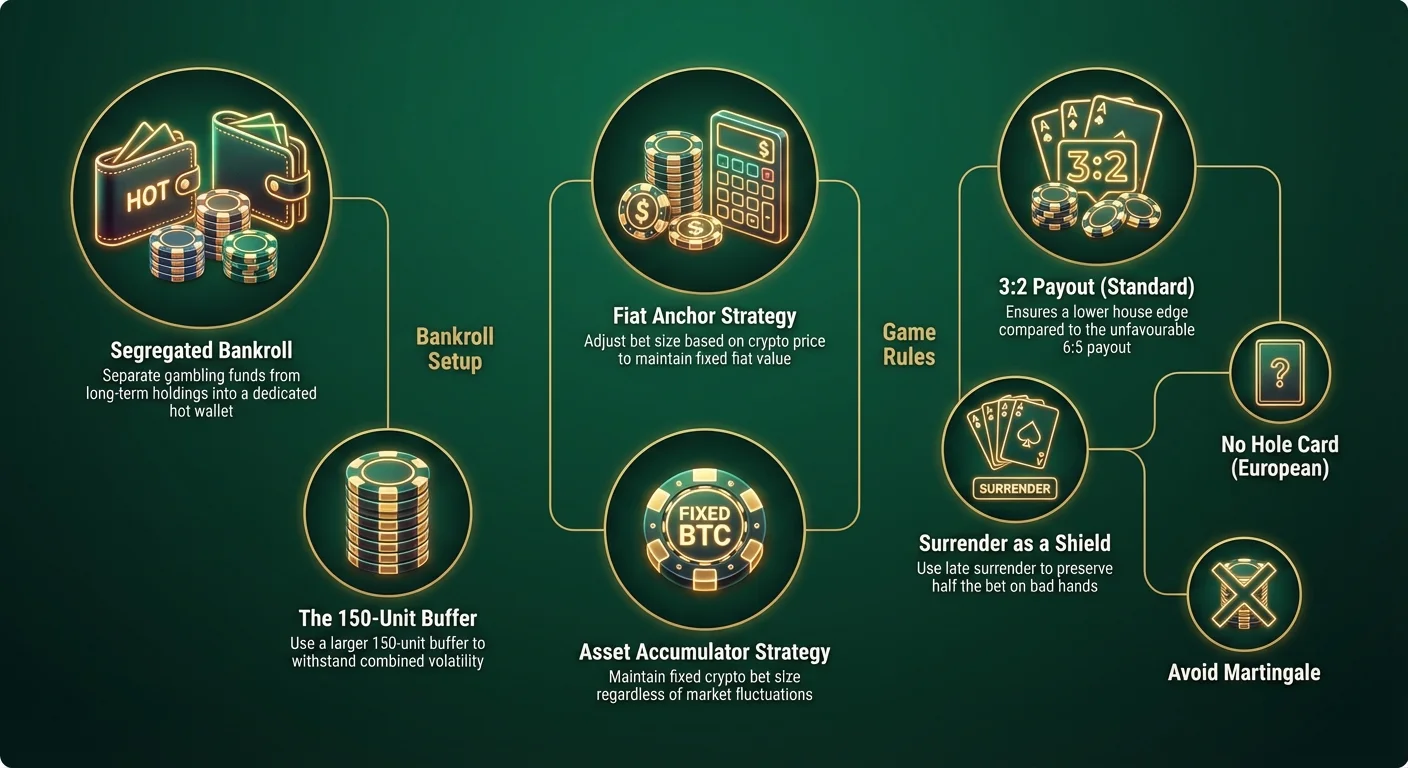
Segregation of Funds
You must have a "Cold Wallet" (for long-term holding) and a "Hot Wallet" (for gambling). Never mix the two. If you hold 1.0 BTC, your gambling bankroll might be 0.05 BTC.
- The Hard Stop: Once the 0.05 BTC is gone, the session (or month) is over.
- The Mental Stop: Do not mentally convert your gambling balance to fiat currency after you have started playing. If you deposited 0.05 BTC, you are playing with 0.05 BTC, regardless of whether the price is $30k or $60k. For advanced storage techniques, including how to handle long-term assets, consult our guide on analyzing security trade-offs.
The 100-Unit Rule
Blackjack is a low-volatility game compared to slots, but it still requires a buffer. In the fiat world, a standard bankroll recommendation is 50 to 100 betting units.
Because crypto is volatile, you need a 150-unit buffer.
- Calculation: If your segregated bankroll is 0.1 BTC.
- Unit Size: 0.1 BTC / 150 = 0.00066 BTC per hand.
This conservative approach ensures that a bad run of cards combined with a market dip won't wipe out your liquidity.
Dynamic Unit Sizing: Two Schools of Thought
How do you determine your bet size when the price of the token changes? There are two distinct strategies for this, depending on your financial goals.
Strategy A: The Fiat Anchor (Preservation Focus)
This strategy is for players who ultimately pay their bills in USD, EUR, or GBP. You view crypto as a medium of transfer, not necessarily a long-term store of value.
How it works:
You decide your bet size is $20. Before every session, you check the price of BTC and adjust your Satoshi wager to match $20.
- BTC at $30,000: Bet size is ~0.00066 BTC.
- BTC at $60,000: Bet size is ~0.00033 BTC.
Pros: predictable risk in real-world purchasing power.
Cons: requires constant calculation; you win less crypto when the price is high.
Strategy B: The Asset Accumulator (Stacking Sats)
This strategy is for the "crypto native" player. You don't care about the USD price. Your goal is to leave the casino with more Bitcoin than you entered with.
How it works:
You set a fixed BTC unit size (e.g., 0.0005 BTC) and stick to it regardless of market fluctuations.
Pros: If you win during a bull run, your gains are exponential.
Cons: High risk. If BTC doubles in price, you are psychologically betting "double" the money you were used to yesterday, which can lead to tilt or fear-based errors in basic strategy.
Blackjack Mechanics and Volatility Management
Not all Blackjack games are created equal. When playing with a volatile asset, you must choose game variations that reduce variance (swings) and lower the House Edge. Every fraction of a percentage point matters when your bankroll is fluctuating in value.
1. The 6:5 Payout Trap
You must avoid tables that pay 6:5 for a natural Blackjack.
- Standard (3:2): A $10 bet wins $15.
- Trap (6:5): A $10 bet wins $12.
As noted in industry analysis, switching from 3:2 to 6:5 increases the House Edge by roughly 1.39%. In a standard game, the edge is around 0.5%. Playing 6:5 nearly quadruples the casino's advantage.
Crypto Implication: With a 2% house edge, your bankroll will erode faster. Combined with a potential 5% drop in crypto prices during a session, you are fighting a mathematical battle you cannot win. Always verify the payout on the virtual felt before sitting down.
2. The Cost of Splits and Doubles
Intermediate players know that Splitting and Doubling Down are essential to reducing the house edge. However, these moves increase your short-term volatility.
- Splitting: You must place a second bet of equal value.
- Doubling: You double your wager for one card.
Scenario: You have a 0.01 BTC bankroll. You bet 0.001 BTC (10% of roll - aggressive). You are dealt a pair of 8s against a dealer 6. Basic strategy says Split. You catch another 8. You Split again. You now have 0.003 BTC on the table in a single round.
If you are using a "Fiat Anchor" strategy, you must ensure your crypto balance can support these high-variance maneuvers. Never bet a unit size so large that you are afraid to Double Down or Split when the math dictates you should. If fear prevents you from doubling an 11 against a 6, you have already lost the mathematical edge.
3. Surrender is Your Shield
"Surrender" is often viewed as a weakness, but for a crypto bankroll manager, it is a strategic shield. Late Surrender allows you to forfeit half your bet after the dealer checks for Blackjack.
Using Surrender correctly reduces the house edge significantly. More importantly, it preserves capital. Retaining 50% of a bet in a token you believe will appreciate in value is better than losing 100% of it on a statistically poor hand (like Hard 16 vs. Dealer Ace).
4. European vs. American Rules
Be aware of the "No Hole Card" rule often found in European Blackjack variants common at crypto casinos.
- American: Dealer peeks for Blackjack. If they have it, the hand ends immediately. You only lose your original bet.
- European: Dealer does not peek. You might Split 8s, Double Down, and put 3 units on the table, only to find out at the end of the hand that the dealer has a Blackjack. You lose all bets.
Strategy Tip: If playing a European (No Hole Card) variant, you must be more conservative with your bankroll management, as the "ruin risk" on a single hand is higher.
Betting Systems: The Martingale Danger
We must address popular betting systems like the Martingale (doubling your bet after every loss). In the fiat world, this is risky. In the crypto world, it is financial suicide.
The Martingale relies on the premise that you have an infinite bankroll to eventually catch a win.
- Table Limits: Crypto tables have maximum bet limits that will cap your progression.
- Asset Fluctuation: Imagine you are on a 6-hand losing streak. You are preparing to bet 64 units to recover. Suddenly, the price of Bitcoin spikes 10%. Your "recovery bet" is now costing you significantly more real-world value than the original loss you are trying to recoup.
Recommendation: Stick to flat betting or very conservative positive progressions (like the Paroli system, where you only increase bets when winning). Never chase losses with a volatile asset.
Practical Toolkit for Crypto Gamblers
To manage betting units effectively, you need a disciplined workflow. Here is a checklist for every session:
1. The Pre-Flight Check
- Check Market Trend: Is the market chopping, pumping, or dumping?
- High Volatility: Lower your unit size or switch to stablecoins (USDT/USDC).
- Low Volatility: Safe to play with major caps (BTC/ETH).
- Set the "Walk Away" Number: If your bankroll hits +20% or -20%, quit. Hard stop.
2. Using Stablecoins as a Hedge
Most top-tier crypto casinos allow you to hold a balance in multiple currencies.
- The Tactic: Keep your main bankroll in USDT or USDC. Only swap into BTC when you want to take a "long" position on the market while playing.
- This neutralizes the "Asset Volatility" leaving you to only deal with "Game Variance." Before relying on these assets, you should evaluate stablecoin security by consulting the collateralization risk matrix.
3. Provably Fair Verification
One advantage of crypto gambling is Provably Fair technology. This creates a cryptographic hash of the deck before the hand begins.
- Why it matters for bankroll: You are already fighting market prices and house edge. You cannot afford to play rigged games. Verify the hash periodically to ensure the RNG (Random Number Generator) is legitimate.
Handling the Mental Game
The psychology of betting with Bitcoin is different. There is a phenomenon known as "Unit Bias."
- Seeing a balance of "0.05" looks smaller than seeing "$3,000."
- It is easier to carelessly toss a 0.005 chip than a $300 chip, even if they are the same value.
To combat Unit Bias:
- Use the "Fiat Display" option if the casino offers it. This shows your BTC balance in USD/EUR equivalent.
- If the casino only displays crypto units, keep a calculator open or a sticky note on your monitor with the current exchange rate for 1 Unit.
Summary: The Golden Rules of Crypto Blackjack
To summarize, successful bankroll management with volatile assets requires adapting standard strategies to the realities of the crypto market.
- Rule 1: Acknowledge "Double Variance." You are fighting the dealer and the chart.
- Rule 2: Increase your bankroll buffer. Use 150 units instead of the standard 100.
- Rule 3: Never play 6:5 Blackjack. It is a bankroll drain that volatility will exacerbate.
- Rule 4: Beware the "No Hole Card" rule. It increases the risk of losing split/doubled bets.
- Rule 5: Avoid the Martingale. It exposes you to exponential risk in a fluctuating market.
- Rule 6: Know when to switch to Stablecoins. If the market is too turbulent, seek the safety of the peg.
By respecting the value of the underlying asset and adhering to strict unit sizing, you can enjoy the speed and anonymity of betting with Bitcoin without falling victim to its volatility. Treat your crypto bankroll like an investment portfolio - manage risk, preserve capital, and quit while you're ahead.