
In the high-stakes ecosystem of sports betting, information is the ultimate currency. While the recreational bettor relies on gut feelings, trends, or team loyalty, the professional bettor relies on math, information arbitrage, and market manipulation. For the advanced bettor operating within the crypto gambling sphere, understanding how to read the market is just as important as handicapping the games themselves.
The sports betting market is a living, breathing entity. It reacts to news, injuries, and - most importantly - money. When vast sums of liquidity hit a specific outcome, sportsbooks are forced to react. This guide explores the phenomenon of "steam," the influence of "sharp money," and how you can use the transparency and speed of crypto sportsbooks to identify where the professional money is flowing.
The Ecosystem: Sharps, Squares, and Bookmakers
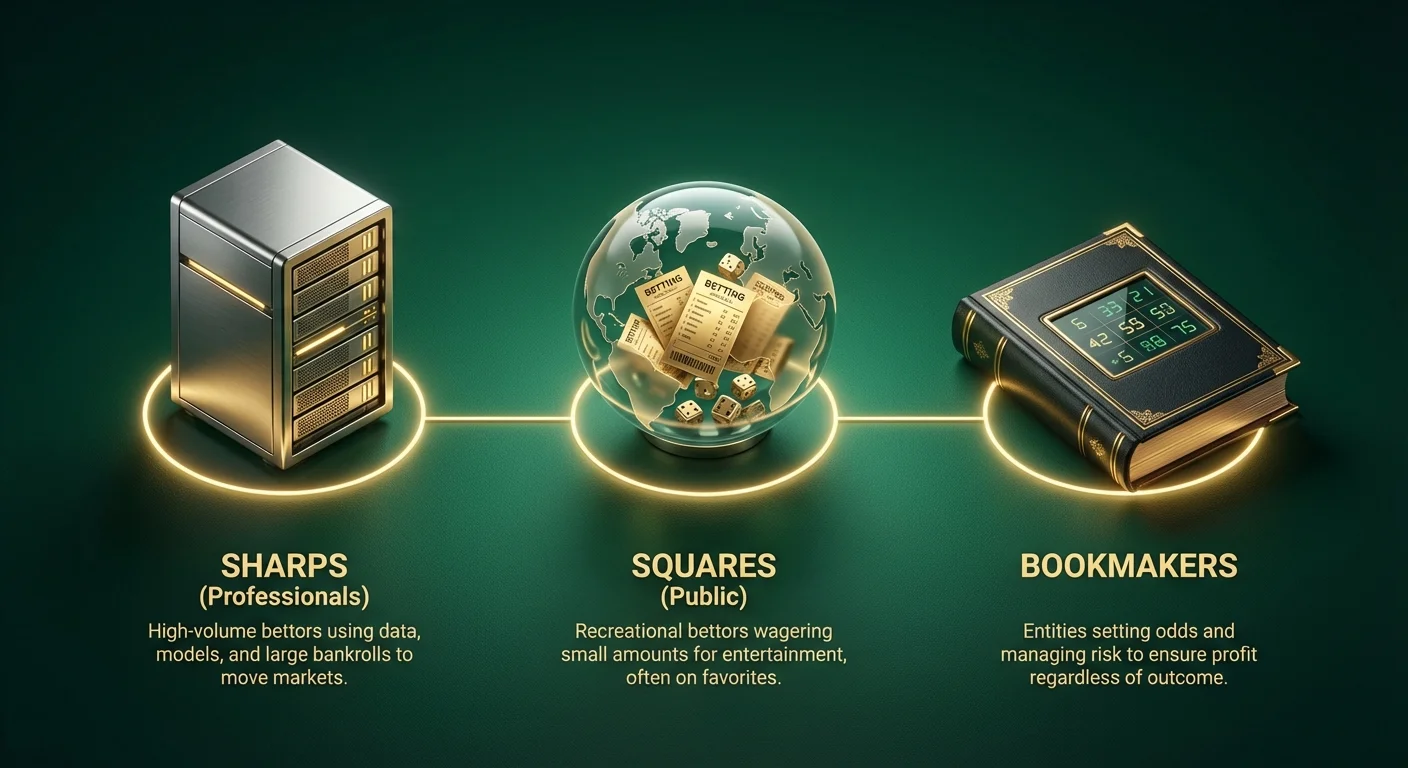
Before dissecting steam moves, you must understand the hierarchy of the betting market. The movement of odds is rarely random; it is a tug-of-war between three entities.
- The Squares (Public): These are recreational bettors. They typically bet small amounts, favor favorites and "Over" totals, and bet for entertainment. Individually, they have no impact on the line. Collectively, they can create exposure for a sportsbook, but bookmakers generally do not fear their opinions.
- The Sharps (Professionals): These are individuals or syndicates who bet for a living. They use sophisticated modeling, proprietary information, and massive bankrolls. When they bet, they bet maximum limits. Bookmakers respect their opinions and move lines immediately when they identify sharp action.
- The Bookmakers: Their goal is traditionally to balance the book to collect the "vig" (juice) regardless of the outcome, though modern sharp books often take positions against the public.
In the crypto betting world, this dynamic is accelerated. Bitcoin and stablecoin transactions allow for instant liquidity, meaning sharps can strike multiple books simultaneously without waiting for bank wires. This creates a faster, more volatile market.
What is a Steam Move?
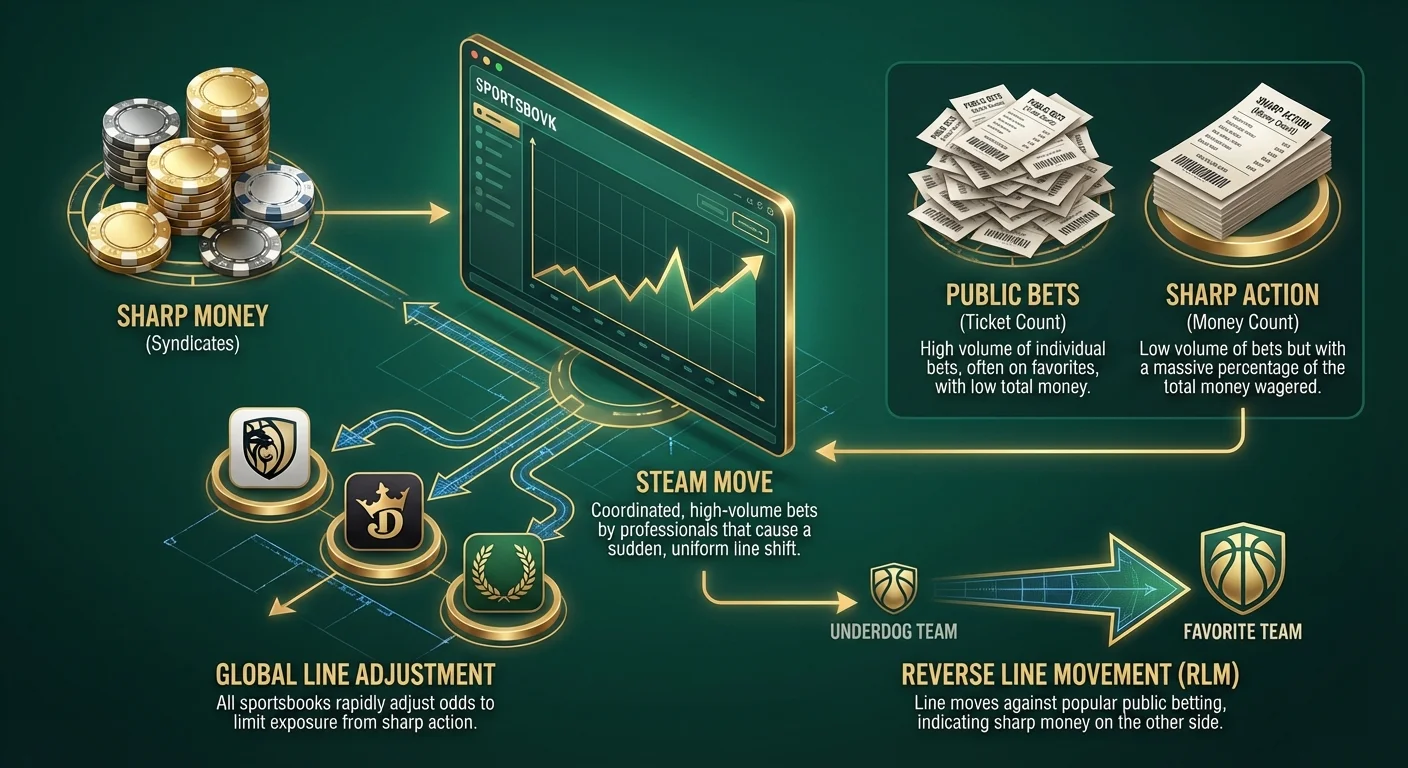
A steam move occurs when a betting line moves suddenly and uniformly across the entire sports betting marketplace. This is not a gradual shift of half a point over three days; it is a violent, orchestrated shift that happens within minutes or even seconds.
The Anatomy of Steam
Steam is caused by syndicates (groups of professional bettors) deciding that a specific number is "off." They coordinate to hit that number at multiple sportsbooks simultaneously.
Imagine an NBA game where the opening line is Golden State -4.
- A sharp syndicate calculates the "true odds" should be Golden State -6.
- They wait.
- At a coordinated time, five different bettors associated with the syndicate place maximum limit bets (e.g., 1 BTC each) on Golden State -4 at ten different crypto sportsbooks.
- The sportsbooks' algorithms trigger an alert: "Max limit bets received from sharp accounts."
- To limit exposure, every book moves the line from -4 to -4.5, then -5, and finally settles at -5.5 or -6.
The "steam" is that trail of smoke left behind as the line rockets upward. If you see the line moving everywhere at once, you are witnessing a steam move.
Identifying Sharp Money vs. Public Money
Not all line movement is sharp. Sometimes, lines move simply because the public is piling on a popular team (like the Kansas City Chiefs or the LA Lakers). To follow the money effectively, you must learn to distinguish between Square Volume and Sharp Action.
The Ticket Count vs. Money Count
This is the holy grail of reading the market.
- Ticket Count: The percentage of total individual bets placed on a side.
- Money Count: The percentage of total currency (handle) placed on a side.
When these two numbers diverge, you have found a potential edge.
| Scenario | Ticket % | Money % | Implication |
|---|---|---|---|
| Public Consensus | 75% on Team A | 70% on Team A | The public loves Team A. The line moves because of sheer volume. No sharp signal. |
| Split Action | 50% on Team A | 50% on Team A | The book is balanced. The line likely stays stagnant. |
| Sharp Action | 30% on Team A | 70% on Team A | The public is on Team B, but the money is on Team A. This is a massive sharp indicator. |
Reverse Line Movement (RLM)
Reverse Line Movement is the strongest indicator of professional betting action.
Example:
- The Dallas Cowboys open as -7 favorites against the NY Giants.
- 80% of the public bets are on the Cowboys because the public loves favorites.
- Logically, the line should move to -7.5 or -8 to encourage betting on the Giants.
- However, the line drops to -6.
Why? Because despite 80% of the tickets being on the Cowboys, a massive amount of sharp money came in on the Giants at +7. The sportsbook respects the sharp money more than the public money, so they move the line against the public percentages. This is RLM, and it is a beacon for following the money.
The Crypto Advantage in Following Money
Crypto sportsbooks have changed how sharps operate, and understanding this helps you track them.
- High Limits and Anonymity: Traditional fiat books often limit winning players quickly. Top-tier crypto sportsbooks (especially those operating on "provably fair" logic or acting as exchanges) often welcome winners and offer higher limits. Sharps flock here.
- API Access: Many modern crypto books offer public APIs. Tech-savvy bettors use these to scrape odds in real-time, detecting line movements milliseconds after they happen.
- The "Tether" Standard: Sharps hate volatility in their bankroll currency. The rise of USDT and USDC betting allows pros to bet large sums without worrying about the price of Bitcoin crashing during the game.
Pro Tip: Monitor the "order books" if you are using a crypto betting exchange. Unlike a traditional sportsbook, an exchange shows you exactly how much money is waiting to be matched at what price. Seeing a "wall" of money appear on an underdog is a clear sign of sharp interest.
Strategies: Chasing Steam and Fading the Public
Once you identify where the money is going, you have a decision to make. Do you follow it?
Strategy 1: Chasing Steam
This involves betting on the same side as the steam move as it is happening.
- The Goal: To get the same odds (or close to them) as the sharps before the market completely corrects.
- The Execution: You need multiple crypto sportsbooks funded. One book (a "market maker" like Pinnacle or a major Asian book) will move first. "Lazy" books (often smaller crypto sites or recreational books) will lag behind by 30 to 60 seconds. You bet the old line at the lazy book before they update.
- The Risk: Stale Numbers. If the sharps bet Team A at -3, and the line moves to -4.5, and you bet it at -4.5, you have lost all the "value." You are betting the same team, but at a worse price. Over the long term, this is a losing strategy. You must catch the move early.
Strategy 2: The Buy-Back (Advanced)
Sometimes, sharps will manipulate the market with a "head fake."
- Syndicates bet heavily on the Favorite to push the line from -7 to -8.
- Other bettors and bots see the steam and bet -8, pushing it to -8.5.
- The Syndicate actually wanted the Underdog. They waited for the line to hit inflated heights (-8.5) and then hammer the Underdog at +8.5 for double the amount they bet on the favorite.
If you see a steam move stop abruptly and then immediately reverse direction with force, you are witnessing a buy-back. The second move is usually the "true" sharp side.
Is Following Sharps Viable?
Should you blindly "tail" the sharp money? The answer is nuanced.
The Argument For:
- Validation: It confirms your handicapping. If you like an underdog and you see RLM in their favor, it increases your confidence.
- Closing Line Value (CLV): If you consistently bet numbers that are better than the closing line (e.g., you bet -3, and it closes -5), you will mathematically win over time. Following steam helps you capture CLV.
The Argument Against:
- You Are Late: By the time you see the line move on an odds screen, the pros have already eaten the best odds. You are often buying their leftovers.
- The "Syndicate Tax": Sharps often win at a 55-57% rate. If you are getting a line that is 1 or 2 points worse than theirs, that 57% win rate might drop to 50% for you - which loses money due to the vigorish.
Practical Steps to Follow the Money
If you want to integrate this into your betting strategy, follow this workflow:
- Get an Odds Screen: You cannot do this by refreshing browser tabs. You need a live odds service (like Don Best, SpankOdds, or various crypto-specific aggregators) that shows 20+ books on one screen.
- Identify Market Makers: Know which books move first. In the crypto space, look for the highest-volume books. When they move, the market follows.
- Wait for Limits to Open: Steam rarely happens when lines first open because limits are low ($500 max). Steam happens the morning of the game or just before kickoff when limits are raised to $10,000+ or high BTC amounts. That is when sharps strike.
- Look for Global Agreement: If only one book moves, it might be a specific liability adjustment. If every book moves within 30 seconds, it's steam.
- Calculate Your Entry: If the steam moves a line from -3 to -4, ask yourself: "Is -4 still a good bet?" If the value is gone, pass. Do not chase a bad number just because the pros bet a good number.
Summary
Following the money is an advanced skill that transitions a bettor from "guessing" to "market reading." It requires discipline, speed, and access to the fast transaction capabilities of crypto sportsbooks.
Key Takeaways:
- Steam is a coordinated, market-wide line move caused by professional syndicates.
- Reverse Line Movement (RLM) occurs when the line moves toward the team receiving the least amount of public tickets - this is the strongest sharp signal.
- Crypto Books are excellent for this strategy due to instant deposits/withdrawals, allowing you to move funds to "lazy" books to catch stale lines.
- Avoid Stale Numbers: The most common mistake is betting a side after the value has been steamed out of the line.
Mastering the art of following the money doesn't guarantee a win on every bet, but it ensures you are standing on the side of the sportsbook's biggest fear: the informed, professional bettor.