
There is a specific lifecycle for every successful sports bettor. It usually starts with the thrill of discovery, moves into the discipline of strategy, peaks with a sustained winning streak, and often ends with a notification that reads: "Your account has been reviewed by our trading team, and we regret to inform you that your wagering limits have been adjusted."
In the world of professional gambling, getting limited is often viewed as a badge of honor. It is the sportsbook's way of admitting that you have beaten them. However, for the bettor looking to generate long-term profit, it is a logistical nightmare. It forces you to scramble for new outs, manage capital across fragmented accounts, and constantly look over your shoulder.
This guide is for the advanced bettor who has moved beyond basic handicapping and is now facing the "final boss" of sports betting: the risk management teams. We will explore the mechanics of why books restrict winners, the specific behaviors that flag your account as "sharp," and the strategies you can employ - particularly within the crypto gambling ecosystem - to extend the lifespan of your accounts and keep the volume flowing.

The Economics of the Ban: Why Books Reject Winners
To understand why you are getting limited, you must understand the business model of the modern sportsbook. The vast majority of sportsbooks, often referred to as "soft books," do not operate on the premise of balancing the action to earn a risk-free commission (vig). Instead, they operate on a model that relies on the players losing.
The "Soft" Model vs. The "Sharp" Model
Soft books spend massive amounts of money on marketing to acquire recreational players (often called "squares"). These players bet for entertainment, favor parlays, and generally lose over the long run. The sportsbook's profit margin is essentially the players' losses minus operating costs.
When a sharp bettor enters this ecosystem, they disrupt the model. If you are consistently beating the closing line and generating a positive Return on Investment (ROI), you are not just reducing the book's profit; you are actively taking money out of their marketing budget.
| Feature | Soft Books (Recreational) | Sharp Books (Professional) |
|---|---|---|
| Business Goal | Profit from player losses | Profit from high volume/turnover |
| Tolerance for Winners | Very Low (Will limit quickly) | High (Winners help shape lines) |
| Odds Pricing | Higher margins, slower to adjust | Lower margins, highly efficient |
| Betting Limits | Variable (Low for sharps) | High (Often $50k+ on major leagues) |
| Response to Sharps | Bans and restrictions | Line movement |
Most European and US-licensed books follow the Soft Model. They are not trying to beat you mathematically; they are trying to curate a customer base of losers.
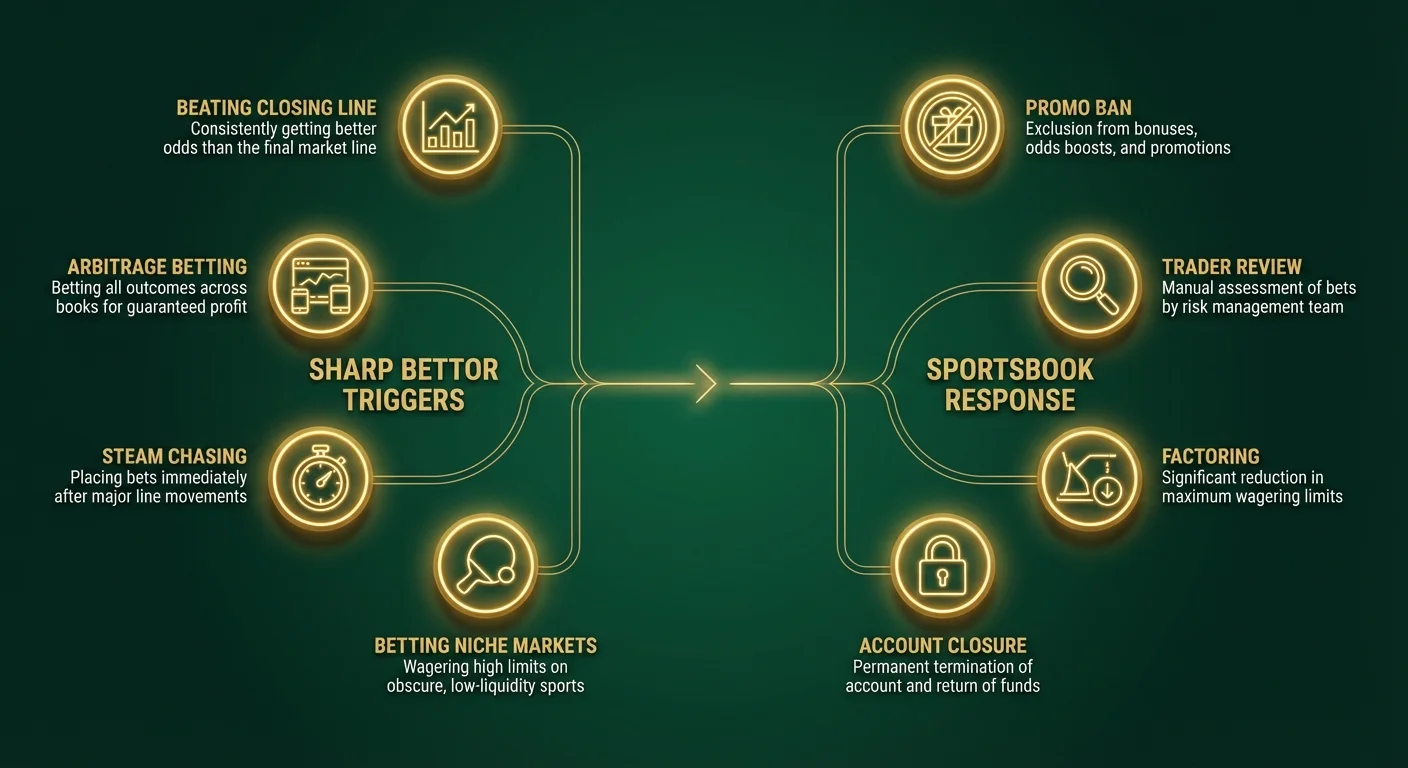
Profiling: How Traders Identify "Sharp" Action
You don't need to win $100,000 to get banned. In fact, you can get limited while you are currently losing money if your betting patterns indicate that you will win in the long run. Sportsbooks use sophisticated AI and manual trading teams to profile customers. Here are the primary triggers for sharp restrictions.
1. Beating the Closing Line (CLV)
This is the single most accurate predictor of future success. Closing Line Value (CLV) measures your bet's odds against the final odds offered when the game starts.
- Example: You bet on the Green Bay Packers at -110. By kickoff, the line has moved to -130. You beat the closing line.
- The Flag: If you consistently beat the closing line, even if you lose the actual bets in the short term, the sportsbook knows you have an edge. Their algorithms will flag you as a sharp bettor, and limits will follow.
2. Arbitrage Betting (Arbing)
Arbitrage betting involves betting on all outcomes of an event across different bookmakers to guarantee a profit regardless of the result.
- The Flag: Arbers often bet weird, specific amounts (e.g., $73.42) to maximize the math of the arb. Furthermore, arbers almost always bet on "outlier" lines - odds that are significantly higher than the rest of the market. Soft books subscribe to odds comparison services; if they see you sniping a mistake line that everyone else has already adjusted, you will be marked immediately.
3. Steam Chasing
"Steam" refers to a sudden, uniform movement in odds across the entire betting market, usually caused by a syndicate placing a massive bet.
- The Flag: If you consistently bet 10 to 30 seconds after a line moves at a sharp book (like Pinnacle), soft books categorize you as a "steam chaser." You aren't handicapping; you are just following the smart money faster than the soft book can adjust its odds.
4. Betting Niche Markets
It is very difficult for a sportsbook to model the odds for obscure markets like Moldovan 3rd Division Soccer or Table Tennis compared to the NFL or Premier League.
- The Flag: If you are betting maximum limits on obscure sports where liquidity is low, the bookmaker assumes you have inside information or a data advantage. They will often limit these markets to mere pennies for winning accounts.
The Escalation Ladder: Signs You Are Being Restricted
Sportsbook bans rarely happen overnight without warning signs. The restriction process is usually an escalation ladder.
- The Promo Ban: The first step is usually exclusion from promotions, odds boosts, and deposit bonuses. The book has identified that you are not a profitable customer to market to.
- The Trader Review: You place a bet, and instead of "Accepted," you see a spinning wheel or a message saying "Sent for manual review." A human trader is now looking at your bet to decide if they want to take the risk.
- The Factoring: This is the functional limit. Your account isn't closed, but your "factor" is reduced. A standard account has a factor of 1.0 (100% of max limit). A restricted account might be factored to 0.1 or 0.01. Suddenly, your max bet on an NBA game is $4.50.
- The Closure: In extreme cases, or if you violate Terms of Service (like multi-accounting), they will close the account entirely and return your funds.
Strategies to Delay the Inevitable
If you are betting at soft books, getting limited is a question of when, not if. However, you can use "camouflage" techniques to extend the life of your account.
1. Round Your Stakes
Never bet precise amounts derived from an arbitrage calculator or a Kelly Criterion spreadsheet.
- Bad: Betting $137.42.
- Good: Betting $135 or $140.
Round numbers look like recreational bets. Precise numbers look like mathematical attacks.
2. The "Mug" Bet
A "Mug Bet" is a bet placed solely to disguise your activity as recreational.
- Strategy: Occasionally place bets on high-profile, televised games (Monday Night Football, Champions League finals) on the "public" side.
- Logic: Sharps usually bet on value, regardless of the team. Squares bet on favorites and popular teams. Mixing in square bets lowers your overall profile threat level.
- Note: This eats into your EV (Expected Value), so treat it as a "subscription cost" for keeping the account open.
3. Utilize the Crypto Advantage
This is where playing at crypto-focused sportsbooks offers a distinct advantage over traditional fiat books.
- Deposit/Withdrawal Speed: Traditional books hate frequent withdrawals. It triggers finance reviews. Crypto books offer instant payouts, meaning you don't have to leave a large bankroll sitting in a vulnerable account.
- Privacy: While many crypto books still require KYC (Know Your Customer), they are generally less invasive regarding "Source of Wealth" checks than regulated fiat books.
- Aggregators: Some crypto platforms operate as aggregators or utilize decentralized liquidity pools. These platforms often care less about individual sharp bettors because the risk is distributed.
4. Avoid "Top of Market" Sniping
If a line is -110 everywhere, but one book is offering +105 due to a mistake or slow update, betting that +105 is the fastest way to get banned.
- Strategy: If you want to keep the account, avoid taking the most obvious "bad lines." If you beat the market by a massive margin, you light up the risk management dashboard.
5. Mix in Parlays
There is nothing a sportsbook loves more than a parlay bettor.
- Strategy: If you are a sharp bettor, consider mixing your sharp straight bets with small, casual parlays. Even though parlays generally have negative EV, they signal to the algorithm that you are a gambler, not a trader.
Life After Limits: Where to Go Next?
Once you have burned through the soft books and your accounts are limited to dollar-store stakes, you must transition your operation.
1. The Sharp Books
There are a handful of sportsbooks globally (often based in Curacao or Asia) that operate on the "high volume, low margin" model. They welcome winners because they use that sharp action to shape their lines for the rest of the world.
- Pros: They will never limit you for winning. High liquidity.
- Cons: The lines are much harder to beat. You won't find the "mistake lines" you see at soft books.
2. Betting Exchanges
Betting Exchanges allow you to bet against other peers rather than the house. The exchange takes a small commission on winnings.
- Pros: You cannot be banned for winning, as the exchange makes money regardless of who wins.
- Cons: Liquidity can be an issue on smaller markets. If nobody wants to take your bet, you can't get money down.
3. Decentralized Sportsbooks (DeFi Betting)
The new frontier for the limited bettor is Web3 betting.
- How it works: Smart contracts hold the funds. Odds are determined by oracles or automated market makers (AMM).
- The Benefit: A smart contract cannot "ban" you. As long as there is liquidity in the pool, you can bet. Wallet addresses are pseudo-anonymous, making it difficult for operators to profile you based on identity.
Practical Checklist: Account Longevity
If you are opening a new account at a soft crypto sportsbook today, follow this checklist to survive longer than a week:
- Deposit in Installments: Do not deposit the maximum amount immediately. Start with a modest bankroll.
- Warm Up the Account: Spend the first week betting on major markets (NFL, NBA, EPL) with average stake sizes. Do not touch obscure markets yet.
- Avoid Bonuses: If you intend to be sharp, decline the welcome bonus. Bonuses come with "rollover" requirements that force you to keep betting, and they invite closer scrutiny from the fraud team.
- Don't Withdraw Immediately: If you win big on day one, let the money sit for a few days before withdrawing. "Hit and run" behavior is flagged.
- Mobile vs. Desktop: Recreational players bet on phones. Pros bet on multi-monitor desktop setups. Use a mobile device for your bets occasionally to blend in.
Summary
Getting limited is the inevitable tax on success in the sports betting world. It is not a sign of failure; it is proof of concept.
The soft bookmakers are running a hospitality business, not a financial market. When you stop acting like a guest and start acting like a raider, they will show you the door. By understanding their profiling methods - CLV, steam chasing, and arbing - you can adopt camouflage strategies that extend your runway.
However, the ultimate evolution for any sharp bettor is to migrate toward betting exchanges, sharp offshore books, and the emerging world of decentralized crypto betting. In these arenas, your skill is not punished, but challenged - and that is where the true game begins.