
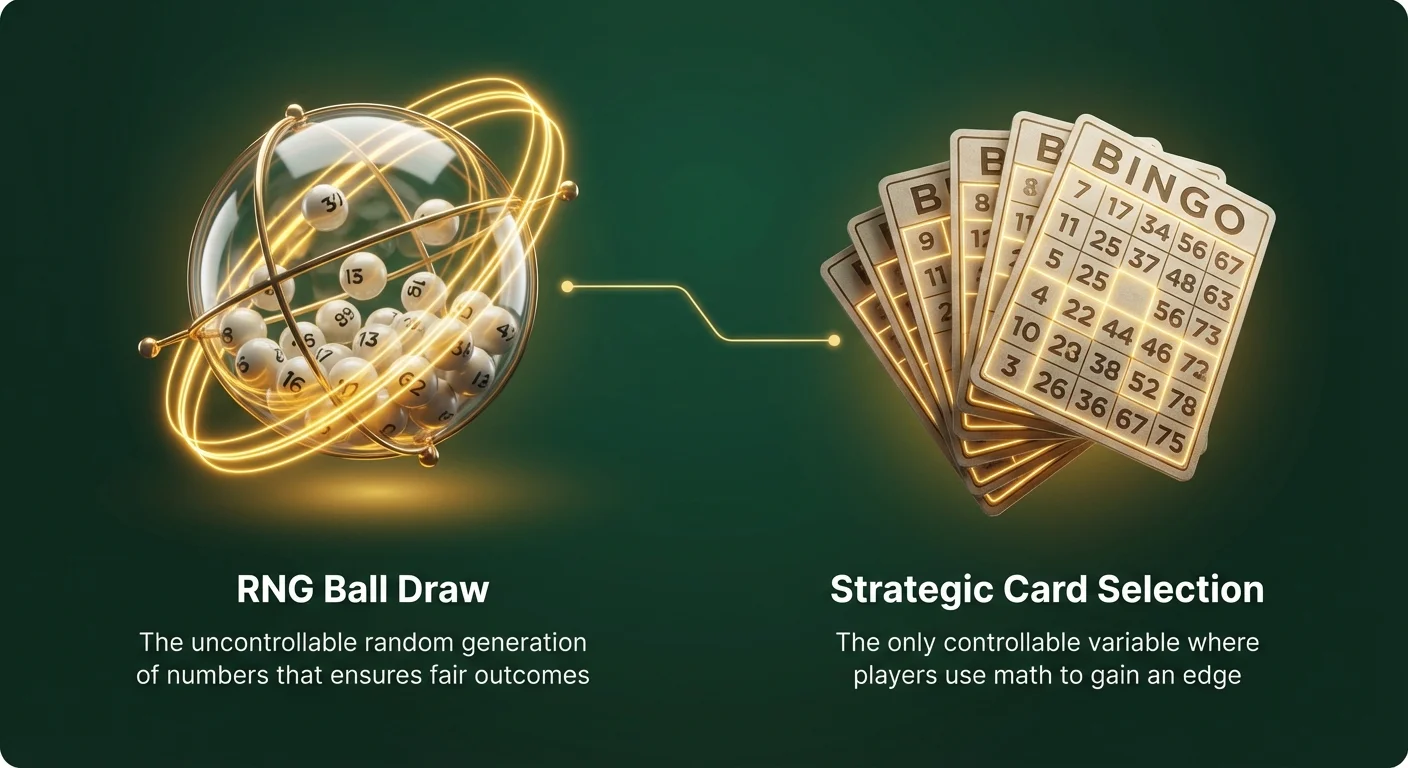
Bingo is often dismissed as a game of pure luck, a lottery played on a grid where the player has zero agency. While it is true that you cannot control the numbers drawn from the RNG (Random Number Generator) or the mechanical cage, this dismissive attitude overlooks the one variable the player can control: the cards they choose to play.
In the world of professional gambling, reducing the house edge is the ultimate goal. In Blackjack, you use basic strategy charts. In Poker, you calculate pot odds. In Bingo, specifically 75-ball bingo found in most North American and high-end crypto casinos, the path to reducing the house edge lies in the statistical theories of Joseph E. Granville and L.H.C. Tippett.
This guide is not for the casual player looking to buy a single ticket and hope for the best. This is an advanced deep dive into the mathematics of card selection, designed for the crypto gambler who wants to apply statistical rigor to their gameplay.
The Mathematical Foundation: RNG vs. Card Selection
Before dissecting the specific systems, we must establish the environment in which we are playing. In modern crypto gambling sites, the "Caller" is a Provably Fair algorithm. This means the sequence of numbers (1 through 75) is generated with cryptographic randomness that can be verified on the blockchain.
Because the draw is truly random (uniform distribution), every single number has an equal probability of being called. The "Gambler's Fallacy" would suggest that if a number hasn't been called in a while, it is "due." This is false. However, over a large sample size (the "Law of Large Numbers"), the distribution of called numbers tends to flatten out.
The Golden Rule of Bingo Strategy: You cannot predict the balls, so you must select cards that are statistically engineered to catch the widest net of random variance.
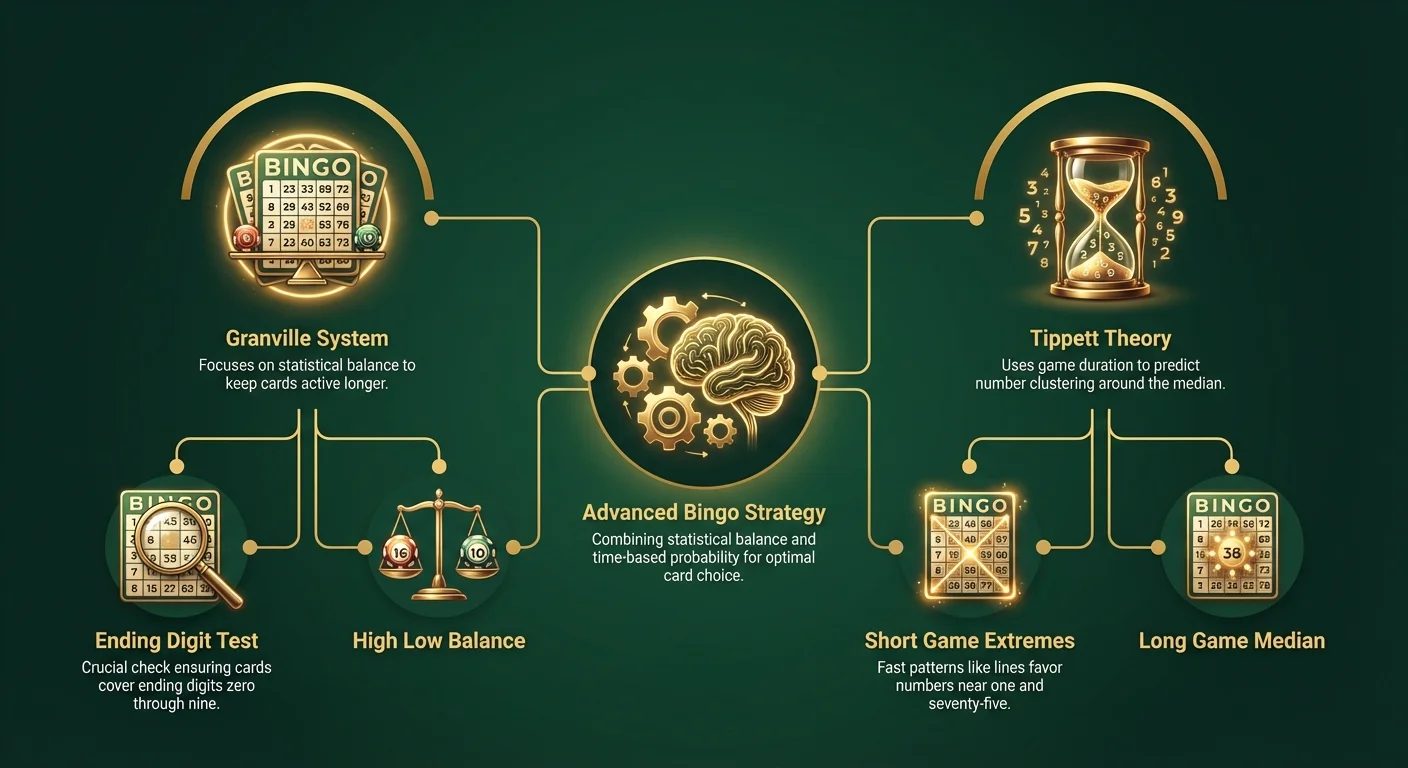
System 1: The Granville Strategy
Joseph E. Granville was not a bingo caller; he was a famous financial writer and stock market analyst. He gained notoriety for his ability to predict market movements based on volume and price inconsistencies. Later in life, he applied these same statistical principles to bingo.
Granville's theory rests on the concept of uniform distribution. He argued that because there is an equal probability of any ball being drawn, a winning card should feature a distribution of numbers that mirrors the distribution of the full 75-ball set.
If you analyze the full set of 75 bingo balls, you will find specific mathematical certainties:
- There is an equal balance of numbers ending in 1, 2, 3, 4, 5, 6, 7, 8, 9, and 0.
- There is an even split between odd and even numbers.
- There is an even split between high and low numbers.
The Three Tests of a Granville Card
According to Granville, a player should reject cards that are "lopsided" and only buy cards that pass the following three tests. This maximizes the probability that your card will hit a number regardless of the RNG's short-term variance.
1. The High/Low Balance
In 75-ball bingo, numbers 1 through 75 are in play.
- Low Numbers: 1-37
- High Numbers: 38-75
A statistically superior card should have a near-even split of high and low numbers. If you hold a card heavy on low numbers, and the RNG produces a streak of high numbers (a common variance), your card becomes dead weight. A balanced card ensures you are marking off squares regardless of the hemisphere the RNG is favoring.
2. The Odd/Even Balance
Similarly, the distribution of odd and even numbers called in a game tends to equalize over time.
- Bad Card: 18 Even numbers, 6 Odd numbers.
- Granville Card: ~12 Even numbers, ~13 Odd numbers (or vice versa).
3. The Ending Digit Distribution (The Most Critical)
This is the cornerstone of Granville's theory. In the first 10 calls of a game, it is statistically improbable that all 10 numbers will end in the same digit (e.g., 11, 21, 31, 41, 51). It is highly probable that the ending digits will be different.
Granville suggests you want a card where the second digits are unique. You want to cover every ending digit from 0 to 9.
Example of a Flawed Card:
| B | I | N | G | O |
|---|---|---|---|---|
| 3 | 19 | 33 | 53 | 63 |
Notice the excessive repetition of the ending digit "3". If the RNG doesn't call numbers ending in 3, this card fails.
Example of a Granville Optimized Card:
Your numbers should look like a spread: 12, 35, 41, 59, 68, 20, 7, etc. If the RNG calls a number ending in 1, you mark a spot. If it calls a number ending in 5, you mark a spot. You remain in the game longer and keep your card "live" for more patterns.
System 2: The Tippett Theory
While Granville focused on the spatial relationship of numbers on the card, British statistician L.H.C. Tippett focused on the temporal aspect of the game: specifically, game length and probability curves.
Tippett was an expert in random sampling numbers. His theory for bingo is derived from the Central Tendency Theory. He posited that the longer a random sample continues, the closer the results will cluster around the "median" (middle) number.
In a 75-ball game, the median number is 38.
(1 + 75) / 2 = 38
Applying Tippett to Game Length
Tippett's system requires the player to identify the type of bingo game being played and estimate how many calls it will take to find a winner.
Short Games (Simple Patterns)
If the objective is a "Line" (horizontal, vertical, diagonal) or "Four Corners," the game typically ends quickly (fewer balls called).
- Theory: In a short sample size, the numbers drawn are more likely to be random and spread out towards the extremes (1 and 75).
- Strategy: Choose cards with a concentration of numbers near 1 and 75.
Long Games (Complex Patterns)
If the objective is a "Blackout" (Coverall), an "X," or other complex shapes, the game will require many balls to be called.
- Theory: As more balls are drawn, the average value of all balls drawn will gravitate toward the median number, 38.
- Strategy: Choose cards with a concentration of numbers near 38.
Tippett Strategy Reference Table
| Pattern Goal | Est. Game Duration | Statistical Focus | Ideal Number Range |
|---|---|---|---|
| One Line | Short | Extremes | 1-15 and 60-75 |
| Four Corners | Short | Extremes | 1-15 and 60-75 |
| Letter Patterns (T, H) | Medium | Mixed | Balanced Spread |
| Blackout / Coverall | Long | Median | 30-45 (Cluster around 38) |
Comparing the Systems: Which One to Use?
Both systems are mathematically sound, but they address different vectors of probability. Granville is about Card Utility (keeping your card active), while Tippett is about Probability Density (predicting clusters based on time).
| Feature | Granville System | Tippett Theory |
|---|---|---|
| Basis | Number Distribution & Balance | Average (Median) & Time |
| Best For | consistent performance in all games | Specific pattern targeting |
| Difficulty | High (Requires detailed card scanning) | Medium (Requires checking proximity to 38) |
| Environment | Best for "Choose Your Own Card" rooms | Best for standard 75-ball variants |
| Key Metric | Ending digits (0-9) | Distance from number 38 |
The Expert Approach:
Use Granville as your baseline filter. Never buy a card that fails the "Ending Digit" test. Once you have a set of cards that are balanced, apply Tippett to select between them based on the specific game pattern you are about to play.
Applying Theory to Crypto Bingo
Playing at a crypto casino offers distinct advantages and challenges when applying these 20th-century theories.
1. The "Auto-Select" Challenge
In a physical bingo hall, you can stand at the counter and sift through paper cards. In online crypto bingo, cards are often randomly assigned.
- The Fix: Look for crypto bingo rooms that offer a "Change Card" or "Shuffle" feature before the game starts. Click this button repeatedly. You won't be able to run a perfect Granville analysis in 5 seconds, but you can do a "Tippett Scan." If you are playing a Blackout game, shuffle until you see a cluster of numbers in the 30s and 40s.
2. Bulk Buying (The Portfolio Strategy)
Crypto casinos allow you to buy huge numbers of cards instantly (often up to 100 or more). You cannot vet 100 cards.
- The Fix: Instead of vetting individual cards, rely on the law of averages by purchasing the maximum allowed cards if your bankroll permits. By owning a massive volume of cards, you naturally create a "Granville Portfolio" - the aggregate of your cards will likely cover all ending digits and high/low spreads.
3. Provably Fair Verification
Unlike traditional online casinos, crypto sites using Provably Fair technology allow you to check the "seed" of the game. While this doesn't help you predict the next number, it guarantees that the "Short Game vs. Long Game" physics of Tippett's theory are not manipulated by a rigged algorithm designed to force long games.
Advanced Practical Strategies
Beyond the math of the numbers, you must apply the math of the environment.
Expected Value (EV) and Room Density
Your probability of winning is inversely proportional to the number of cards in play.
- The Sweet Spot: You want a room with enough players to generate a decent prize pool (in Bitcoin or USDT), but few enough players that your equity remains high.
- Tip: Play during "off-peak" hours for the specific crypto platform. If the site is Euro-centric, play during US afternoons. If the site is Asia-centric, play during European mornings.
- Jackpot Hunting: If a Progressive Jackpot is the goal (usually triggered by a Blackout in a low number of calls), Tippett's theory of "Short Game/Extremes" applies, even though the pattern is a Blackout. Why? Because to win the Jackpot, the game must effectively be a short game.
Bankroll Management with Crypto
Because crypto markets are volatile, your bankroll fluctuates even when you aren't playing.
- Stablecoin Play: To strictly apply a betting system, use USDT or USDC. This isolates your gambling variance from market variance.
- The 5% Rule: Never invest more than 5% of your total session bankroll on a single game round, regardless of how "perfect" your cards look.
Summary: The Statistical Edge
Can you guarantee a win in Bingo? No. The RNG is the ultimate arbiter. However, by applying the Granville System, you ensure that your cards are statistically designed to interact with the widest range of called numbers. By applying the Tippett Theory, you align your card's number density with the expected duration of the game.
Key Takeaways:
- Granville: Balance your card. Equal High/Low, Equal Odd/Even, and maximize unique ending digits (0-9).
- Tippett: Adapt to the pattern. Pick numbers near 1 and 75 for lines/corners; pick numbers near 38 for blackouts.
- Context: These theories apply strictly to 75-ball bingo.
- Execution: Use the "Swap Card" features in crypto bingo rooms to find cards that match these profiles.
Bingo is a game of probability. Most players cross their fingers; experts cross-check their ending digits. Play smart, play provably fair, and let the math work in your favor.