
For the casual player, Video Poker is a game of patience and solid decision-making. For the professional, it is a game of mathematics and opportunity. While standard Video Poker offers some of the highest Return to Player (RTP) percentages in the casino world - often exceeding 99% with optimal strategy - the house still retains a minute edge.
However, that edge evaporates when you step into the world of Progressive Jackpots.
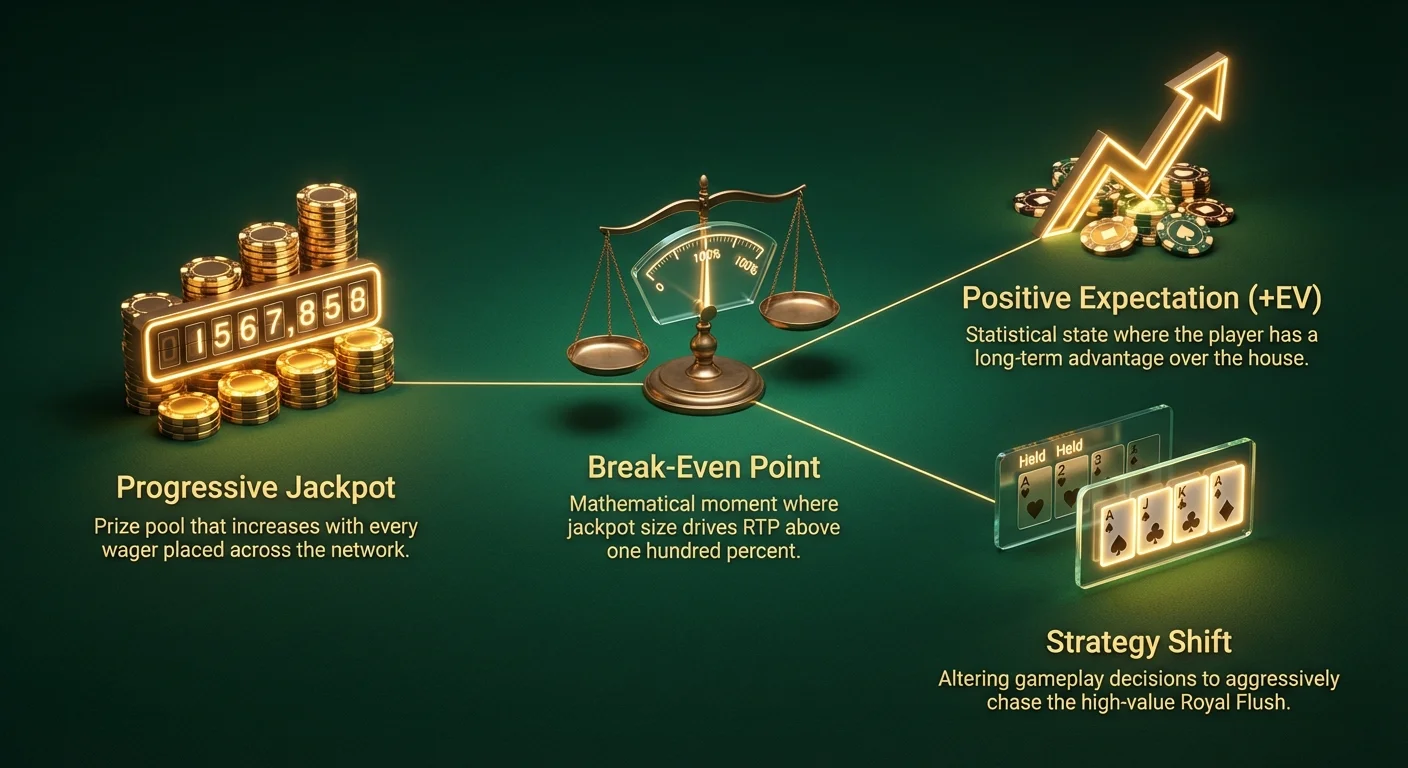
In a progressive game, the top prize isn't fixed. It grows with every bet placed across the network until one lucky hand hits the Royal Flush. There comes a specific mathematical moment - the "Break-Even Point" - where the value of the jackpot becomes so high that the RTP crosses 100%. At this moment, the game enters a state of Positive Expectation (+EV). You are no longer gambling against the house; mathematically, you are being paid to play.
This advanced guide moves beyond basic hand charts. We will dissect the math behind calculating the break-even point, analyze when to alter your strategy to aggressively chase the Royal, and discuss how playing with cryptocurrency enhances the profitability of jackpot hunting.
The Mechanics of the Progressive Meter
To exploit a progressive machine, you must first understand how it differs from a "flat top" (fixed jackpot) machine.
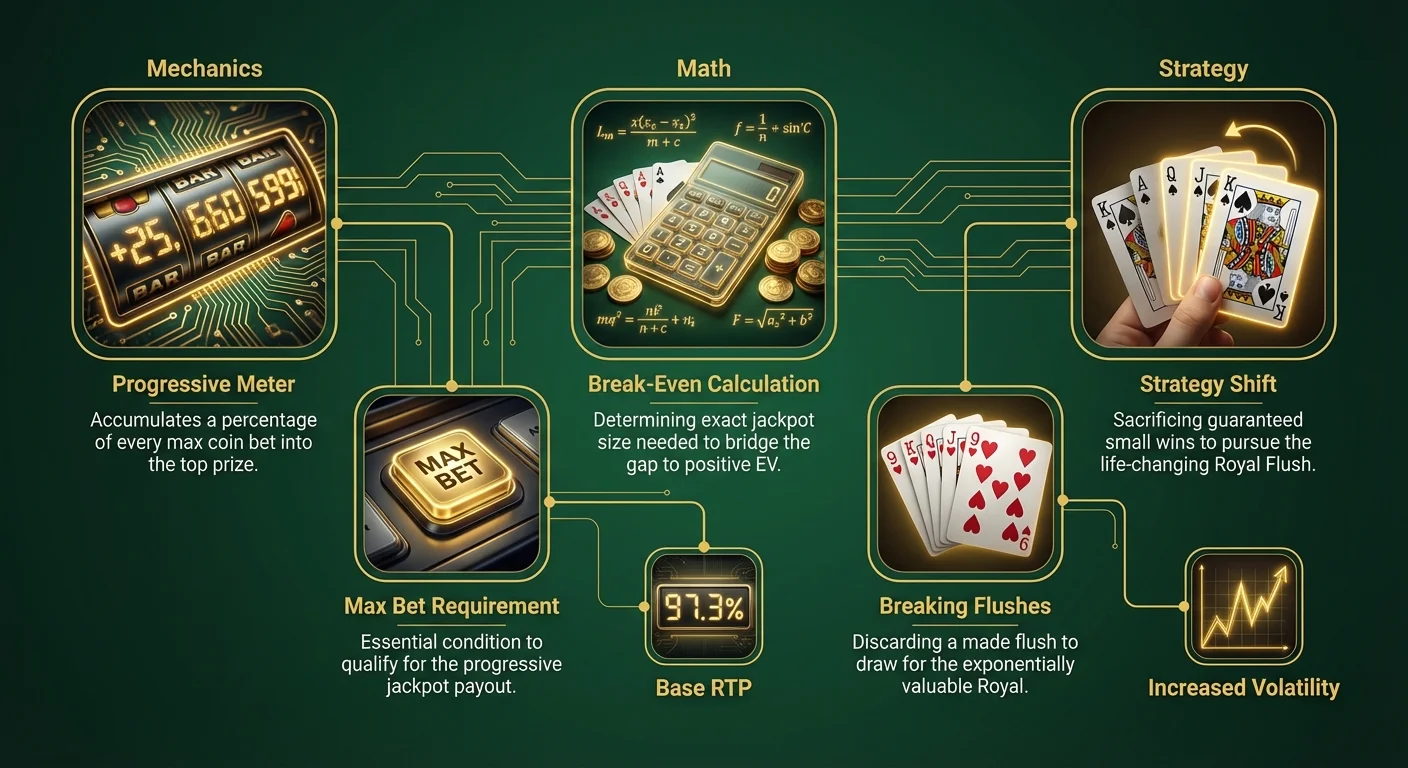
In a standard game of 9/6 Jacks or Better, a Royal Flush typically pays 4,000 coins on a 5-coin bet. This payout is static. In a progressive version, a percentage of every wager (usually between 0.5% and 2%) feeds the "Meter."
There are generally two types of progressive machines you will encounter at crypto casinos:
- Standalone Progressives: The jackpot is fed only by the machine you are currently playing.
- Wide-Area Progressives: The jackpot is fed by a network of machines, causing the prize pool to swell much faster.
The fundamental rule of progressive Video Poker is non-negotiable: You must bet Max Coins. If you bet 1 to 4 coins, you are usually playing for a fixed, smaller payout, disqualifying you from the progressive meter entirely. If you cannot afford the Max Bet, do not play a progressive machine.
The Advanced Math: Calculating the Break-Even Point
The "Break-Even Point" is the exact jackpot value at which the game's return percentage hits exactly 100%. Above this number, the player has the advantage. To calculate this, we need to understand the base RTP and the "Royal Contribution." (See also: Expected Value Explained.)
1. Determine the Base RTP
First, identify the game variant and its paytable. For this example, let's use an 8/5 Jacks or Better progressive.
- Full House pays: 8
- Flush pays: 5
- Base RTP (excluding Royal): Approximately 97.30% (assuming standard payouts for other hands).
In a standard game, the Royal Flush contributes roughly 1.98% to the total return. In our progressive scenario, the "base" game (without the jackpot) is a losing proposition. We need the jackpot to bridge the gap between 97.30% and 100%+.
2. The Rule of Thumb Calculation
The probability of hitting a Royal Flush in a standard 52-card deck is approximately 1 in 40,391 hands.
To find the Break-Even point, you can use a simplified formula:
However, a more practical "floor" method used by advantage players is analyzing the incremental increase.
For every 1 coin added to the jackpot in an 8/5 Jacks or Better game, the RTP increases by a tiny fraction.
- The Magic Number: In Jacks or Better, for every 10,000 coins added to the jackpot total, the theoretical return increases by roughly 0.5%.
3. The Calculation Example
Let's assume we are playing a 25-cent machine (Total bet = $1.25 for 5 coins). The base paytable gives us a 97.3% return. We need to gain 2.7% to reach 100%.
If 10,000 coins = 0.5% increase:
- We need roughly 5.4 increases of 0.5% to bridge the 2.7% gap ($2.7 / 0.5 = 5.4$).
- .
So, the jackpot needs to be roughly 54,000 coins (or $13,500 on a 25-cent machine) above the base reset amount to reach the break-even point.
Table: Expected Return Based on Jackpot Size (8/5 JoB)
| Jackpot Size (Coins) | Approximate RTP | Expectation |
|---|---|---|
| 4,000 (Reset Base) | 97.30% | Negative (House Edge) |
| 20,000 | 98.10% | Negative |
| 40,000 | 99.30% | Negative (but better than most slots) |
| 54,000 | 100.00% | Neutral (Break-Even) |
| 70,000 | 100.80% | Positive (+EV) |
| 100,000 | 102.30% | Highly Positive (Must Play) |
Note: These figures are approximations for 8/5 JoB. Different variants (Deuces Wild, Double Bonus) have different probabilities and break-even points.
Strategy Shift: When to Chase the Royal
Here lies the complexity. When the jackpot is low, you play Basic Strategy to minimize losses. When the jackpot soars past the Break-Even point, you must switch to Progressive Strategy.
In Progressive Strategy, the value of the Royal Flush is weighted so heavily that you make moves that would be considered "errors" in a standard game. You are willing to sacrifice small wins (pairs, flushes) for a shot at the life-changing payout.
The Hierarchy of Change
Below are the critical deviations you must make when the jackpot is significantly high (>101% RTP).
1. Breaking High Pairs
In standard strategy, if you are dealt a High Pair (Jacks through Aces), you hold it. It guarantees a return of your bet.
- Progressive Shift: If you have a High Pair and 4 cards to a Royal Flush, you discard the pair to chase the Royal.
- Why? The mathematical value of the Royal attempt is now worth more than the guaranteed payout of the pair.
2. Breaking Flushes and Straights
In standard play, a made Flush (payout 5 or 6) is almost never broken.
- Progressive Shift: If you have a made Flush (e.g., A♥ K♥ Q♥ J♥ 9♥), standard strategy keeps the Flush. Progressive strategy dictates you discard the 9♥ to draw for the Royal Flush (Need the 10♥).
- The Risk: You are trading a guaranteed win for a 1-in-47 shot. But if that shot is worth $50,000, the math supports the risk.
3. Three-to-a-Royal vs. High Pair
This is the most common tough decision.
- Hand: Ace♠, King♠, 10♠, Jack♦, 4♣
- Standard Play: Hold A♠ K♠ (or the high off-suit cards depending on exact variant rules) or hold the unsuited high cards.
- Progressive Play: Hold A♠ K♠ 10♠ (3-to-a-Royal). The mere possibility of catching the two running cards required justifies the play due to the inflated jackpot.
Strategy Comparison Table
| Hand Dealt | Standard Strategy (Low Jackpot) | Progressive Strategy (High Jackpot) |
|---|---|---|
| A♥ K♥ Q♥ J♥ 9♥ (Pat Flush) | Hold all 5 (Take the Flush win) | Hold A♥ K♥ Q♥ J♥ (Break Flush for Royal) |
| A♠ A♣ K♠ Q♠ J♠ (Pair of Aces + 4-Royal) | Hold A♠ A♣ (Take the Pair win) | Hold A♠ K♠ Q♠ J♠ (Break Pair for Royal) |
| A♦ K♦ Q♦ 10♠ 4♣ (3-to-Royal vs 4-to-Straight) | Hold 4-to-Straight (usually) | Hold A♦ K♦ Q♦ (Chase the Royal) |
Bankroll Management for the Chase
Calculated aggression comes with a cost: Volatility.
When you switch to Progressive Strategy, your variance skyrockets. By breaking pairs and flushes, you are voluntarily giving up small, steady payouts to chase a rare event. This means your bankroll will deplete faster than in a standard game, even though your long-term expectation is positive.
The "Ruin" Reality
Even with a 102% RTP, it is entirely possible to lose your entire session bankroll before hitting the Royal.
- Recommendation: To seriously chase a progressive jackpot, you need a bankroll 3x to 5x larger than what you would use for standard play.
- Stop-Loss: Set a strict limit. Do not chase a jackpot down to your last Satoshi if it jeopardizes your financial stability.
The Crypto Advantage in Progressive Gaming
Playing progressive Video Poker on crypto gambling platforms offers distinct advantages over traditional online or land-based casinos, specifically regarding high-value wins.
1. Instant Settlements
In the fiat world, hitting a $50,000 progressive jackpot often involves a manual verification process that can take weeks, followed by structured payments (annuities) or checks.
- Crypto: Most reputable crypto casinos process withdrawals automatically or within hours. If you hit a 2 BTC jackpot, the funds are usually in your wallet the same day.
2. Provably Fair Verification
Many crypto-native Video Poker games offer Provably Fair technology. This allows you to verify that the RNG (Random Number Generation) wasn't manipulated. When chasing a jackpot where the odds are 1 in 40,000, knowing the deck is truly random is vital for peace of mind.
3. Lower House Edge (Often)
Crypto casinos often have lower overheads than land-based casinos. This can result in "looser" progressive meters or higher base paytables (e.g., seeing 9/6 JoB as a base rather than the tighter 8/5 or 7/5 often found in Las Vegas).
Summary: The Professional's Checklist
Chasing the Royal is the pinnacle of Video Poker excitement, but it requires discipline. Before you sit down at the virtual terminal, run through this checklist:
- Check the Meter: Is the jackpot high enough to create Positive Expectation (>100% RTP)? If not, play a standard machine with a better base paytable.
- Verify the Base Game: Is it Jacks or Better? Deuces Wild? Ensure you know the specific base strategy for that variant before applying progressive adjustments.
- Bankroll Check: Do you have enough Bitcoin/USDT to withstand the increased volatility of breaking winning hands?
- Bet Max: Always bet the maximum coins (usually 5). This is the golden rule.
- Adjust Strategy: Be prepared to break High Pairs, Flushes, and Straights if you hold 4 cards to the Royal.
Video Poker is one of the few games where the player can turn the tables on the casino. By combining advanced math with the speed and transparency of cryptocurrency, you aren't just gambling - you're investing in a statistical probability. Keep your eye on the meter, trust the math, and happy hunting.