
The image of the sophisticated gambler counting cards to beat the house is a staple of casino lore, immortalized by the "MIT Blackjack Team" and Hollywood films. It is a proven mathematical reality that in Blackjack, a skilled player can flip the odds in their favor. Naturally, high-stakes players and crypto gambling enthusiasts often ask: Can you apply the same logic to Baccarat?
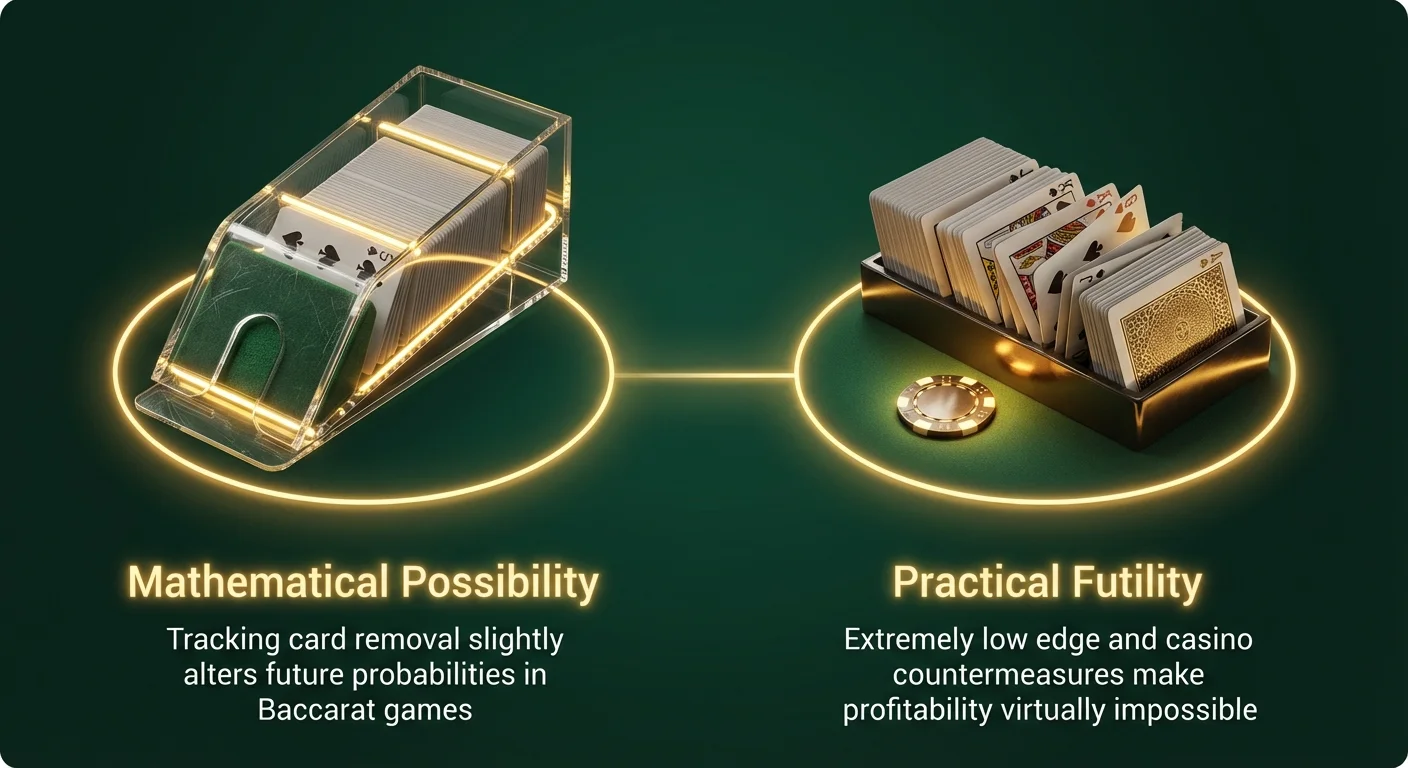
The short answer is yes, counting cards in Baccarat is mathematically possible. The long answer, however, is that it is arguably the most futile effort in the world of advantage play.
In this guide, we will dissect the mathematics behind card counting in Baccarat, explain why the mechanics differ drastically from Blackjack, and analyze why this strategy falls apart in modern online and crypto casino environments.
The Theory: How Card Counting Works
To understand why Baccarat counting is so difficult, we must first understand the fundamental concept of card counting: Dependent Events.
In games dealt from a "shoe" (a container holding multiple decks of cards that are not shuffled between hands), the result of the previous hand impacts the probability of the next hand. If four Aces are dealt in the first round, those Aces are gone from the shoe, making it impossible to draw them in the immediate future.
The Blackjack vs. Baccarat Comparison
In Blackjack, this dependency is massive.
- Blackjack: If low cards (2 through 6) are removed from the deck, the remaining deck is rich in 10s and Aces. This statistically favors the player because high cards increase the chance of the dealer busting and the player hitting a "Blackjack" (3 to 2 payout).
- Baccarat: In Baccarat, the rules of the game are symmetrical. There is no "busting" in the same fatal sense as Blackjack, and high cards do not inherently guarantee a win for the Player or the Banker.
While the removal of certain cards does shift the house edge in Baccarat, the shift is microscopic compared to the swings seen in Blackjack.

The Mathematics of Baccarat Counting
Gambling mathematicians, including the renowned Dr. Edward Thorp and Michael Shackleford (The Wizard of Odds), have run computer simulations on millions of Baccarat hands to determine the value of card removal.
Here is the reality of how card removal affects the Expected Value (EV) of the two main bets:
| Card Removed | Effect on PLAYER Bet | Effect on BANKER Bet |
|---|---|---|
| Ace | Slightly Negative | Slightly Positive |
| 2, 3, 4 | Positive (Good for Player) | Negative |
| 5, 6, 7, 8 | Negative | Positive (Good for Banker) |
| 9 | Negative | Positive |
| 10, J, Q, K | Minimal Impact | Minimal Impact |
The "Symmetry" Problem
The core issue revealed by the data above is symmetry. In Blackjack, a face card is worth 10, and a 10 is the most powerful card for the player. In Baccarat, face cards are worth zero. Because the winning hand is the one closest to 9, and face cards add nothing to the total, a deck rich in face cards doesn't drastically favor one side over the other.
While removing 4s favors the Player bet and removing 6s favors the Banker bet, the advantage gained is rarely enough to overcome the House Edge.
- Banker House Edge: ~1.06%
- Player House Edge: ~1.24%
To get a mathematical edge over the casino, you would need a count so extreme that it might occur only once every few hundred shoes.
The Practicality Gap: Why It Fails
Even if you memorize the table above and keep a perfect count, you face significant hurdles that make Baccarat card counting ineffective, particularly for online players.
1. The Profitability is Non-Existent
Expert Peter Griffin calculated that a perfect Baccarat card counter, betting only when they have an advantage, would place a bet roughly once every 400 hands. Even then, the advantage would be so slim that if you were betting $1,000 per hand, your expected profit would be less than $1.00 per hour.
In the world of high-stakes crypto gambling, tying up your capital for a $0.80 hourly return is a poor investment strategy.
2. Deck Penetration (The Cut Card)
This is the "Count Killer." Card counting relies on deep penetration - meaning the dealer deals almost all the cards in the shoe before shuffling. The further you get into the shoe, the more accurate your count becomes.
However, casinos (both land-based and Live Dealer studios) use a "cut card." They typically cut off the last 1 to 1.5 decks of the 8-deck shoe. The cards behind the cut card are never dealt. In Baccarat, the mathematical advantage usually appears only at the very end of the shoe. If the casino shuffles before you reach that point, your count is useless.
3. The Commission Barrier
The Banker bet is the statistically superior bet, but the 5% commission charged on wins acts as a buffer. Even if the count suggests the Banker is more likely to win, the 5% tax often eats up the marginal advantage you identified.
The Exception: Counting Side Bets
While counting for the main game is a myth in terms of profitability, there is one area where advantage play has historically existed: Side Bets.
Specifically, in EZ Baccarat, there are two side bets: the Dragon 7 and the Panda 8.
- Dragon 7: Pays 40:1 if the Banker wins with a 3-card total of 7.
- Panda 8: Pays 25:1 if the Player wins with a 3-card total of 8.
Because these bets rely on specific cards appearing (specifically 7s and 8s), counting systems were developed to attack them. If a shoe is rich in 7s and 8s and low in other cards, the probability of these specific hands hitting increases.
However, be warned: Online casinos and crypto gambling sites are aware of this. They combat it by shuffling earlier (reducing penetration), rendering this strategy largely ineffective in a digital environment.
Online and Crypto Baccarat: A Different Beast
For the modern player using Bitcoin, Ethereum, or USDT on a platform like CryptoGambling.com, the environment makes card counting even less viable than in a physical casino in Las Vegas or Macau.
Virtual (RNG) Baccarat
In virtual "video game" style Baccarat, card counting is impossible. These games use a Random Number Generator (RNG) to determine the outcome. Crucially, the "deck" is reset and shuffled after every single hand.
- Result: Every hand is dealt from a fresh 8-deck shoe. Past results have zero influence on future outcomes.
- Provably Fair: Many crypto games use "Provably Fair" technology. While this guarantees the casino isn't cheating, the algorithmic nature confirms that each round is an independent event, nullifying any counting strategy.
Live Dealer Baccarat
Live Dealer games streamed from studios (like Evolution Gaming or Pragmatic Play) offer a visual shoe, but they are designed to thwart counters:
- The Cut: They cut the shoe very thick (often leaving 2 decks out).
- Burn Cards: Dealers burn cards at the start of the shoe and occasionally during play, obscuring the count.
- Speed: The game moves fast. If you are sitting out hands waiting for a count (which you must do to count profitably), you may be timed out of the seat for inactivity.
Real Strategy: How to Optimize Your Game
If card counting is a bust, how do you play smartly? Baccarat is still one of the best games in the casino because of its naturally low house edge. Instead of counting, focus on these advanced management strategies.
1. Adhere to the Banker Rule
The Banker bet has the lowest house edge (1.06%). Despite the commission, it wins more often than the Player hand.
- Strategy: Bet Banker continuously.
- Exception: If you want to avoid the commission calculation and nuisance, the Player bet is only marginally worse (1.24% edge). It is perfectly acceptable for casual play.
2. Avoid the Tie Bet at All Costs
The Tie bet offers a tempting 8:1 payout, but it carries a disastrous house edge of 14.36%.
- Card Counting Note: Interestingly, the Tie bet is the most susceptible to card counting, but because the starting house edge is so massive, even a perfect count rarely brings the edge down enough to make it positive for the player. It is a "sucker bet."
3. Cryptocurrency Bankroll Management
In the crypto sphere, volatility is a factor.
- Play with Stablecoins: When playing Baccarat, consider using USDT or USDC. This prevents the value of your bankroll from fluctuating mid-session due to market volatility.
- Stop Loss Limits: Set a "Stop Loss" in your crypto wallet. If you transfer 1 SOL to the casino, play until that 1 SOL is gone or doubled. Do not "dip back" into your main holding wallet to chase losses.
4. Ignore the "Roadmaps"
You will see complex grids on the bottom of Baccarat screens (Big Road, Bead Plate, Cockroach Pig). These show patterns of previous wins.
- The Myth: "The Banker has won 5 times in a row, so Player is due."
- The Reality: This is the Gambler's Fallacy. The cards do not care who won the last hand. Baccarat trends are retrospective - they tell you what happened, not what will happen. Do not base your bets on these patterns.
Summary: Fact vs. Fiction
To summarize the reality of card counting in Baccarat:
- Fact: Removing cards does change the odds of the remaining deck.
- Fact: It is possible to assign point values to cards and keep a "count" in Baccarat.
- Fiction: You can make a reliable living counting cards in Baccarat like you can in Blackjack.
- Fiction: Counting works on RNG/Software-based Baccarat games found at crypto casinos.
Final Verdict
For the vast majority of players, card counting in Baccarat is an intellectual trap. It requires immense effort for a nonexistent reward.
The beauty of Baccarat lies in its simplicity. It offers the best odds in the casino without requiring you to memorize charts or do mental arithmetic. The smartest "strategy" is to bet on the Banker, manage your crypto bankroll responsibly, and enjoy the game for the entertainment it provides, rather than trying to force a mathematical advantage that simply isn't there.