The allure of the blackjack table is undeniable. It is one of the few casino games where strategy, mathematics, and skill can genuinely reduce the house edge to a razor-thin margin. However, if you have spent any time at a digital table on CryptoGambling.com or a physical casino, you have likely noticed the flashy betting circles next to your main wager spot. These are the Side Bets.
The most popular among them - Perfect Pairs and 21+3 - offer tantalizing payouts. While a standard blackjack win pays 1:1, these side bets dangle the carrot of 30:1 or even 100:1 returns. They turn a grind-it-out strategy game into a high-octane jackpot hunt.
But here is the question every smart player must ask: Are these bets a fun way to spice up the game, or are they a mathematical trap designed to drain your crypto wallet?
In this guide, we will break down the mechanics, payouts, and statistical realities of Perfect Pairs and 21+3. We will compare them to standard play and help you decide if they deserve a place in your betting strategy.
The Economics of Blackjack: A Baseline
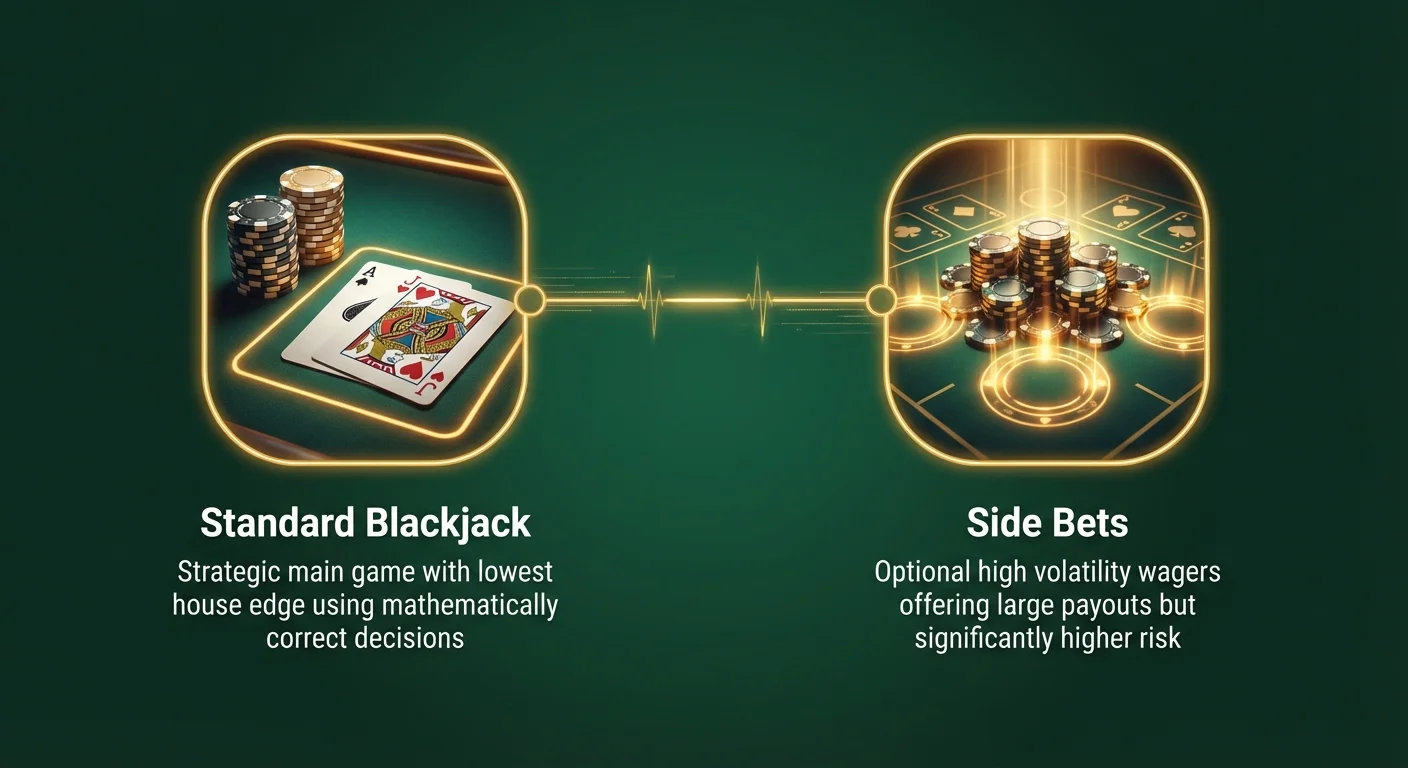
Before analyzing the side bets, we must establish the baseline of the game. As highlighted in standard strategy guides, Blackjack is unique because it offers one of the lowest House Edges in the casino.
When you play with Basic Strategy charts - making the mathematically correct decision to hit, stand, split, or double down - the House Edge on a standard 3:2 blackjack table is approximately **0.5%**. This means for every $100 you bet, the casino expects to keep $0.50 over the long run. This low volatility is why blackjack is a favorite for players using Bitcoin or Ethereum; it allows for extended playtime and lower risk.
However, side bets operate independently of the main game. They have their own pay tables, their own probabilities, and crucially, their own House Edge. Unlike the main game, skill does not influence the outcome of a side bet. It is pure luck, akin to playing a slot machine spin while waiting for your cards.
Deep Dive: Perfect Pairs
Perfect Pairs is one of the most straightforward side bets to understand, which contributes to its popularity among beginners.
How It Works
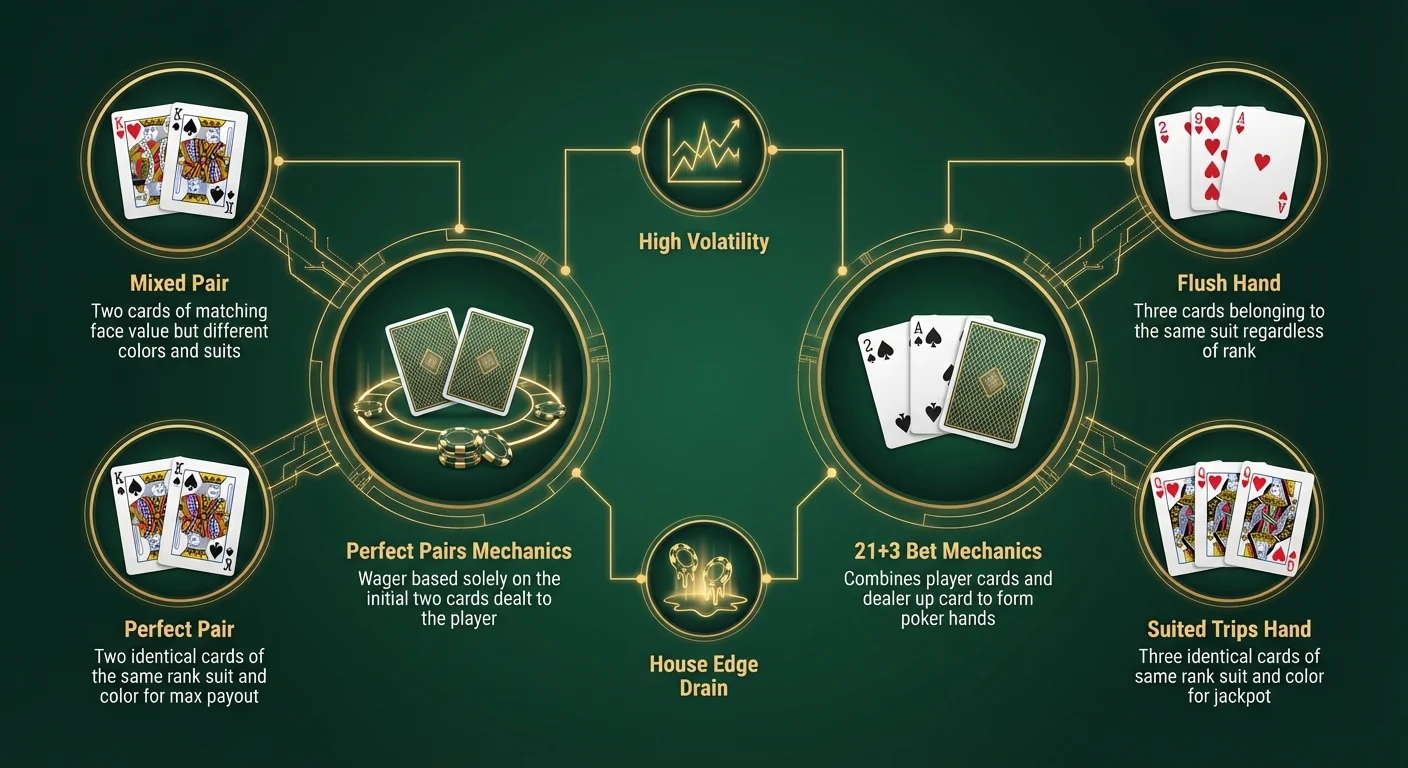
To play Perfect Pairs, you place a wager in the designated side bet circle before the cards are dealt. This bet focuses exclusively on your initial two cards. The dealer's hand is irrelevant to this specific wager.
If your first two cards form a pair (e.g., two Kings, two Fours), you win. If they are not a pair, you lose the side bet immediately, and the standard hand continues as normal.
The Winning Conditions
Not all pairs are created equal. The payout depends on the "perfection" of the pair, categorized into three tiers:
- Mixed Pair: Two cards of the same face value but different colors (e.g., King of Hearts and King of Spades).
- Colored Pair: Two cards of the same face value and the same color, but different suits (e.g., King of Hearts and King of Diamonds).
- Perfect Pair: Two identical cards - same value, same suit (e.g., King of Spades and King of Spades).
Note: A Perfect Pair is only possible in games using multiple decks (usually 6 or 8 decks), which is standard for most online crypto blackjack games. For context on why this matters, see our guide on how deck count changes strategy.
Payout Structure and Probability
While payouts can vary slightly between software providers (Evolution, Pragmatic Play, etc.), the standard pay table looks like this:
| Hand Type | Example | Typical Payout | Probability (Approx) |
|---|---|---|---|
| Mixed Pair | 8♥ + 8♠ | 5:1 | 3.86% |
| Colored Pair | 8♥ + 8♦ | 12:1 | 1.93% |
| Perfect Pair | 8♥ + 8♥ | 25:1 (or 30:1) | 1.69% |
| No Pair | 8♥ + 7♠ | Loss | 92.5% |
The Verdict on Perfect Pairs
The math here is sobering. You will lose this bet roughly 92.5% of the time. When you combine the frequency of losses with the payout structure, the House Edge for Perfect Pairs usually hovers between 2% and 11%, depending on the number of decks used and the specific pay table.
Compared to the 0.5% edge of the main game, betting on Perfect Pairs is statistically expensive. It increases the volatility of your session significantly.
Deep Dive: 21+3
If Perfect Pairs is for those who love symmetry, 21+3 is for players who enjoy a touch of Poker with their Blackjack. This side bet is generally considered more exciting because it involves the dealer's card, giving you more "action" on the table.
How It Works
The "21" represents your two cards, and the "+3" includes the dealer's up-card. This side bet analyzes these three cards to see if they form a winning 3-card poker hand.
The Winning Conditions
The winning hands are derived from poker rankings. From lowest to highest payout, they are:
- Flush: Three cards of the same suit (e.g., 2♥, 9♥, Ace♥).
- Straight: Three cards in consecutive value, regardless of suit (e.g., 5♣, 6♥, 7♦). Ace can be high or low.
- Three of a Kind: Three cards of the same face value (e.g., Jack♥, Jack♣, Jack♦).
- Straight Flush: Three cards in consecutive value AND the same suit (e.g., 5♦, 6♦, 7♦).
- Suited Trips: Three identical cards (e.g., Queen♠, Queen♠, Queen♠).
Payout Structure and Probability
The volatility on 21+3 is extreme because of the massive payouts for the top hands. Here is the standard pay table found at most crypto casinos:
| Hand Type | Typical Payout | Probability (Approx) |
|---|---|---|
| Flush | 5:1 | 5.8% |
| Straight | 10:1 | 3.1% |
| Three of a Kind | 30:1 | 0.5% |
| Straight Flush | 40:1 | 0.2% |
| Suited Trips | 100:1 | 0.02% |
The Verdict on 21+3
The House Edge on 21+3 typically sits around 3% to 7%, depending on the deck count. While this is generally "better" than Perfect Pairs in many variations, it is still significantly worse than the main blackjack game.
The lure here is the Suited Trips payout of 100:1. This is a "lottery ticket" style bet. You are accepting many small losses for the faint hope of a massive crypto payout instantly.
The Risk Analysis: Standard Play vs. Side Bets
To truly understand if these bets are "worth it," we need to look at the concept of Return to Player (RTP).
- Standard Blackjack (Main Game): 99.5% RTP.
- 21+3 Side Bet: ~96% RTP.
- Perfect Pairs Side Bet: ~94% RTP.
- Slots: ~94% - 97% RTP.
When you place a side bet, you are effectively pausing your game of Blackjack to play a hand of slots.
The "Bleed" Effect
Beginners often underestimate how quickly side bets drain a bankroll. If you are betting $10 on your main hand and $5 on a side bet, you are putting 33% of your total wager into a bet with a massive house edge.
Because you lose side bets over 90% of the time, your bankroll "bleeds" out rapidly, even if you are breaking even on the main blackjack game. This high variance necessitates conservative strategies for volatile assets.
The Problem with Correlation
Another risk factor is that winning a side bet does not guarantee a winning hand.
- Scenario: You bet Perfect Pairs. You are dealt two Jacks of Hearts.
- Result: You win the side bet! Huge payout (Perfect Pair).
- The Problem: You now have a hard 20 against a dealer. This is actually a great scenario.
- The Bad Scenario: You bet 21+3. You have a 2, 7, and Dealer shows a 6 (Flush). You win the side bet! But your hand is a hard 9 vs Dealer 6. You double down and get a 2 for an 11. Dealer hits to 17. You lose the double down.
While side bets pay out independently, the emotional highs and lows can affect your discipline on the main hand.
Strategic Considerations for Crypto Players
If you are playing at a crypto casino, there are specific factors to keep in mind regarding side bets.
1. Provably Fair Verification
One advantage of playing side bets with crypto is the Provably Fair system utilized by many blockchain casinos. Because side bets like "Suited Trips" rely on specific random card generation (like getting three Queen of Spades), players are often skeptical of the odds.
In Provably Fair games, you can verify the "seed" of the shuffle after the hand to ensure the deck order was predetermined and fair. This provides peace of mind when chasing those 100:1 odds. Understanding RNG software vs. live dealer mechanics can further build trust in digital shuffles.
2. Volatility and Wagering Requirements
If you are playing with a crypto welcome bonus, check the terms and conditions. Often, side bets contribute differently to wagering requirements than standard blackjack hands.
- Standard Blackjack often contributes only 5% or 10% to wagering.
- High-risk side bets might contribute 100% at some casinos (check the rules first!).
If side bets contribute 100%, playing them might actually be a valid strategy to clear a bonus quickly, despite the higher house edge, because of the high variance.
3. Micro-Betting
Crypto allows for fractions of currency (Satoshis, etc.). This is the best way to engage with side bets. If your main bet is 1 mBTC, keep your side bet to 0.1 mBTC. Treat it as a "tip" to the dealer or a small fun fee, rather than a core profit strategy.
When Should You Play Side Bets?
Despite the harsh mathematics, people play side bets for a reason: Entertainment. Here is a guide on when to play them and when to avoid them.
PLAY Side Bets If:
- You are feeling lucky: You are there for the thrill, not a professional income.
- You have a surplus: You are up significantly in your session and want to take a "shot" with house money.
- You want variance: The table is "cold" and chopping (win/loss/win/loss), and you want a chance at a quick 30xYou are grinding: If you are using a strategy like the Paroli or Martingale system (as discussed in our popular betting systems), side bets will ruin your math.etting Strategy guides), side bets will ruin your math.
- Your bankroll is low: If you have less than 20 betting units left, cut the side bets immediately to survive longer.
- The Rules are Poor: If you see a table paying only 6:5 on Blackjack (instead of 3:2), do not play side bets there. The casino is already greedy; do not give them more edge.
Expert Tips for Blackjack Beginners
To wrap up, here are practical tips to improve your game, incorporating what we know about side bets:
- Master Basic Strategy First: Before you drop a single chip on a side wager, ensure you have a Basic Strategy chart open. Reducing the house edge on the main game is your priority.
- The "One-Unit" Rule: Never bet more than 10-20% of your main wager on a side bet. If you bet $20 on the hand, the side bet should be $1 or $2 maximum.
- Ignore the "Hot" Streak: Just because a side bet hasn't hit in 20 hands does not mean it is "due." This is the Gambler's Fallacy. Every hand is an independent event.
- Don't Split Tens: You might win a Perfect Pair with two Kings. In the main game, Basic Strategy dictates you Never Split Tens. Don't let the excitement of the side bet win cause you to make a strategic error on the main hand. Take your side bet profit, keep the 20, and likely win the main hand too.
Conclusion: Are They Worth The Risk?
From a strictly mathematical standpoint, Perfect Pairs and 21+3 are not "worth it." They carry a house edge significantly higher than the standard game, acting as a drain on your bankroll over time.
However, gambling is not always about strict math - it is about the experience. The thrill of hitting a Suited Trips for a 100:1 payout is a feeling standard Blackjack rarely offers.
The verdict? Treat side bets like the garnish on a meal. They add flavor and excitement, but they shouldn't be the main course. If you choose to play them, do so with small amounts, verify the fairness via your crypto platform, and never let them distract you from the primary objective: beating the dealer to 21.
Disclaimer: Gambling involves risk. Please gamble responsibly and only bet what you can afford to lose.