
For the casual player, the Craps table is a chaotic symphony of shouting stickmen, flying dice, and scattered chips. For the advanced player, however, the table is merely a grid of probabilities and payout ratios. While beginners cling to the Pass Line and superstitions about "hot shooters," veteran gamblers know that the real war against the house edge is fought in the nuances of Buy Bets vs. Place Bets.
If you are transitioning from basic strategies to advanced bankroll management - particularly in the realm of crypto craps where the mechanics are faster and the math is precise - understanding when to pay the commission (the "vig") is vital.
This guide will dissect the mathematics behind buying numbers versus placing them, explaining why paying a 5% tax to the casino can actually save you money in the long run, and how to exploit these rules at digital tables.
The Economics of the Layout: Place vs. Buy
To understand why we would ever voluntarily pay a commission, we first need to understand the inefficiency of the standard Place Bet.
The Place Bet
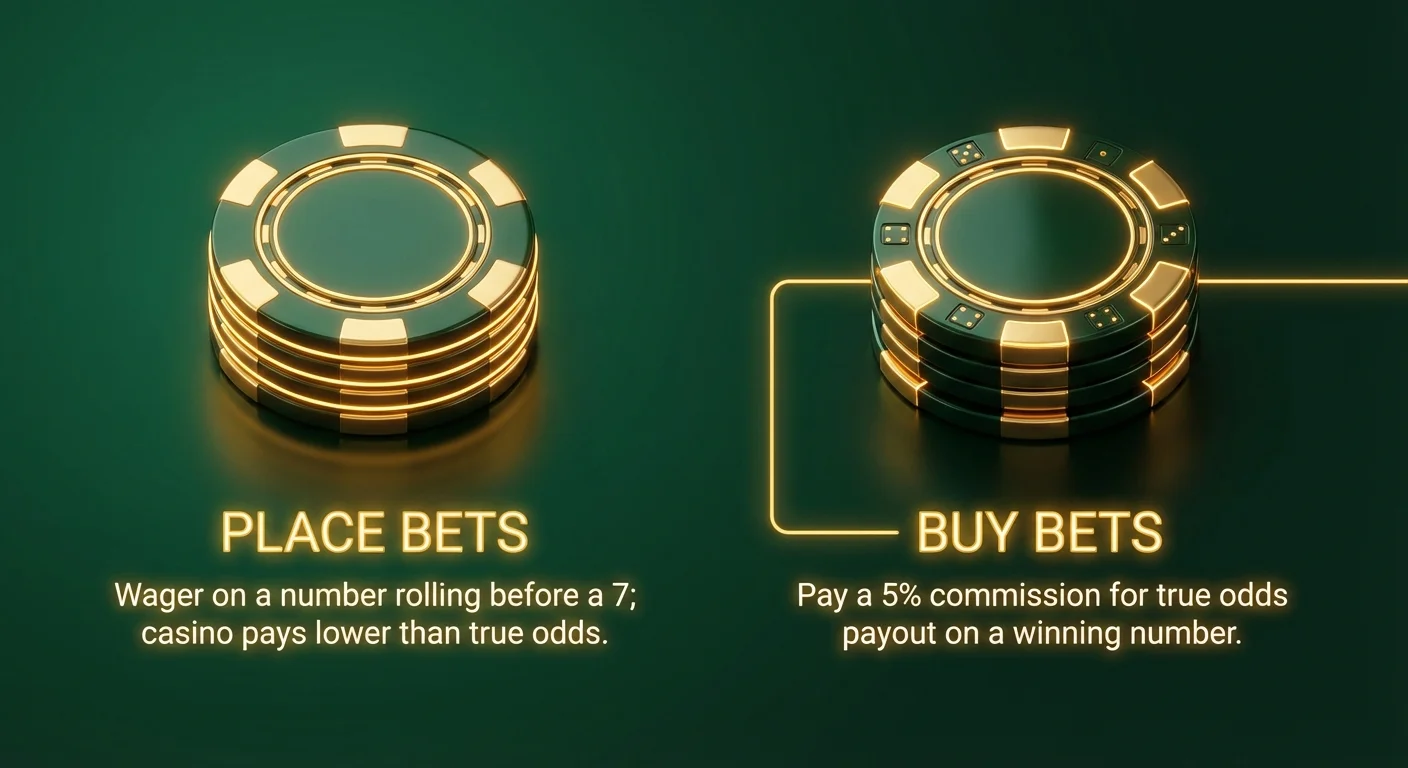
When you "Place" a number (4, 5, 6, 8, 9, or 10), you are betting that the number will roll before a 7. Because you are not paying a commission, the casino creates its House Edge by paying you less than the "true odds" of the roll.
- True Odds: The mathematical probability of the number rolling vs. the 7 rolling.
- Casino Payout: What the casino actually pays you.
The difference between these two figures is the House Edge.
The Buy Bet
When you "Buy" a number, the casino agrees to pay you the true odds on that bet. However, in exchange for this fair payout, they charge a 5% commission (vig) on the amount of the wager (or the amount of the win, depending on the casino rules).
The advanced strategy lies in calculating the "tipping point" where the cost of the commission is lower than the money you lose by accepting the poor payout odds of a Place bet.
The Battle of the 4 and 10
This is the most critical section of this guide. If you take nothing else away, remember this: The 4 and 10 are the battleground where Buy bets reign supreme.
The 4 and 10 are the hardest box numbers to roll (3 ways to roll a 4, 3 ways to roll a 10, vs. 6 ways to roll a 7). Because they are harder to hit, they offer the highest true odds (2 to 1).
The Math of Placing the 4 or 10
If you Place the 4, the casino typically pays out at 9 to 5 (or 1.8 to 1).
- True Odds: 2.0 to 1
- Place Payout: 1.8 to 1
- House Edge: 6.67%
A 6.67% house edge is terrible. It is worse than American Roulette (5.26%) and drastically worse than the Pass Line (1.41%). In the world of smart gambling, Placing the 4 or 10 is considered a "sucker bet."
The Math of Buying the 4 or 10
When you Buy the 4, the casino pays you 2 to 1.
- Scenario: You bet $20 on the 4.
- Result: It hits. You win $40.
- Commission: You pay 5% of the $20 bet, which is $1.
- Net Win: $39.
By paying the $1 commission, you netted $39. If you had Placed the $20 instead, you would have been paid $36 (9 to 5 odds).
You made $3 extra profit simply by agreeing to pay the commission.
Even with the commission factored in, the House Edge on a Buy bet for the 4 or 10 drops significantly. The exact edge depends on when the casino collects the commission (more on this below), but it generally drops from 6.67% down to 1.67% or roughly 4.76% depending on the rules.
Verdict: 4 and 10
ALWAYS Buy. NEVER Place.
The math is undeniable. Unless you are betting the table minimum (where commissions might round up unfavorably), buying the 4 and 10 is mathematically superior.
The Middle Ground: 5 and 9
The 5 and 9 occupy a gray area where the math requires a closer look at the specific rules of your crypto casino.
The Math of Placing the 5 or 9
- True Odds: 3 to 2 (1.5 to 1)
- Place Payout: 7 to 5 (1.4 to 1)
- House Edge: 4.00%
A 4% edge is mediocre, but standard for table games.
The Math of Buying the 5 or 9
- True Odds: 3 to 2.
- Commission: 5%.
If you Buy the 5 for $20:
- Win $30 (True Odds).
- Pay $1 Commission (5% of $20).
- Net Win: $29.
If you Place the 5 for $20:
- Win $28 (7 to 5 odds).
- Net Win: $28.
Here, Buying yields $1 more than Placing on a $20 bet. However, because the payouts are lower than the 4/10, the commission eats a larger percentage of your profit margin. Consequently, the House Edge on buying the 5/9 hovers around 4.76% if the vig is collected upfront, which is actually worse than the Place bet (4.00%).
However, if the casino only charges the vig on the win (a common feature in crypto craps), the House Edge drops to roughly 2.00%.
Verdict: 5 and 9
- Land-based Casino: Usually better to Place.
- Crypto Casino (Vig on Win): Better to Buy.
- General Rule: If you don't know the specific commission rules, stick to Placing.
The Trap: 6 and 8
The 6 and 8 are the most frequently rolled numbers other than the 7. Because of this, the casino offers very fair payouts on Place bets to keep the action moving.
The Math of Placing the 6 or 8
- True Odds: 6 to 5 (1.2 to 1)
- Place Payout: 7 to 6 (1.166 to 1)
- House Edge: 1.52%
This is one of the best bets in the casino. The 1.52% edge is very close to the Pass Line (1.41%).
The Math of Buying the 6 or 8
Because the payout is so low (just slightly better than even money), the 5% commission destroys your value. The cost of the vig far outweighs the fractional gain you get from true odds. Buying the 6 or 8 typically spikes the house edge to over 4.7%.
Verdict: 6 and 8
ALWAYS Place. NEVER Buy.
There is almost no scenario in standard Craps where buying the 6 or 8 is mathematically sound.
Comparative Data: The Edge Matrix
Here is a quick reference table to help you memorize the strategy. (Note: "Vig on Win" assumes the casino only deducts commission from winning bets, which is standard for competitive crypto gambling sites).
| Number | True Odds | Place Payout | House Edge (Place) | House Edge (Buy - Vig Upfront) | House Edge (Buy - Vig on Win) | Optimal Strategy |
|---|---|---|---|---|---|---|
| 4 & 10 | 2:1 | 9:5 | 6.67% | 4.76% | 1.67% | BUY |
| 5 & 9 | 3:2 | 7:5 | 4.00% | 4.76% | 2.00% | CHECK RULES |
| 6 & 8 | 6:5 | 7:6 | 1.52% | 4.76% | 2.27% | PLACE |
Critical Concept: Vig "Upfront" vs. "On Win"
To be a truly advanced player, you must check the "Help" or "Rules" tab of your chosen crypto craps game to determine when the commission is charged.
1. Vig Upfront (The Bad Rule)
The casino charges you $1 the moment you place the bet.
- You bet $20 on the 4. You pay $21 total.
- If the 7 rolls, you lose $21.
- This effectively increases your risk and raises the house edge.
2. Vig on Win (The Good Rule)
The casino only charges the $1 if the number hits.
- You bet $20 on the 4.
- If the 7 rolls, you lose $20.
- If the 4 rolls, you win $40, and they deduct $1.
- This drastically lowers the house edge, making Buying the 4 and 10 one of the best bets on the table (1.67% Edge), nearly rivaling the Pass Line.
Crypto Advantage: Most reputable crypto casinos utilize the "Vig on Win" model because the software can automatically deduct the fee from the payout instantly. This is a significant advantage over many physical casinos that require chips to be thrown in upfront.
Crypto-Specific Strategy: Beating "Breakage"
In a physical casino, chips have fixed denominations ($1, $5, $25). This leads to a problem called "breakage." If you buy the 4 for $10, the 5% commission is 50 cents. If the casino doesn't have 50-cent chips, they might charge you $1 anyway. That turns a 5% commission into a 10% commission.
Therefore, in live casinos, you must bet at least $20 to get fair value ($1 vig on $20 = 5%).
In Crypto Craps, this barrier disappears.
Because cryptocurrencies like Bitcoin (BTC) or Ethereum (ETH) are divisible to eight decimal places, the software can charge you exactly 5% of your wager, no matter how small.
- Live Casino: You bet $5 on the 4. Vig is likely rounded up to $1 (20% fee!). Terrible deal.
- Crypto Casino: You bet 0.001 BTC on the 4. Vig is exactly 0.00005 BTC (5% fee). Fair deal.
Pro Tip: Even with exact math, always check if the platform has a "minimum commission." If the site enforces a minimum fee of 0.01 mBTC, ensure your bet size is large enough that the fee represents only 5% of your wager, not more.
Minimizing the Vig: The "Buy" Strategy Checklist
Before you sit at the virtual table, run through this checklist to ensure you are getting the best odds:
- Identify the Commission Structure: Does the game take the 5% commission from your stack immediately (Upfront) or from your winnings (On Win)? If it's Upfront, stick to Placing the 5 and 9. If it's On Win, Buy the 4, 5, 9, and 10.
- Ignore the 6 and 8: Regardless of the rules, keep Placing the 6 and 8. The margin is too tight to make Buying worth it.
- Check for "Free Buys": Some aggressive crypto casinos offer promotions with reduced juice or "Free Buy" tournaments. If you find a table offering Buy bets with no commission, you should abandon the Pass Line and betting strategies entirely and simply Buy all the numbers (excluding 6/8 perhaps), as the house edge drops to zero.
- Bankroll Management: Buying requires a slightly higher bankroll volatility tolerance. While Place bets can be turned "off" easily, Buy bets are also removable, but ensure you aren't paying vig upfront on bets you pull down later.
Summary: The Advanced Cheat Sheet
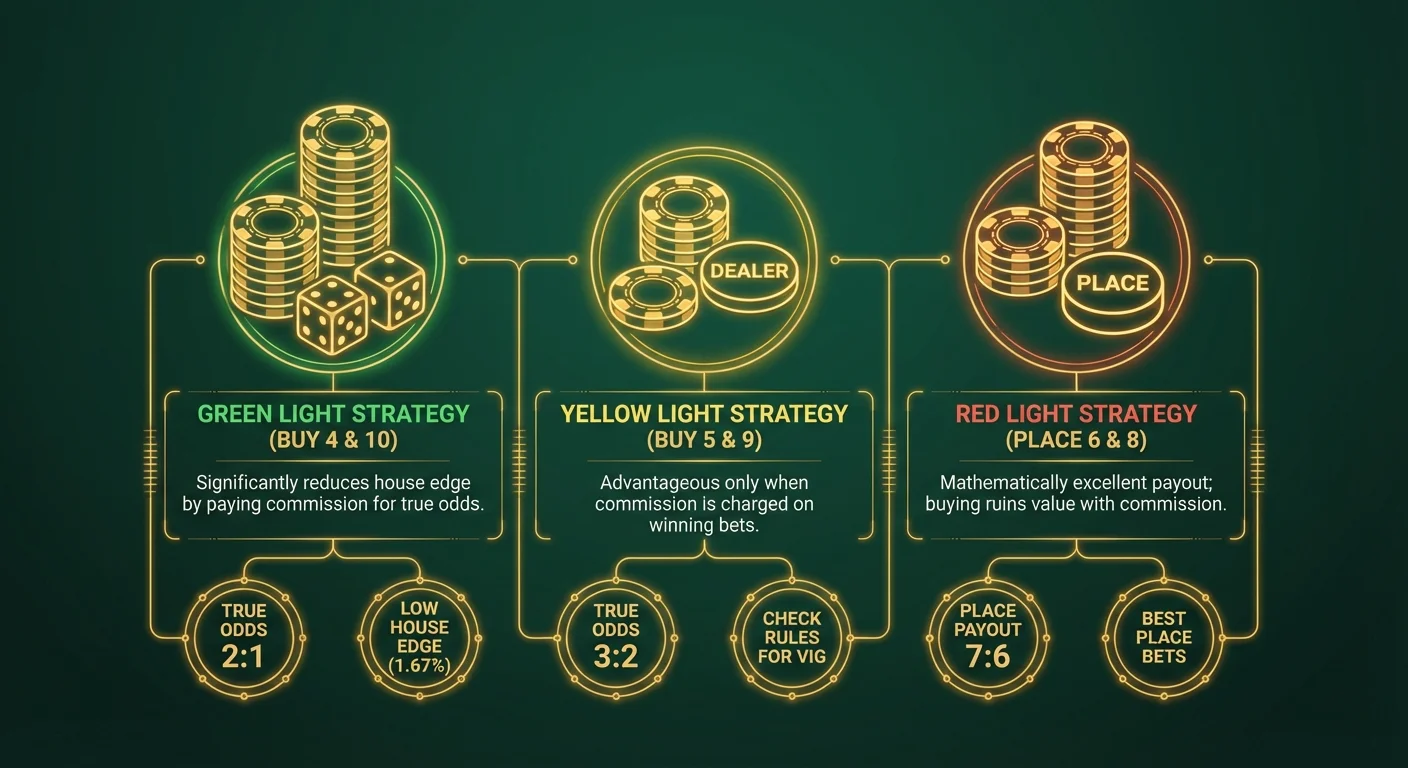
You don't need a PhD in statistics to play smarter than the crowd. You just need to remember the "Traffic Light" system for Buy bets:
- 🟢 Green Light (Buy 4 & 10): The Place payout (9:5) is a rip-off. Paying the commission for true odds (2:1) reduces the house edge significantly. Always Buy.
- 🟡 Yellow Light (Buy 5 & 9): Proceed with caution. Only Buy these if the casino charges the commission only on winning bets. If they charge upfront, or if you aren't sure, stick to Placing them.
- 🔴 Red Light (Buy 6 & 8): Stop. The Place payout (7:6) is mathematically excellent. The commission on a Buy bet ruins the value. Always Place.
By switching your 4 and 10 wagers from Place to Buy, you effectively reduce the casino's advantage by nearly 75% on those specific numbers. In the high-volume, high-speed world of crypto gambling, those percentage points are the difference between a depleted wallet and a massive withdrawal.