
Welcome to the modern era of blackjack, where the green felt table has been digitized, and the cards are dealt faster than a physical dealer could ever manage. Or, perhaps you prefer the high-definition stream of a real human dealer smiling at you from a studio in Riga or Manila.
When you log into a top-tier crypto casino to play blackjack, you are immediately potential faced with a choice that confuses many beginners: RNG (Random Number Generator) Blackjack or Live Dealer Blackjack.
To the untrained eye, the goal is the same: beat the dealer to 21 without busting. However, "behind the deal," these two versions of the game function on entirely different mechanics. They offer different odds, different pacing, and vastly different levels of transparency.
In this guide, we will pull back the curtain on how these games operate. We will explore the algorithms behind Provably Fair crypto games, compare them to the optical recognition technology of live studios, and help you decide which format suits your bankroll and playing style.
The Tale of Two Tables
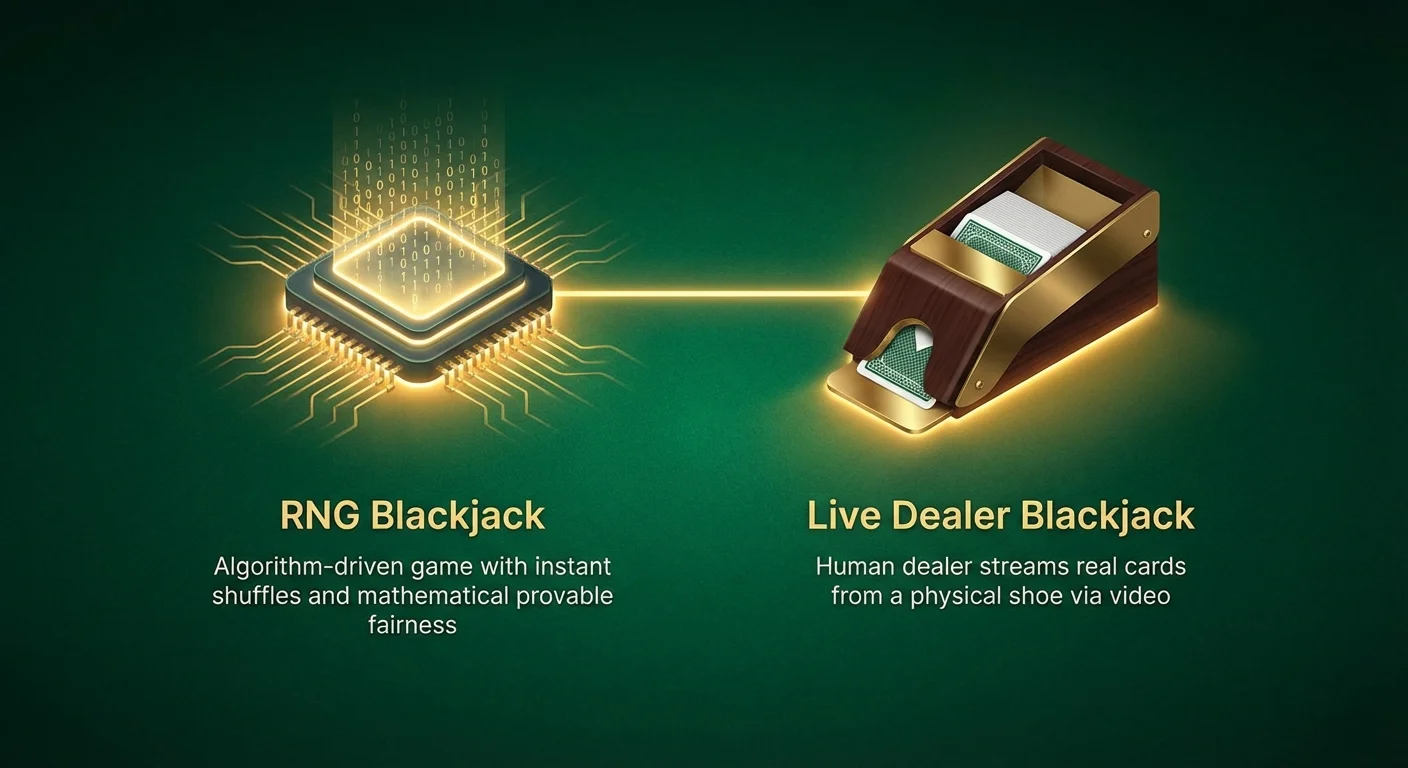
Before we dive into strategy and odds, we need to define the contenders. The primary difference lies in who - or what - is shuffling the deck.
1. RNG (Random Number Generator) Blackjack
In the digital world, an RNG is a complex algorithm that produces random outcomes. When you press "Deal" on a software-based blackjack game, the computer instantly selects cards from a virtual deck (or multiple decks) using this algorithm.
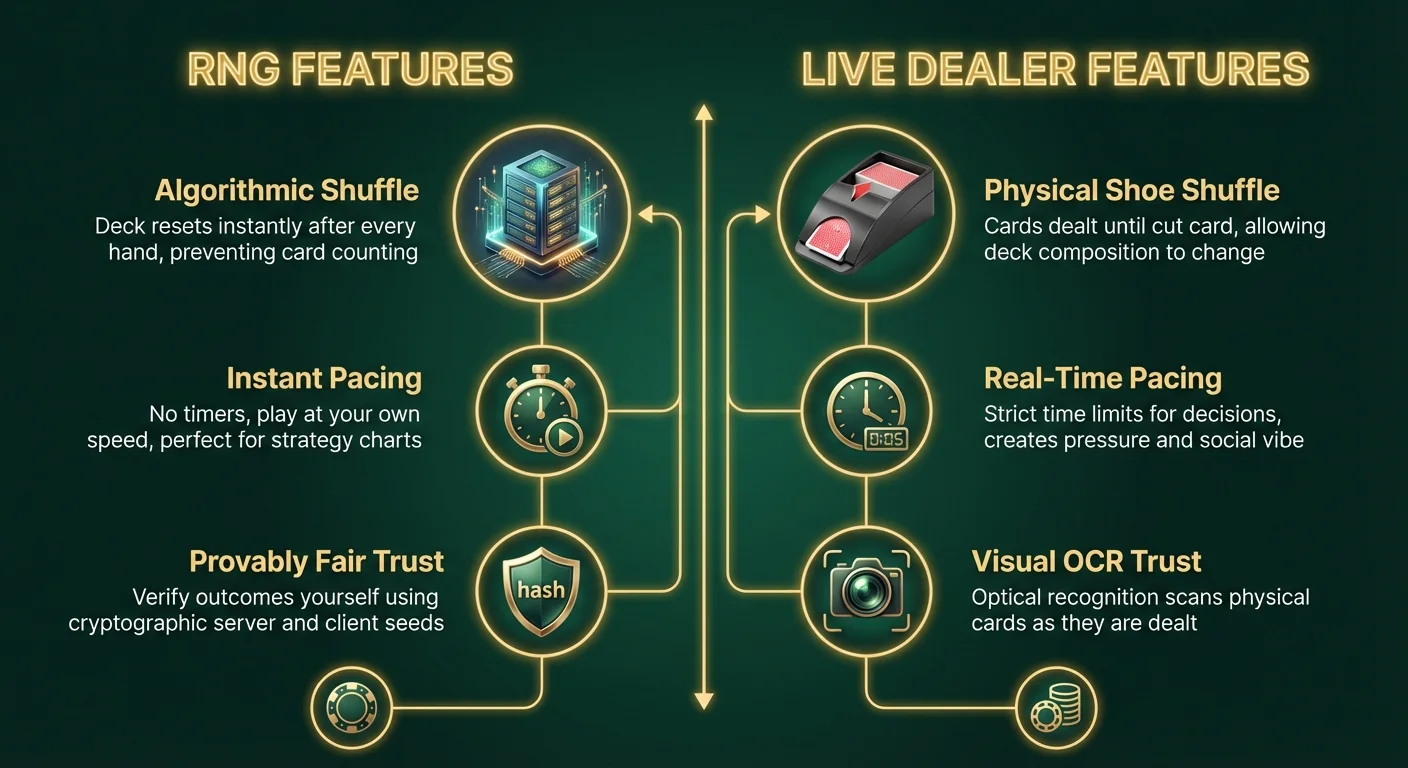
- The Shuffle: In almost all RNG blackjack games, the virtual deck is shuffled after every single hand.
- The Interface: It looks like a video game. You are the only player. There is no chat box, no timer, and no waiting for other players to act.
- The Crypto Twist (Provably Fair): Exclusive to crypto gambling, many RNG games utilize "Provably Fair" technology. This allows you to verify the fairness of the hand yourself using cryptographic hashes, demonstrating how the outcomes are verified.
2. Live Dealer Blackjack
This is the closest experience to walking into a physical casino in Las Vegas or London. A real human dealer stands at a real table, dealing physical cards from a "shoe" (a box holding multiple decks).
- The Tech: Cameras stream the action in HD. Optical Character Recognition (OCR) technology scans the cards as they slide out of the shoe so the computer knows what you have.
- The Shuffle: The cards are usually shuffled by a machine assistant or the dealer when the "cut card" is reached (usually about halfway through the shoe). They are not shuffled every hand.
- The Vibe: It is social. You can chat with the dealer and sometimes other players.
Deep Dive: How the "Shuffle" Changes Your Odds
The most significant difference between these two playstyles is how the cards are randomized. This affects everything from the House Edge to the viability of advantage play methods like card counting.
The Algorithm: Infinite Randomness
In an RNG game, imagine a 6-deck shoe. You play a hand. The cards used in that hand are immediately returned to the virtual pile, and the entire pile is reshuffled before the next nanosecond passes.
What this means for you:
- Card Counting is Impossible: You cannot track high and low cards because the deck composition resets every round.
- Consistency: The odds remain exactly the same for every single hand. You never encounter a "hot shoe" or a "cold shoe" based on remaining cards; you only experience statistical variance.
The Human Deal: Deck Penetration
In Live Dealer games, the dealer works through a physical shoe (usually 6 or 8 decks). They will deal until they reach a colored plastic card inserted into the deck, usually leaving about 1 to 2 decks unused (this is called "deck penetration").
What this means for you:
- The "Flow" of the Game: While card counting is extremely difficult online due to poor deck penetration (they shuffle too early), the composition of the deck does change. If 20 low cards come out in a row, the remaining deck is rich in high cards.
- Human Error: While rare, human dealers can make mistakes. They might misdeal or expose a card. In these instances, the "Pit Boss" (a floor manager) is called over, just like in a land-based casino.
Provably Fair: The Crypto Game Changer
If you are playing with Bitcoin, Ethereum, or other cryptocurrencies, you have access to a specific type of RNG game called Provably Fair.
In a standard online casino, you have to trust a third-party auditor that the RNG software is fair. In a Provably Fair crypto casino, the power is in your hands.
How it Works (Simplified)
- Server Seed: Before the hand starts, the casino generates a random string of numbers (the seed) and shows you a hashed (encrypted) version of it.
- Client Seed: You (the browser) generate a random seed, or you can choose your own.
- The Result: The hand result is calculated by combining the Server Seed and the Client Seed.
- Verification: After the hand, the casino reveals the unencrypted Server Seed. You can check that the seeds match the result, proving the casino didn't change the outcome while the "cards were in the air."
Why choose this? If you are a skeptic who worries that the game is "rigged," Provably Fair blackjack is the safest bet in the entire gambling industry.
Rules and Variations: What to Look For
Whether you choose Live or RNG, the rules of the table dictate your payout. Based on standard European and American rules, here are the pitfalls you must avoid.
1. The Payout Trap: 6 to 5 vs. 3 to 2
As noted in industry reports, casinos are increasingly moving toward 6:5 payouts for Blackjack.
- 3:2 Payout: If you bet $10 and get a Blackjack (Ace + 10-value card), you win $15.
- 6:5 Payout: If you bet $10 and get a Blackjack, you win $12.
This sounds like a small difference, but it increases the House Edge by roughly 1.39%. In RNG games, you can often check the "Info" tab to ensure it pays 3:2. In Live Dealer games, especially low-stakes tables, 6:5 is becoming common. Always check the felt before you bet.
2. European vs. American Rules
In Live Dealer lobbies, you will often see "European Blackjack" and "American (or Standard) Blackjack."
- American: The dealer takes two cards - one face up, one face down (hole card). If the face-up card is an Ace or a 10, they check for Blackjack immediately. If they have it, the hand ends.
- European: The dealer takes only one card face up. They do not take the second card until after all players have acted.
The Risk: In European rules, you might Double Down or Split, putting more money on the table, only to find out at the end of the round that the dealer has a Blackjack, causing you to lose your original bet and your secondary bets. In American rules, you are saved from this because the dealer checks first.
3. Splitting and Doubling Mechanisms
- RNG: The software prevents errors. If you have a pair of 5s, the "Split" button might light up, but experienced players know you should never split 5s. The software allows you to play at your own pace, consulting strategy charts without pressure.
- Live Dealer: You have a timer (usually 15 seconds). If you don't click "Split" or "Double" in time, the game auto-stands or hits based on default settings. This pressure can lead to mistakes for beginners.
Strategy Comparison: Where Should You Practice?
Understanding basic strategy is non-negotiable if you want to preserve your bankroll. But which format is better for executing it?
Learning Basic Strategy
Winner: RNG Blackjack
When you are learning when to hit, stand, or double, you need time. In an RNG game, you can have a "Basic Strategy Chart" open in another window. You can look at your hand (e.g., Hard 13 vs. Dealer 2), look at the chart, and make the correct move (Stand) without a dealer staring at you or a timer counting down.
Testing Betting Systems
Winner: RNG Blackjack
Many players enjoy using betting progressions like the Martingale (doubling after a loss) or the Paroli (doubling after a win).
- Speed: RNG deals are instant. You can play 100 hands in the time it takes to play 20 live hands.
- Limits: RNG tables often have very low minimum bets (e.g., $0.10 or $1.00 in crypto equivalent). This allows you to test a system without risking a fortune. Live tables often start at $5, $10, or higher.
Card Counting / Advantage Play
Winner: Live Dealer (Technically)
While we established that counting is hard online, it is impossible on RNG. If you are determined to try counting, you must play Live Dealer. However, be warned:
- Deck Penetration is low: They shuffle the shoe when there are still many cards left, which kills the advantage of counting.
- Game Speed is slow: You won't see enough hands per hour to make the tiny edge worth your time.
The Verdict: Which Game Fits Your Profile?
To help you decide, compare your player profile against the table below.
| Feature | RNG / Provably Fair | Live Dealer |
|---|---|---|
| Speed of Play | Instant (Turbo mode available) | Slow / Realistic |
| Minimum Bet | Very Low ($0.10 - $1) | Medium/High ($5 - $50) |
| Social Interaction | None (Solitary) | Chat with dealer/players |
| Timer | None (Play at your pace) | Yes (Strict time limits) |
| Trust Mechanism | Provably Fair (Math-based) | Visual (See the cards) |
| Strategy Use | Perfect for chart referencing | Harder due to time pressure |
| Shuffle | Every hand | Manual/Machine (Shoe) |
Profile 1: The Beginner
Recommendation: RNG (Provably Fair)
If you are new to Blackjack, do not start with Live Dealers. The pressure of the timer and the higher minimum bets will drain your bankroll before you learn the rules. Use RNG software to memorize the Basic Strategy chart. play strictly 3:2 payout games, and enjoy the ability to pause the game whenever you like.
Profile 2: The Social Gambler
Recommendation: Live Dealer
If you miss the banter of a land-based casino and want to feel like a high roller, Live Dealer is for you. The slower pace extends your playing session, and seeing the physical cards provides a visceral thrill that computer graphics cannot match. Look for tables with "Unlimited Blackjack" or "Bet Behind" options if the main seats are full.
Profile 3: The Crypto Purist
Recommendation: Provably Fair RNG
If your main priority is anonymity and verifying that the casino isn't cheating, stick to Provably Fair RNG titles. You can verify every hash, ensuring that the result was predetermined by math, not manipulated by a studio boss.
5 Practical Tips for Your Next Session
Whether you choose the algorithm or the human, these universal truths will keep you in the game longer.
- Never Take Insurance: As mentioned in expert guides, insurance is a "sucker bet." The house edge on insurance is nearly 6%. Unless you are an expert card counter (which, as discussed, is unlikely online), simply ignore this button.
- Avoid the "Side Bets": Live Dealer games are famous for flashing side bets like "Perfect Pairs" or "21+3." These offer high payouts but carry massive House Edges (often 4% to 10%). Stick to the main game.
- Surrender is Your Friend: If the game offers "Surrender" (giving up half your bet to fold a terrible hand), use it. It is statistically better to lose 50% of your bet than to play a hand where you will lose 80% of the time.
- Tip: Surrender 16 against a Dealer 9, 10, or Ace.
- Check the "Soft 17" Rule: Does the dealer Hit or Stand on a Soft 17 (Ace + 6)?
- Dealer Stands on Soft 17: Good for the player.
- Dealer Hits on Soft 17: Increases House Edge by about 0.22%.
- Manage Your Crypto Bankroll: Because crypto transactions are instant and often irreversible, set a strict "Stop Loss" before you open the table. If you deposit 0.01 BTC, plan to play with only that amount.
Conclusion
The battle between RNG and Live Dealer games isn't about which is "better" - it's about which is better for you.
RNG software offers speed, privacy, and the ultimate mathematical transparency of Provably Fair technology. It is the training ground for the strategic player. Live Dealer games offer immersion, atmosphere, and the human connection, bringing the glitz of the casino floor to your screen.
Whichever you choose, remember that Blackjack offers some of the best odds in the casino - but only if you respect the math behind the deal. Good luck!