
For decades, the sports betting industry operated on a simple, unilateral premise: the bookmaker sets the price, and you decide whether to take it. In this traditional model, the math is rigorously stacked against you. The "vig" or "juice" ensures the house wins regardless of the match outcome, while you are left hoping for a specific result.
But the rise of betting exchanges - and specifically the integration of cryptocurrency into these platforms - has democratized the industry. You no longer have to be the punter. You can be the house.
Laying bets is the act of betting against an outcome happening. It is the fundamental mechanism that allows betting exchanges to exist. When you lay a bet, you are effectively acting as the bookmaker, offering odds to other bettors (backers) and accepting their stakes. If the selection loses, you keep their stake. If the selection wins, you pay out their winnings.
While this sounds like a license to print money, it introduces a concept that traditional bettors rarely deal with: unlimited (or high) liability. This guide is designed for advanced bettors ready to transition from casual wagering to exchange trading. We will explore the mechanics of exchange laying, the mathematics of liability, and strategies to secure value by betting against the public.
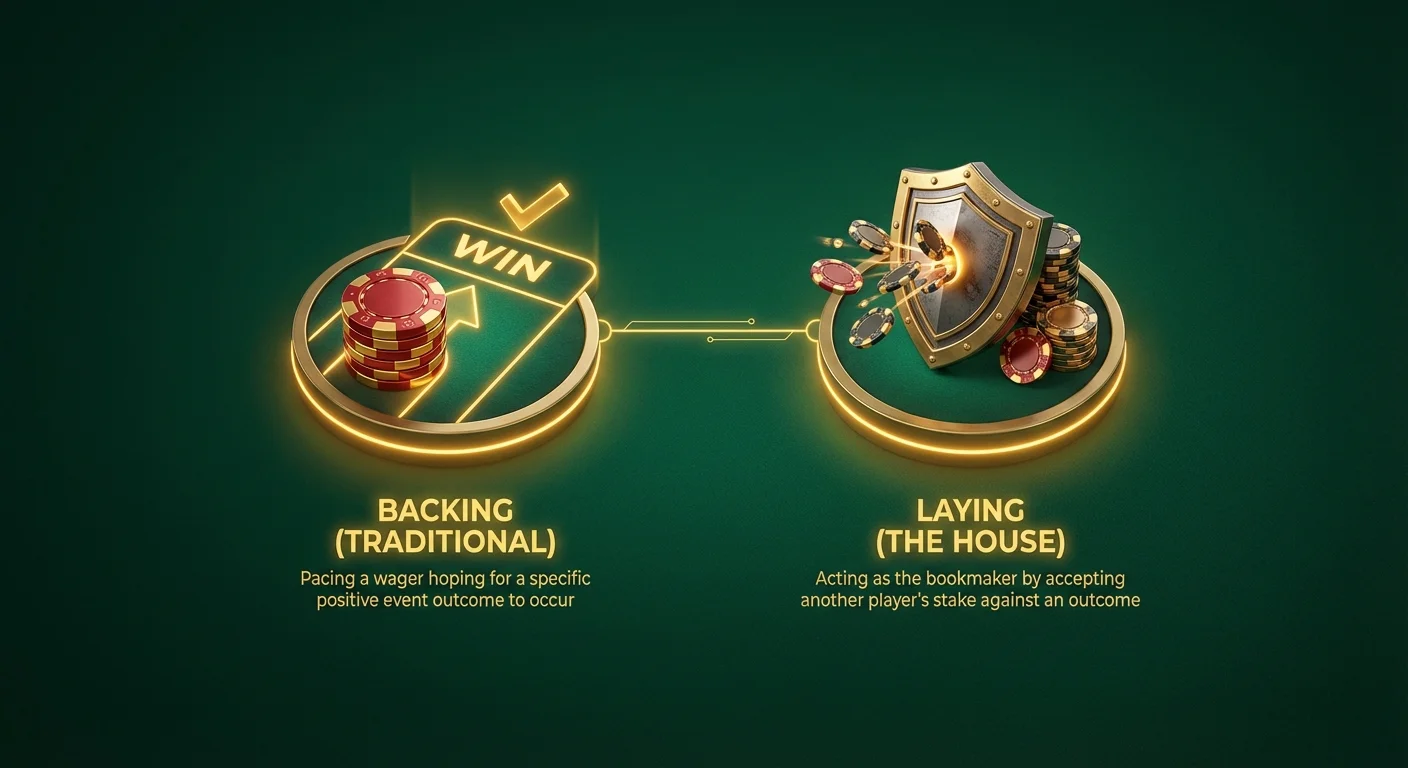
The Fundamental Shift: Backing vs. Laying
To master the exchange, you must first completely rewire how you view a betting market. In a standard sportsbook, you are "Backing." You are betting for something to happen.
- Backing: You bet on Team A to win. You want Team A to win.
- Laying: You bet against Team A winning. You win if Team A loses OR if the match ends in a draw.
The Ecosystem of an Exchange
A crypto betting exchange does not take positions on games. It is merely a peer-to-peer platform (often built on blockchain technology for transparency) that matches people who want to back an outcome with people who want to lay it.
Because there is no middleman taking a heavy margin, the odds on exchanges are almost always superior to traditional sportsbooks. The exchange makes money by charging a small commission (often significantly lower on crypto platforms compared to fiat exchanges) on net winnings.

Anatomy of a Lay Bet
When you lay a bet, you are selling a price. Let's look at a practical example using a standard football (soccer) match between Liverpool and Arsenal.
Suppose you believe Liverpool is overrated and will not win the game. On an exchange, you look at the "Lay" column.
- Selection: Liverpool
- Lay Odds: 2.0 (Decimal)
- Backer's Stake: 0.01 BTC
If you choose to lay this bet, you are accepting the other person's 0.01 BTC wager.
- If Liverpool Wins: The Backer wins. You must pay them their winnings. Since the odds were 2.0, you pay them 0.01 BTC (profit) + return their 0.01 BTC stake. You have lost 0.01 BTC.
- If Arsenal Wins: You win. You keep the Backer's 0.01 BTC stake.
- If it is a Draw: You win. You keep the Backer's 0.01 BTC stake.
By laying Liverpool, you have effectively backed "Arsenal or Draw" (Double Chance), but often at a better price than a sportsbook would offer for that specific market.
Understanding Liability: The Trader's Trap
This is the most critical section of this guide. If you do not understand liability, you will go bankrupt.
When you back a horse for $10, the most you can lose is $10.
When you lay a horse, your risk depends entirely on the odds.
The Liability Formula
Your liability is the amount you must pay out if the outcome you bet against actually happens.
Liability = Backer's Stake × (Decimal Odds - 1)
Example A: Laying a Favorite
You lay a strong favorite (e.g., Manchester City) at odds of 1.50 for a stake of $100.
- Math: 50$.
- Risk: You are risking $50 of your own money to win the backer's $100.
- Verdict: This is low risk, high reward (but high probability of losing, as favorites often win).
Example B: Laying a Longshot
You lay an underdog (e.g., a bottom-tier horse) at odds of 50.0 for a stake of $10.
- Math: 490$.
- Risk: You are risking $490 of your own money to win the backer's $10.
- Verdict: This is "picking up pennies in front of a steamroller." You win small amounts frequently, but one loss wipes out 49 wins.
Comparison Table: Backing vs. Laying Risk Profiles
| Feature | Backing (Traditional) | Laying (The House) |
|---|---|---|
| Goal | Event MUST happen | Event must NOT happen |
| Max Loss | Your Stake | Your Liability (can be huge) |
| Max Profit | (Stake × Odds) - Stake | The Backer's Stake |
| Win Condition | Specific outcome | Any other outcome |
| Bankroll Impact | Linear depletion | Potential for sudden shocks |
Pro Tip: Crypto exchanges usually require you to have the full liability amount in your wallet before they allow the bet to be matched. This is known as "ring-fencing" your funds.
Why Use Crypto for Exchange Laying?
While Betfair paved the way for fiat exchanges, crypto betting exchanges offer distinct advantages for the lay bettor:
- Liquidity Access: Decentralized exchanges and global crypto platforms allow players from restricted jurisdictions (who cannot access Betfair) to participate, increasing the pool of liquidity.
- Lower Commissions: Traditional exchanges charge 2% to 5% on winnings. Many crypto exchanges charge 1% or less, sometimes offering 0% fees on specific pairs. In a strategy where margins are thin, saving 4% is the difference between profit and loss.
- Instant Settlement: Smart contracts execute payouts immediately. You don't have to wait for a bookie to approve a withdrawal; the funds move to your wallet the moment the oracle confirms the result.
- Privacy: No intrusive KYC (Know Your Customer) checks on many decentralized platforms allows you to trade freely.
Strategy: When Does Laying Offer Value?
You should not simply lay bets because you "have a feeling" a team will lose. You lay bets when the market price is too short (too low) compared to the actual probability of the event occurring.
1. The Drifting Favorite
In sports markets, team news moves lines. If a star player is rumored to be injured, or the pitch conditions deteriorate, the favorite's chances of winning decrease.
- Strategy: Monitor team news feeds (Twitter/X is faster than news sites). If you catch news of an injury to a key striker before the market adjusts, Lay the Favorite at the current low odds.
- As the news spreads, the odds will rise (drift). You can then "Back" the team at higher odds to lock in a guaranteed profit (Green Book).
2. Laying the Draw (LTD)
This is the most famous exchange trading strategy.
- Concept: Draws are statistically difficult to predict but priced conservatively.
- Execution: Before kickoff, you Lay the Draw (usually around odds of 3.0 to 3.8).
- The Swing: You wait for a goal to be scored. As soon as a goal is scored (by either team), the probability of a draw plummets, and the odds for the draw rise (e.g., to 6.0).
- The Exit: You then Back the Draw at the higher odds. Because you layed low and backed high, you lock in a profit regardless of how the match ends.
- Risk: The risk is a 0-0 stalemate. You must have an exit strategy (stop-loss) if no goal is scored by the 70th minute.
3. Arbitrage Betting
Arbitrage involves covering all outcomes of an event to guarantee a profit.
- Scenario: A retail crypto sportsbook is slow to update their odds and offers Team A to win at 2.10. The Exchange, reacting to smart money, has Team A's lay price at 2.02.
- Action: You Back Team A at 2.10 on the sportsbook and Lay Team A at 2.02 on the exchange.
- Result: You have created a "risk-free" bet where you capture the difference in price.
4. Laying Low Liquidity "Steams"
Sometimes, a "tipster" will tell thousands of followers to bet on an obscure horse or lower-league team. This causes the price to crash artificially due to the volume of bets, not the actual probability of winning.
- Strategy: Identify when a price has crashed too far due to hype. Lay the outcome at the artificially low price. You are effectively betting that the market has overreacted.
Step-by-Step Guide: How to Place a Lay Bet
If you are using a standard crypto betting exchange interface (like BetDEX, SX Bet, or Betfair clones), the process usually follows this workflow:
- Identify the Market: Navigate to the sport and specific match.
- Select the Pink/Red Box: Exchange interfaces universally use Blue for Back and Pink/Red for Lay. Click the box in the Lay column corresponding to the outcome you want to bet against.
- Check the Price: Ensure the odds are acceptable. Note: The liquidity shown under the odds is the maximum stake you can match instantly.
- Enter "Backer's Stake": This is where beginners get confused. You are entering the amount you want the other person to bet.
- If you enter 0.1 BTC, you are looking to win 0.1 BTC.
- Verify Liability: The system will calculate your liability. Check this twice. Ensure you have sufficient crypto in your account to cover this liability.
- Place Bet: Confirm the transaction.
- Unmatched Bets: If you try to lay at odds lower than the current market, your bet will sit "Unmatched" until a backer decides to take your price. If it remains unmatched when the event starts, the money is returned to your wallet.
Common Pitfalls for New Layers
1. The "Fat Finger" Error
In crypto, transactions are irreversible. If you meant to lay at odds of 4.5 but accidentally typed 45.0, your liability increases tenfold instantly. If a bot snaps up that value (which happens in milliseconds), you cannot cancel it. Always double-check decimal points.
2. Going In-Play Without a Plan
In-play (live) laying is chaotic. Prices move rapidly. There is usually a broadcast delay (latency) between the live event and your screen. People at the stadium or with faster data feeds will "court-side" you - picking off your lay bets right before a goal is recorded on the exchange.
- Tip: Only lay in-play if you are trading a longer-term trend or during a stoppage in play.
3. Ignoring Commission
When calculating arbitrage or thin-value trades, you must factor in the exchange commission.
- Calculation: Profit = (Stake) - (Stake * Commission %).
- If you don't factor this in, a winning trade can turn into a net loss.
4. Chasing Losses
The most dangerous mindset is trying to recover a loss by laying a high-odds outcome (like a Correct Score of 3-3) because "it will never happen." While it is unlikely, the liability is massive. One freak result can wipe out your entire bankroll.
Summary: The House Edge
Laying bets transforms sports betting from a game of picking winners to a game of price enforcement. By becoming the bookmaker, you gain the flexibility to profit from teams losing, draws occurring, or markets overreacting to hype.
Key Takeaways:
- Laying = Betting against an outcome.
- Liability is your true risk, not your stake. Always calculate liability before confirming.
- Value exists when the lay odds are lower than the true probability of the event.
- Crypto Exchanges offer the best environment for laying due to low fees, high speed, and global accessibility.
Mastering the art of exchange laying is the hallmark of a professional bettor. It requires discipline, a deep understanding of probability, and a bankroll sufficient to cover liability. Once mastered, however, it is the most powerful tool in the gambler's arsenal. You are no longer fighting the house; you are the house.