
Most Keno players begin their journey with a "Straight Ticket." You pick your lucky numbers - perhaps a birthday, an anniversary, or a "hot" number like 23 - you place your wager, and you hope the Random Number Generator (RNG) smiles upon you. It is simple, direct, and effectively a Crypto Keno 101.
However, seasoned gamblers and mathematical strategists know that the Straight Ticket is often the most volatile way to play. To truly elevate your game, you must understand Way Tickets and Combination Bets.
These advanced wagering methods allow you to cover more of the board, manipulate the volatility of the game, and potentially secure multiple payouts from a single draw. In the world of crypto gambling, where automated betting interfaces and Provably Fair algorithms offer unprecedented control, mastering these tickets can significantly change your Keno experience.
This guide will move beyond basic "lucky numbers" and delve into the mechanics of Way Tickets, how to calculate them, and how to leverage them using cryptocurrency bankrolls.
The Limitation of the Straight Ticket
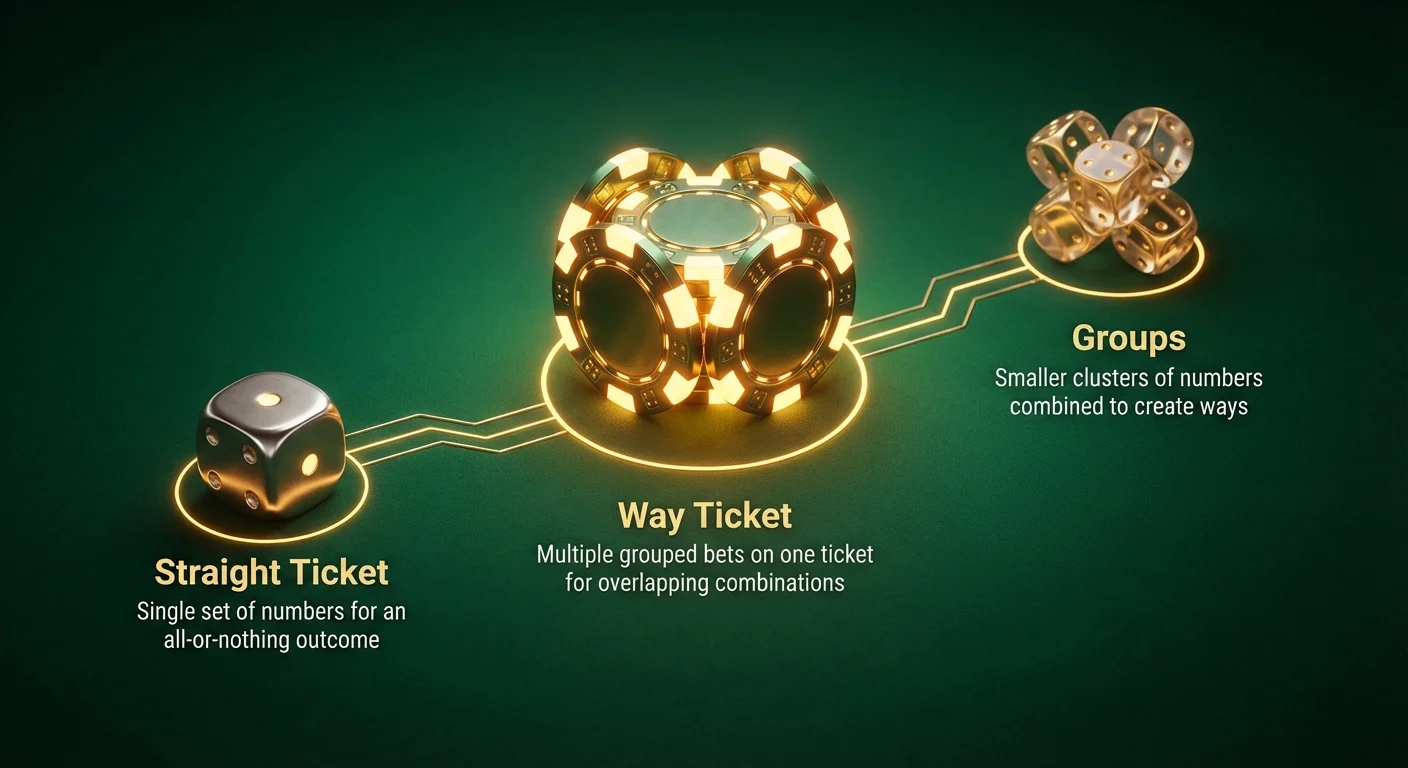
Before dissecting complex tickets, it is essential to understand the problem they solve. When you play a standard Straight Ticket - let's say a "Pick 5" - you are betting on an all-or-nothing outcome regarding that specific set of numbers.
If you hit 3 out of 5, you might get your money back. If you hit 5 out of 5, you win big. But if you hit the numbers 1, 2, 3, 4, and 5, but you played them on five separate tickets alongside non-winning numbers, you might win nothing.
Way Tickets solve this by allowing you to group numbers. They let you play multiple combinations of numbers on a single ticket, effectively mathematically "boxing" your bets to ensure that if a cluster of numbers hits, you aren't just paid once - you are paid multiple times across different overlapping combinations.
What is a Way Ticket?
A Way Ticket is a Keno ticket that contains multiple bets. Instead of marking a single set of numbers (a "spot"), you mark distinct groups of numbers. The ticket then calculates every possible combination (way) those groups can form based on your instructions.
To understand this, we must introduce the concept of Groups.
The Anatomy of a Group
Imagine you have six favorite numbers: 1, 2, 3, 11, 12, 13.
On a Straight Ticket, you would mark all six as a single "6-Spot" bet. To win the jackpot, you need all six to hit.
On a Way Ticket, you could divide these numbers into smaller clusters. For example:
- Group A: 1, 2, 3
- Group B: 11, 12, 13
You now have two groups of three numbers. You can bet on these groups in several "ways":
- Way 1: Bet on Group A (a 3-spot bet).
- Way 2: Bet on Group B (a 3-spot bet).
- Way 3: Bet on Group A + Group B combined (a 6-spot bet).
If you played this ticket "3 Ways," you are making three separate wagers. If the RNG draws numbers 1, 2, and 3:
- You win the 3-spot prize for Way 1.
- You lose Way 2.
- You likely win a partial payout for hitting 3 out of 6 on Way 3.
The Cost Factor
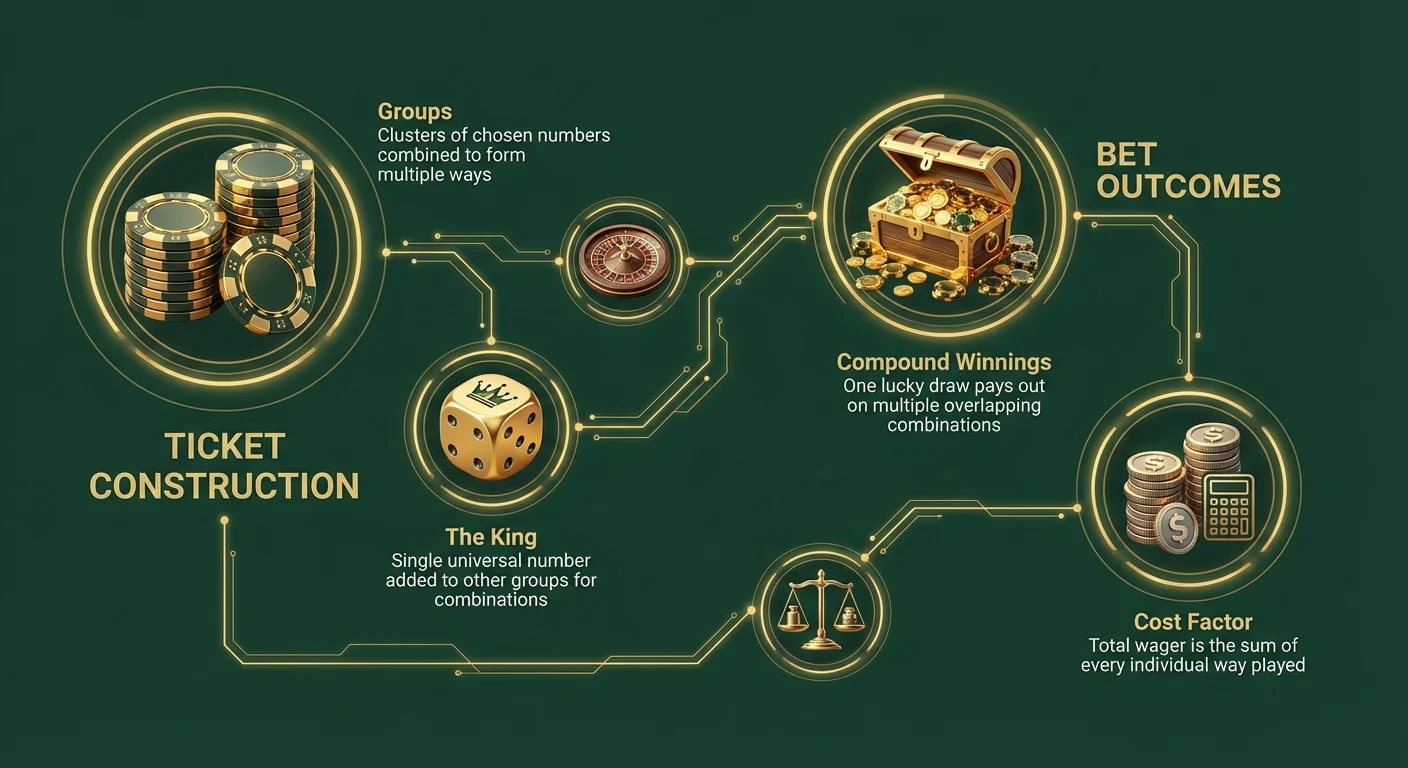
It is crucial to remember that you pay for every "Way" you play. If the base bet is 1 mBTC (millibitcoin) and you play a ticket with 7 Ways, your total cost for that round is 7 mBTC.
Common Types of Advanced Tickets
Once you understand grouping, you can utilize various ticket structures common in both land-based and crypto casinos.
1. The Combination Way Ticket
This is the most standard form of advanced betting. You circle groups of numbers and tell the system (or write on the ticket) how to combine them.
Example: The 3 x 3s
- Selection: You pick three groups of numbers, each containing 3 spots. Let's call them Group A, Group B, and Group C.
- The Logic: You want to play all possible combinations of two groups.
- The Math:
- Group A + Group B = One 6-spot bet.
- Group A + Group C = One 6-spot bet.
- Group B + Group C = One 6-spot bet.
- Result: You have a "3-Way 6." You are playing three separate 6-spot games on one ticket. If Groups A and B both hit perfectly, you win the jackpot for the first combination, the jackpot for the second combination, AND the jackpot for the third combination.
2. The King Ticket
A "King" is a single number that is circled by itself. It serves as a universal number that is added to other groups to form combinations.
Example:
- The King: Number 7.
- Group A: Numbers 10 and 11.
- Group B: Numbers 20 and 21.
- The Ways:
- King + Group A = A 3-spot bet (7, 10, 11).
- King + Group B = A 3-spot bet (7, 20, 21).
- King + Group A + Group B = A 5-spot bet (7, 10, 11, 20, 21).
King tickets are incredibly popular for players who have one "lucky number" (like a birth date) they want to include in every calculation.
3. Split Tickets
In the era of paper tickets, a "Split Ticket" meant writing two entirely separate sets of numbers on the same physical slip of paper to save time.
In Crypto Keno, this is less relevant mechanically, as digital interfaces allow you to just click "Bet" again. However, the strategy remains: playing two distinct clusters (e.g., "Top Half" vs. "Bottom Half") simultaneously to hedge your variance.
The Mathematics of Winning: Why Play Way Tickets?
Why complicate things? Why not just play straight bets? The answer lies in Volatility Reduction and Compound Winnings.
Compound Winnings
The magic of a Way Ticket is that the numbers overlap. In a standard lottery, if you have two tickets and one number hits, it only counts for the ticket it is on. In a Way Ticket, if a number in "Group A" hits, it counts toward every single combination that includes Group A.
Scenario: You play a "3-Way 4" (Three groups of 2 numbers combined).
- Ticket: Group A (1,2) + Group B (3,4) + Group C (5,6).
- Ways: A+B, B+C, A+C.
- The Draw: The numbers 1, 2, 3, and 4 are drawn.
- The Result:
- Way 1 (A+B) matches 4 out of 4. Jackpot.
- Way 2 (B+C) matches 2 out of 4. Small Prize.
- Way 3 (A+C) matches 2 out of 4. Small Prize.
You turned a single good draw into one massive win and two smaller wins, compounding your payout significantly compared to playing these as isolated straight tickets.
Cost vs. Coverage Table
One of the biggest hurdles for new advanced players is the cost. Because you pay per way, tickets can get expensive. However, in Crypto Keno, you can often bet in Satoshis (fractions of a Bitcoin) or small units of USDT, making complex Way Tickets affordable.
| Ticket Type | Description | Total Bets (Ways) | Cost @ $0.10 per way |
|---|---|---|---|
| Straight 6 | One block of 6 numbers | 1 | $0.10 |
| 3-Way 4 | 3 Groups of 2 numbers combined | 3 | $0.30 |
| 12-Way 4 | A complex mix of 4 groups | 12 | $1.20 |
| 190-Way 8 | The legendary "Catch-All" ticket | 190 | $19.00 |
Note: The "190-Way 8" is an extreme example where a player picks 20 numbers and plays every possible combination of 8 spots. This is usually only possible with automated crypto betting scripts.
Advanced Strategies: Clusters and Patterns
Now that you understand the mechanics, how do you pick the groups? We can adapt standard Keno patterns (Clusters, Corners, Lines) into Way Ticket strategies.
1. The 4x5 Corner Way Strategy
Many players believe in playing the corners of the board (1, 2, 11, 12 / 9, 10, 19, 20, etc.).
Instead of playing one giant 20-spot ticket (which has terrible odds), use a Way Strategy:
- Group A: Top Left Corner (4 numbers).
- Group B: Top Right Corner (4 numbers).
- Group C: Bottom Left Corner (4 numbers).
- Group D: Bottom Right Corner (4 numbers).
The Play: Bet them as "Six 8-spot ways" (combining every pair of groups: AB, AC, AD, BC, BD, CD).
If the RNG hits heavily on the "Top" of the board, your "AB" combination hits big, even if the bottom corners miss completely.
2. The "Hot Number" King
Statistical analysis of Keno (over millions of sessions) suggests certain numbers appear slightly more often due to variance, though theoretically, all numbers are equal. Common "Hot" numbers cited by players include 1, 4, 23, 34, and 72.
Strategy:
Select number 23 (or your preferred hot number) as your King.
Select three groups of 3 numbers from different quadrants of the board.
Play combinations of King + Group.
- This ensures that if your "Hot King" hits, it boosts the payout of every single group that also catches numbers.
3. The Cold Number Hedge
Conversely, some players track "Cold Numbers" (numbers that haven't hit in a long time). A Way Ticket allows you to hedge.
- Group A: 5 Hot Numbers.
- Group B: 5 Cold Numbers.
- Play: Way 1 (Group A), Way 2 (Group B), Way 3 (Group A+B).
- This strategy admits that you don't know if the algorithm is running hot or cold, so you bet on both outcomes separately, plus a "Super Jackpot" way in case the board is evenly distributed.
Crypto-Specific Advantages for Way Betting
Playing complex tickets at a land-based casino requires filling out a paper slip with specific fraction codes (e.g., "3/4" means 3 ways of 4). It is slow and prone to human error. Crypto gambling platforms offer distinct advantages for this style of play.
1. Automated Scripting
Many top-tier crypto casinos allow "Auto-Bet" features with programmable logic. You can set up a script that automatically plays a specific Way pattern (e.g., "If I lose 3 rounds, switch from a 3-Way 4 to a King Ticket"). This level of precision is impossible offline.
2. Micro-Wagering
In a physical casino, the house minimum might be $1.00 per way. If you want to play a "20-Way" ticket, that costs $20 per game - too rich for many bankrolls.With Bitcoin or Litecoin, you can wager fractions of a cent per way. You could play a 100-Way ticket for $0.01 per way, costing only $1.00 total. This allows you to enjoy the mathematical thrill of high-way tickets without breaking the bank.
3. Provably Fair Verification
When you play a complicated ticket with 15 different winning combinations, you want to be sure the result was fair. Crypto Keno utilizes Provably Fair technology. Before the draw, you receive a hashed "seed." After the draw, you can reveal the seed to mathematically prove that the numbers were determined before you placed your bet and weren't altered based on your complicated ticket structure.
Practical Tips for Success
Moving from straight bets to Way tickets requires discipline. Follow these guidelines to keep your bankroll healthy.
- Check the Paytable First: Not all "Ways" pay the same. Some casinos offer reduced payouts for "Catch 5 of 5" if you are playing it inside a Way ticket compared to a Straight ticket. Always verify the paytable for "Multi-Way" games.
- Don't Over-Cover: It is tempting to try and cover 50% of the board using groups. Remember, Keno has a high house edge (often 10-15% or more). Buying more ways increases your cost, not necessarily your Return to Player (RTP).
- Stick to the "Sweet Spot": In Keno probability, the most "hittable" significant pays are usually found in the 4, 5, and 6-spot ranges. Construct your Way tickets to create combinations of 4, 5, or 6. Avoid trying to build "Way 10s" or "Way 15s" as the odds of hitting those are astronomical.
- Watch Your Balance: Way tickets can drain a crypto balance rapidly. If you are playing a "10-Way" ticket, you are betting 10x your base unit every few seconds. Ensure your base bet size is small enough to sustain a losing streak.
Summary
Way Tickets and Combination Bets transform Keno from a passive lottery game into a strategic pursuit. By grouping your numbers and playing multiple combinations, you smooth out the volatility and open the door for compound wins where a single lucky draw pays out on multiple lines.
While no strategy can overcome the house edge of Keno entirely, utilizing King Tickets, Corner Groups, and Micro-wagering on crypto platforms allows you to play smarter, longer, and with much more excitement than a simple straight bet ever could.
Remember to utilize the Provably Fair tools available on crypto sites to verify your draws, and always manage your bankroll by calculating the total cost of your ways, not just the base bet.
Key Takeaways
- Way Tickets allow multiple bets on a single ticket using groups of numbers.
- Groups and Kings are the building blocks of advanced Keno wagers.
- You pay for every Way you play, so costs can multiply quickly.
- Crypto Casinos are superior for Way betting due to micro-betting limits and automated interfaces.
- Focus on constructing ways that result in 4, 5, or 6-spot outcomes for the best balance of risk and reward.