
For the seasoned sports bettor, finding value in the odds is only half the battle. The other half - often the more perilous one - is determining exactly how much of your bankroll to wager on that edge. Enter the Kelly Criterion, a mathematical formula celebrated for maximizing the logarithmic growth of a bankroll over time. In theory, "Full Kelly" is the mathematically optimal path to immense wealth.
In practice, however, Full Kelly is a volatile beast that has bankrupted more aspiring sharps than bad handicapping ever has.
If you are betting with cryptocurrency, where the underlying asset itself carries significant volatility, the margin for error shrinks even further. This guide dives into the advanced mechanics of bankroll management for volatile assets, explaining why professional syndicates and serious crypto bettors almost universally reject Full Kelly in favor of Fractional Kelly (Quarter or Half). We will explore the trade-offs between aggressive growth and survival, ensuring your crypto stack withstands the inevitable variance of sports betting.

The Theory: A Brief Refresher on Kelly
Before dissecting why you should slice the Kelly criterion, we must briefly revisit what the Full Kelly actually is. At its core, the Kelly Criterion calculates the optimal bet size based on two factors: the odds offered and your actual probability of winning.
The formula for Full Kelly () is:
Where:
- is the fraction of the current bankroll to wager.
- $b$ is the decimal odds minus 1 (i.e., the net fractional odds).
- $p$ is the probability of winning.
- $q$ is the probability of losing ($1 - p$).
The Promise of Full Kelly
Mathematically, Full Kelly maximizes the expected geometric growth rate of your bankroll. If you have an infinite timeline, perfect knowledge of your edge, and a robotic lack of emotion, Full Kelly will outperform any other staking strategy.
However, the real world is not a mathematical vacuum. It is filled with variance, estimation errors, and in the case of crypto gambling, exchange rate fluctuations.
The Danger Zone: Why Full Kelly Fails in Reality
If Full Kelly is mathematically optimal, why do sharps avoid it? The answer lies in the shape of the utility curve and the devastating impact of "Drawdown Risk."
1. The Volatility Tax
Full Kelly is incredibly aggressive. If you identify a significant edge, the formula might suggest betting 10%, 15%, or even 20% of your entire bankroll on a single event. While this accelerates growth during a winning streak, the downswings are mathematically violent.
A losing streak while betting Full Kelly results in massive drawdowns. Losing 50% of your bankroll requires a 100% gain just to break even. Full Kelly strategies frequently encounter drawdowns of 50% or more. For a crypto bettor holding Bitcoin, a 50% betting drawdown combined with a 20% market dip could leave your portfolio in ruins.
2. The Risk of Overbetting (The Clifford Variance)
The most dangerous aspect of the Kelly Criterion is that it assumes you know your edge ($p$) with 100% certainty.
- Scenario A: You calculate a 5% edge, but you actually have a 5% edge. Full Kelly works (albeit with high variance).
- Scenario B: You calculate a 5% edge, but you actually have a 0% edge (breakeven). If you bet Full Kelly based on a phantom edge, you are mathematically guaranteed to ruin your bankroll over time.
Betting more than the optimal Kelly fraction decreases your growth rate and drastically increases your risk of ruin. Betting less than the optimal fraction (Fractional Kelly) decreases growth slightly but dramatically increases safety. Because it is impossible to calculate your edge with perfect precision, betting Full Kelly implies you are never wrong.
3. The Psychological Toll
Can you stomach watching 1.5 BTC vanish from a 3 BTC bankroll in a single weekend? Most bettors cannot. Full Kelly induces "tilt" - the emotional breakdown that leads to bad decision-making. Fractional Kelly keeps the volatility within a range that permits rational, long-term thinking.
Fractional Kelly: The Professional's Choice
Fractional Kelly simply involves taking the recommended Full Kelly stake () and multiplying it by a fraction (usually 1/2, 1/4, or 1/8).
- Half Kelly: Betting 50% of the Full Kelly suggestion.
- Quarter Kelly: Betting 25% of the Full Kelly suggestion.
The Growth vs. Safety Trade-off
This is where the magic happens. The relationship between the "Kelly Fraction" and "Growth Rate" is parabolic, not linear.
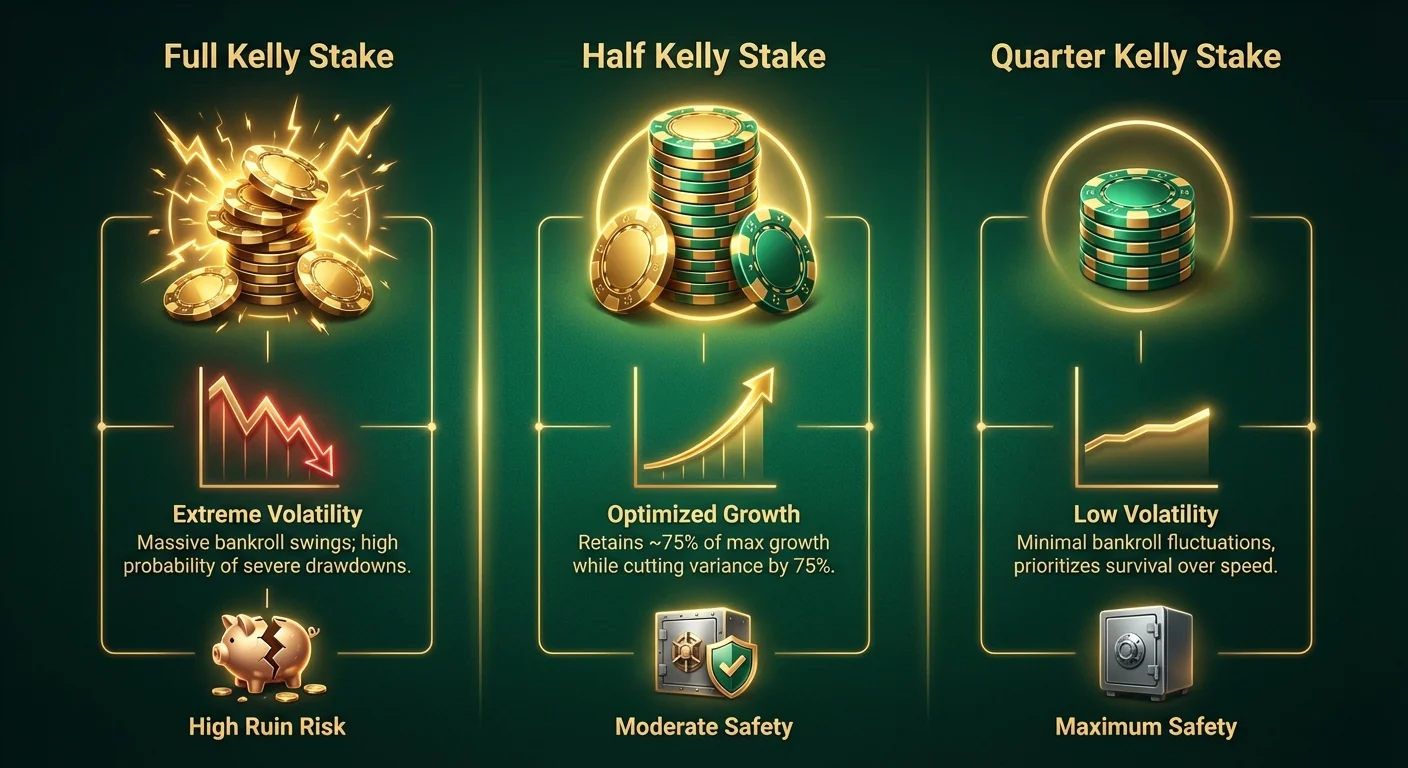
By cutting your bet size in half (Half Kelly), you do not cut your expected growth rate in half. You actually retain 75% of the maximum growth rate, while reducing your variance (risk) to 25% of the Full Kelly volatility.
The Golden Rule of Staking:
It is far better to bet half of the optimal amount than double the optimal amount.
Comparative Analysis: Full vs. Half vs. Quarter
Let's look at a simulation of a bettor with a $10,000 (or equivalent crypto) bankroll.
- Bet: Standard spread bet (-110 American / 1.91 Decimal).
- Win Probability: 55% (A massive, professional-level edge).
- Full Kelly Calculation: 5.5% of bankroll per bet.
| Metric | Full Kelly | Half Kelly | Quarter Kelly |
|---|---|---|---|
| Bet Size | 5.50% | 2.75% | 1.37% |
| Expected Growth | Maximum | ~75% of Max | ~43% of Max |
| Variance/Volatility | Extreme (100%) | Moderate (25%) | Low (~6%) |
| Chance of Halving Bankroll | ~1 in 3 | ~1 in 400 | Negligible |
| Comfort Level | Panic Inducing | Manageable | Relaxed |
As the table illustrates, Half Kelly offers the sweet spot. You sacrifice 25% of your potential growth speed to eliminate 75% of the variance. Quarter Kelly is even more conservative, often preferred by bettors who are unsure of the precision of their edge or who are dealing with high-variance markets (like player props or massive underdogs).
The Crypto Context: Why Conservation is King
When betting on platforms like Cloudbet, Stake, or Sportsbet.io using cryptocurrency, you are exposed to a unique set of risks that make Fractional Kelly non-negotiable.
1. The "Double-Edged" Volatility
In fiat betting, $1 is always $1. In crypto betting, your bankroll is often denominated in BTC, ETH, or SOL.
If you are betting Full Kelly and hit a losing streak (down 30%) during a bear market (coin price down 30%), your real-world purchasing power has crashed by over 50%. Fractional Kelly acts as a buffer, ensuring that you preserve the quantity of coins you hold, allowing you to benefit when the market eventually rallies.
2. Instant Settlement and Churn
Crypto sportsbooks offer instant payouts and high-speed settlement. This ease of access can lead to "over-trading" or placing too many simultaneous bets. If you have 10 bets pending at Full Kelly sizing, you have exposed over 50% of your bankroll to market variance at once. Fractional Kelly ensures that even on a busy Sunday of NFL betting, your total liability remains safe.
Implementing Fractional Kelly: A Step-by-Step Guide
Moving from theory to practice requires discipline. Here is how to implement a Fractional Kelly strategy for your sports betting portfolio.
Step 1: Honest Edge Assessment
You cannot use Kelly without an estimated probability of winning.
- Do not trust your gut. "I feel good about the Lakers" is not a probability.
- Use Closing Line Value (CLV): Track your bets. If you bet the Chiefs at -3 and the line closes at -4.5, you likely had an edge.
- Conservative Estimate: If your model says you have a 6% ROI, calculate your stakes assuming you only have a 3% ROI. This "margin of safety" naturally leads you toward Fractional Kelly.
Step 2: Choose Your Fraction
- Quarter Kelly (0.25x): Recommended for beginners, new models, or high-variance markets (Parlays, Futures, Correct Score). Also recommended if your bankroll is in a volatile Altcoin.
- Half Kelly (0.50x): Recommended for proven winners with a track record of 500+ bets and a verified edge. Best for liquid markets (NFL sides, NBA totals).
- Full Kelly (1.0x): Not recommended.
Step 3: Calculate the Stake
Let's run a practical example for a crypto bettor.
- Bankroll: 1.0 Bitcoin (BTC)
- Bet: NBA Moneyline at 2.00 (+100) decimal odds.
- Assumed Win Probability: 53%
- Full Kelly Formula: or $6%$.
Staking:
- Full Kelly: 0.06 BTC (Too risky)
- Half Kelly: 0.03 BTC
- Quarter Kelly: 0.015 BTC
Step 4: Continuous vs. Static Resizing
There are two ways to handle the bankroll size "B" in the formula:
- Continuous: Recalculate the stake after every single bet result. This is mathematically optimal but tedious.
- Session/Daily: Recalculate your bankroll size at the start of the day. If you start with 1 BTC and win 0.1 BTC, tomorrow's stakes are calculated based on 1.1 BTC. This is the industry standard.
Advanced Considerations: Simultaneous Events
A common mistake advanced bettors make is calculating Kelly stakes for games that happen at the same time without adjusting for portfolio risk.
If you identify value on 5 different NBA games starting at 7:00 PM, and your Quarter Kelly calc suggests betting 2% on each, you are betting 10% of your bankroll at once. If the "public" takes a bath that night, or if there is a correlation between your bets (e.g., betting mostly Overs on a night where officiating is tight), you could suffer a massive blow.
The Fix: When betting simultaneous events, reduce the fraction further. If you usually bet Quarter Kelly, but have 10 bets pending at once, consider scaling down to Eighth Kelly for that session to keep total exposure under control.
Practical Tips for the Crypto Sharp
- Stablecoin vs. Coin Staking: If you want to play closer to Full Kelly (more aggressive), consider keeping your bankroll in USDT or USDC. This removes the market volatility variable, leaving you to deal only with the variance of the game outcomes.
- The "Unit" System Translation: Most bettors talk in "Units" (1% of bankroll). Quarter Kelly on a standard spread bet usually equates to roughly 1 to 1.5 Units. This aligns well with standard conservative advice.
- Automated Tools: Many crypto-friendly betting tools and Excel sheets have Kelly calculators built-in. Use them. Do not do mental math for Kelly stakes; the human brain is bad at logarithmic intuition.
- Don't Chase Losses: Kelly naturally handles losing streaks by recommending smaller bet sizes as your bankroll shrinks. Never override this. Increasing your bet size after a loss (Martingale) is the opposite of Kelly and guarantees ruin.
Summary: The Trade-off Matrix
To wrap up, review this decision matrix to decide which Fractional approach suits your current standing.
| Your Profile | Recommended Strategy | Why? |
|---|---|---|
| New Bettor / Unverified Edge | Flat Staking (1%) | Do not use Kelly until you have a proven edge. |
| Proven Edge / High Variance Mkts | Quarter Kelly | Maximizes safety; accounts for high volatility. |
| Pro Sharp / Liquid Markets | Half Kelly | The optimal balance of growth and preservation. |
| Bankroll in Volatile Crypto | Quarter Kelly | Protects against the "double dip" of loss + coin crash. |
| Bonus Abuser / Arber | Full Kelly | Only applicable when the edge is mathematical and guaranteed (arbitrage). |
Conclusion
The allure of Full Kelly is the allure of perfection - a mathematical promise of the fastest route to riches. But in the trenches of sports betting, perfection is a myth. Edges are estimated, variance is brutal, and emotions are real.
For the crypto bettor, Fractional Kelly is not just a strategy; it is an insurance policy. By utilizing Half or Quarter Kelly, you capture the majority of the upside while building a fortress around your bankroll. In a game where "survival" is the prerequisite for "success," Fractional Kelly is the only logical choice for the serious operator.
Disclaimer: This guide provides strategies for bankroll management but does not guarantee profits. Betting on sports and cryptocurrencies involves high risk. Invest only what you can afford to lose.