
The tension in the air is palpable. You have been grinding for four hours. The field has narrowed from 500 hopefuls to 51 gritty survivors. The tournament pays 50 spots. One more player must leave empty-handed before everyone else locks in a profit.
This is the tournament bubble. It is the most psychologically and mathematically complex stage of any poker tournament.
For the uninitiated, the bubble is a time of terror - a desperate hope to fold your way to a min-cash. For the advanced player, however, the bubble is the most profitable phase of the game. It is a time to weaponize the fears of your opponents, accumulate chips without showdowns, and set yourself up not just to survive, but to win the entire event.
This guide will move beyond basic survival instincts. We will delve into ICM poker (Independent Chip Model), explore the mathematics of bubble strategy, and teach you how to dominate the table when everyone else is praying for a fold. Whether you are grinding high-stakes Bitcoin tournaments or fast-paced daily events on crypto poker platforms, mastering the bubble is essential for your ROI.
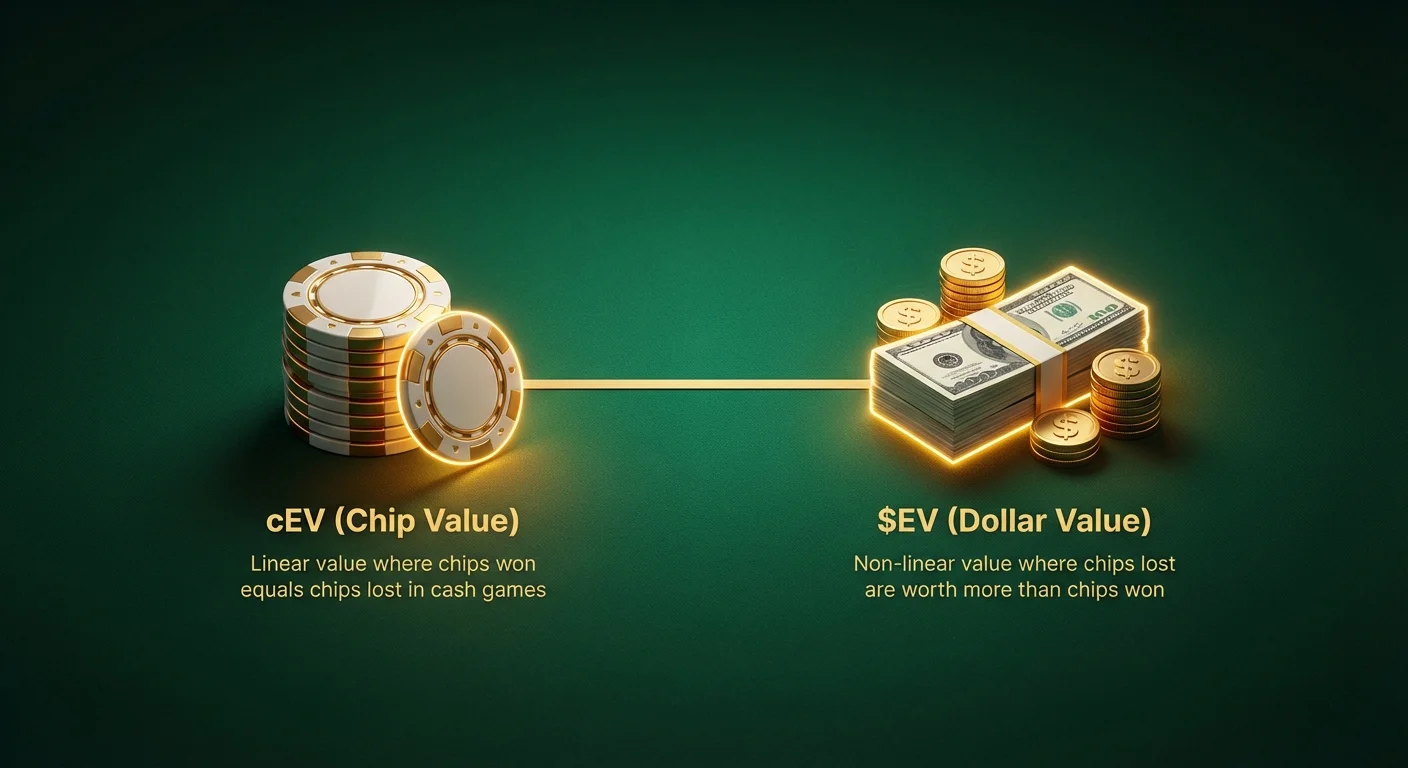
The Paradigm Shift: cEV vs. $EV
To understand advanced bubble play, you must first understand why your standard cash game instincts will lead you off a cliff.
In a cash game (or early in a tournament), chip value is generally linear. Gaining 1,000 chips is roughly as good as losing 1,000 chips is bad. This is known as cEV (Chip Expected Value).
On the tournament bubble, this linearity shatters. Because of the payout structure - where the difference between finishing 51st (bubble) and 50th (money) is massive - chips you lose are worth significantly more than chips you win. This concept is the foundation of Dollar Expected Value ($EV).
The Survival Premium
If you double your stack on the bubble, you do not double your probability of winning money; you simply increase your likelihood of a deeper run. However, if you lose your stack, your equity drops to exactly zero.
Therefore, the Risk Premium - the extra equity you need to call an all-in bet - skyrockets. In a cash game, you might call a shove with a flush draw getting 1.5 to 1. On the bubble, making that same call could be financial suicide, even if the pot odds look correct mathematically.
Demystifying ICM (Independent Chip Model)
ICM is the formula used to calculate a player's equity in the prize pool based on their stack size relative to the total chips in play and the payout structure. You don't need to be a calculus wizard to use ICM, but you must understand its implications.
The Core ICM Rule:
- Chips lost are worth more than chips won.
This asymmetry creates a "Bubble Factor." The Bubble Factor measures how much more valuable survival is compared to accumulation.
Who Hurts Whom?
Understanding who can end your tournament life is vital.
- Big Stacks: They can bust you. Their Bubble Factor against you is high.
- Short Stacks: You cover them. If you lose an all-in to them, you are crippled but alive. Your Bubble Factor against them is lower.
This dynamic dictates that you should avoid confrontations with players who cover you (have more chips) and apply immense pressure to players you cover.
Strategic Approaches by Stack Size
Your strategy on the bubble is entirely dependent on your stack depth relative to the blinds and your opponents.
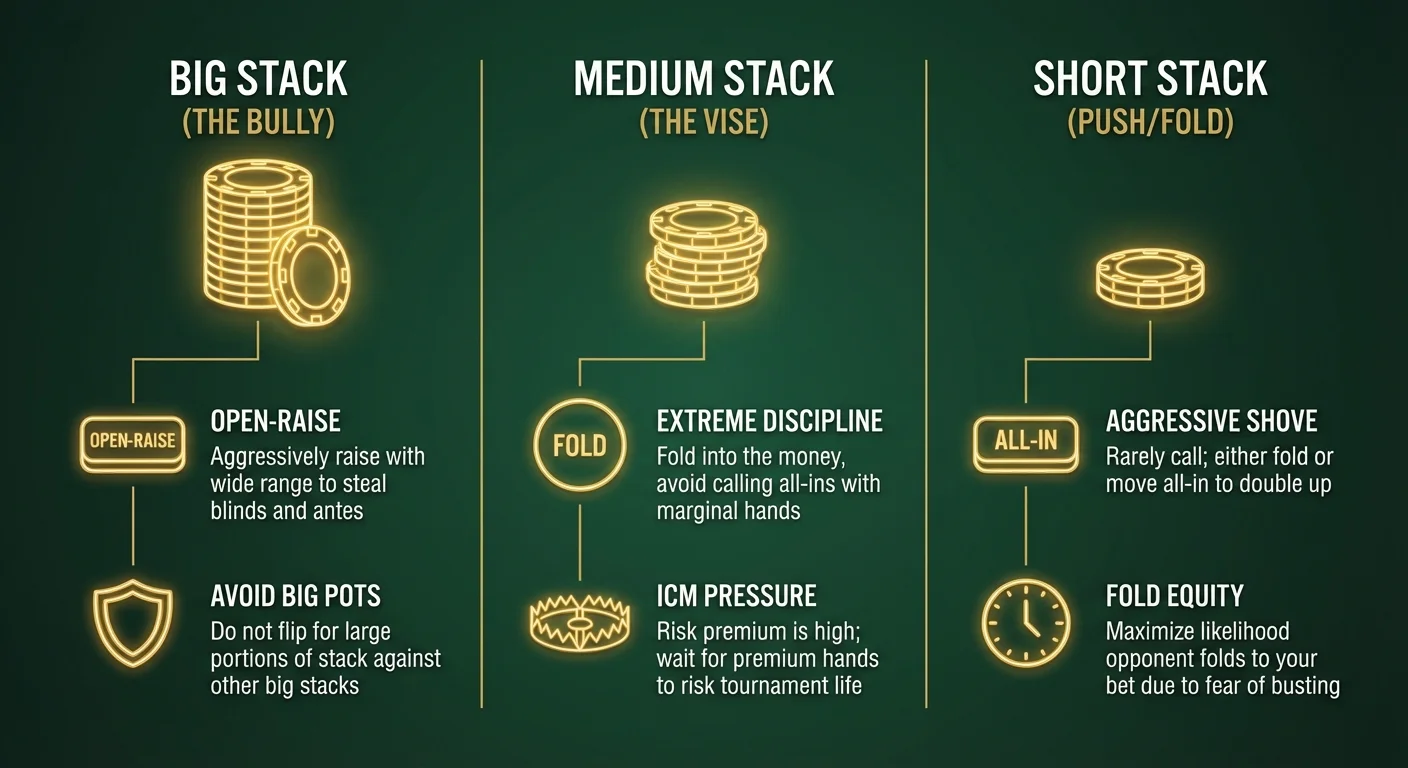
1. The Big Stack (The Bully)
If you are the chip leader or have a massive stack, the bubble is your playground. You are the only player at the table who isn't risking their tournament life in a standard confrontation.
- Strategy: Open-raise with a very wide range of hands (sometimes 50-80% of hands from late position).
- Goal: Steal the blinds and antes relentlessly.
- The Adjustment: While you should bet aggressively, you must call tightly. If a mid-stack shoves on you, do not call lightly just because you have chips to spare. You want to win small pots without showdowns, not flip coins for massive portions of your stack.
2. The Medium Stack (The Vise)
This is the hardest position to play. You have enough chips to make the money comfortably if you fold, but not enough to bully the table.
- Strategy: extreme discipline. You are the target of the Big Stack.
- Goal: Fold into the money.
- The Trap: Do not "call off" (call an all-in) with marginal hands like Ace-Ten or pocket Sixes against a Big Stack. Even if you think they are bluffing, the ICM cost of being wrong is too high. You must wait for premium hands (QQ+, AK) to risk your life.
3. The Short Stack (Push/Fold)
If you have 10 big blinds or fewer, you cannot afford to wait. The blinds will eat you alive.
- Strategy: Aggressive "Push/Fold." You should rarely just call. You either fold, or you move All-In.
- Goal: Double up or steal the blinds to stay alive.
- Fold Equity: As explained in basic poker theory, fold equity is the likelihood your opponent folds to your bet. As a short stack, shoving all-in puts the decision on your opponent. Even with a mediocre hand, if you shove, a medium stack often has to fold due to ICM pressure.
Weaponizing Fold Equity
Fold equity is the currency of the bubble. Because everyone is afraid to bust, bluffs work significantly more often.
Ashley Adams, a noted poker educator, describes fold equity as the percentage of the pot you win because your opponent folds. On the bubble, you want to maximize this percentage.
The "ATC" Shove
There are spots on the bubble where you can shove Any Two Cards (ATC) profitably.
Scenario:
- You are on the Button with 12 Big Blinds.
- The Small Blind and Big Blind are both medium stacks (20-30 BBs).
- Action folds to you.
In this scenario, the blinds are terrified of busting before the money. They cannot call your shove without a premium hand (likely Top 5% of hands). This means they will fold 95% of the time. You can shove 7-2 offsuit here and print money because the fold equity is massive.
Tightening the Calling Range
Conversely, your calling range must shrink. You cannot rely on "Pot Odds" alone.
| Situation | Pot Odds Needed (Cash Game) | Equity Needed (Bubble ICM) |
|---|---|---|
| Calling a Shove (BB vs SB) | ~45% | ~60-65% |
| Calling a 3-Bet | ~33% | ~55% |
| Set Mining | ~10:1 Implied Odds | ~20:1 Implied Odds |
Note how the bubble demands you have a much stronger hand to make a call than the math of pot odds would suggest.
Crypto Poker Nuances: Speed and Aggression
When playing on modern crypto poker sites, specific factors influence bubble strategy:
- Speed of Play: Many crypto tournaments are "Turbo" or "Hyper-Turbo" structures. The blinds increase rapidly. This reduces the edge of post-flop play and increases the importance of pre-flop Push/Fold charts.
- The "Gamble" Mentality: Players depositing via Bitcoin or Ethereum often come from a trading or gambling background. You may encounter players who do not respect ICM and will call you down with weak hands. Against these "wildcards," you must reduce your bluffing frequency and value-bet wider.
- Instant Payouts: One psychological advantage of crypto poker is the immediacy of the reward. Knowing that the min-cash hits your wallet instantly can make the bubble even more stressful for recreational players. Use this anxiety against them.
Practical Strategy: The 5 Golden Rules of Bubble Play
1. Identify the "Stallers"
Players will often take the maximum amount of time for every decision to let the clock run, hoping someone busts at another table.
- Tip: If you are a big stack, punish the stallers. Raise their blinds. They want the hand to be over; oblige them by making them fold, but take their chips first.
2. Attack the "Middle"
Do not attack the short stacks (who are desperate and will call you) or the massive stacks (who can bust you). Attack the players in the middle of the pack. They have the most to lose and will fold the most often.
3. All-In is Better than Calling
You always want to be the aggressor.
- Shoving: You have two ways to win: the opponent folds, or you win the showdown.
- Calling: You have only one way to win: winning the showdown.
On the bubble, that "fold equity" component is worth its weight in gold.
4. Isolate the Limpers
If a player limps (just calls the blind) on the bubble, they are usually weak and scared. If you are in position, raise them. They will almost always fold, surrendering their dead money.
5. Monitor the Lobby
In online crypto tournaments, keep the tournament lobby open. Watch the number of players left. If there are 51 players and 50 paid, and you see a player at another table with 0.5 Big Blinds left, do not play a hand. Fold everything (even Aces, in extreme survival scenarios) because that player is likely to bust in the next minute, guaranteeing you the money.
Advanced Concept: Collision Avoidance
In the late stages, you must actively avoid "collisions" with other big stacks.
Imagine you have Aces (AA) and the Chip Leader has Kings (KK). In a cash game, this is a dream scenario. On the bubble, if you both have 100BB stacks and the average stack is 20BB, getting all the money in pre-flop is a disaster for the tournament ecosystem (though you obviously never fold Aces).
However, with hands like AK or QQ, you should often proceed with caution against the Chip Leader. If you 4-bet shove and they call, you are flipping for your tournament life when you could have coasted to the final table. Sometimes, flat-calling or pot-controlling is superior to "getting it in" to reduce variance.
Summary: Survival of the Smartest
The bubble is not a time for standard poker. It is a unique game state where the value of your chips divorces from their face value.
Key Takeaways:
- Tighten your calling ranges: Don't be the hero who busts on the bubble with Ace-Jack.
- Loosen your shoving ranges: Punish medium stacks who are terrified of elimination.
- Respect the Big Stack: Avoid them unless you have the nuts.
- Leverage ICM: Understand that survival is often more profitable than a slight edge in chips.
By mastering bubble strategy, you transform a stressful period of the tournament into your primary accumulation phase. While others are paralyzed by the fear of missing the payout, you will be building the stack that propels you to the final table and the major crypto payouts that come with it.
Play smart, stay aggressive, and let the math dictate your moves. Good luck at the tables.