
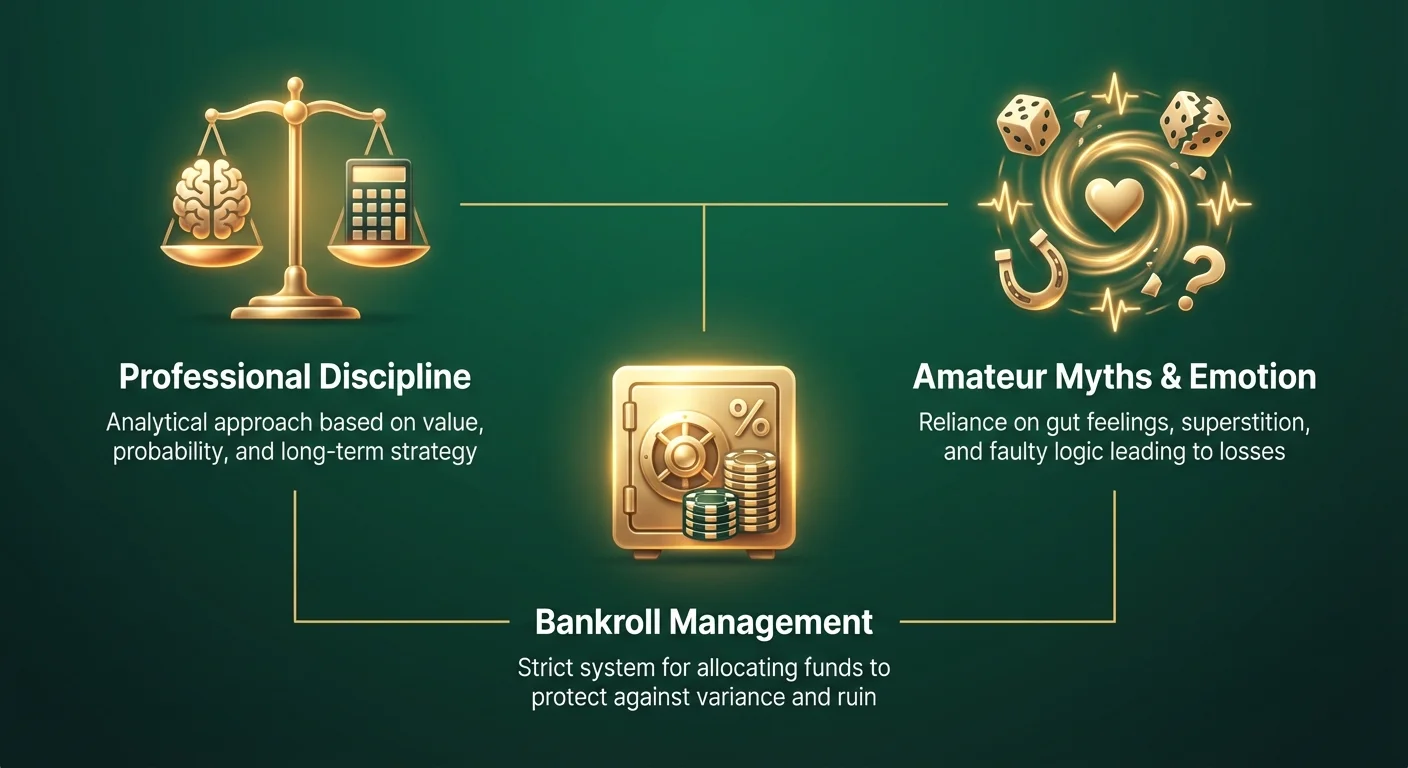
Entering the world of sports betting is often compared to walking through a minefield while blindfolded. For every professional bettor who treats wagering like a stock market investment, there are thousands of "squares" - casual bettors - who rely on gut feelings, superstition, and faulty logic. The sportsbooks know this. In fact, their entire business model relies not just on the mathematical house edge, but on the psychological mistakes bettors make every single weekend.
If you have ever convinced yourself that a team is "due" for a win, or that a heavy favorite is "free money," you are falling victim to the very myths that keep the lights on in Las Vegas and the servers running at major crypto sportsbooks. These misconceptions are insidious because they often feel like common sense.
This guide is designed to strip away the noise. We are going to dismantle the 10 most dangerous sports betting myths that are actively destroying your bankroll. Whether you are betting with Bitcoin, Ethereum, or fiat currency, the math of the game remains the same. By understanding these gambling fallacies, you can stop bleeding money on bad logic and start making decisions based on value and probability.
Myth #1: The Gambler's Fallacy ("They Are Due")
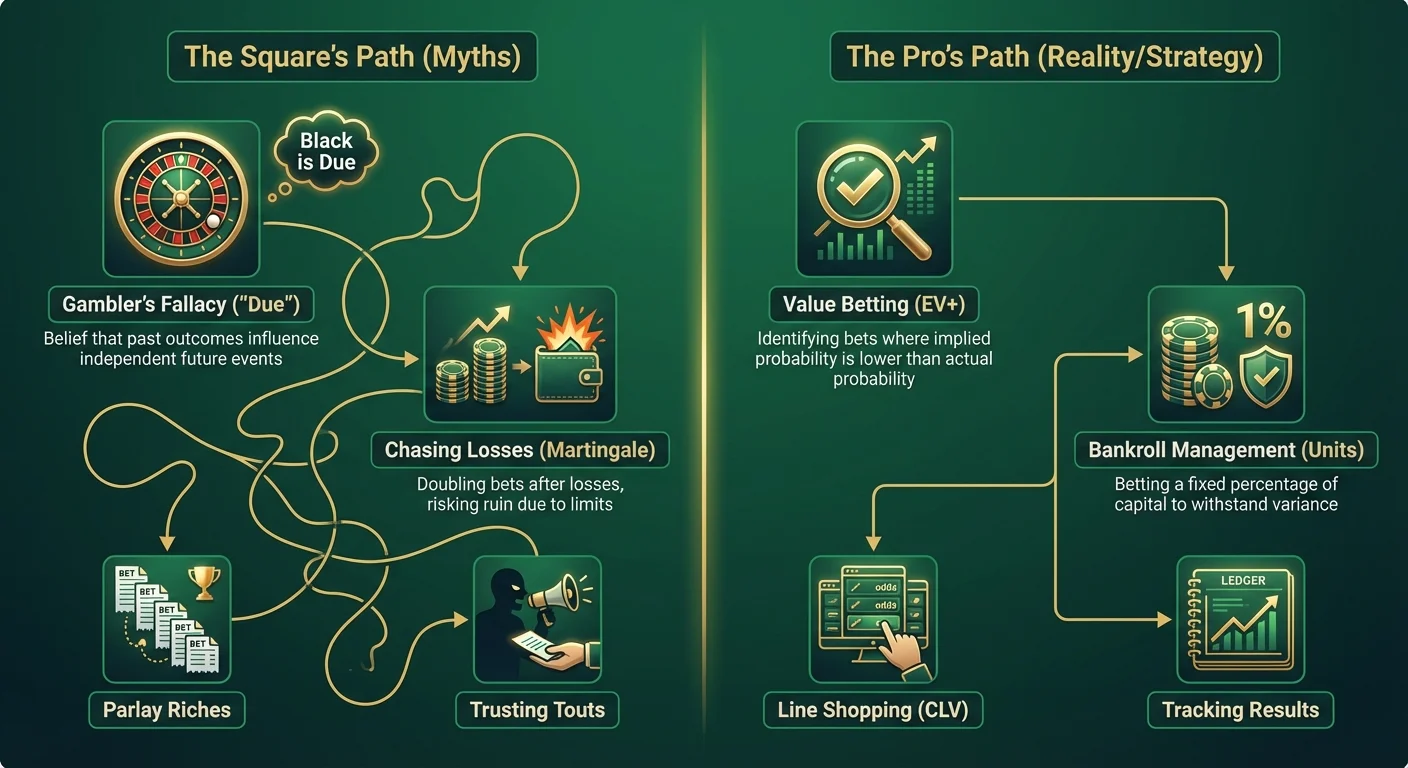
This is arguably the most common and destructive myth in all of gambling. The Gambler's Fallacy is the erroneous belief that if a particular event occurs more frequently than normal during the past, it is less likely to happen in the future (or vice versa).
In sports betting, this usually manifests as: "The Chiefs have lost three games in a spread; they are absolutely due to cover the spread this week."
The Reality
Sports events are, for the most part, independent events. While player morale and fatigue exist, the universe does not keep a scorecard that demands equilibrium in the short term. A coin that flips heads ten times in a row still has exactly a 50% chance of flipping heads on the eleventh try.
When a team is on a losing streak, there is often a tangible reason: injuries, locker room discord, or poor coaching schemes. Betting on them simply because they haven't won in a while is ignoring the data in front of you.
Practical Tip: Instead of looking for who is "due," analyze why a team is losing. If the fundamental stats (yards per play, turnover differential) suggest they are playing better than their record shows, that is "positive regression." That is a strategy. Betting on them because "they can't lose forever" is charity.
Myth #2: The "Lock" or "Sure Thing" Exists
You will hear it from TV pundits, touts selling picks on Instagram, and your buddy at the bar: "This bet is a total lock."
The Reality
There is no such thing as a lock in sports betting. If there were, sportsbooks would cease to exist. Variance is the great equalizer in sports. A star quarterback can tear an ACL in the first quarter. A referee can make a phantom pass interference call that changes the game. A freak weather event can turn a high-scoring passing game into a mud-slog under.
Even the heaviest favorites in history lose. When you bet with the mindset that a wager cannot lose, you tend to bet more than your bankroll can handle.
The "Lock" Danger:
- Overconfidence: Leading to massive bet sizing (e.g., 20% of your bankroll).
- Tilt: When the "lock" loses, the psychological blow causes emotional chasing.
Myth #3: Betting Favorites is the Safer Way to Build a Bankroll
Many beginners look at the board, see a dominant team like Manchester City or the Boston Celtics, and think, "I'll just bet the moneyline. It's a small return, but a safe one."
The Reality
Betting heavy favorites is one of the fastest ways to go broke due to the "Vig" (vigorish) or juice. The implied probability of the odds requires you to win at an unsustainable rate just to break even.
Let's look at the math of betting heavy favorites:
| Moneyline Odds | Implied Probability | Breakeven Win % Needed | Risk |
|---|---|---|---|
| -150 | 60.0% | 60.0% | Moderate |
| -200 | 66.7% | 66.7% | High |
| -300 | 75.0% | 75.0% | Very High |
| -500 | 83.3% | 83.3% | Extreme |
If you bet favorites at -300 (betting $300 to win $100), you must win 3 out of every 4 bets just to break even. If you go 10-4 (a 71% win rate, which is incredible in sports betting), you actually lose money.
Practical Tip: Look for value, not just winners. Sometimes the smart bet is the underdog that has a 45% chance to win but is priced at +150 odds.
Myth #4: The Martingale System (Chasing Losses)
The Martingale strategy suggests that every time you lose a bet, you should double your wager on the next one. The logic is that eventually, you will win, and that win will cover all previous losses plus a small profit.
The Reality
This is the "Black Widow" of betting myths. It sounds mathematically sound in a vacuum, but in the real world, it faces two insurmountable obstacles:
- Bankroll Limits: You will run out of money before you turn it around.
- Table Limits: Sportsbooks have maximum bet limits to prevent exactly this strategy.
Consider a losing streak of just 8 games (which happens to everyone) starting with a $50 bet:
- Bet $50 (Lose)
- Bet $100 (Lose)
- Bet $200 (Lose)
- Bet $400 (Lose)
- Bet $800 (Lose)
- Bet $1,600 (Lose)
- Bet $3,200 (Lose)
- Bet $6,400 (Lose)
By the 9th bet, you have to risk $12,800 just to win your original $50 back. Do you have the stomach (and the crypto wallet balance) to risk a Bitcoin for a $50 profit?
Crypto Note: While crypto betting sites often offer higher limits than traditional bookies, the volatility of your base currency (like BTC or ETH) adds another layer of risk to this strategy. If Bitcoin drops 10% and you are doubling your wagers, your purchasing power is evaporating from both ends.
Myth #5: Paid "Touts" Have Inside Information
The internet is littered with services guaranteeing "Fixed Games," "Whale Plays," or "Inside Info." They claim to know about injuries before the books or have connections with referees.
The Reality
If someone truly had a system that guaranteed wins, they would not be selling it to you for $50 a month. They would be betting it themselves, quietly, until the sportsbooks limited their accounts.
Most "touts" are marketers, not successful bettors. They often play both sides, selling Team A to half their email list and Team B to the other half, ensuring 50% of their customers think they are geniuses.
Practical Tip: Ignore the "Fixed Match" telegram groups. Trust your own research or follow transparent handicappers who post a third-party tracked record of their wins and losses (ROI).
Myth #6: Parlays Are Your Ticket to Riches
We all see the viral screenshots on social media: "Bettor turns $5 into $50,000 on a 15-leg parlay!"
The Reality
Parlays are the primary source of profit for sportsbooks. They hold a massive house edge. When you chain bets together, the probability of winning drops drastically, but the payout odds rarely reflect the true mathematical risk.
While they are fun "lottery tickets," relying on them as a strategy is a sports betting mistake. The "Compound Probability" works against you. Even if you are a great picker with a 60% win rate:
- Single Bet Win Probability: 60%
- 3-Team Parlay Win Probability: 21.6%
- 5-Team Parlay Win Probability: 7.7%
Crypto Strategy: If you enjoy parlays, treat them as entertainment, not investment. Use small amounts of crypto "dust" (leftover fractions of coins) for these moonshot bets, but keep 95% of your bankroll on straight bets (singles).
Myth #7: You Have to Bet Every Game to Win Big
It is Sunday morning. There are 14 NFL games. The myth is that you need to have "action" on the early slate, the afternoon slate, and Sunday Night Football to maximize your weekend.
The Reality
Volume is the enemy of ROI (Return on Investment). The more you bet, the more you expose yourself to the "vig" (house edge). Professional bettors are snipers, not machine gunners. They might scan 50 games and only find value in 2 or 3 of them.
Forcing a bet on a game where you don't have a strong edge is just gambling for the dopamine hit.
Practical Tip: Practice "Selective Aggression." Identify your strongest "Game Category" (e.g., NBA player props or EPL corners) and stick to that. Pass on the televised game if there is no value, even if it is boring to watch without a wager.
Myth #8: The "Hot Hand" and Recent Trends
"The Lakers have covered the spread in 8 of their last 10 games against Eastern Conference teams played on Tuesdays."
The Reality
Trend betting is dangerous because it often relies on small sample sizes and coincidence (data mining). Just because a trend happened in the past does not mean it has predictive power for the future.
Furthermore, the "Hot Hand" fallacy in betting assumes that a bettor (or team) on a winning streak has gained a supernatural ability to keep winning. In reality, regression to the mean is inevitable. If a team is playing 20% above their statistical average, they will eventually come back down to earth - usually burning the bettors who jumped on the bandwagon late.
What to look for instead:
- Injuries: Is a key player out?
- Matchups: Does a team with a bad run defense face a team with an elite running back?
- Motivation: Is this a playoff game or a meaningless end-of-season scrimmage?
Myth #9: House Money is "Free Money"
You deposited $100. You won a few bets and now have $200. You decide to place a risky $100 bet because "It's just the house's money."
The Reality
Once the money is in your account balance, it is your money. Treating winnings as "House Money" leads to reckless betting and is the main reason bettors give back their profits.
This psychological separation allows you to justify bad decisions. If you wouldn't take $100 out of your physical wallet and set it on fire, you shouldn't throw your $100 profit on a bad bet.
Crypto Aspect: This is especially relevant in crypto gambling. If your Bitcoin deposit doubles in value due to marketbull runs and you win bets, you might feel rich and careless. Remember: 1 BTC is 1 BTC. Protect it.
Myth #10: The Sportsbooks Rig the Games
"The ref made that call because Vegas made the call."
The Reality
While match-fixing has occurred in history, it is incredibly rare in major league sports (NFL, NBA, Premier League) due to the high salaries of players and the scrutiny on the games.
The truth is, sportsbooks don't need to rig the games. They have the math (the vig) and the bettors' own mistakes (myths 1 through 9) to guarantee their profit. Believing the game is rigged is a defense mechanism to protect your ego when you lose.
The Crypto Solution - Provably Fair:
While you can't control the outcome of a football match, if you are playing virtual sports or casino games alongside your sports betting, look for Provably Fair algorithms. This is a crypto-specific technology that allows you to verify the randomness of a result on the blockchain, ensuring the casino didn't manipulate the outcome.
Practical Tips for Bankroll Management
To counter these myths, you need a strict system. Here is the framework used by professionals:
1. The Unit System
Never bet arbitrary amounts. Define a "Unit."
- Conservative: 1% of your total bankroll per bet.
- Standard: 2% of your total bankroll per bet.
- Aggressive: 3% of your total bankroll per bet.
- Example: If you have $1,000 in your account, your Unit is $10 to $20. Never deviate.
2. Shop for Lines (CLV)
Closing Line Value (CLV) is critical. If one book has the Rams at -6.5 and another has them at -7, taking the -6.5 is a massive advantage over time.
- Crypto Advantage: Crypto sportsbooks often allow for instant deposits and withdrawals, allowing you to move funds quickly between books to grab the best line before it changes.
3. Track Your Bets
You cannot fix what you do not measure. Use a spreadsheet or an app to track:
- Date
- Sport
- Bet Type (Spread, Moneyline, Prop)
- Odds
- Result
- Profit/Loss
Summary: How to Stop Being a "Square"
Sports betting is a battle of discipline, not just prediction. The myths listed above - from the Gambler's Fallacy to the allure of the "Lock" - are psychological traps designed to exploit human nature.
To protect your bankroll:
- Accept Variance: Losing streaks happen. Don't chase them.
- Respect the Math: Understand implied probability and the vig.
- Ignore the Noise: Forget trends, touts, and "due" teams. Focus on matchups and value.
- Manage Your Money: Treat your bankroll like a business, not a slot machine.
By betting with your head rather than your gut, and leveraging the speed and transparency of crypto betting platforms, you shift the odds slightly back in your favor. The goal isn't to get rich in a weekend; it's to stay in the game long enough for your edge to pay off.