
It is the silent killer of bankrolls. It isn't the vig (juice), it isn't a lack of sports knowledge, and it isn't even "rigged" matches. The number one reason bettors go bust - especially in the high-octane world of crypto gambling - is the inability to handle variance.
If you have been betting for any significant amount of time, you know the feeling. You spent hours handicapping the perfect NFL Sunday or researching the exact expected value (EV) of a Blackjack strategy. You made the right decisions. And yet, you lost. Then you lost again. And again. Suddenly, a standard weekend turns into a decimated bankroll.
This guide is for the intermediate bettor who understands the rules of the game but struggles with the emotional and financial toll of a losing streak. We are going to pop the hood on the mathematics of luck, define exactly how ugly betting variance can get, and provide you with the crypto-specific bankroll management strategies needed to survive the storm and live to bet another day.
Defining the Beast: What is Variance?
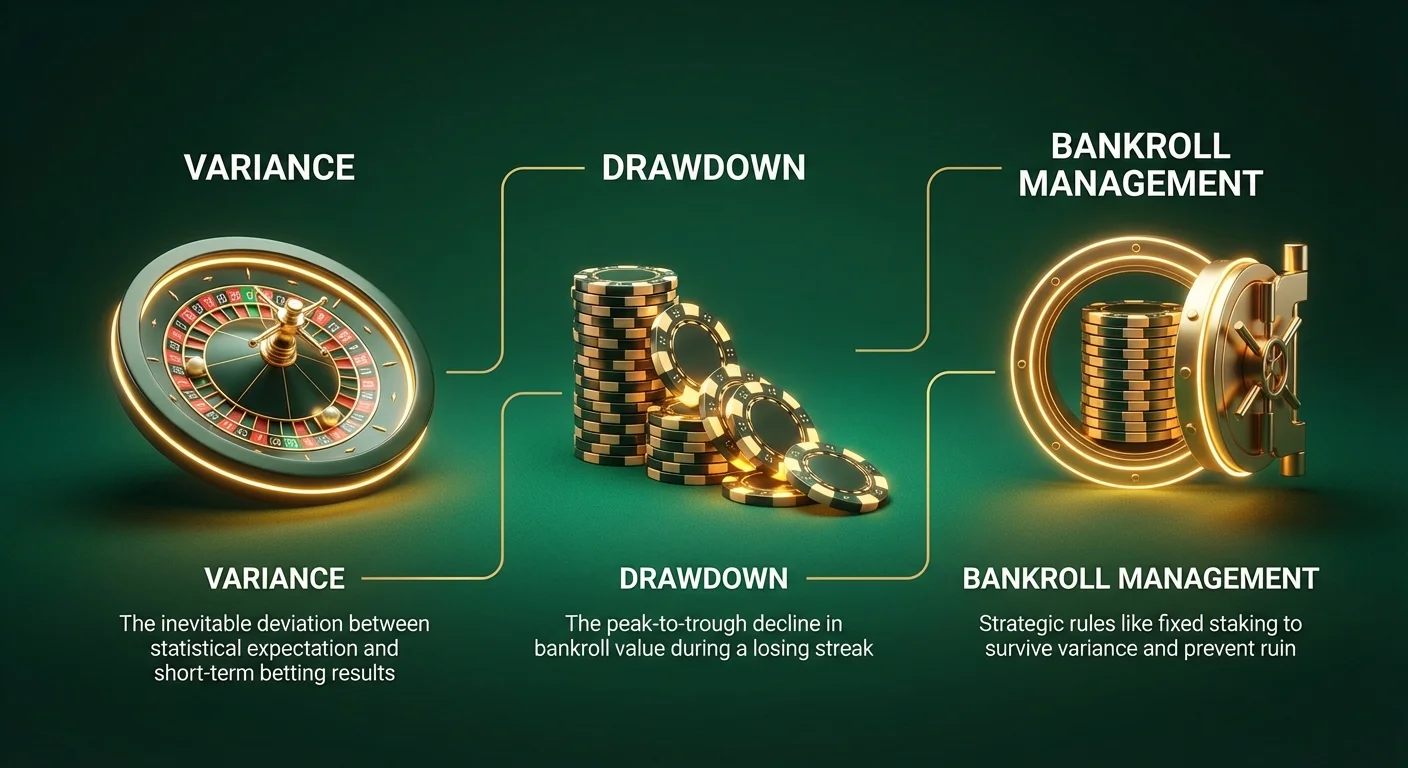
In gambling terms, variance is the difference between what should happen (mathematical expectation) and what actually happens (short-term results).
If you flip a fair coin 10 times, you expect 5 heads and 5 tails. However, if you get 8 heads and 2 tails, that is variance. In sports betting and casino games, variance measures how far your current results deviate from the statistical mean.
The Two Types of Variance
To survive, you must distinguish between the two forces at play:
- Positive Variance (Running Hot): This is when you hit a parlay you had no business winning, or the dealer busts five hands in a row. It feels like skill, but often it is just luck.
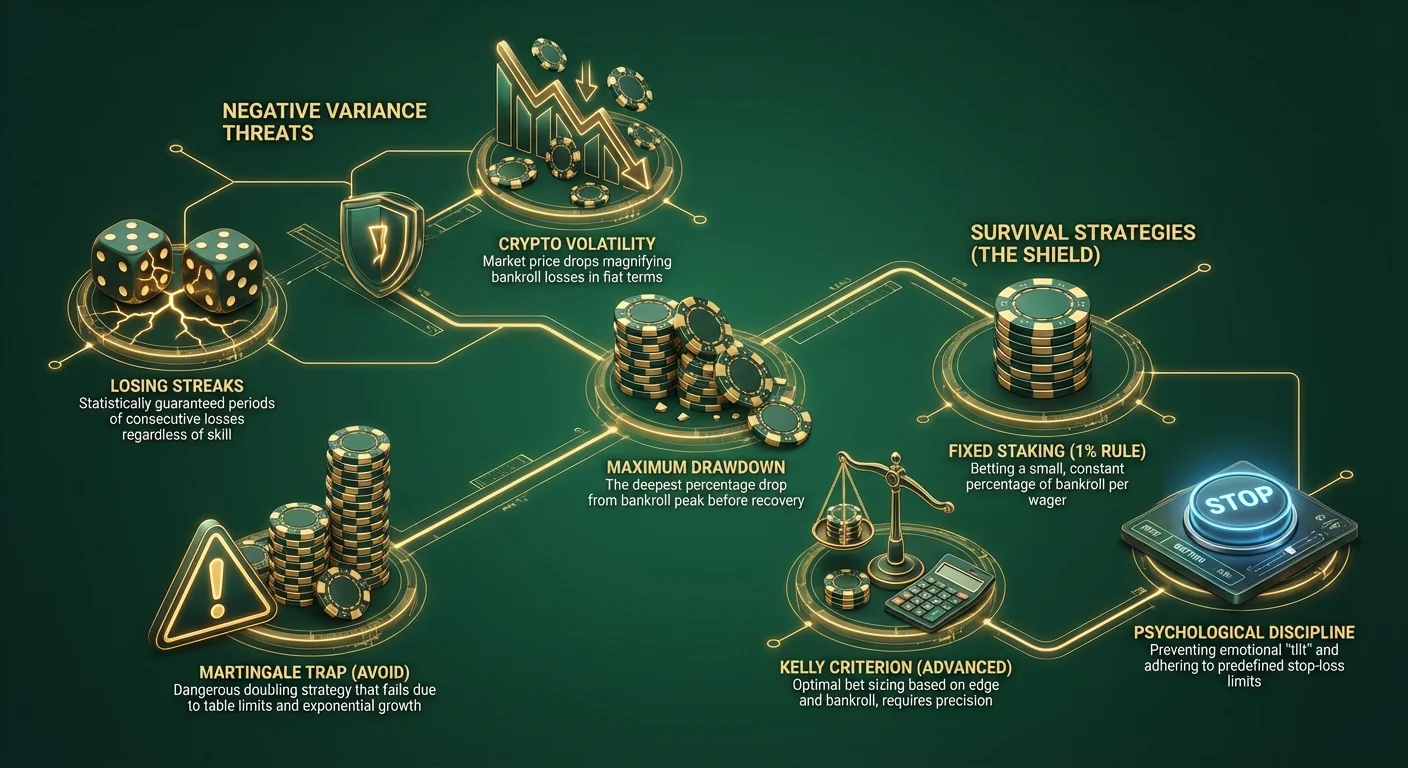
- Negative Variance (Running Cold/Drawdown): This is when your 70% free throw shooter misses both shots to kill your spread cover, or you miss a flush draw four times in a row. This is what causes losing streaks.
The danger for most bettors is that they attribute positive variance to their own genius and negative variance to "bad luck." To be a professional or serious hobbyist, you must accept that both are simply math manifesting over time.
The Mathematics of Losing Streaks
Many bettors quit because they believe a losing streak of 10 games is impossible if they are "good" at picking winners. Mathematics disagrees. The concept of the "Law of Large Numbers" dictates that results eventually even out, but in the short term, chaos reigns.
Let's look at the raw probability of losing streaks based on your win rate (or the implied probability of your bets).
Table: Probability of Consecutive Losses
| Win Probability | Implied Odds (Decimal) | 5 Losses in a Row | 8 Losses in a Row | 10 Losses in a Row |
|---|---|---|---|---|
| 40% (Underdog) | 2.50 | 7.7% | 1.6% | 0.6% |
| 50% (Coin Flip) | 2.00 | 3.1% | 0.39% | 0.09% |
| 55% (Sharp Bettor) | 1.82 | 1.8% | 0.16% | 0.03% |
| 60% (Favorite) | 1.67 | 1.0% | 0.06% | 0.01% |
Analyzing the Data
Look at the 55% row. A 55% win rate in sports betting makes you a world-class, profitable bettor (since you only need 52.38% to break even on standard -110 lines).
Even as a world-class bettor, if you place 1,000 bets in a year, you are mathematically guaranteed to face multiple streaks of 5 losses in a row. You have a distinct possibility of hitting a streak of 8 to 10 losses.
If you are betting on underdogs (Win Probability 40% / Odds 2.50), a 10-game losing streak is not just possible; it is a statistical eventuality. If you do not have a plan for a 10-game slide, you do not have a strategy; you have a ticking time bomb.
Understanding Drawdown
In financial trading and professional gambling, a losing streak is quantified as drawdown. Drawdown is the decline of your bankroll from its peak to its lowest trough before it recovers.
Unlike a simple "loss," drawdown measures the depth of the pain. If you start with 1 BTC, go up to 1.5 BTC, and then drop to 0.8 BTC, your drawdown is calculated from the 1.5 BTC peak, not your starting point.
The Relationship Between ROI and Drawdown
Here is the counter-intuitive truth: Higher ROI strategies often come with higher variance.
- Low Variance: Betting heavy favorites (-200 / 1.50). You win often, but one loss wipes out two wins. Your graph is a slow, steady climb with sharp drops.
- High Variance: Betting parlays or underdogs (+200 / 3.00). You lose often, but one win covers two losses. Your graph looks like a heart monitor - flatlining with huge spikes.
To survive a losing streak, you must calculate your Maximum Expected Drawdown. If you are a flat bettor (betting the same amount every game), a standard rule of thumb for sports betting is that you should expect a drawdown of roughly 20 to 30 units at some point in your career.
If your bankroll is 50 units total, a 30-unit drawdown leaves you with almost nothing. This brings us to the only shield you have against variance: Bankroll Management.
Bankroll Management: The Crypto Bettor's Shield
In the world of crypto gambling, where transactions are instant and limits are high, discipline is the only thing separating you from zero. When you are in the middle of a brutal losing streak, you cannot rely on "picking better winners." You must rely on math.
1. The 1% Rule (Fixed Staking)
The gold standard for surviving variance is Fixed Staking. This means you bet exactly the same amount on every game, regardless of how confident you feel or how much you lost yesterday.
- Conservative: 1% of total Bankroll per bet.
- Aggressive: 2% - 3% of total Bankroll per bet.
- Suicidal: 5%+ of total Bankroll per bet.
If you bet 5% of your bankroll per game, a 10-game losing streak (which we proved above is possible) wipes out 50% of your holdings. Recovering from a 50% loss requires a 100% gain just to break even.
2. The Kelly Criterion (Simplified)
For advanced intermediate bettors, the Kelly Criterion offers a way to maximize growth while theoretically avoiding ruin. It suggests betting a percentage of your bankroll based on your edge.
Formula: (BP - Q) / B
- B = Decimal odds - 1
- P = Probability of winning
- Q = Probability of losing (1 - P)
Warning: Full Kelly staking can be incredibly volatile. During a losing streak, Kelly dictates you lower your bet size significantly as your bankroll shrinks. This acts as a natural brake, preventing you from going bust, but it can be frustrating to grind back up with tiny bets.
3. The Martingale Trap (Avoid at All Costs)
This is the most dangerous strategy for crypto bettors. The Martingale system suggests doubling your bet after every loss to win back the previous losses plus a small profit.
Why it fails during losing streaks:
- Table Limits: Crypto sportsbooks and casinos have maximum bet limits. A long streak will hit the cap, and you will be unable to double, locking in a catastrophic loss.
- Exponential Growth: Starting with a $10 bet, your 8th bet in a losing streak would need to be $1,280. Your 10th bet would be $5,120. Risking over $5,000 to win a net $10 is poor risk management.
Verdict: Never use Martingale to combat variance. It works until it doesn't, and when it fails, it takes everything.
The Double-Edged Sword of Crypto Betting
Gambling with cryptocurrency introduces a layer of variance that fiat bettors don't face: Asset Volatility.
The "Double Drawdown"
Imagine you have a bankroll of 1 Bitcoin. You go on a betting losing streak and lose 0.2 BTC (20% of your bankroll). Simultaneously, the price of Bitcoin drops by 20% against the US Dollar.
In fiat terms, your purchasing power has been smashed from two directions. This can induce severe panic and "tilt."
Strategy:
- Stablecoins: If you are struggling with the mental aspect of variance, consider keeping your betting bankroll in USDT or USDC. This isolates your betting variance from the market variance.
- The "HODL" Mindset: If you bet in BTC or ETH, view your bankroll strictly in crypto terms. If you have 1 BTC and win 0.1 BTC, you are up, regardless of the Dollar price.
The Speed Factor
Crypto gambling sites are famous for instant deposits and withdrawals.
- The Danger: When chasing losses, the ability to instantly scan a QR code and deposit more funds from a mobile wallet removes the "cooling off" friction of bank transfers.
- The Advantage: When you hit a winning streak or need to stop a slide, you can withdraw instantly to a cold wallet. This "locks in" the funds and physically prevents you from betting them back during a tilt session.
Psychology: How to keep your Head
Variance is mathematical; how you react to it is psychological. The state of emotional confusion and frustration caused by losing is known as emotional Tilt.
1. The Gambler's Fallacy
This is the belief that because an event hasn't happened recently, it is "due."
- Example: "The Lakers have lost 5 against the spread (ATS) in a row. They have to cover tonight."
- Reality: The coin has no memory. The roulette wheel has no memory. Each event is independent. Betting based on the Gambler's Fallacy is a surefire way to extend a losing streak.
2. Recency Bias
This is the tendency to overvalue the most recent results. If you lose three bets in a row on the Premier League, you might convince yourself that your strategy is broken, causing you to abandon a proven system right before it corrects itself.
3. Desensitization to Money
In crypto betting, seeing "0.005 BTC" can feel less real than seeing "$300." This abstraction makes it easier to chase losses. Always keep a mental (or physical) note of the fiat value of your bets to maintain respect for the money you are risking.
Practical Steps to Break a Slump
You are in the hole. You've lost 8 of your last 10 bets. Your bankroll is bleeding. What do you actually do right now?
Step 1: The Hard Stop
Close the browser. Walk away. Do not place a "recovery bet" on a late-night table tennis match or a Japanese baseball game you know nothing about. Set a rule: If I lose X units in a day, I stop for 24 hours.
Step 2: The Audit
Once you are calm, review your betting history. Be honest.
- Was it Bad Luck? Did you lose on buzzer-beaters, injuries, or bad officiating? If yes, your strategy might still be sound.
- Was it Bad Betting? Did you bet on heavy favorites with no value? Did you bet on sports you don't follow? Did you chase losses?
- Was it Variance? Are you betting high-odds underdogs? If so, this streak is normal.
Step 3: Lower Your Unit Size
If your confidence is shaken, cut your bet size in half. If you usually bet 0.002 BTC, drop to 0.001 BTC. This allows you to keep playing and seeing results without the heavy financial stress. The goal here is to stabilize your psychology, not to make back the money instantly.
Step 4: Bonus Hunting
Use the competitive nature of the crypto gambling market to your advantage. If you are in a slump, look for:
- Rakeback: Ensure you are claiming all VIP rakeback or cashback offered by your casino/sportsbook. This lowers the house edge.
- Deposit Bonuses: If you must reload, find a site offering a wager-free or low-wager deposit bonus to pad your bankroll against variance.
Summary: Embracing the Grind
Surviving a losing streak isn't about magic picks; it's about resilience.
Variance is the admission price for the game of gambling. If there were no variance, and the favorites always won, sportsbooks wouldn't exist. The unpredictability that causes your losing streaks is the same mechanism that allows for your winning streaks.
Key Takeaways:
- Accept Math: Losing streaks of 10+ games are statistically possible even for winning bettors.
- Respect Drawdown: Plan for a 20-30 unit dip. If your bankroll can't handle that, your bets are too big.
- No Martingale: Never double down to catch up.
- Crypto Discipline: Use stablecoins if market volatility hurts your mental state, and utilize instant withdrawals to lock in wins.
- Review: constantly audit your bets to ensure you are losing to variance, not bad strategy.
The difference between a degenerate gambler and a professional sports bettor is not who wins more games; it is how they handle the weeks when they lose. Keep your unit size small, keep your head cool, and trust the long-term math.