
For the average sports bettor, the goal is often to mitigate risk. This is why standard teasers are so popular; they allow you to buy points, moving the spread in your favor to cushion the blow of a bad beat. But for the advanced handicapper - the bettor who hunts for value in the uncomfortable corners of the sportsbook - there exists a far more volatile and potentially lucrative cousin to the teaser.
Welcome to the world of Pleasers and Reverse Teasers.
These are not bets for the faint of heart. They are high-risk betting instruments that require you to give points away to the house in exchange for significantly inflated payouts. While a standard teaser asks, "How can I make this bet safer?", a pleaser asks, "How confident am I that the market is wrong?"
In this guide, we will dissect the mathematics, strategies, and psychological discipline required to utilize pleasers effectively. We will explore why these bets exist, when they offer positive Expected Value (+EV), and how utilizing crypto sportsbooks can maximize your edge in these high-variance markets.
What is a Pleaser Bet?
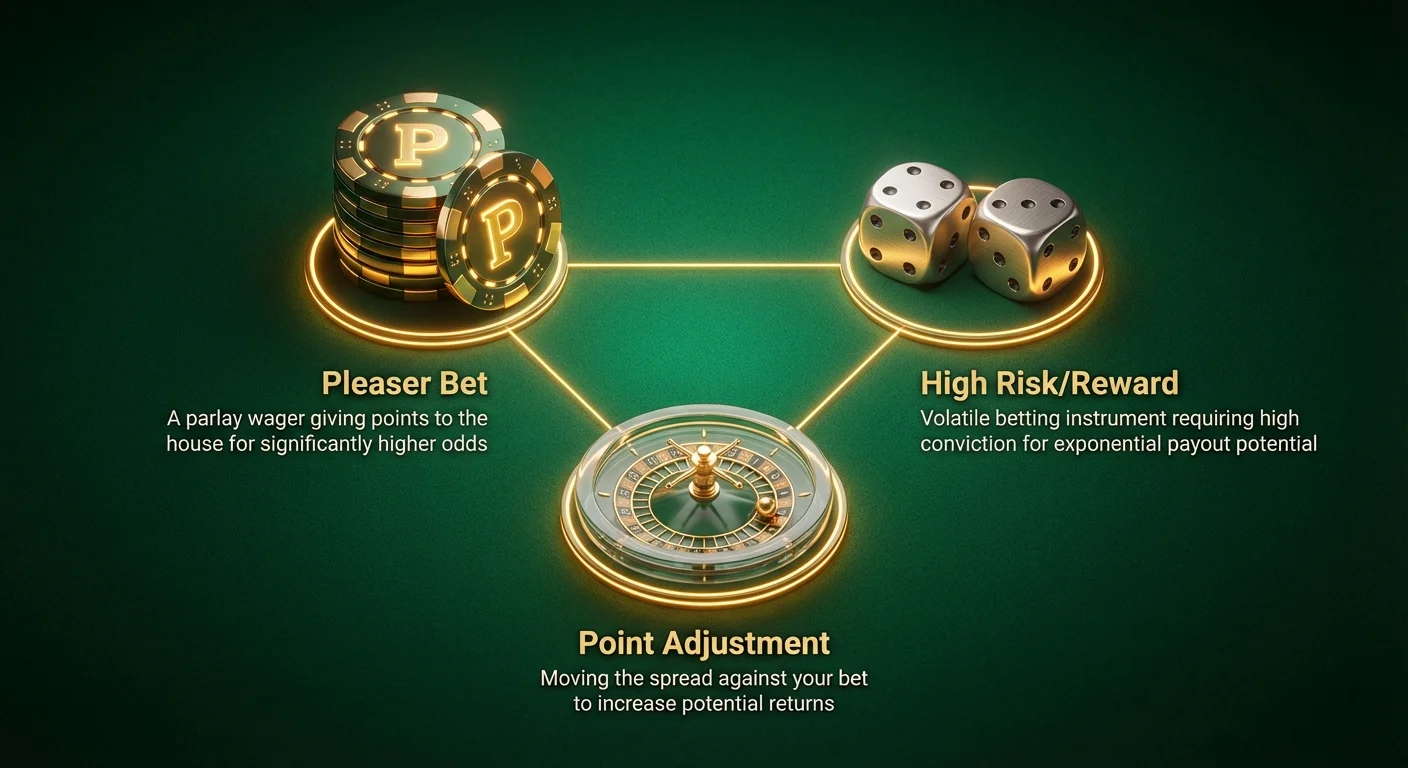
A Pleaser (often synonymous with a Reverse Teaser) is a parlay wager in which the line is moved against the bettor in exchange for much higher odds.
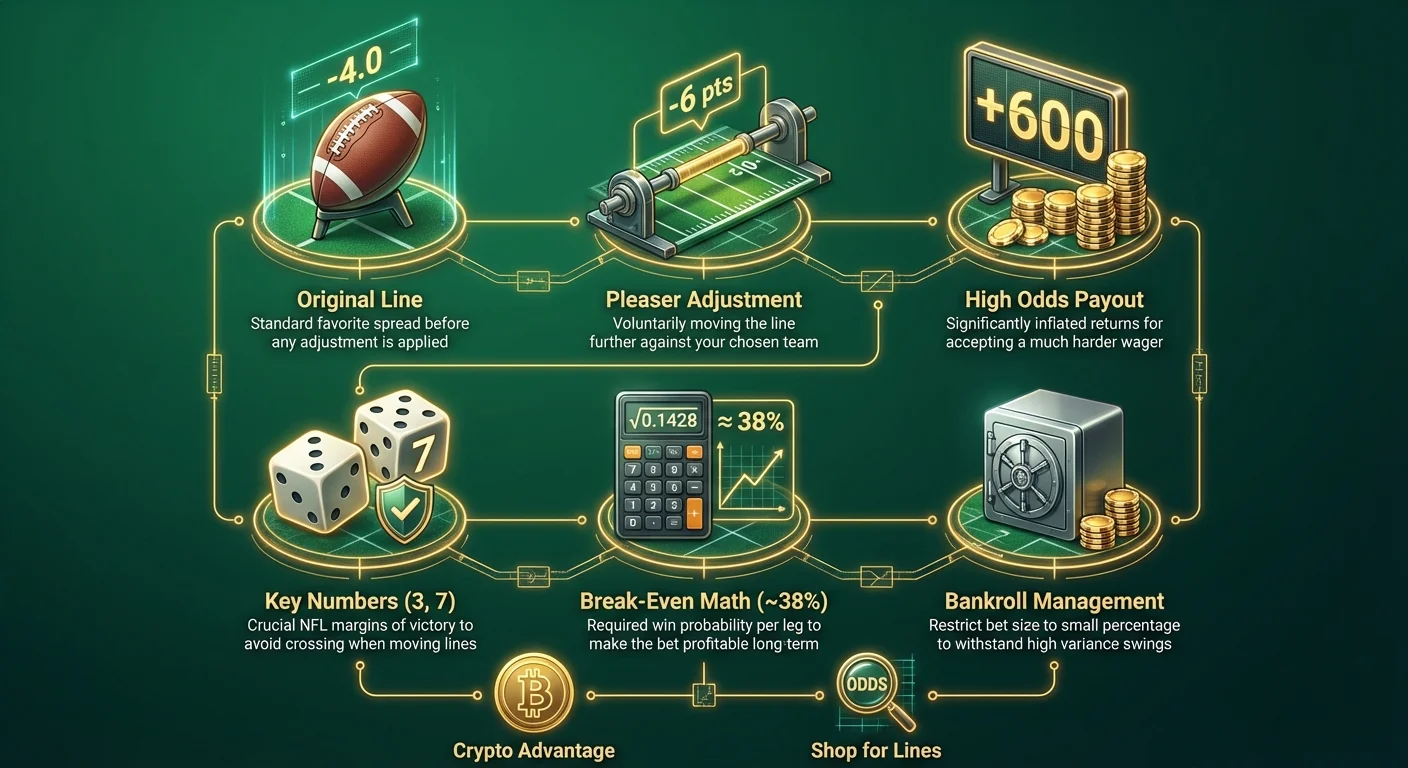
In a standard NFL teaser, you might take a 6-point advantage. For example, moving a -7 favorite to -1. In a 6-point pleaser, you move that same -7 favorite to -13.
To win the bet, all legs of the pleaser must cover the adjusted spread. Because you are voluntarily accepting a worse line than the general public, the sportsbook rewards you with odds that far exceed a standard parlay.
The Mechanics of the Move
Let's look at a concrete example using two NFL games.
Original Lines:
- Green Bay Packers (-4.0) vs. Chicago Bears
- Buffalo Bills (-3.0) vs. Miami Dolphins
Standard 2-Team Parlay:
If you parlayed these two favorites at standard -110 odds, the payout would be approximately +264 (2.64 to 1).
6-Point Pleaser:
Here, you subtract 6 points from your chosen teams (making it harder for them to cover).
- Green Bay Packers (-10.0)
- Buffalo Bills (-9.0)
If both teams cover these new, steeper spreads, the payout is typically around +600 (6 to 1) or higher, depending on the sportsbook.
Nomenclature: Pleaser vs. Reverse Teaser
While the terms are often used interchangeably, there is a subtle distinction in how some books present them:
- Pleasers are usually fixed-odds cards or specific options where you select a set number of points (6, 6.5, 7) and the payout is fixed based on the number of teams.
- Reverse Teasers sometimes refer to manually buying points against yourself on a customized parlay ticket, where the odds are calculated dynamically based on the specific lines chosen.
The Math Behind the Madness
Why would anyone make a bet harder to win? The answer lies in the implied probability and the payout structure.
To understand if a pleaser is a "sucker bet" or a "sharp play," you must understand the break-even percentage.
Comparative Payout Analysis
Below is a comparison of typical payouts (in American Odds) for 6-point adjustments. Note: Odds vary significantly between different crypto sportsbooks.
| Bet Type | Points Adjusted | 2-Team Payout | 3-Team Payout | 4-Team Payout |
|---|---|---|---|---|
| Standard Teaser | +6 Points (In your favor) | -110 to -120 | +160 | +260 |
| Standard Parlay | 0 Points (No change) | +260 | +600 | +1200 |
| Pleaser | -6 Points (Against you) | +600 to +700 | +1700 to +2500 | +4500 to +6000 |
The Break-Even Calculation
Let's focus on the 2-team 6-point pleaser paying +600.
- Total Return: $100 bet returns $700 ($600 profit + $100 stake).
- Implied Probability: 1 / 7 = 14.28%
To break even on this bet, your ticket must win more than 14.28% of the time. Since there are two legs, we need to find the square root of 0.1428 to determine how often each individual leg must win.
- or 37.8%
Therefore, if you believe that shifting the line by 6 points against you still leaves each team with a greater than 37.8% chance of covering, the bet has positive expected value (+EV).
The Critical Question: Does moving a line from -4 to -10 reduce the win probability to below 38%? In the NFL, where margins of victory are often tight, it frequently does. This is why pleasers are generally considered "square" (bad) bets unless applied to specific mathematical anomalies known as Key Numbers.
Strategic Implementation: Hunting Key Numbers
You cannot blindly fire pleasers on random games. That is the fastest way to deplete your bankroll. The only time a pleaser makes mathematical sense is when you are manipulating the line through "dead numbers" and avoiding crossing "key numbers."
1. The Value of the Half-Point
In sports betting, not all points are created equal. In the NFL, the numbers 3 and 7 are king. Roughly 15% of games end with a margin of 3, and about 9% end with a margin of 7.
Bad Pleaser Strategy:
- Taking a team at -3 and pleasing them to -9.
- Why? You have taken a push/win scenario at 3 and turned it into a loss. You have also crossed 4, 6, and 7 - very common margins of victory.
Good Pleaser Strategy:
- Taking a team at -0.5 and pleasing them to -6.5.
- Why? You are moving the line through 1, 2, 4, 5, and 6. These are less frequent margins of victory than 3 or 7. As long as the team wins by a touchdown (7 points), you win. You essentially traded "low value" numbers for a massive payout increase.
2. Flipping the Favorite (The Moneyline Pleaser)
One of the most popular strategies is taking a small underdog and flipping them to a favorite.
- Scenario: Team A is +3.5.
- The Pleaser: You apply a 6-point pleaser, moving Team A to -2.5.
- The Logic: If you believe the underdog will not just cover, but win the game outright, you are effectively betting the moneyline but getting significantly better odds by pairing it in a pleaser. You are betting on them to win by a field goal or more.
3. Correlated Outcomes
While many sportsbooks block correlated parlays (e.g., betting a team to win the first half and the game), pleasers on totals and spreads in the same game are sometimes permitted in crypto sportsbooks.
- Logic: If a massive underdog (+14) is going to cover a pleased spread (adjusted to +8), it is highly likely that the game total will stay Under (as the underdog dictates the pace).
- Warning: Advanced algorithms at modern sportsbooks are very good at pricing this, so proceed with caution.
The Crypto Advantage in High-Risk Betting
When engaging in high-variance strategies like pleasers, the platform you use matters just as much as the bet itself. Crypto gambling sites offer distinct advantages for this specific type of wagering.
Higher Limits and Liquidity
Pleasers can generate massive multipliers. A $100 bet on a 3-team pleaser could return $2,500. Traditional fiat sportsbooks often limit accounts that hit high-odds wagers, flagging them as "sharp" or "risky."
Crypto sportsbooks, particularly those operating on decentralized protocols or with large Bitcoin liquidity pools, generally have higher tolerance for high-multiplier payouts.
Instant Settlement and Reinvestment
High risk betting involves losing often. When you do hit that +1000 pleaser, you want access to those funds immediately.
- Fiat: You might wait 3-5 days for a bank transfer.
- Crypto: Bitcoin, Ethereum, or USDT withdrawals are often processed in minutes. This allows for better bankroll agility.
Anonymity
Strategies involving reverse teasers can sometimes look like arbitrage or sharp action to a risk management team. Using a privacy-focused crypto book prevents your identity from being "marked" across a network of casinos, preserving your ability to get money down.
Practical Tips for Betting Pleasers
If you are going to incorporate pleasers into your portfolio, adhere to these strict guidelines to prevent catastrophic variance.
1. Bankroll Management is Non-Negotiable
Pleasers are high volatility. You might lose 8 in a row before hitting one.
- Standard Unit: If your standard bet is 1 Unit (e.g., $100), your pleaser bet size should be 0.20 to 0.25 Units ($20-$25).
- Don't Chase: Never increase your bet size to "make back" losses from missed pleasers.
2. Stick to 2-Teamers
The math degrades quickly as you add teams.
- A 2-team pleaser requires ~38% win probability per leg to break even.
- A 3-team pleaser increases the variance exponentially without always offering a commensurate increase in true odds compared to the risk.
- Recommendation: Stick to 2-team, 6-point pleasers.
3. Shop for Lines
Because pleasers are a niche market, odds vary wildly. One book might offer +600 while another offers +700 for the exact same wager. In the long run, that 100-point difference in ROI is the difference between a winning and losing season.
4. Avoid "Zero"
Try not to cross zero if you can help it, unless you are flipping a favorite to a dog or vice versa. Moving a line from -3 to +3 (in a teaser) is valuable because you catch both sides of the draw. Moving a line from +3 to -3 (in a pleaser) is dangerous because you lose the push protection on both sides.
5. Know the Sport
- NFL: The best sport for pleasers due to the predictability of scoring margins (3, 7, 10).
- NBA: Terrible for pleasers. Scoring runs are too volatile, and "key numbers" virtually don't exist in basketball.
- College Football: High variance makes it risky, but blowouts are common. Only use pleasers here if you expect a total mismatch.
Common Pitfalls to Avoid
The "Lock" Mentality
Novice bettors look at a -14 favorite and think, "They will definitely win by at least 20." They please the line to -20.
The Reality: In the NFL, teams play to win, not to cover. If a team is up 21 late in the 4th quarter, they play "prevent defense," allowing the opponent to score a garbage-time touchdown. Your -20 pleaser loses because the favorite won by 14.
Ignoring Push Rules
Read the Terms & Conditions of your crypto sportsbook.
- Ties Win: Rare, but amazing for pleasers.
- Ties Reduce: If one leg pushes and the other wins, does the bet revert to a straight bet?
- Ties Lose: In some high-payout pleaser cards, a push is graded as a loss. Avoid these at all costs.
Summary: Are Pleasers Worth the Risk?
Pleasers and reverse teasers are tools, not lottery tickets. In the hands of a recreational bettor just looking for a big score, they are bankroll poison. The house edge on a randomly selected pleaser is generally higher than almost any other bet on the board.
However, for the disciplined sharp who understands key numbers and market inefficiencies, they offer a way to capitalize on strong convictions. If you genuinely believe a line is off by a touchdown, a standard spread bet leaves value on the table. A pleaser captures that value.
Key Takeaways:
- Definition: You give points to the sportsbook in exchange for massive odds (usually +600 or higher for 2 teams).
- Math: You need roughly a 38% win probability per leg on a 2-team 6-point pleaser to break even.
- Strategy: Only cross "dead numbers." Protect the 3 and 7.
- Crypto: Use crypto sportsbooks for higher limits, faster payouts, and access to better odds.
- Discipline: Keep bet sizing small (0.25u) to survive the inevitable swings.
Mastering the pleaser is the ultimate test of a handicapper's ability to predict game flow rather than just picking winners. Proceed with caution, do the math, and never bet more than you can afford to lose.