
In the high-stakes world of professional gambling, the difference between a winning session and a depleted bankroll often comes down to damage control. While most players fixate on how to maximize their wins - when to double down, when to split, or how to press a streak - the true professionals are equally obsessed with minimizing their losses and surviving losing streaks.
This is where the concept of Blackjack Surrender comes into play. Often misunderstood as a coward's way out or a sign of defeat, the surrender option is actually a mathematically powerful tool that, when used correctly, significantly lowers the house edge.
Whether you are playing high-limit Live Dealer tables using Bitcoin or grinding out hands on an RNG-based crypto platform, understanding when to wave the white flag is a hallmark of advanced play. This guide will move beyond the basics, diving into the mathematics, the variations between early and late surrender, and the specific scenarios where folding is your most profitable move.
The Mathematics of Retreat: Why Surrender Works
To master the surrender option, you must first strip away the ego associated with "giving up." In blackjack, every decision is a calculation of Expected Value (EV).
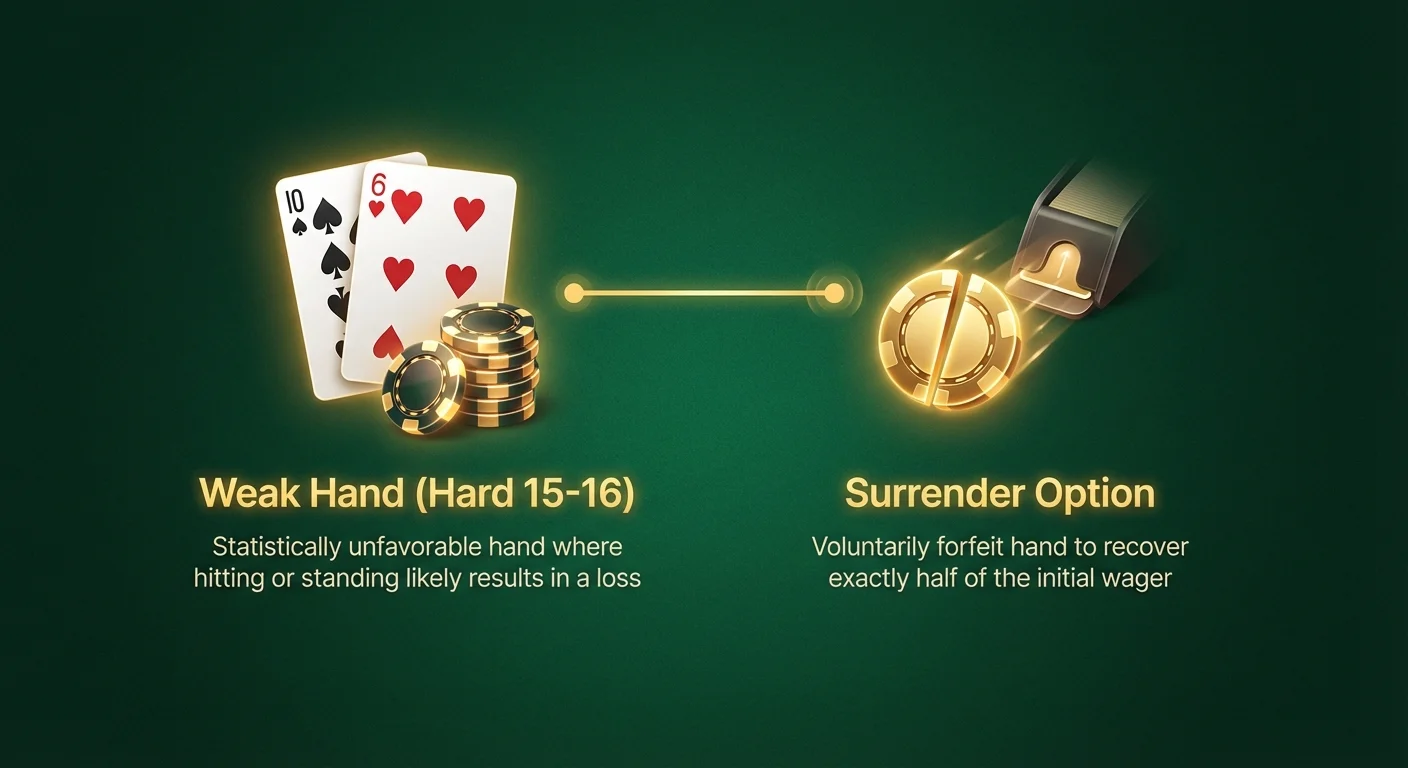
When you surrender, you voluntarily forfeit your hand in exchange for the return of 50% of your initial wager. Mathematically, this locks your loss at -50 cents on the dollar. Therefore, surrender becomes the correct play only when the Expected Value of playing the hand (either by Hitting or Standing) is worse than -50%.
For example, if you hold a hard 16 against a Dealer's 10, your statistical likelihood of winning is abysmal. If you play that hand out to conclusion 100 times, you will likely lose far more than 50% of your money - statistical models suggest a loss nearer to 53% or 54% depending on the specific deck composition. By surrendering, you save that extra 3% to 4%. Over thousands of hands, this seemingly small percentage is exactly what keeps a bankroll alive.
Early Surrender vs. Late Surrender
Not all white flags are created equal. In the landscape of online crypto casinos, you will encounter two primary variations of this rule. Knowing the difference is critical, as it dictates your strategy entirely.
Late Surrender (The Standard)
This is the version you will find in 99% of US casinos and the vast majority of online crypto blackjack tables (typically under "American Blackjack" rules).
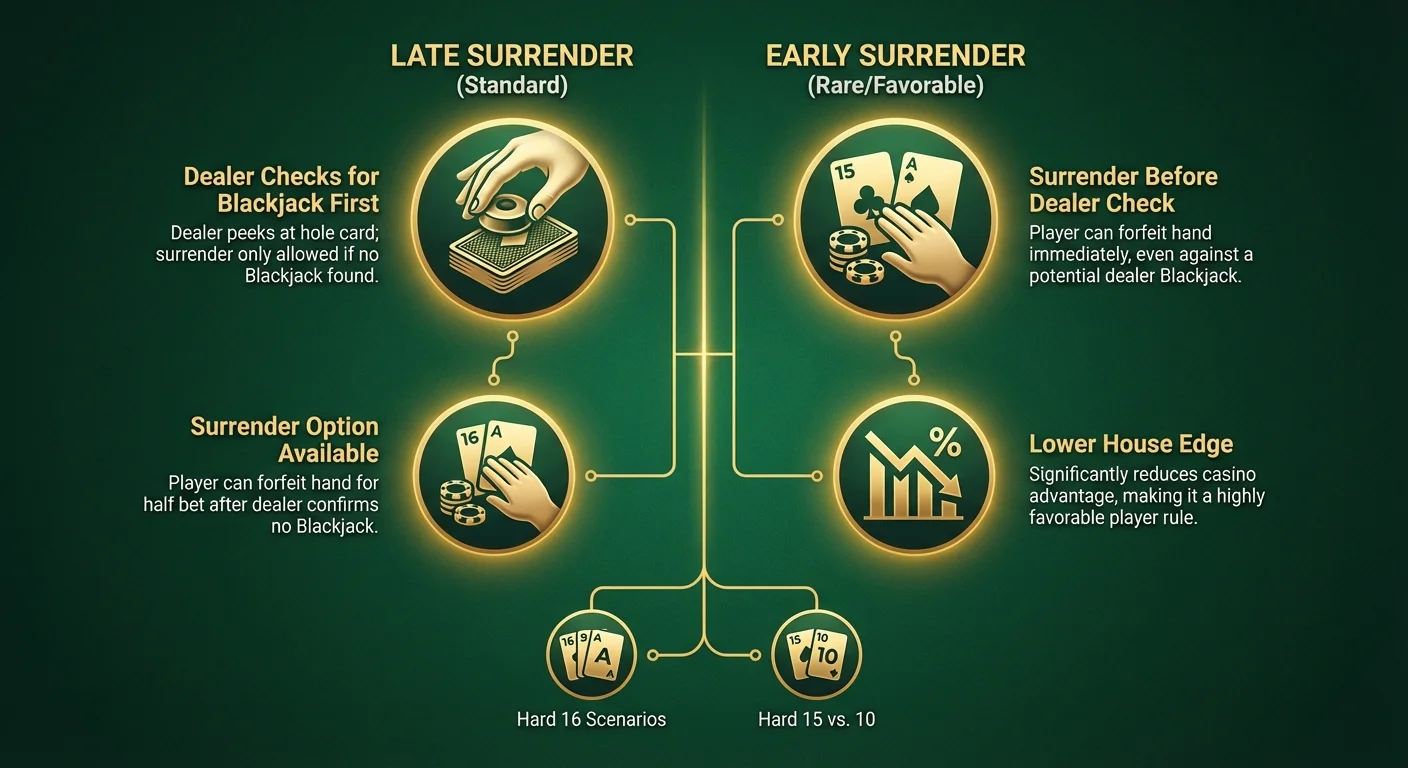
In Late Surrender, you may only surrender your hand after the dealer has checked for Blackjack.
- The cards are dealt.
- The dealer peeks at their hole card (if they have a 10 or Ace showing).
- If the dealer has Blackjack, the game ends immediately, and you lose your full bet.
- If the dealer does not have Blackjack, you are then given the option to surrender.
Because you cannot surrender against a dealer Blackjack, the house maintains its edge on those instant-loss scenarios.
Early Surrender (The Holy Grail)
Early Surrender is a rare rule, often found in older variations of European Blackjack or specific high-limit rooms. It is incredibly favorable to the player - so much so that casinos often modify other rules (like using more decks) to compensate for it.
In Early Surrender, you may forfeit your hand before the dealer checks for Blackjack. This means if the dealer is showing an Ace, and you have a hard 15, you can take half your money back immediately. If the dealer turns over a King for Blackjack, it doesn't matter - you are already safe with half your stack.
Pro Tip: If you find a crypto casino offering Early Surrender with standard payouts (3:2), play it. It effectively reduces the house edge by roughly 0.60% to 0.70%, which is massive in gambling terms.
The Strategy: When to Surrender
Assuming you are playing a standard Multi-Deck game (4 to 8 decks) with Late Surrender, which is the industry standard for online crypto gambling, there is a rigid set of rules to follow. Deviating from these due to "hunches" will cost you money in the long run.
The following strategy applies to games where the dealer Hits on Soft 17 (H17) or Stands on Soft 17 (S17).
1. The Hard 16
The Hard 16 is widely considered the worst hand in blackjack. It is too low to win comfortably but high enough that hitting likely results in a bust.
- Dealer shows 9, 10, or Ace: SURRENDER.
- The Logic: If you hit, you likely bust. If you stand, the dealer likely makes a better hand. The EV of playing this hand is worse than -50%.
- Exception: If you hold a pair of 8s, do not surrender against the 9 or 10. You should Split them (unless specifically playing "No Double After Split" games, but generally, split 8s). However, against an Ace, surrender the pair of 8s if the Dealer Hits Soft 17.
2. The Hard 15
The Hard 15 is the cousin of the 16 - slightly better, but still a statistical nightmare against strong dealer cards.
- Dealer shows 10: SURRENDER.
- Dealer shows Ace:
- If Dealer Hits Soft 17 (H17): SURRENDER.
- If Dealer Stands Soft 17 (S17): HIT (Do not surrender).
- The Logic: The dealer's 10 is a powerhouse. Your 15 is weak. Surrendering saves you from the inevitable bust or beat.
3. The Hard 17 (The Trap)
Novice players often feel the urge to surrender a Hard 17 against a Dealer Ace. Do not do this.
While 17 is a weak total, the math dictates that standing results in a loss less frequently than the threshold required to make surrender profitable. You will lose money on 17 vs. A, but you will lose less money by standing than by surrendering.
Summary Table: Late Surrender Strategy
| Your Hand | Dealer Upcard | Action (H17 Game) | Action (S17 Game) |
|---|---|---|---|
| Hard 16 | 9, 10, Ace | Surrender | Surrender |
| Hard 15 | 10 | Surrender | Surrender |
| Hard 15 | Ace | Surrender | Hit |
| Pair of 8s | Ace | Surrender | Split |
| Hard 17 | Ace | Stand | Stand |
European Blackjack and No Hole Card
When playing at crypto casinos offering "European Blackjack," be very careful with the surrender rules. As noted in general rule guides, European dealers often do not take a "hole card" (a second face-down card) until after the players have acted.
In strictly European rules (ENHC - European No Hole Card), if you double or split and the dealer subsequently draws a Blackjack, you lose all your bets.
However, regarding surrender:
- Implicit Late Surrender: Some online variations check for BJ electronically before letting you play.
- No Surrender: Many strict European tables simply do not offer the surrender option.
- ES10: Some variations allow Early Surrender against a 10, but not an Ace.
Always check the specific table rules (usually under the "i" or "?" icon) before sitting down.
Crypto-Specific Nuances
Playing blackjack with cryptocurrency introduces unique advantages and speed that can impact how you utilize surrender.
1. The Speed Factor and Mistakes
Crypto blackjack, especially RNG (Random Number Generator) versions, moves incredibly fast. There is no dealer shuffling physical cards; the algorithms deal instantly.
- The Risk: It is easy to "auto-pilot" and click Hit on a 16 vs. 10 because you are in a rhythm.
- The Fix: Slow down. Treat every Hard 15 and 16 as a "stop sign." Look for the Surrender button (sometimes hidden in a sub-menu in mobile interfaces).
2. Provably Fair Verification
One of the benefits of crypto gambling is the "Provably Fair" system found in proprietary games (like those on BC.Game or Stake originals). These systems allow you to verify that the deck shuffle wasn't manipulated.
- Why this matters for surrender: It ensures that the "clumping" of high cards (which might make you paranoid about hitting a 16) is purely random variance, validating the mathematical decision to surrender based on standard probability.
3. Bankroll Preservation with Volatile Assets
If you are betting with Bitcoin or Ethereum, your bankroll is subject to market volatility. Surrender is a tool for variance reduction. By cutting your losses on the worst hands, you smooth out the swings of the session. In a crypto context, where the token value itself fluctuates, preserving the quantity of your chips is vital.
Surrender and Card Counting (Advanced)
If you are playing Live Dealer crypto blackjack and attempting to count cards (using Hi-Lo or similar), surrender indices become dynamic.
The "Fab Four" are a set of indices developed by Don Schlesinger that tell counters when to deviate from basic surrender strategy based on the True Count.
- 15 vs. 10: If the True Count is +3 or higher, you surrender (even if basic strategy might suggest otherwise in some variations).
- 15 vs. 9: Normally a Hit. If the True Count is +2 or higher, Surrender.
- 15 vs. A: If the count is high, the deck is rich in 10s. Surrendering becomes even more valuable.
Note: Card counting is ineffective on RNG-based crypto games as the deck is "shuffled" after every hand.
Common Surrender Mistakes to Avoid
Even advanced players fall into traps. Ensure you aren't making these errors:
1. Surrendering on 6:5 Tables
If you are playing a blackjack game that pays 6:5 instead of 3:2, leave the table. As detailed in guides regarding 6:5 payouts, the house edge is increased by nearly 1.4%. Using surrender on a 6:5 table is like putting a band-aid on a gunshot wound. The math of the game is already too broken for surrender to save you.
2. The "Flow of the Cards" Fallacy
Do not surrender because you "feel" a 10 is coming. Do not refuse to surrender because "the dealer has busted three times in a row." The cards have no memory. Stick to the chart.
3. Surrendering Soft Hands
Never surrender a "Soft" hand (a hand containing an Ace counted as 11). For example, a Soft 16 (Ace + 5) should never be surrendered. You cannot bust on a one-card hit, so you always have a "free" shot at improving your hand.
Conclusion: The Professional Mindset
Surrender is not about losing; it is about winning less negatively. In the long game of blackjack, saving 50% of a bet on a losing setup is mathematically identical to winning 50% of a bet on a winning setup.
For the crypto gambler, where transaction speeds are high and play is rapid, integrating the Surrender option into your arsenal is essential. It requires discipline to look at a Hard 16, swallow your pride, and take back half your Bitcoin. But that discipline is exactly what separates the casual punter from the card shark.
Key Takeaways:
- Late Surrender is the standard; use it after the dealer checks for blackjack.
- Hard 16 surrenders against Dealer 9, 10, and Ace.
- Hard 15 surrenders against Dealer 10 (and Ace in H17 games).
- Never surrender soft hands.
- Always split 8s, unless facing an Ace in a game that permits surrender (and check specific table rules).
By tightening up your defense with the surrender option, you ensure your bankroll lives to fight - and win - another day.