
Live dealer blackjack has revolutionized the online gambling industry, bridging the gap between the solitary efficiency of software-based games and the electric atmosphere of a physical casino floor. For players at crypto casinos, this format offers the best of both worlds: the anonymity and speed of cryptocurrency transactions combined with the trust and transparency of seeing real physical cards dealt by a human being.
However, transitioning from Random Number Generator (RNG) blackjack to a live dealer stream requires more than just a webcam. The game flows differently. The pace changes, the shoe composition matters, and social pressures come into play. If you are an intermediate player looking to maximize your edge, you cannot play a live game exactly the same way you play a computer algorithm.
This guide explores the strategic nuances of live dealer blackjack, focusing on timing adjustments, the "Bet Behind" feature, managing table dynamics, and ensuring you don't fall into common traps set by the live format.
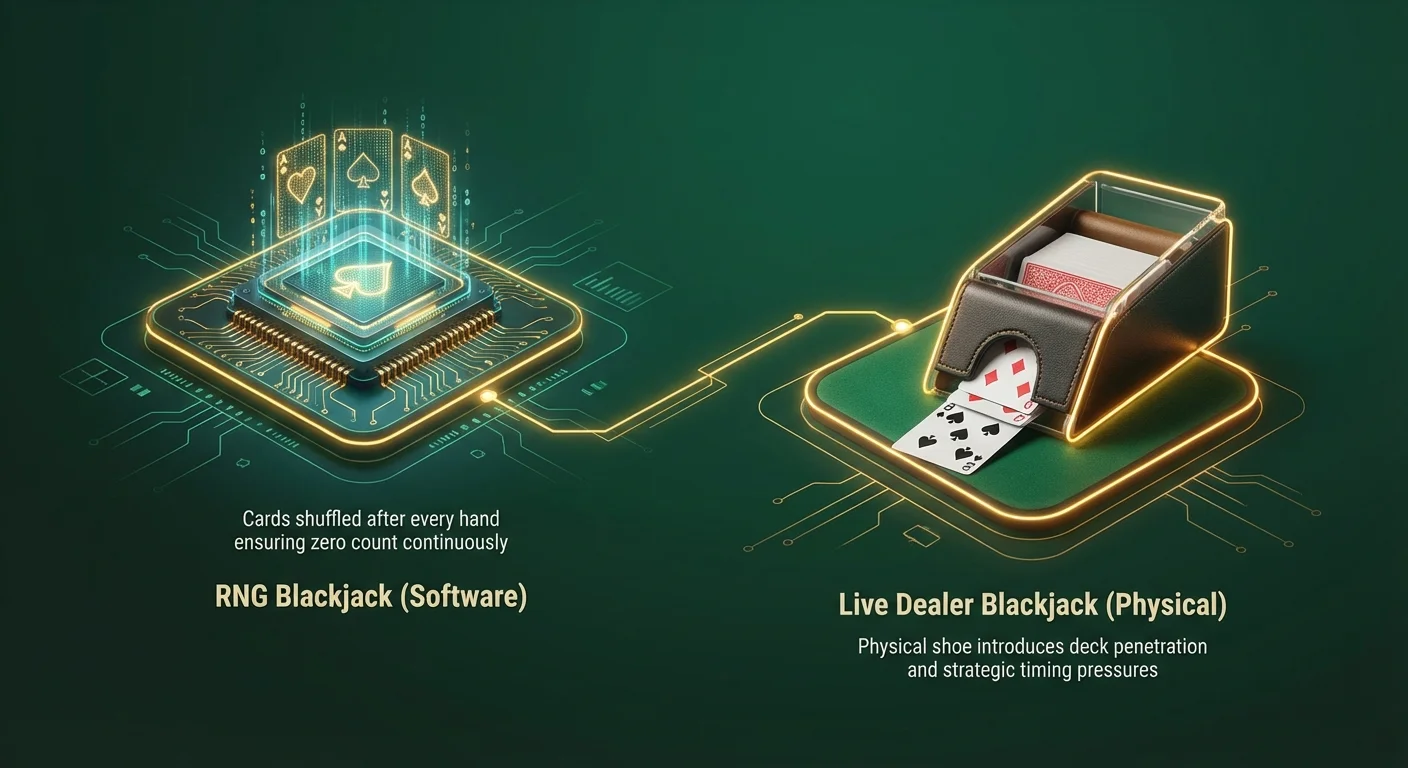
The Fundamental Shift: RNG vs. Human Dealers
To adjust your strategy, you first need to understand the mechanics at play. In standard digital blackjack (RNG), the cards are shuffled after every single hand (or generated via a Provably Fair algorithm). This means the "count" is always zero at the start of a hand.
In live dealer blackjack, the game uses a physical shoe, typically containing six or eight decks. The cards are not shuffled every hand; they are shuffled only when the "cut card" is reached. This fundamental difference reintroduces the concept of deck depletion, which is the cornerstone of intermediate and advanced strategy.
Comparison: Live Dealer vs. RNG Blackjack
| Feature | RNG (Software) Blackjack | Live Dealer Blackjack |
|---|---|---|
| Shuffling | Every hand (fresh deck) | Once per shoe (continuous play) |
| Pacing | Instant; player controls speed | Slower; dealer controls speed |
| Time Limit | None (usually) | Strict timer (10-15 seconds) |
| Other Players | Solo play | Multiplayer (seats can be full) |
| Minimum Bets | Very low ($0.10 - $1.00) | Higher ($5.00 - $50.00+) |
| Mistake Prevention | often has "Warning" popups | No warnings; moves are final |
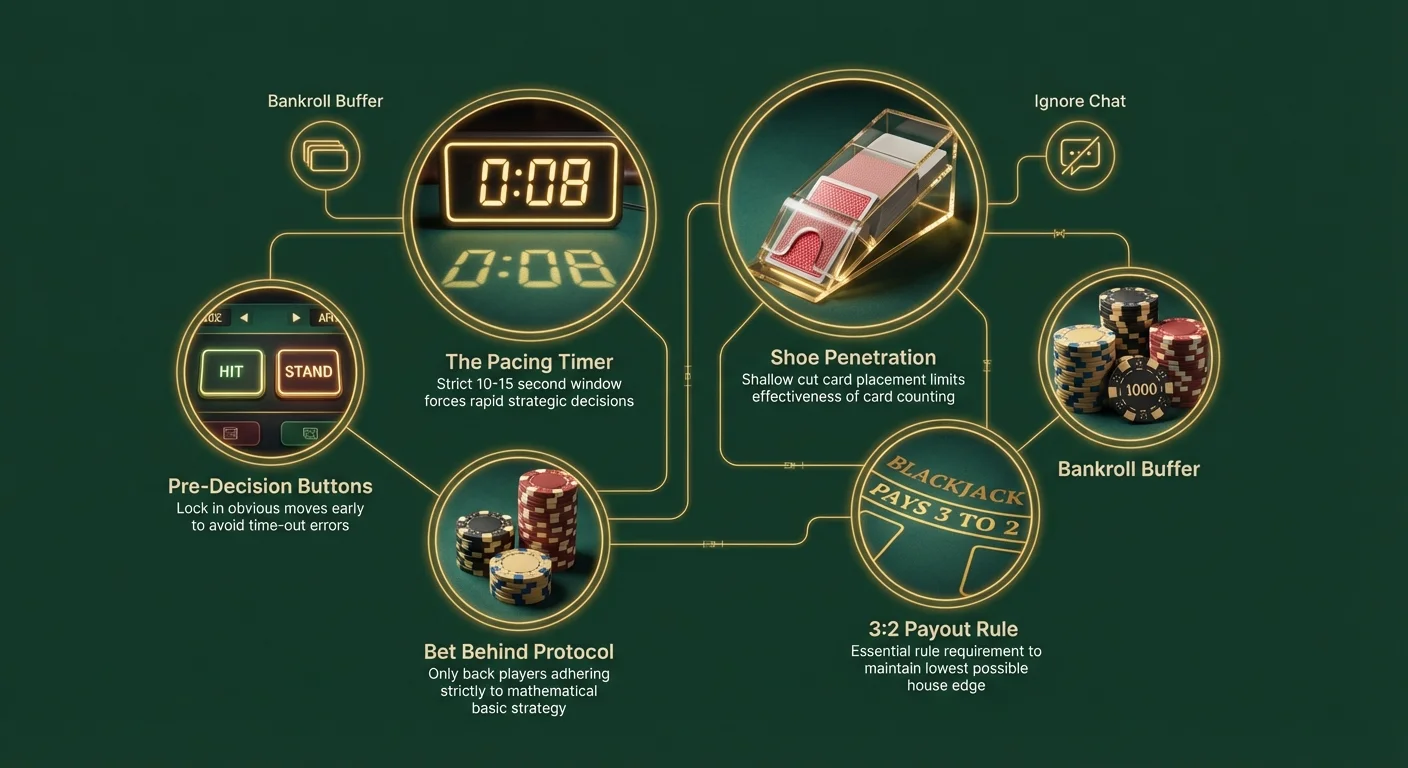
adapting to the Pace: The "Timer" Strategy
One of the most jarring adjustments for players moving to live tables is the betting timer. In an RNG game, you can stare at a strategy chart for five minutes before hitting "Double Down." At a live table, you generally have 10 to 15 seconds to act. If you time out, the system will automatically "Stand" or "Hit" based on predefined rules (usually standing on hard 12+ and hitting anything else), which can be disastrous.
Pre-Decision Buttons
Most top-tier live providers (like Evolution or Pragmatic Play, commonly found on crypto gambling sites) offer "Pre-Decision" buttons. You can select Hit, Stand, Double, or Split before the dealer gets to your turn.
- Strategy Tip: Always use pre-decision buttons for obvious hands (e.g., Hard 19, Hard 5). This keeps the game moving and reduces the chance of a "mis-click" due to panic when the timer turns red.
- The Psychological Edge: Using pre-decisions stops you from second-guessing the math. If you have a 16 against a 10, the math says Hit (or Surrender). If you wait, you might talk yourself into Standing out of fear.
The Art of "Betting Behind"
One common issue at popular live crypto casinos is that prime tables (typically those with $5 to $25 minimums) are often full. Rather than waiting, you can choose to "Bet Behind" a seated player. You stake money on their hand, and your result mirrors theirs.
However, betting behind is risky if you choose the wrong "pilot."
How to Choose Who to Bet Behind
Never bet behind a player blindly. Watch a few rounds first and look for these indicators:
- Basic Strategy Adherence: Watch how they handle "stiff" hands. If a player Stands on a 16 against a Dealer 7, or fails to Double Down on 11, do not bet behind them. Their mathematical errors will cost you money.
- The "Hot" Player Fallacy: Don't choose a player just because they have a high stack of chips. They may have won that money playing recklessly. Look for competence, not just luck.
- Configuration Settings: Check your settings menu. Most interfaces allow you to set strict rules for your bet behind wagers.
- Double Down: You can configure the game to automatically double your bet when the main player doubles, or to keep your bet the same. Recommendation: Always follow the double if the player is using Basic Strategy.
- Split: You can choose to split your bet or not.
Pro Tip: If you are betting behind a solid strategy player, this is actually an advantage. It allows you to "flat bet" (bet the same amount consistently) while they endure the stress of making decisions.
Shoe Penetration and Card Counting
Can you count cards in live dealer blackjack? The short answer is: Yes, but it is less effective than in a physical casino.
Live dealer studios know that players are watching from home with computers. To combat card counting, they instruct dealers to place the "cut card" (the card that signals the end of the shoe) very early - often cutting off 50% of the shoe (4 out of 8 decks).
The Implication for Strategy
Because penetration is shallow, you will rarely see a "True Count" high enough to justify massive bet variations. However, you can use Deck Composition to make minor adjustments.
- The Ace/Ten Rich Deck: If you notice a shoe has produced a disproportionate number of low cards (2s, 3s, 4s, 5s, 6s) in the first few hands, the remaining deck is "Ten Rich."
- Adjustment: In a Ten-Rich deck, you might slightly increase your bet size. More importantly, be slightly more aggressive with Insurance (though generally, insurance remains a bad bet) or taking "Even Money" on blackjack if the count is extremely high.
- The Low Card Rich Deck: If face cards are flowing out early, tighten your bets. The probability of the dealer busting on a stiff hand decreases significantly when the high cards are gone.
Navigating 6:5 Payouts and Table Rules
As noted in standard blackjack guides, the payout ratio is the single biggest factor in the House Edge. A standard "Natural Blackjack" should pay 3:2.
Many "Party" style live dealer tables (where the music is loud and the dealers are chatty) sneak in a 6:5 payout rule.
- 3:2 Payout: A $10 bet wins $15.
- 6:5 Payout: A $10 bet wins $12.
This difference increases the house edge by approximately 1.39%, making it one of the worst games in the casino.
Strategy Adjustment:
Always check the table felt (the text written on the virtual table) or the "Info" tab before sitting down. If it says "Blackjack pays 6:5," leave immediately. In the crypto casino ecosystem, there are almost always standard 3:2 tables available if you scroll down the lobby list to the "Pro" or "VIP" sections.
Live Game Variants: Specific Strategies
Crypto casinos often feature variations of blackjack provided by studios like Evolution Gaming. These require specific strategy tweaks.
1. Infinite Blackjack / One Blackjack
In these games, an unlimited number of players bet on a single hand dealt by the dealer. However, each player makes their own decisions. If you Stand and another player Hits, the dealer draws a card. That card "doesn't exist" for you but applies to the other player.
- The Trap: These games often include the "Six Card Charlie" rule (win automatically with 6 cards under 21). While this sounds good, it rarely happens.
- The Side Bets: Infinite Blackjack is famous for side bets like "Hot 3" or "21+3." These have a house edge ranging from 3% to 10%+. Avoid side bets to preserve your bankroll.
2. Speed Blackjack
The rules are standard, but the dealing order changes. The player who hits "Hit" first gets the next card.
- The Adjustment: Do not play this unless you know Basic Strategy by heart. If you hesitate, you get the card last. This doesn't mathematically change the odds of the card value, but it forces you to rush, leading to errors.
Bankroll Management for Live Tables
Because live dealer games have higher operational costs (salaries for dealers, studio lighting, bandwidth), minimum bets are higher. You cannot play with a $20 deposit and expect to last long on a $5 minimum table.
The 50-Unit Rule
For live blackjack, a safe bankroll is 50 times your base bet unit.
- If you want to play $10 hands, you should have $500 in your crypto wallet.
- This creates a buffer against standard variance (losing streaks).
If your bankroll is smaller, stick to RNG Blackjack until you build it up. RNG tables allow for micro-stakes (often $1 or less), allowing you to grind up a balance safely.
Table Etiquette and Chat Interaction
While you are behind a screen, the dealer is a real person. Strategy extends to how you interact with the game environment.
- Don't Blame the Dealer: If the dealer draws a 5 to a 16 and makes 21 to beat your 20, do not abuse them in the chat. It creates a negative vibe at the table.
- Tipping: It is customary (though not mandatory) to tip the dealer after a big winning session. In crypto casinos, chips are often denominated in currency equivalents (USD/EUR) even if you deposited BTC. A small $1 or $5 tip maintains good karma.
- Distractions: The chat box can be distracting. Players will often shout out bad advice ("Always split 10s!"). Ignore the chat regarding strategy. Trust the math, not the avatar named "CryptoKing99".
Summary: The Live Dealer Checklist
Before you commit your Bitcoin or Ethereum to a live seat, run through this mental checklist:
- Check the Payout: Is it 3:2 or 6:5? (Only play 3:2).
- Check the Dealer Rules: Does the dealer Hit or Stand on Soft 17? (Stand on Soft 17 is better for the player).
- Assess the Stream: Is your internet connection stable? If you disconnect during a live hand, the game will auto-stand for you, which could ruin a Double Down opportunity.
- Know Your Tablemates: If betting behind, verify the main player is competent.
- Ignore the Side Bets: Focus on the main game to keep the house edge under 0.5%.
Live dealer blackjack offers the most immersive experience in online gambling. By adjusting for the timer, ignoring the bad advice in the chat, and understanding the mechanics of shoe penetration, you can enjoy the human element without sacrificing your mathematical edge.