
When players first transition from casual play to serious strategy, the first variable they usually target is the number of decks. There is a prevailing myth in the gambling world that Single Deck Blackjack is the "Holy Grail" while the 8-deck shoe is a trap designed to drain your bankroll.
The reality, however, is far more nuanced. While the number of decks plays a critical role in the mathematical house edge, it is often the rules attached to those decks that determine your fate. A single-deck game can carry a higher house edge than an 8-deck shoe if the casino tweaks just one or two payout rules.
For crypto casino players, understanding this dynamic is essential. The digital landscape offers everything from algorithmic, Provably Fair single-deck games to live-streamed 8-deck shoes from studios in Riga or Manila. This guide will dismantle the myths, explain the math, and help you choose the right game for your bankroll and playstyle.

The Mathematics of the Shoe: Why Deck Count Matters
To understand why players hunt for fewer decks, you must understand the "Effect of Removal."
In Blackjack, unlike Roulette or Craps, the odds change after every single card is dealt. If an Ace is removed from the deck, the player's chances of hitting a Blackjack (and getting that sweet 3:2 payout) decrease.
- In a Single Deck game (52 cards): Removing one Ace drastically alters the composition of the remaining deck.
- In an 8-Deck Shoe (416 cards): Removing one Ace is a drop in the ocean. The probabilities shift, but barely.
Mathematically, adding decks increases the House Edge, assuming all other rules remain exactly the same. Here is the general breakdown of how the House Edge increases purely based on deck count:
| Number of Decks | House Edge Increase |
|---|---|
| Single Deck | Baseline (0.00%) |
| 2 Decks | +0.32% |
| 4 Decks | +0.48% |
| 6 Decks | +0.54% |
| 8 Decks | +0.57% |
At first glance, this table suggests you should never play an 8-deck game. However, this data exists in a vacuum. In the real world, casinos know that single-deck games favor the player, so they often alter the rules to compensate.
The Single Deck Trap: Read the Fine Print
If you log into your favorite crypto casino and see a "Single Deck Blackjack" table, do not instantly sit down with your maximum bet. You need to investigate the rules immediately.
Because a true Single Deck game offers the player such a distinct advantage (sometimes reducing the house edge to negative figures with perfect card counting), casinos often implement "The 6:5 Rule" to protect themselves.
The 6:5 Payout Disaster
Standard Blackjack pays 3:2. If you bet roughly 10 mBTC and hit a natural Blackjack, you win 15 mBTC.
In a 6:5 game, that same 10 mBTC bet only wins 12 mBTC.
As detailed in expert analyses of payouts, switching from 3:2 to 6:5 increases the house edge by approximately 1.39%. This is catastrophic.
- Scenario A: You play an 8-Deck Shoe with standard rules (3:2 payout). House Edge is roughly 0.5%.
- Scenario B: You play a Single Deck game with 6:5 payout. House Edge is roughly 1.45%.
The Verdict: A standard 8-deck shoe is significantly better for your bankroll than a bastardized single-deck game. Always check the felt or the "Help" section for the payout ratio before playing.
The 8-Deck Shoe: Consistency and Comps
The 8-deck shoe is the standard for most Live Dealer games at crypto casinos (such as those provided by Evolution or Pragmatic Play). While the math is slightly less favorable off the top, these games often come with player-friendly rules that you won't find at single-deck tables.
Advantages of the Shoe
- Liberal Rules: To compensate for the 8 decks, casinos often allow:
- Doubling down on any two cards (Single deck games usually restrict this to 9, 10, 11).
- Doubling after splitting (DAS).
- Surrender (A massive tool for intermediate players).
- Stability: The variance in an 8-deck shoe is lower. You are less likely to see the deck "run hot" or "run cold" as violently as you would in a single or double-deck game.
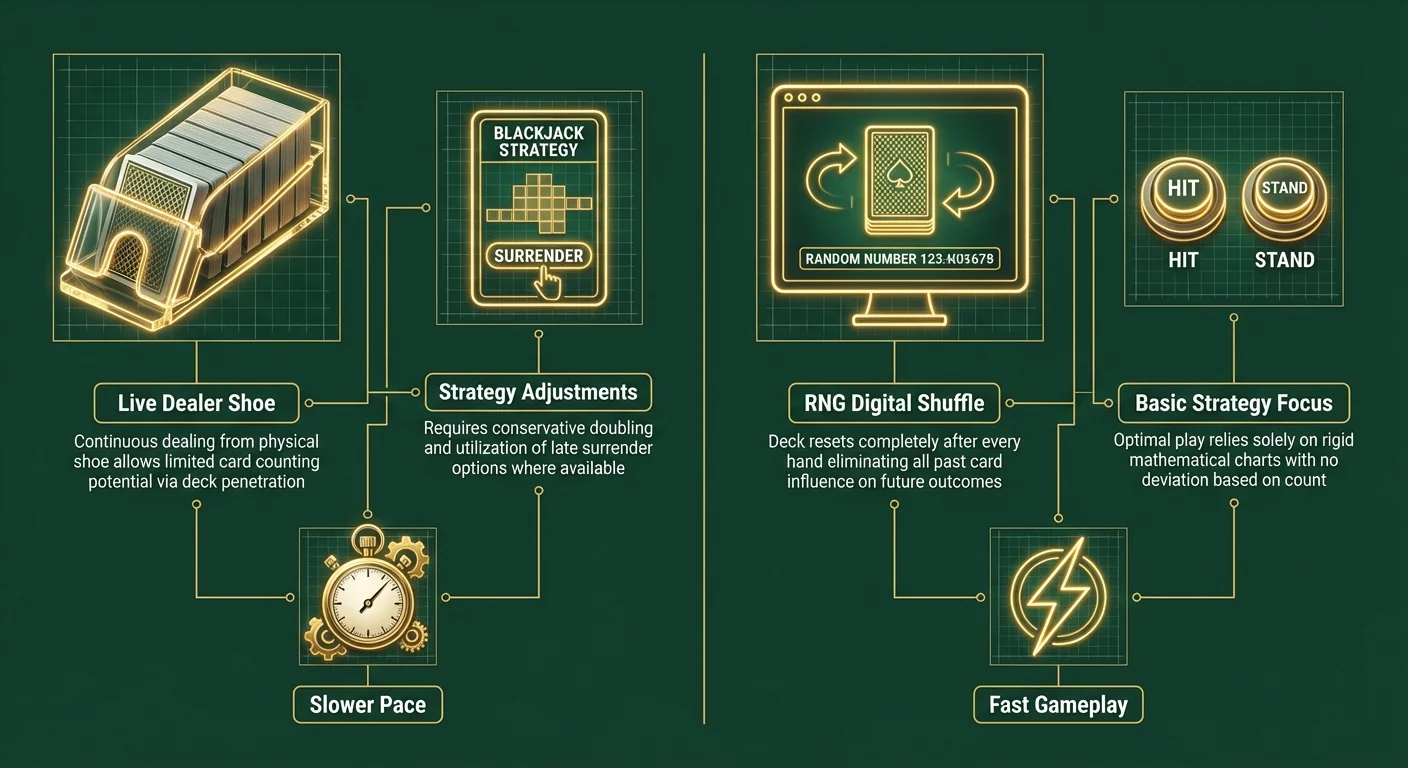
- Shuffle Frequency: In Live Dealer settings, an 8-deck shoe is dealt until the "cut card" is reached (usually about 50-75% through the shoe). This allows for a rhythm to develop.
Strategic Adjustments: How Your Play Must Change
Basic Strategy is not universal. It changes based on the number of decks and whether the dealer hits or stands on Soft 17. If you are using a generic strategy chart for a Single Deck game, you are likely making costly errors.
Here are the key strategic differences to keep in mind:
1. Doubling Down
In single-deck games, the "density" of high cards matters more.
- Single Deck: You should be more aggressive. For example, you might Double Down on an 11 against a Dealer Ace (depending on exact rules), or Double on 9 against a Dealer 2.
- 8-Deck Shoe: You must be more conservative. The probability of pulling that 10-value card is slightly lower due to the dilution of the deck.
2. Splitting Pairs
- Single Deck: You might split a pair of 6s against a Dealer 7.
- 8-Deck Shoe: That same hand might be a "Hit" rather than a split, because the odds of drawing a card that busts your split hands are slightly higher.
3. The Surrender Option
Surrender is rarely offered in Single Deck games. However, in 8-deck crypto live dealer games, "Late Surrender" is a common feature.
- Strategy Tip: If you have a hard 16 against a Dealer 9, 10, or Ace, and Surrender is available, take it. It is statistically better to lose half your bet than to play a losing hand in a multi-deck shoe.
Card Counting: Viability in Crypto Casinos
Intermediate players often ask: Can I count cards in crypto casinos? The answer depends entirely on the format of the game (Software vs. Live).
Software-Based (RNG) Blackjack
In purely digital blackjack games (often called "Table Games" or "Provably Fair" Blackjack), the deck is usually "shuffled" by the Random Number Generator (RNG) after every single hand.
- Deck Count: Even if it says "Single Deck," it effectively resets every hand.
- Viability: Card counting is impossible. Past cards have zero influence on future cards. Focus entirely on Basic Strategy.
Live Dealer Blackjack
In Live Dealer streams, a human dealer uses a physical shoe.
- Deck Penetration: This is the most critical factor. Penetration refers to how many cards are dealt before the shuffle. If a casino uses 8 decks but cuts off 4 of them (50% penetration), card counting is useless because you never see deep enough into the shoe to gain an advantage.
- The Crypto Advantage: Some high-stakes crypto tables offer better penetration. Look for dealers who place the cut card further back in the shoe.
- Counting Difficulty: Counting an 8-deck shoe requires immense patience. You are looking for a "True Count" (Running Count divided by Decks Remaining). In an 8-deck shoe, a running count of +10 is only a True Count of roughly +1.5 at the start of the shoe - hardly enough to raise your bet significantly.
Crypto-Specific Considerations: Provably Fair & Speed
When playing with Bitcoin, Ethereum, or USDT, you have options that traditional casinos cannot match.
Provably Fair Single Deck
Some crypto-native casinos (like Stake or BC.Game originals) offer "Provably Fair" Blackjack.
- Pros: Minimal house edge (often < 0.5%), instant payouts, and you can verify the fairness of every shuffle on the blockchain.
- Cons: No card counting (shuffle on every hand) and often simplified graphics.
- Best For: Grinders looking to execute perfect Basic Strategy using a flat-betting or conservative progressive system (like Paroli).
Speed and Bonuses
Crypto casinos are aggressive with bonuses. However, check the "Wagering Contribution."
- The Catch: Blackjack often contributes only 5% or 10% toward bonus rollover.
- The Hack: Single Deck games are often excluded entirely from bonus wagering because the house edge is too low. If you are grinding a bonus, you will likely be forced onto the 6 or 8-deck shoes.
Summary Comparison: What Should You Play?
Use this table to decide which game suits your current session goals.
| Feature | Single Deck (Crypto) | 8-Deck Shoe (Live Dealer) |
|---|---|---|
| Typical House Edge | 0.15% - 1.45% (Watch for 6:5) | 0.45% - 0.70% |
| Blackjack Payout | Often 6:5 (Beware) | Standard 3:2 |
| Card Counting | Impossible (RNG Shuffle) | Possible (Hard due to penetration) |
| Game Speed | Instant | Slow / Social |
| Variance | High (Swingy) | Low (Smoother) |
| Bonus Wagering | Often 0% Contribution | Often 5-10% Contribution |
| Best Strategy | Aggressive Doubling | Conservative / Use Surrender |
Practical Tips for Your Next Session
Before you deposit your crypto and take a seat, run through this mental checklist:
- Check the "Pays" Line: Look at the table felt. If it says "Blackjack pays 6 to 5," close the window immediately. It is mathematically impossible to beat this game long-term.
- Find the "S17" or "H17" Rule:
- S17 (Dealer Stands on Soft 17): Better for the player.
- H17 (Dealer Hits Soft 17): Increases house edge by about 0.22%.
- Tip: Many single deck games force H17, whereas premium 8-deck shoes might offer S17.
- Adjust Your Chart: Do not use the same strategy card for every game. Search for "Single Deck Basic Strategy" or "multi-deck strategy" specifically.
- Manage Bankroll for Speed: Digital single-deck games are fast. You can play 600 hands an hour. This exposes your bankroll to the house edge rapidly. If you are losing, you will lose faster on a digital single-deck game than a live 8-deck shoe, simply due to volume.
Conclusion
The number of decks in the shoe is a vital piece of the Blackjack puzzle, but it is not the whole picture. While a genuine 3:2 Single Deck game offers the best odds in the casino, they are rare "unicorns" in the modern crypto gambling space.
For most intermediate players, a reputable Live Dealer 8-Deck Shoe playing 3:2 with the ability to Surrender offers the best balance of fair odds, consistent gameplay, and protection against the dreaded 6:5 payout trap.
Remember to utilize the transparency of crypto casinos. Check the rules, verify the hash if playing Provably Fair, and always adjust your betting strategy to match the deck count.