
In the modern era of poker, the days of passively limping into pots to "see a flop" are long gone. If you want to crush the tables, whether you are grinding traditional fiat cash games or high-stakes Bitcoin tournaments, you must be comfortable with aggression. Pre-flop poker has evolved into a complex battlefield of re-raises, bluffs, and counter-bluffs known as 3-betting and 4-betting.
This guide moves beyond "ABC Poker." We aren't just looking at the strength of your hand; we are looking at the strength of your range, the mathematical advantage of fold equity, and the psychological pressure applied to your opponents. If you want to survive the volatility of high-octane crypto poker games, you must master the art of pre-flop warfare.
Defining the Battlefield: The Hierarchy of Bets
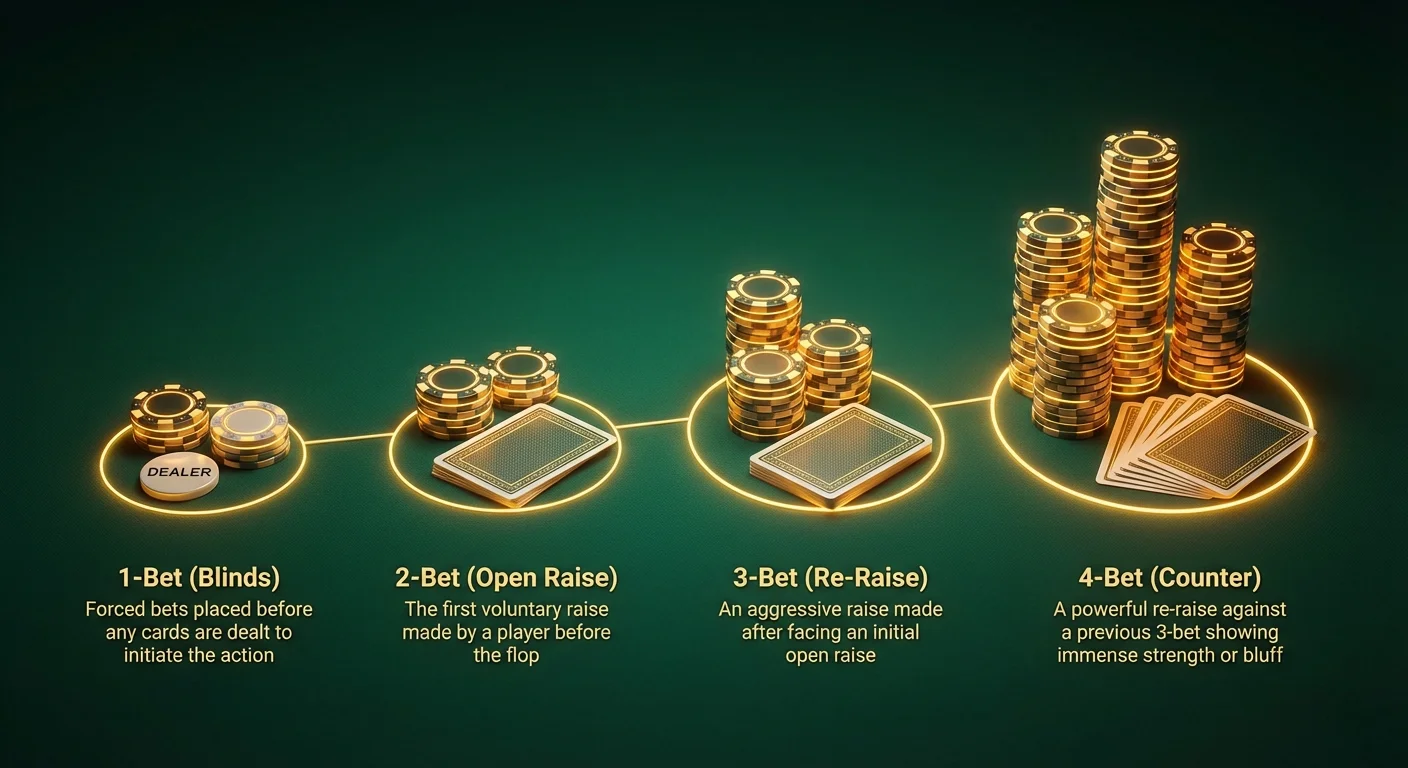
Before diving into complex ranges, we must establish a clear lexicon. In No-Limit Hold'em (NLHE) and Pot Limit Omaha (PLO), the betting sequence is numbered based on the forced bets.
- 1-Bet (The Blinds): The Big Blind is technically the first forced bet.
- 2-Bet (The Open): When a player raises pre-flop (an "Open Raise"), this is the second bet.
- 3-Bet (The Re-Raise): If a player faces an open raise and decides to raise again, this is a 3-bet.
- 4-Bet (The Counter): If the original opener (or a third party) re-raises the 3-bettor, this is a 4-bet.
- 5-Bet (The Jam): Typically, in 100 big blind (bb) stack depth games, the 5-bet is an all-in shove.
Understanding this hierarchy is important because the strategic implications change with every escalation. A 3-bet is a common maneuver used to isolate weak players or build a pot. A 4-bet, however, usually commits a significant portion of a player's stack, narrowing ranges to the absolute strongest hands or the most calculated bluffs.
The 3-Bet: The Primary Weapon of Aggression
A 3bet strategy is the hallmark of a winning player. If your 3-bet percentage is too low (e.g., under 5%), observant opponents will know you only hold Aces or Kings, and they will simply fold, denying you value. If it is too high (e.g., over 15%), they will 4-bet you relentlessly or trap you post-flop.
Why Do We 3-Bet?
There are three primary reasons to 3-bet, and understanding "why" you are betting dictates "what" hands you choose.
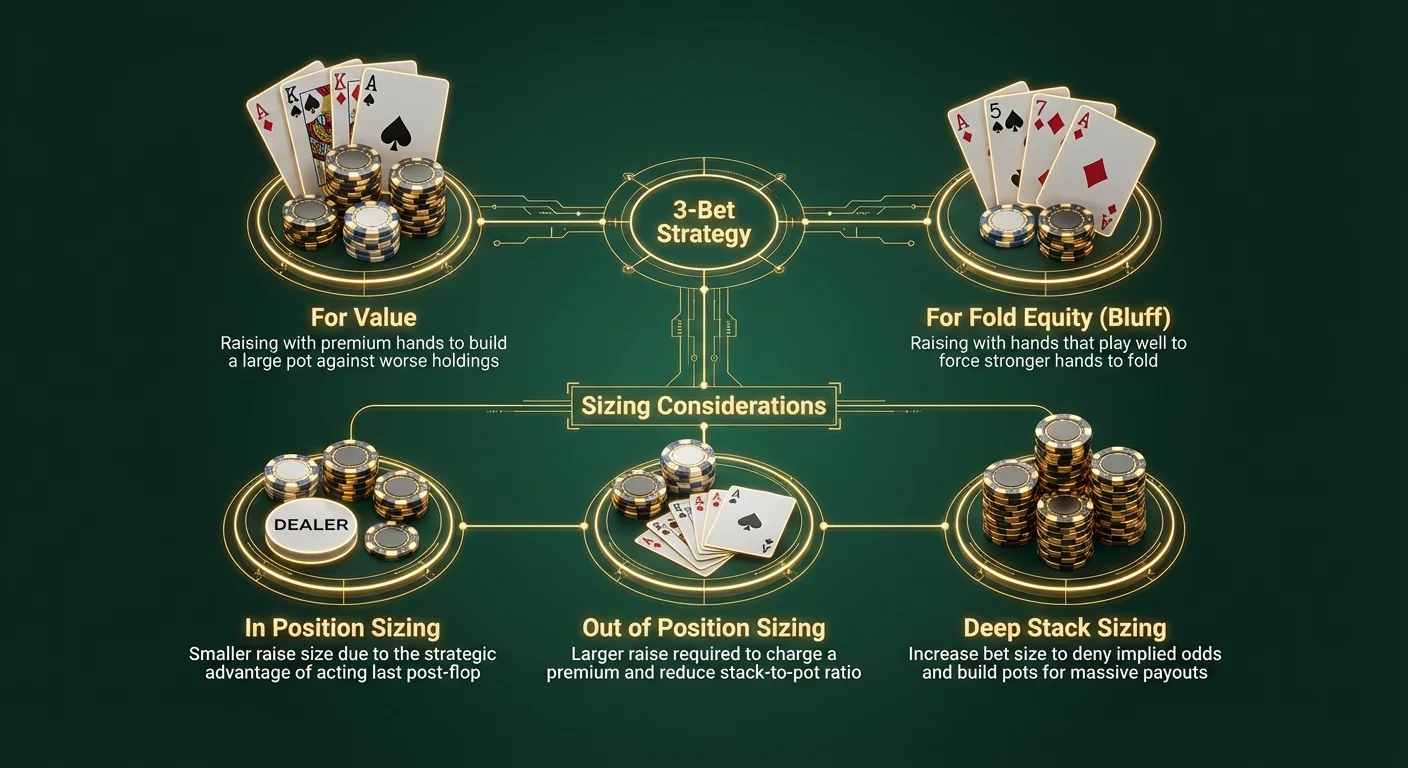
- For Value: You have a premium hand (AA, KK, QQ, AK) and you want to build a large pot while you likely have the best equity. You want worse hands (like JJ, TT, AQ) to call you.
- To Isolate: A loose, aggressive player opens from late position. You 3-bet to force the blinds to fold, creating a heads-up pot against a player with a wide, weak range.
- For Fold Equity (Bluffing): You have a hand that plays well (like 78s or A5s) but isn't strong enough to call. You 3-bet hoping the opponent folds. As discussed in poker theory regarding fold equity, if you can force an opponent to fold a hand that had decent equity against you, you win 100% of the pot immediately.
Linear vs. Polarized Ranges
The most important concept in 3-betting is constructing your range based on your opponent and your position.
Linear Range (Merged Range)
A linear range consists of the very top of your hands, extending downwards to "good" hands. You do not have bluffs in the traditional sense; you are 3-betting for value and thin value.
- Composition: AA, KK, QQ, JJ, TT, AK, AQ, KQs.
- When to use: Against calling stations or "loose-passive" players who hate folding. If a player calls 3-bets with KJo or 55, you should 3-bet them with TT and AQ because you dominate their calling range.
Polarized Range
A polarized range consists of the absolute "nuts" (best hands) and "air" (bluffs), with nothing in the middle. The middle hands (like KQo, 99, ATs) are used to just call.
- Composition:
- Value: JJ+, AK.
- Bluffs: A2s-A5s (blockers), 67s-89s (playability).
- When to use: Against strong regulars or tight players. If an opponent only continues against a 3-bet with premium hands, 3-betting AQo is a mistake because if they call, you are crushed. Instead, you 3-bet A5s; if they fold, great. If they 4-bet, you fold easily.
Sizing Your 3-Bets
Sizing requires precision. In the crypto poker environment, where action is fast, mistakes in sizing are punished quickly.
| Position Scenario | Recommended Sizing | Reasoning |
|---|---|---|
| In Position (IP) | 3x the Open Raise | You have the advantage of acting last post-flop. You don't need to bet as large to put pressure on the opener. |
| Out of Position (OOP) | 4x to 5x the Open Raise | Acting first is a disadvantage. You must charge the opponent a premium to see the flop and reduce the stack-to-pot ratio (SPR). |
| Deep Stacked (200bb+) | Add 1x-2x | With deeper stacks, implied odds increase. Larger bets deny implied odds and build the pot for a massive payout. |
The 4-Bet: Entering Deep Waters
When you put in a 4bet poker move, you are essentially saying, "I am willing to play for stacks." At 100bb depth, a 4-bet usually involves putting in 20% to 25% of your stack. Calling a shove afterwards is often mathematically mandatory due to pot odds.
Value 4-Betting
This is straightforward. You have AA or KK. Occasionally QQ or AK, depending on how aggressive the Villain is. You re-raise because you want to get all the money in pre-flop.
Bluff 4-Betting
This is where advanced strategy comes into play. If you only 4-bet with Aces and Kings, good players will never pay you off. You must have bluffs.
The best 4-bet bluffs use "Blockers."
A blocker is a card in your hand that mathematically reduces the combinations of strong hands your opponent can hold.
- The Gold Standard: A5 suited.
- Holding an Ace makes it less likely the opponent has AA (reduced from 6 combos to 3) or AK (reduced from 16 combos to 12).
- If called, the 5 gives you straight wheel potential and the suit gives flush potential.
- KQs is another decent candidate as it blocks KK, QQ, AK, and AQ.
Strategic Tip: Do not 4-bet bluff at low stakes or against "fish." If a recreational player 3-bets you, they usually have a monster. Do not try to blow them off their hand. 4-bet bluffing is a strategy reserved for battling other aggressive regulars.
Defending Against Aggression
It is inevitable: you open with JTs, and the button 3-bets you. What do you do?
1. The Call
You call when your hand has good post-flop playability and the price is right.
- Hands: Suited connectors (98s, T9s), pocket pairs (77-JJ), and broadway hands (KQs, AJs).
- Condition: You must realize your equity. If you are Out of Position (e.g., Small Blind vs. Button), you should call tighter because it is hard to play draws without position.
2. The Fold
Fold equity works both ways. Do not be stubborn.
- Hands: Easily dominated hands like AJo, KQo, or small off-suit connectors.
- The "Gap" Concept: You need a stronger hand to call a raise than to make a raise.
3. The 4-Bet (For Value or Bluff)
As discussed above, if you believe the 3-bettor is getting out of line (bluffing too much), you turn the tables with a 4-bet.
Calculating Pot Odds to Call
Reference the math. If you open to 3bb, and Villain makes it 9bb, the pot is now roughly 12bb (ignoring blinds for simplicity). You have to call 6bb more.
- Total Pot after you call: 3bb (you) + 9bb (villain) + 1.5bb (blinds) + 6bb (call) = ~19.5bb.
- You call 6bb to win a total pot of 19.5bb.
- Roughly 3:1 odds. You need ~25% equity to break even.
- Raw equity isn't enough. You need Playability. A hand like
22has equity, but it is miserable to play post-flop if you don't hit a set.T9shas lower raw equity vs.AKthan22does, butT9scan realize that equity much better by hitting straights and flushes.
Pre-Flop Warfare in Crypto Poker
Crypto gambling sites offer unique environments that influence 3-bet and 4-bet strategies.
1. Anonymous Tables and HUDs
Many crypto-native poker sites prioritize anonymity to protect recreational players. If you cannot use a HUD (Heads-Up Display) to see a player's "3-Bet %" stat, you must rely on Population Tendencies.
- General Crypto Pop Tendency: The player pool is often split between "nits" (tight players trying to preserve Bitcoin) and "maniacs" (gamblers looking for fast action).
- Strategy: Identify the player type early. Versus the Nit, fold to 3-bets. Versus the Maniac, widen your value 4-betting range to include TT+ and AQ+.
2. The Impact of Rake
Some crypto poker rooms have different rake structures. High rake environments discourage flat-calling.
- Why? If you call, you see a flop, and if you win, you pay rake. If you 3-bet and everyone folds, you win the pot pre-flop rake-free (on most sites).
- Adjustment: In high-rake games, adopt a "3-Bet or Fold" strategy, specifically from the Small Blind and Big Blind. Flat calling is losing money to the house.
3. Instant Deposits and Aggression
Because players can reload their stacks instantly with Ethereum or Bitcoin, the fear of "going broke" is reduced compared to someone who drove an hour to a casino. This leads to higher aggression factors. Be prepared to face lighter 4-bets and 5-bet jams.
Advanced Concepts: The Squeeze and The Cold 4-Bet
The Squeeze Play
A squeeze occurs when there is an Open Raise and at least one Caller, and you re-raise (3-bet) huge.
- The Logic: The Opener has a capped range (they didn't 4-bet), and the Caller has a weak range (they didn't 3-bet).
- Sizing: The rule of thumb is 4x the open + 1x for every caller.
- Example: Open to $3, Call $3. You are in the BB. You squeeze to $15 or $18. This prints money against loose tables.
The Cold 4-Bet
This is the "nuclear option." Player A opens, Player B 3-bets, and you (Player C) 4-bet.
- Strength Signal: This move represents immense strength. You are attacking two players at once.
- Range: Usually AA/KK/AK.
- Bluffing: Cold 4-bet bluffs are incredibly risky but effective because no one gives you credit for a bluff here. A5s is, again, the only real candidate.
Common Pitfalls to Avoid
Even experienced players make leaks in their 3-bet/4-bet game.
- 3-Betting Too Small: raising to 6bb over a 3bb open gives the opponent incredible odds to call with their entire range. Make it hurt. Make it 9bb-11bb.
- Calling 4-Bets OOP: If you 3-bet from the SB, get 4-bet, and you hold AQo, just fold. Calling 4-bets out of position with non-premium hands is a recipe for bleeding chips.
- Over-Adjusting to Aggression: If a player 3-bets you twice in a row, don't immediately shove all-in with K9s out of anger. Variance happens. Wait for a spot or 4-bet a proper blocker hand.
- Ignoring Stack Sizes: Never light 3-bet a short stack (less than 40bb). They are looking for a reason to shove. Conversely, be careful 3-betting deep stacks (200bb+) with mediocre hands, as you run the risk of huge reverse implied odds.
Summary: Aggression is the Key to Profit
Mastering preflop aggression is about taking control of the hand before the community cards are even dealt. By using a balanced 3bet strategy and understanding the dynamics of 4bet poker, you move from being a passenger to being the driver.
- Be Selective: Choose your spots based on position and opponent type.
- Be Balanced: Mix value hands with appropriate bluffs (A5s, suited connectors) so opponents can't easily read you.
- Be Aware: Adjust your sizing based on position (IP vs OOP) and keep an eye on stack depths.
In the fast-paced world of crypto gambling, fortune favors the bold, but only if that boldness is backed by mathematical discipline and strategic foresight. Load up your wallet, wait for your spot, and apply the pressure.