If you have grown tired of the slow grinds in No Limit Hold'em or feel like you are folding for hours waiting for a playable hand, Short Deck Hold'em (often called 6+ Hold'em) is the adrenaline injection you've been looking for. Originating in the high-stakes rooms of Macau and popularized by the Triton Super High Roller Series, this variant has taken the crypto gambling world by storm.
Short Deck creates a game where equities run closer, big hands collide frequently, and action is virtually guaranteed. However, playing it with a standard Texas Hold'em mindset is the fastest way to lose your crypto stack. The math is different, the hand rankings have shifted, and the strategy requires a complete overhaul.
This guide explores the mechanics, mathematics, and winning strategies for Short Deck Hold'em, specifically tailored for the intermediate player looking to crush the tables at crypto casinos.
What is Short Deck (6+ Hold'em)?
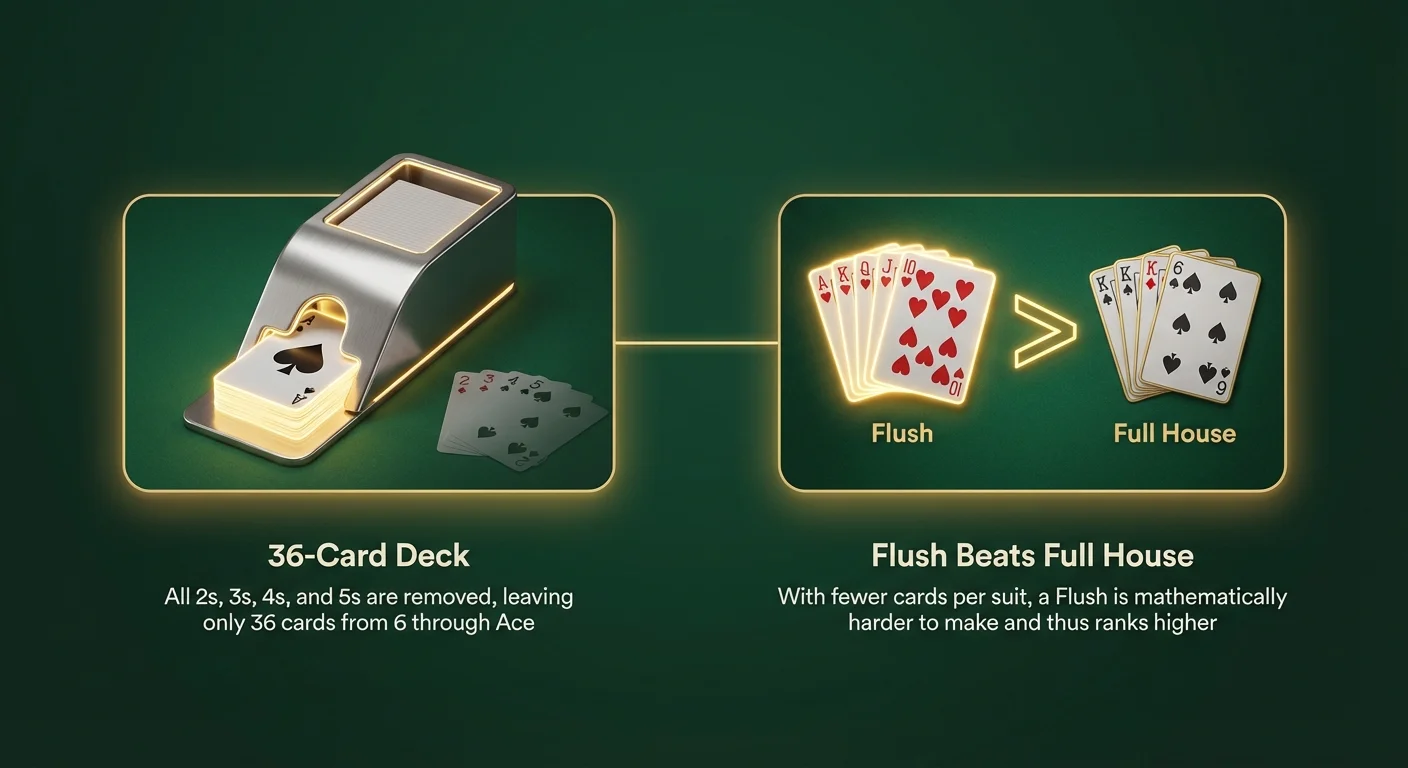
The defining characteristic of Short Deck is in the name: the deck is shortened. All 2s, 3s, 4s, and 5s are removed from the deck. This leaves a total of 36 cards (6 through Ace).
This simple removal changes the entire landscape of the game:
- More Action: With fewer low cards, players receive premium starting hands much more frequently.
- Stronger Boards: You will connect with the flop more often.
- Closer Equities: It is mathematically harder to be a massive favorite pre-flop. Even Aces can be vulnerable.
The Button Blind Structure
While some online games use standard Small Blind/Big Blind structures, many Short Deck games utilize an "Ante-Only" or "Button Blind" structure.
- The Ante: Every player at the table pays an ante.
- The Button Blind: The player on the button pays a "blind" (usually 2x or equal to the size of the ante) in addition to their ante.
This structure creates a massive pot before the cards are even dealt, incentivizing aggressive pre-flop play.
Critical Rule Changes: Hand Rankings
Before you bet a single Satoshi, you must memorize the hand ranking changes. Because the probability of making certain hands shifts with a 36-card deck, the hierarchy of hands changes to reflect the math.
The "Flush Beats Full House" Rule
This is the most significant change. In a 52-card deck, it is harder to make a Full House than a Flush. In Short Deck, because there are fewer cards of each suit (only 9 cards per suit), hitting a Flush is mathematically much harder than making a Full House.
Therefore, in almost all Short Deck games: A Flush beats a Full House.
The Low Straight (A-6-7-8-9)
Since the 2, 3, 4, and 5 are missing, the Ace still acts as a low card for straights, but it connects with the 6.
- The hand A-6-7-8-9 is a straight (the equivalent of A-2-3-4-5 in standard poker).
- Note: This straight loses to any higher straight (e.g., 6-7-8-9-T).
The "Trips vs. Straight" Controversy
There are two variations of Short Deck hand rankings regarding Three-of-a-Kind (Trips) and Straights.
- Standard/Online Rules: Straight beats Three-of-a-Kind (same as Texas Hold'em).
- Triton/High Stakes Rules: Three-of-a-Kind beats a Straight.
Strategy Tip: Most crypto poker sites use the Straight > Trips ranking. However, always check the "Game Info" tab before sitting down. This guide assumes the standard Straight > Trips ranking.
Short Deck Hand Ranking Chart
| Rank | Hand Category | Key Difference from Hold'em |
|---|---|---|
| 1 | Royal Flush | Same |
| 2 | Straight Flush | Same |
| 3 | Four of a Kind | Same |
| 4 | Flush | Beats Full House |
| 5 | Full House | Loses to Flush |
| 6 | Straight | A-6-7-8-9 is the low straight |
| 7 | Three of a Kind | Usually loses to Straight |
| 8 | Two Pair | Very vulnerable in Short Deck |
| 9 | One Pair | Often a bluff-catcher |
| 10 | High Card | Rarely wins at showdown |
The New Math: Calculating Odds and Outs
In standard Texas Hold'em, players use the "Rule of 4 and 2" to estimate their equity (multiply outs by 4 on the flop, and by 2 on the turn). That math relies on a 52-card deck. In Short Deck, with only 36 cards, the remaining unknowns are fewer, meaning your outs hit more often.
The Rule of 6 and 3
To calculate your percentage of hitting a draw in Short Deck:
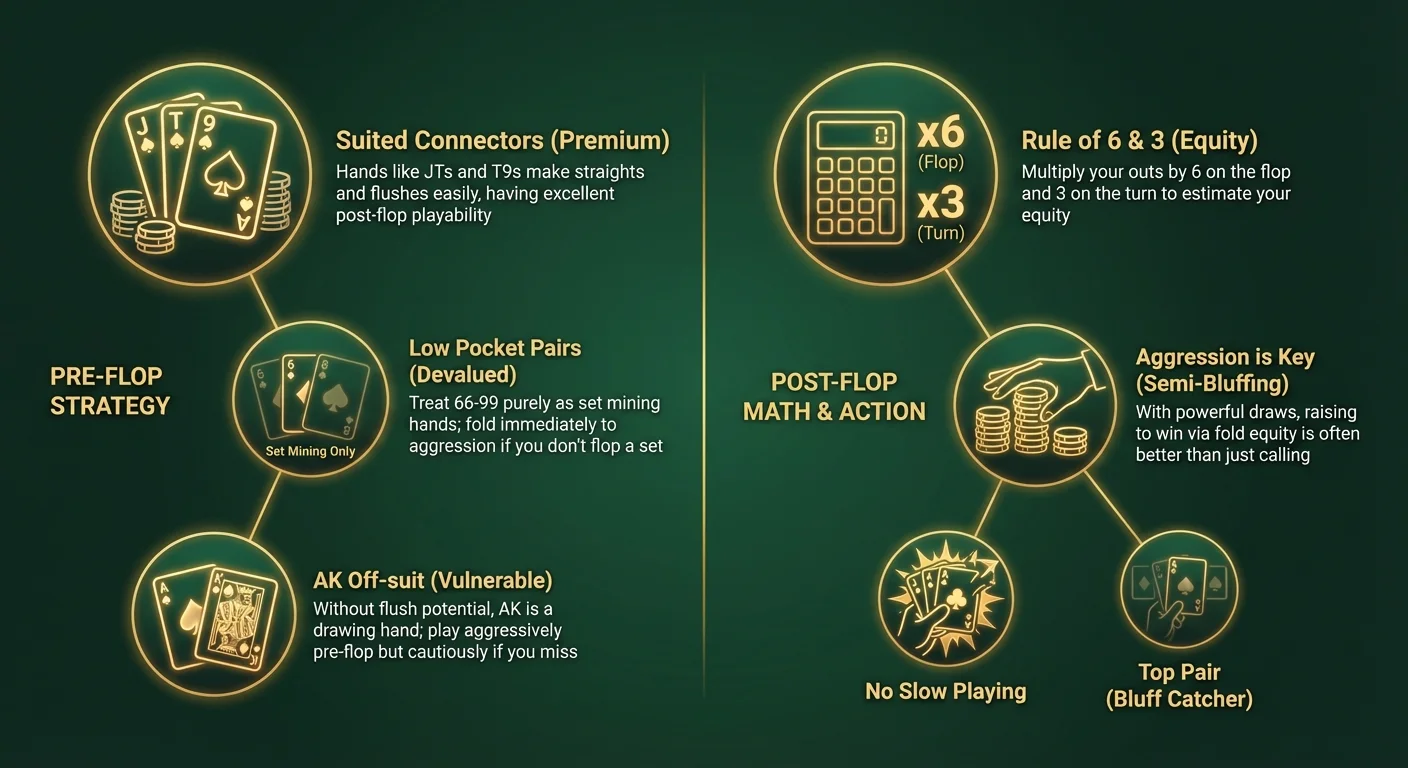
- On the Flop: Multiply your outs by 6.
- On the Turn: Multiply your outs by 3.
Example:
You have an open-ended straight draw (8 outs) on the flop.
- Hold'em: 8 outs x 4 = ~32% equity.
- Short Deck: 8 outs x 6 = ~48% equity.
You are basically a coin flip to hit your straight with two cards to come. This explains why Short Deck is such a high-variance game; drawing hands are incredibly powerful.
Set Mining Math
Because the deck is smaller, you will flop a set much more often.
- Hold'em: You flop a set with a pocket pair roughly 12% of the time (1 in 8).
- Short Deck: You flop a set roughly 18% of the time (nearly 1 in 5).
Pre-Flop Strategy: Rethinking Hand Values
In Short Deck, the gap between the best hand and the worst hand is smaller. In Hold'em, AA is roughly an 85% favorite against a random hand. In Short Deck, equities are "squished." AA might only be a 65-70% favorite.
1. Suited Connectors are Gold
Hands like JTs, T9s, and QJs are the premier hands of Short Deck.
- They make straights easily.
- They make flushes (the nuts).
- They have excellent playability post-flop.
In many scenarios, JTs is a flip (50/50) against a hand like AK off-suit because the JT interacts so well with the board.
2. Pocket Pairs Devalued
While Pocket Aces and Kings are still strong, low and medium pocket pairs (66 through 99) are significantly weaker than in Hold'em.
- Even if you hit your set, straight draws are everywhere.
- If you don't hit your set, your pair is almost always dead.
- Tip: Treat low pairs purely as "set mining" hands. If you don't flop a set, be ready to fold immediately to aggression.
3. The Problem with AK Off-suit
In Hold'em, Ace-King is a powerhouse. In Short Deck, unsuited Ace-King is a drawing hand. Without the flush potential, AK is vulnerable. If you miss the flop, you usually have nothing. Even if you hit Top Pair, Top Kicker, it is rarely the nuts by the river. Play AK aggressively pre-flop, but proceed with caution if you don't improve on the flop.
Post-Flop Strategy: Aggression and Fold Equity
Because drawing hands have so much equity in Short Deck, the concept of Fold Equity becomes vital. As noted in general poker theory, fold equity is the percentage of the time you win the pot because your opponent folds to your bet.
Semi-Bluffing is Mandatory
With the "Rule of 6," your draws are massive. If you have a flush draw or an open-ended straight draw, you should rarely be calling. You should be raising.
- Why? If you call, you can only win by hitting your card. If you raise (Semi-bluff), you can win by hitting your card OR by making your opponent fold.
- Since equities are close, making an opponent fold a hand that has 40% equity against you is a huge victory.
Don't "Slow Play"
Slow playing (checking a monster hand to trap an opponent) is dangerous in Short Deck. Because straights and sets are so easy to hit, a "safe" board can turn into a disaster on the turn.
- If you flop a set, bet.
- If you flop a straight, bet.
- Charge your opponents the maximum price to see the next card.
Re-evaluating Top Pair
In Texas Hold'em, Top Pair/Top Kicker is a hand you can often take to showdown. In Short Deck, Top Pair is a bluff catcher.
With so many straights and sets possible, if a significant amount of money goes into the pot post-flop, Top Pair is almost never good. Be willing to fold Top Pair if the action gets heavy.
The Crypto Advantage in Short Deck
Short Deck is particularly popular on crypto gambling sites for several reasons that savvy players can exploit.
1. Dealing with Variance via Instant Bankroll Management
Short Deck is a high-variance game. You will take "bad beats" where your Aces get cracked, or your set loses to a straight. In traditional fiat poker, reloading your account can take days.Crypto poker sites allow for instant deposits and withdrawals. This allows you to keep a tighter bankroll on the site (for security) while being able to instantly reload from your cold wallet if you hit a downswing, ensuring you never miss a good game due to liquidity issues.
2. Provably Fair Shuffles
In a game where outliers (sets over sets, quads, royal flushes) happen frequently, players often suspect the software is rigged.
Crypto casinos often utilize Provably Fair algorithms. This allows you to cryptographically verify that the deck was shuffled randomly and the removal of the 2-5 cards was handled correctly. This transparency is essential for peace of mind in such an action-heavy game.
Short Deck Strategy Cheat Sheet
To help you transition from Hold'em, here is a quick reference guide for your next session.
| Situation | Strategy Adjustment |
|---|---|
| Starting Hands | Prioritize suited connectors (JTs, T9s) and high pairs. Fold off-suit trash. |
| Calculating Outs | Multiply outs by 6 on the flop and 3 on the turn. |
| Flush Draws | Remember there are only 9 cards of a suit. A flush draw has only 5 outs (vs 9 in Hold'em). However, if you hit it, you beat full houses. |
| Limping | Limping is more acceptable in Short Deck (especially in Ante-only structures) to see cheap flops with speculative hands. |
| 3-Betting | 3-Betting ranges should be wider for value. Merged ranges work better than polarized ones. |
| Bankroll | You need a larger bankroll (in terms of buy-ins) than Hold'em due to high variance. |
Common Mistakes to Avoid
1. Overvaluing Low Sets
In Hold'em, bottom set is a monster. In Short Deck, if you hold 66 on a board of A-Q-6, you have bottom set, but any opponent holding J-10 has a massive draw against you. If the turn is a K, 9, 8, or 7, your set might be dead.
2. Chasing Flushes Incorrectly
Players often forget that while Flushes are powerful, they are harder to hit. In Hold'em, you have 9 outs to a flush. In Short Deck, you only have 5 outs.
- Do not chase flush draws passively.
- Do not overpay to see a flush card.
- However, if you have a Flush Draw and a pair, or a straight blocker, play it aggressively.
3. Playing "Scared Money"
Because equities run close, you will be in many "coin flip" situations. If you are afraid to put your chips in the middle with a 55% edge, you will be bullied off the table. You must be willing to embrace the variance.
Conclusion
Short Deck Hold'em is not just a "mini" version of Texas Hold'em; it is a distinct beast that rewards aggression, mathematical adaptation, and courage. By understanding the power of suited connectors, respecting the strength of flushes, and utilizing the "Rule of 6" to calculate your equities, you can gain a significant edge over opponents who are still playing with a 52-card mindset.
The game is fast, the swings are wild, and the action is relentless. For the crypto gambler looking for a game where skill, math, and speed intersect, Short Deck is the ultimate challenge. Remember to verify the hand rankings of your specific crypto casino, manage your bankroll for high variance, and never fall in love with Top Pair.
Ready to play? Load up your wallet, check the ante structure, and get ready for the fastest poker variant on the planet.