
Most sports bettors operate on instinct. They watch the games, they follow the narratives, and they bet on who they think will win. This approach, while entertaining, is mathematically guaranteed to lose money over time. The "house edge" is designed to grind down players who bet on winners rather than prices. For a deep dive into this fee, read our guide on understanding Juice and Vig.
If you want to move from a recreational gambler to a profitable investor, you must abandon the question "Who will win?" and replace it with "What is the price?"
This is the domain of Expected Value (EV). EV is the single most critical concept in gambling mathematics. It is the measure of what a bettor can expect to win or lose per bet placed on the same odds over and over again. EV betting is not about predicting the future; it is about exploiting inefficiencies in the market's pricing.
In this advanced guide for CryptoGambling.com, we will strip away the luck and focus entirely on profitable betting math. We will cover how to calculate EV, how to determine the "true" probability of an event, and how the efficiency of crypto betting platforms can help you capture value before the market corrects itself.
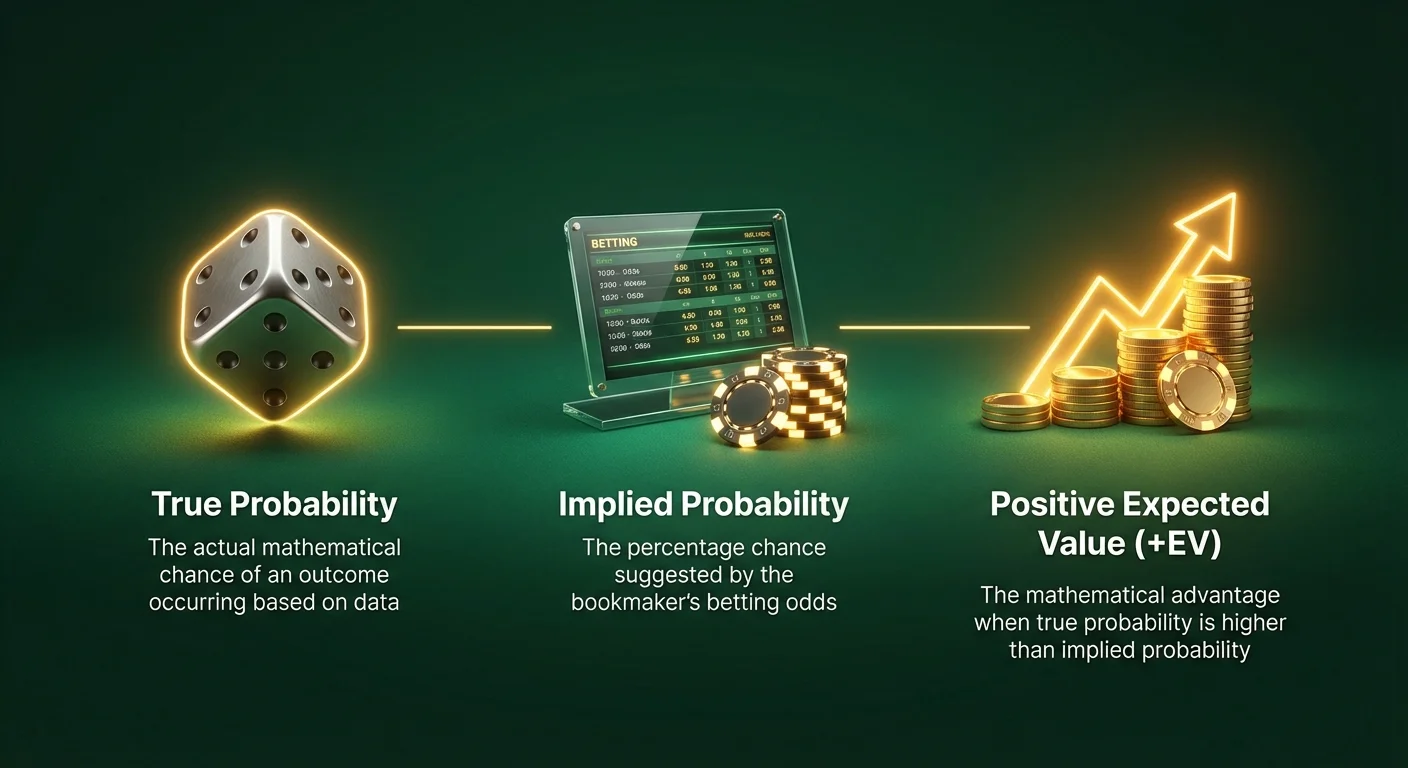
What is Expected Value (EV)?
At its core, Expected Value is a calculation that determines the average result of a specific wager if it were placed an infinite number of times.
- Positive EV (+EV): implies profit over the long run.
- Negative EV (-EV): implies loss over the long run.
- Neutral EV: implies breaking even.
Think of it like a coin toss. A fair coin has a 50% chance of landing on Heads and a 50% chance of landing on Tails.
If a friend offers you a bet where you wager $10 to win $10 on Heads, the EV is neutral. You will win half the time and lose half the time.
However, if that friend offers to pay you $12 for every win, while you still only lose $10 for every loss, you have found Positive EV. You will still lose 50% of the flips, but the math dictates that you will make a profit eventually because the payout exceeds the implied probability of the event.
In sports betting, the bookmaker sets lines (odds) that imply a certain probability. Your goal is to find instances where the bookmaker's implied probability is lower than the actual true probability of the outcome.
The EV Formula
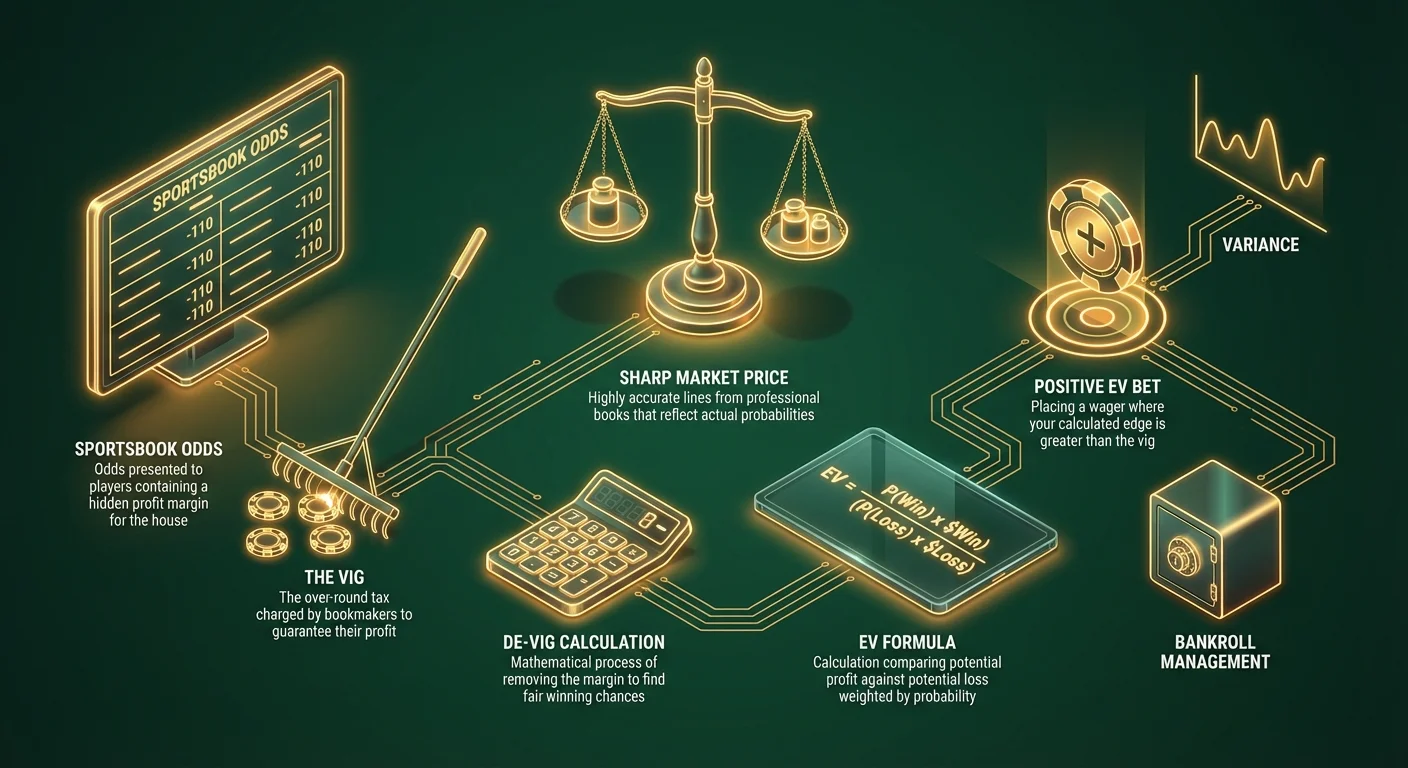
The formula for Expected Value looks like this:
' in math mode at position 32: …y_{Win} \times̲<em>{Win}) - (P…" style="color:#cc0000">EV = (Probability_{Win} \times <em>{Win}) - (Probability</em>{Loss} \times_{Loss})
- Probability (Win): The actual percentage chance that your bet wins.
- $ (Win): The amount of profit you make if you win.
- Probability (Loss): The actual percentage chance that your bet loses.
- $ (Loss): The amount you wager (stake).
The Mathematics of Implied Probability
To find value, you first need to understand what the bookmaker is telling you. Odds are simply a representation of probability, adjusted to include a fee (the vig or juice).
Before calculating EV, you must convert betting odds (American, Decimal, or Fractional) into Implied Probability.
Converting Odds to Percentage
Here is how to convert the most common odds formats into a percentage chance of winning as implied by the bookmaker.
| Odds Format | Example Odds | Conversion Formula | Implied Probability |
|---|---|---|---|
| Decimal | 2.50 | 40.00% | |
| American (+) | +150 | 40.00% | |
| American (-) | -150 | 60.00% |
The Vig (The Bookie's Fee)
If you look at a standard NFL spread, you will usually see both sides listed at -110 (1.91).
- Implied probability of -110 is 52.38%.
- Since there are two sides, 52.38% + 52.38% = 104.76%.
That extra 4.76% is the Vig (vigorish) or over-round. It is the tax the bookmaker charges to accept your bet. To be a profitable EV bettor, your calculated edge must be strong enough to overcome this tax.
How to Calculate Expected Value: A Practical Example
Let's apply the formula to a real-world sports betting scenario.
Scenario: A UFC match between Fighter A and Fighter B.
Your Assessment: Based on your model (or by comparing sharp lines), you believe Fighter A has a 60% chance of winning.
The Odds: A crypto sportsbook is offering Fighter A at +100 (2.00).
Let's run the math on a $100 wager.
Determine True Probabilities:
- $P(Win) = 0.60$ (60%)
- $P(Loss) = 0.40$ (40%)
Determine Financials:
- $ (Win) = $100 (At +100 odds, a $100 bet profits $100)
- $ (Loss) = $100 (Your stake)
Calculate EV:
- $EV = (60) - (40)$
- $EV = +$20
Result: The Expected Value of this bet is +$20.
This means that for every $100 you bet on this specific line, you expect to earn $20 on average. This is a massive 20% ROI. Even if Fighter A loses this specific fight, the bet was mathematically correct.
The Hardest Part: Estimating True Probability
The math above is simple algebra. The difficult part of EV betting is knowing what numbers to plug in for $P(Win)$. If you arbitrarily guess that a team has a 70% chance of winning when they only have a 50% chance, your EV calculation will be useless.
There are two main ways to estimate true probability: Origination and Market-Based Betting.
1. Origination (Building Your Own Model)
This involves creating your own statistical models using data sets, player metrics, weather conditions, and historical trends. You generate your own probability and compare it to the bookmaker's.
- Pros: If your model is unique, you can find edge where no one else looks.
- Cons: Extremely difficult. Competing against multi-billion dollar syndicates with faster data feeds is challenging.
2. Market-Based Betting (The "Sharp" Method)
This is the most accessible strategy for 99% of advanced bettors. It relies on the "Wisdom of the Crowds."
You assume that the "Sharp" sportsbooks (books known for high limits and accepting professional action, like Pinnacle) represent the True Probability. By removing the vig from the sharp lines, you get the "fair odds." You then look for "Soft" sportsbooks (recreational books) that have failed to update their lines to match the sharp market.
How to "De-Vig" a Line to Find True Odds
To find the true probability, you must remove the bookmaker's margin.
Example:
- Sharp Book Line: Team A (-105) / Team B (-105).
- Implied Probability with Vig: 51.22% for both. Total = 102.44%.
- Remove the Vig: Divide the implied probability by the total market percentage.
- $51.22 / 102.44 = 0.50$ (50%).
- True Probability: Both teams have exactly a 50% chance of winning.
- The Play: If you find a Soft Book offering Team A at +110, you have found +EV.
The Crypto Advantage in EV Betting
Cryptocurrency sportsbooks have revolutionized EV betting by removing friction. In the fiat world, moving money between books to capture a fleeting line can take days. In crypto, it takes minutes.
1. Speed of Execution
Positive EV lines are ephemeral. When a sharp book moves a line, soft books usually follow within minutes. You need to bet before they adjust. Bitcoin, Litecoin, and USDT allow for rapid deposit and withdrawal, ensuring your bankroll is liquid and ready to deploy where the value is.
2. Line Shopping and Arbitrage
Because many crypto-native betting sites operate globally with lower overheads, they often have "rogue" lines.
- Arbitrage: Sometimes, the discrepancy between books is so large that you can bet on both sides at different books and guarantee a profit.
- Reduced Juice: Some crypto books offer reduced vig (e.g., -105 lines instead of -110). Lower vig lowers the break-even percentage, making it easier to find +EV bets.
3. Provably Fair (Casino Context)
While this guide focuses on sports, it is worth noting that in crypto casinos, EV is transparent via Provably Fair algorithms. Unlike traditional slots where the Return to Player (RTP) is hidden, Provably Fair games allow you to verify the seed and hash, confirming the exact mathematical edge the house holds. While casino games are almost always negative EV (-EV), crypto offers the only environment where you can mathematically verify how negative it is.
Managing Variance: The Reality of +EV Betting
Finding positive expected value is only half the battle. The other half is surviving the variance.
You can make 100 bets, all with +10% EV, and still lose money in the short term. This is called Variance. A coin flip with a 60% bias towards heads can still land on tails five times in a row.
The Law of Large Numbers
EV only materializes over the "Long Run." In sports betting, the long run is not a week or a month; it is thousands of bets.
If you bet on a +EV edge of 3%, you are effectively grinding out a profit margin similar to a casino. The casino doesn't panic when a player hits a jackpot because they know the math guarantees them profit over 1,000,000 spins. You must adopt the casino mindset.
Bankroll Management (Kelly Criterion)
To survive variance, you must size your bets correctly. If you bet 50% of your bankroll on a single +EV bet and lose, you are ruined.
Most sharps use a fractional Kelly Criterion strategy. The Kelly Criterion calculates the exact amount of your bankroll you should wager based on your edge.
- Tip: A standard approach for advanced bettors is to never wager more than 1% to 3% of their total bankroll on a single play, regardless of how high the EV is.
Step-by-Step Guide to EV Betting
Ready to start betting like a mathematician? Follow this workflow:
- Identify the Sharp Consensus: Look at lines from market-making bookmakers.
- Calculate True Probability: Remove the vig from the sharp lines to find the actual percentage chance of the outcome.
- Scan Soft Books: Look at your crypto sportsbooks to see if any lines differ significantly from the sharp consensus.
- Calculate EV: Use the formula: .
- Assess the Edge: Is the EV positive? Is it high enough to warrant the variance (usually looking for >2% edge)?
- Place the Wager: Bet an appropriate percentage of your bankroll.
- Record the Bet: Track the Closing Line Value (CLV). Did the line move to your numbers by game time? If you bet -110 and the line closes at -125, you made a good bet, regardless of the game result.
Practical Tips for the EV Hunter
- Don't ignore the "Steam": Steam moves occur when syndicates dump heavy money on a side, causing the line to move rapidly across all books. Chasing steam (betting immediately after a move) can be profitable if you catch a "sleepy" book that hasn't moved yet.
- Avoid Parlays: Generally, parlays compound the bookmaker's vigorish, making them heavily -EV. The only exception is if every leg of the parlay is +EV, but this increases variance significantly.
- Understand Market Width: A market with lines of -110/-110 is "tight" and liquid. A market with lines of -140/+110 has a huge hold (vig). It is much harder to beat markets with high holds (like player props or exotic bets) because you have to overcome a larger tax.
- Use Odds Aggregators: Do not check books manually. Use odds comparison sites that highlight discrepancies between major crypto sportsbooks.
Summary
In the world of professional gambling, feelings are irrelevant. The only number that matters is Expected Value.
By understanding profitable betting math, you stop being a gambler and start being a trader. You are buying outcomes at a price lower than their intrinsic value.
- If the math says a team wins 50% of the time, and you get paid as if they only win 45% of the time, you have an edge.
- If you repeat this process thousands of times, the laws of probability dictate that you will profit.
Leverage the speed of crypto transactions to catch these inefficiencies, manage your bankroll to survive the inevitable downswings, and trust the process. The game isn't played on the field; it's played on the spreadsheet.