
Deciding between cash games (often called "ring games") and Multi-Table Tournaments (MTTs) is one of the most defining moments in a poker player's journey. While the rules of No-Limit Hold'em or Omaha remain the same regardless of the format, the strategies, lifestyle, and mindset required to succeed in each are vastly different. It is entirely possible to be a shark in a cash game and a fish in a tournament, simply because the variables of play shift so dramatically.
For the modern crypto poker player, this choice is even more nuanced. With the speed of Bitcoin transactions and the availability of stablecoins like USDT, the liquidity and accessibility of both formats have improved. Whether you are looking to grind out a steady hourly wage in ETH or aiming for a massive Bitcoin jackpot in a Sunday Major, understanding the fundamental differences between these formats is essential.
This guide explores the structural, strategic, and financial disparities between cash games and tournaments to help you decide which path leads to your personal poker glory.

The Fundamental Differences: Chips vs. Cash
To understand the strategy, you must first understand the objective. The primary difference lies in what the chips represent and how the game ends.
Cash Games: The Infinite Grind
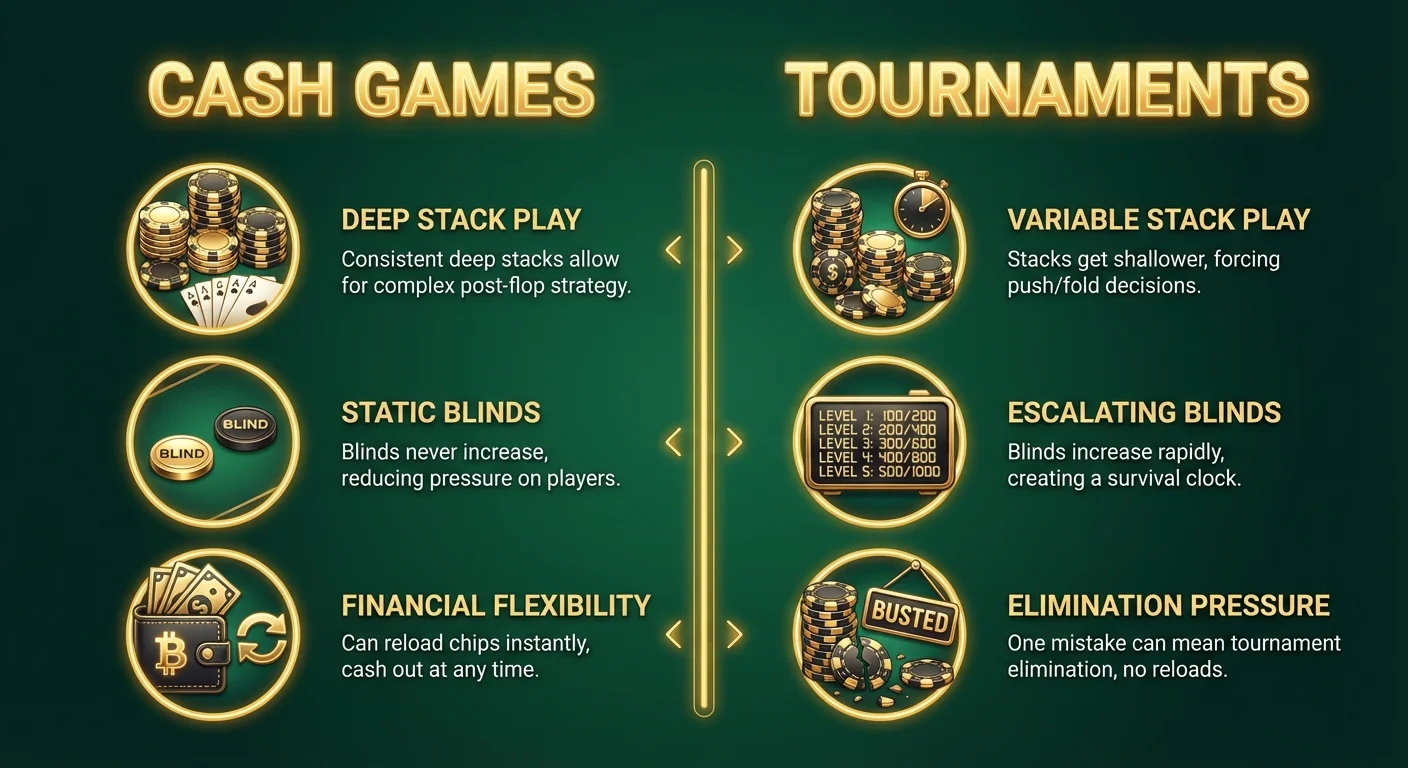
In a cash game, your chips are directly equivalent to money. If you have 100 mBTC in front of you, you can stand up, cash out, and walk away with that 100 mBTC at any moment (provided you aren't in the middle of a hand).
- Blinds: The blinds remain static (e.g., $1/$2 or 0.001/0.002 BTC) indefinitely.
- Re-buys: If you lose your stack, you can reach into your wallet and reload immediately up to the table maximum.
- Objective: To win more blinds/chips than you lose over a specific session.
Tournaments (MTTs): The Survival Game
In a tournament, you pay a buy-in (entry fee) to receive a set amount of tournament chips. These chips have no cash value outside the tournament context. You cannot cash out halfway through; you must play until you lose all your chips or win them all.
- Blinds: The blinds increase at set intervals (e.g., every 10, 12, or 15 minutes).
- Payouts: Only the top percentage of the field (usually 10-15%) gets paid. The winner takes the lion's share, often significantly more than second place.
- Objective: To survive the escalating blinds and accumulate all the chips in play.
Strategic Deep Dive: How Gameplay Changes
While a pair of Aces is strong in both formats, how you play them depends heavily on the format. The presence of escalating blinds in tournaments introduces a "ticking clock" element that does not exist in cash games.
1. Stack Depth and Maneuverability
Cash Games (Deep Stack Poker):
Cash games are typically played "deep stacked," usually starting with 100 Big Blinds (BB) or more. Because the blinds never rise, your stack relative to the blind remains consistent unless you win or lose a massive pot. This allows for play across all betting streets (pre-flop, flop, turn, and river). You can play speculative hands like suited connectors (7s8s) or small pocket pairs because the Implied Odds are high - if you hit your hand, you can win a massive stack.
Tournaments (Variable Stack Poker):
In tournaments, stack depth is constantly deteriorating due to rising blinds. You might start with 200BB, but three hours later, the average stack might be only 25BB.
- Early Stage: Plays like a cash game (Deep stacks).
- Middle/Late Stage: As stacks get shallower (below 20BB), implied odds vanish. You cannot afford to call raises with speculative hands. The game shifts to "Push/Fold" mathematics.
2. Fold Equity and Aggression
Fold equity - the likelihood that your opponent will fold to a bet - is a concept vital to both formats but utilized differently.
- In Cash Games: You use fold equity primarily to bluff opponents off better hands or to semi-bluff with draws. Since players can reload, they may be "stickier" (more willing to call) if the pot odds are correct, knowing they aren't risking their tournament life.
- In Tournaments: Fold equity is a survival tool. When you are short-stacked, shoving all-in pre-flop is often the only move. You aren't just trying to win the pot; you are trying to steal the blinds and antes to stay alive for another orbit. Because opponents risk elimination by calling, you can exert immense pressure on medium stacks, often forcing them to fold better hands than yours.
3. The "All-In" Dynamic
The concept of going "All-In" carries different weight in each format.
| Feature | Cash Games | Tournaments |
|---|---|---|
| Consequence | Financial loss only. You can reload immediately. | Elimination. Game over (unless it's a re-buy period). |
| Frequency | Rare. Usually reserved for the "nuts" or massive bluffs. | Common. Becomes the standard move when stacks are short. |
| Calling Range | Tighter. Players calculate strict pot odds vs. monetary value. | Dependent on ICM (Independent Chip Model). Players fold more often near the "bubble" to ensure they cash. |
In a cash game, if you have a slight mathematical edge (e.g., 51% equity), it is always correct to take the gamble because you can reload and realize that equity over the long run. In a tournament, taking a 51% flip might be a bad decision if losing means you miss the money (the bubble) or lose a chance at a deep run. This is known as ICM pressure.
Variance and Financial Considerations
When choosing your format, you must consider your bankroll and your tolerance for financial swings (variance).
Cash Game Variance: The Slow Climb
Cash games generally have lower variance. A good winning player might expect to win 60% of their sessions. The income is more steady and predictable.
- Metric: Win rate is measured in bb/100 (Big Blinds won per 100 hands).
- Bankroll Requirement: typically 20 to 40 buy-ins. If you play $50 buy-in games, a $1,500 - $2,000 bankroll is often sufficient.
- Crypto Benefit: Playing cash games with crypto allows for instant settlement. You finish a session, withdraw your winnings to your wallet, and have the funds available immediately.
Tournament Variance: The Rollercoaster
MTTs are high variance. You can play perfectly for weeks and not make a final table. The payouts are top-heavy; you lose your buy-in 85% of the time, make a small profit 10-12% of the time, and hit a massive score 1% of the time.
- Metric: Success is measured in ROI% (Return on Investment).
- Bankroll Requirement: typically 100 to 200 buy-ins. The "swings" (downswings) can be brutal and last a long time.
- The "Bink": The allure of tournaments is the massive ROI. Turning a $20 crypto buy-in into $10,000 in a single night is something that simply doesn't happen in cash games.
The Lifestyle Factor: Flexibility vs. Commitment
Your choice of format should also align with your lifestyle and available time.
Cash Games: The Flexible Professional
Cash games offer ultimate freedom. You can log into your favorite crypto poker site, sit down for 20 minutes while waiting for a meeting, or grind for 10 hours straight. If you get tired, tilt, or get distracted, you simply click "Stand Up" and leave.
- Pros: Play when you want, leave when you want. Easier to manage tilt (just quit).
- Cons: can become monotonous; lacks the adrenaline of a "final table."
Tournaments: The Scheduled Grinder
Tournaments require a rigid schedule. If you register for a large Sunday Major, you are locking yourself in for 6 to 12 hours. You cannot quit if you get tired or hungry without forfeiting your equity.
- Pros: immense glory, competitive sports-like feel, massive payouts.
- Cons: If you bust in 10th place after playing for 8 hours, you get paid significantly less than the winner, despite putting in the same time. You are a slave to the tournament clock.
Strategic Adjustments: Pre-Flop Ranges
To illustrate the difficulty difference, let's look at how your "starting hand" requirements change.
Cash Game Ranges
Because the blinds are static and you are usually deep-stacked:
- Position is King: You play tight in Early Position (EP) and loose in Late Position (LP).
- Speculative Hands: You can frequently play small pairs (22-66) and suited connectors (65s, 78s) because the implied odds of stacking an opponent are high.
- Consistency: Your opening ranges remain relatively static throughout the session.
Tournament Ranges
Your range must be fluid, adapting to the stage of the tournament:
- Deep Stack Phase: Similar to cash games.
- Mid-Stage (30-50BB): You stop playing small pairs and low suited connectors. They lose value because you don't have enough chips behind to get the implied odds. You prioritize "High Cards" (KJ, AQ, AJ) that can make top pair and win at showdown.
- Short Stack Phase (<15BB): You enter "Push/Fold" mode. Position matters less; raw card equity matters more. You might shove All-In with A-2 offsuit or a pair of 4s just to steal the blinds.
Practical Tips for Transitioning
If you are moving from one format to the other, here are the adjustments you need to make immediately.
From Cash to Tournaments
- Learn Push/Fold Charts: Memorize which hands you can shove with 10BB, 15BB, and 20BB. This is non-negotiable.
- Defend Your Big Blind: In tournaments, with antes in play, you get incredible odds to call in the Big Blind. You must defend wider than in cash games to preserve your stack.
- Tighten Up Early: Don't splash chips around in the early levels. "You can't win the tournament in the first hour, but you can lose it."
- Understand ICM: Near the bubble (when money is about to be awarded), tighten up significantly. Survival is worth more than chip accumulation at this specific moment.
From Tournaments to Cash
- Reload Often: Always keep your stack at 100BB (or the table max). Playing short-stacked in a cash game puts you at a disadvantage against skilled players.
- Post-Flop Play: In tournaments, many hands end pre-flop. In cash games, you will see many more flops, turns, and rivers. Work on your post-flop lines.
- Leave When Tilted: Unlike a tournament where you are trapped until you bust, in cash games, your biggest edge is the ability to quit when you are playing poorly.
- Value Bet Thinly: In cash games, players call more. Don't be afraid to bet for value with second pair or top pair/weak kicker in the right spots.
Which Format Fits Your Profile?
Still undecided? Use this profile matcher to see where you fit best.
The "Glory Hunter" -> Play Tournaments
- You crave the rush of competition and the prestige of a trophy or badge.
- You have a high risk tolerance and can handle losing many sessions in a row.
- You have large blocks of uninterrupted free time.
- You want the chance to turn 0.001 BTC into 1.0 BTC in a single run.
The "Steady Earner" -> Play Cash Games
- You view poker as a business or a second income.
- You prefer consistent, smaller wins over lottery-style payouts.
- You have a busy life and need the flexibility to play for 30 minutes or 3 hours.
- You excel at deep-stack post-flop psychology and reading players.
Conclusion: The Crypto Advantage
Regardless of which format you choose, playing on crypto-centric platforms offers distinct advantages for both.
For Cash Game players, the ability to deposit and withdraw via Bitcoin, Litecoin, or USDT eliminates the banking friction that plagues fiat sites. You can book a win and have the profit in your cold storage wallet within minutes.
For Tournament players, crypto sites often feature massive guaranteed prize pools (GTDs) with softer fields than the old-school pro-heavy networks. Additionally, the transparency of blockchain technology often allows for "Provably Fair" verification, ensuring the RNG (Random Number Generator) dealing those critical river cards is truly random.
Ultimately, the best format is the one you enjoy the most. Poker is a grind; if you don't love the game you are playing, you won't study enough to beat it. Try a week of dedicated cash game play, then a week of scheduled tournaments. Let your results - and your enjoyment - make the final decision.