
Omaha Hi-Lo (also known as Omaha 8-or-Better, or simply O8) is widely regarded as one of the most complex, action-packed, and profitable variants of poker. While No-Limit Hold'em often descends into a pre-flop shoving match, Omaha Hi-Lo requires deep post-flop navigation, sophisticated hand reading, and the ability to calculate pot odds for two separate winning conditions simultaneously.
For the crypto poker player, this variant offers a unique ecosystem. The fields in PLO8 (Pot Limit Omaha 8) on crypto gambling sites are often softer than traditional fiat sites, populated by gamblers chasing action rather than grinders calculating equity. However, the variance can be brutal. To survive the swings and extract maximum value from your Bitcoin or USDT stack, you must move beyond basic rules and master the art of the "Scoop."
This guide delves into advanced strategies for Omaha Hi-Lo, focusing on starting hand construction, the mathematics of split pots, and leveraging the speed of crypto poker to maximize your hourly rate.
The Core Objective: Why We Play for the Scoop
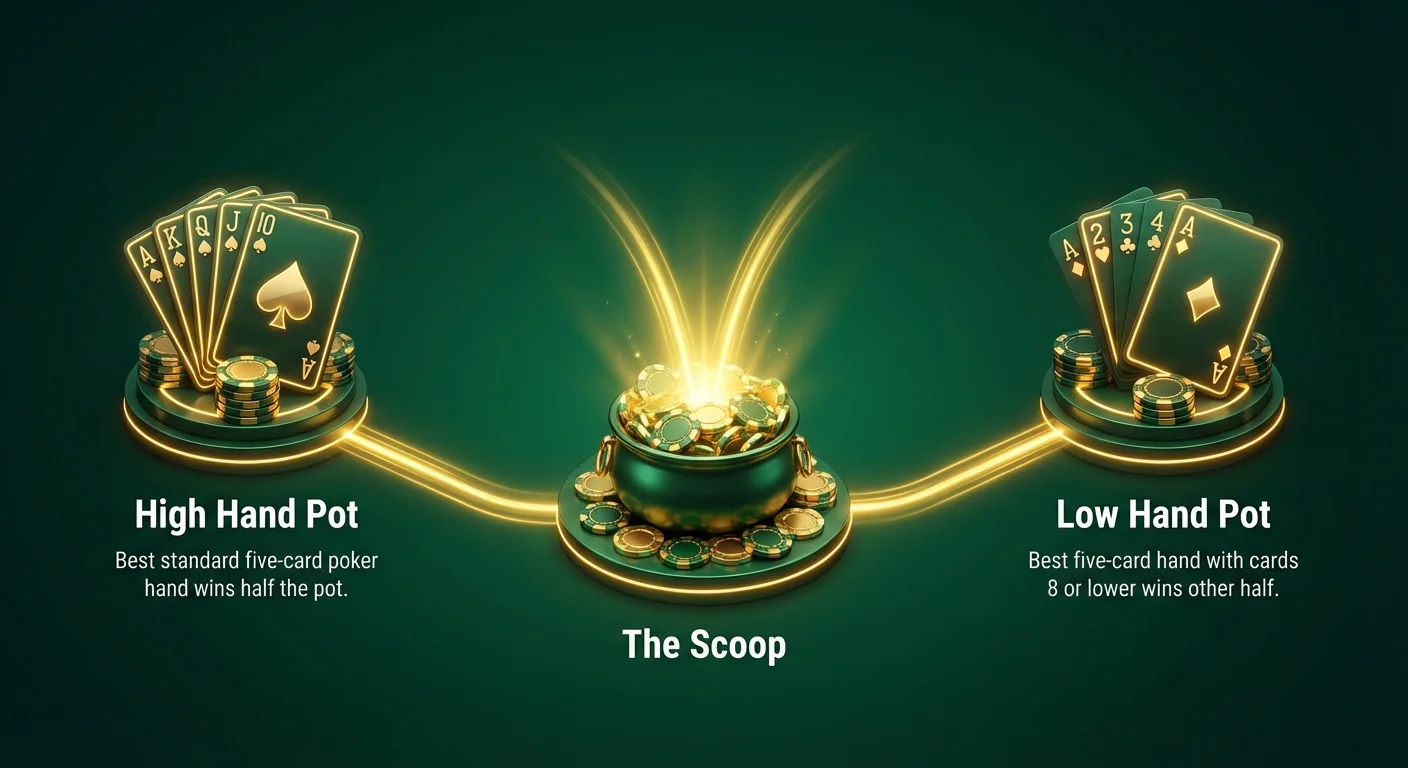
In Texas Hold'em, you play to win the pot. In Omaha Hi-Lo, if your goal is to merely win half the pot, you are setting yourself up for failure. The rake in poker games is unforgiving; if you split a pot with one other player, you are essentially getting your money back minus the house fee. To be a long-term winner, your strategy must revolve entirely around scooping - winning both the High and the Low halves of the pot.
The Mechanics of the Split
Before diving into advanced ranges, let's briefly crystallize the winning conditions to ensure we are on the same page regarding the "8-or-better" qualifier.
- The High Hand: The best standard five-card poker hand wins half the pot.
- The Low Hand: The best five-card hand consisting of cards ranked 8 or lower (with no pairs) wins the other half. Aces are played as low for this purpose.
- The Qualifier: To win the low, the board must contain at least three unconnected cards ranked 8 or lower. If the board is
K-Q-J-9-2, there is no low possible, and the High hand scoops the entire pot.
Crucial Rule: You can use different combinations of your hole cards for the High and the Low. For example, if you hold A-K-2-3 and the board is Q-J-10-4-5, you can use A-K for a straight (High) and A-2 for the nut low.
Advanced Starting Hand Selection
In standard Pot Limit Omaha (High), you look for four cards that work together. In Omaha Hi-Lo, you are looking for four cards that work together in two different directions.
The biggest leak for intermediate players is playing "one-way" hands. These are hands that can only win the High (like K-K-Q-J with no suits) or hands that can only win the Low (like A-2-8-9 off-suit).
The Holy Trinity of Starting Hands
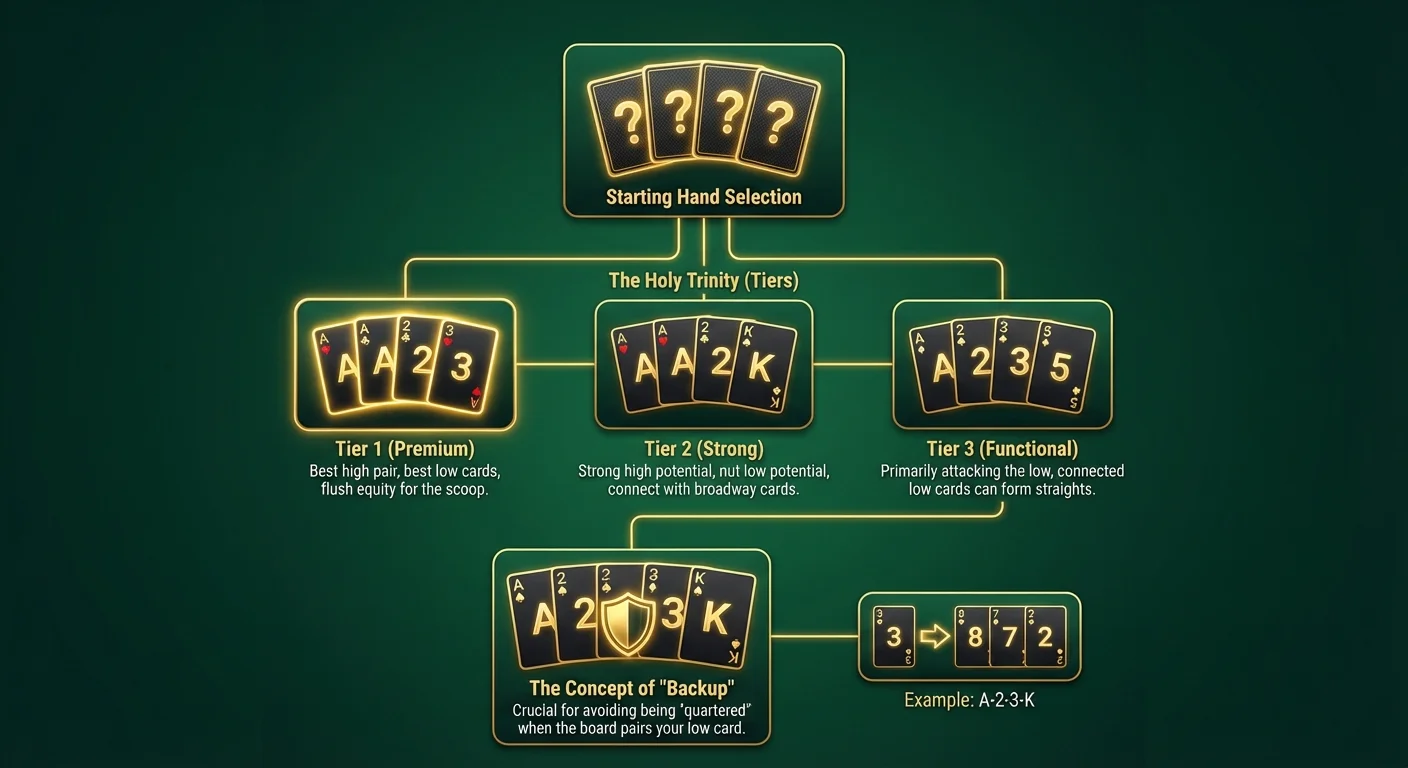
To scoop pots, you need hands that possess "Backup" and "Double Suitability."
| Tier | Hand Structure | Why It's Powerful |
|---|---|---|
| Tier 1 (Premium) | A-A-2-3 (Double Suited) | The absolute nuts. You have the best high pair, the two best low cards, and counterfeit protection (the 3). Double suits give you flush equity for the scoop. |
| Tier 2 (Strong) | A-A-2-x (Suited to the Ace) | Strong high potential and nut low potential. The "x" should ideally be a broadway card (K, Q, J, 10) to connect with the Aces. |
| Tier 3 (Functional) | A-2-3-x / A-2-4-x | These are "Wheel" hands. You are primarily attacking the low, but the connected low cards can also form straights for the high. |
| Tier 4 (High Only) | A-A-K-K / A-A-J-10 (Double Suited) | Playable for the high scoop, but dangerous if low cards hit the flop. You must play these aggressively pre-flop to isolate. |
The Concept of "Backup"
In advanced PLO8, simply having A-2 is not enough. This is a concept known as "counterfeiting."
Imagine you hold A-2-J-Q and the flop comes 8-7-2. You currently have the nut low (A-2 on the 8-7-2 board). However, if the turn is a 2 (pairing the board), your low is now A-2-2-7-8, which is not a low hand (pairs don't count). You are left with just A-7-8 from the board plus your J-Q for high, which is likely losing.
However, if you held A-2-3-K (having the 3 as backup), when the 2 hits the turn, you simply slot the 3 into your low hand. You remain live for the nut low. Always prioritize hands with backup low cards (3s and 4s).
Post-Flop Strategy: Fold Equity and Aggression
Many players treat Omaha Hi-Lo as a passive game of "did I hit the nuts?" However, understanding Fold Equity is what separates the sharks from the fish.
Fold equity is the additional value you gain from the likelihood that your opponent will fold to a bet or raise. In split-pot games, aggression is a tool used to force out players who might be drawing to a "chop."
Leveraging the "Freeroll"
The most powerful position in O8 is when you have the "lock" (guaranteed) low hand and are drawing to a high hand.
Scenario:
- You:
A-2-K-K(Suited Spades) - Board:
3-7-8(Two Spades) - Analysis: You have the nut low (
A-2-3-7-8). You cannot lose the low half of the pot. You also have a flush draw and a pair of Kings for the high.
Strategy: This is the time to bet pot or raise maximum. You are "freerolling." You have half the pot secured, and you are gambling with "house money" to try and win the other half. By betting big, you might force a player holding A-4 (a worse low draw) or 9-10-J-Q (a weak high straight draw) to fold.
If you can make a High hand fold, you increase your chances of scooping the whole pot. If they call, you are still guaranteed half. This is the definition of a high-value crypto poker situation - low risk, massive reward.
Bluffing in Hi-Lo?
Can you bluff in a game where people call down with lows? Yes, but you must choose your spots:
- The "High" Scare Card: If you have been contesting a low pot and a high card (like an Ace or King) hits the river that ruins the low possibilities, you can represent a strong high hand.
- Representing the Quarter: If you hold the Nut Low, betting aggressively can convince an opponent who also holds the Nut Low that you have the High as well. They might just call instead of raising, or fold a weak high hand, allowing you to take the high pot uncontested.
The Nightmare of Getting "Quartered"
One of the most distinct financial dangers in Omaha Hi-Lo is getting "quartered." This happens when you have the same low hand as another player, but you lose the high.
The Math of Quartering:
- Pot is $100.
- You and Opponent B both have the Nut Low (A-2).
- Opponent B also has a Flush (High).
- Opponent B wins $50 (High) + $25 (Half of Low) = $75.
- You win $25 (Half of Low).
If you put $40 into the pot to get to showdown, and you only withdraw $25, you have lost money despite having a winning hand.
How to avoid this:
- Don't overplay naked A-2 hands. If you have
A-2-9-Jrainbow, and there is heavy action, assume someone else has A-2. If you have no high potential, proceed with extreme caution. - Play for the High. The High hand usually scoops or takes 75% of the pot more often than the Low hand does. Prioritize hands that have strong High potential (sets, nut flushes) first, with Low as a bonus.
Pot Odds and Implied Odds in Crypto Poker
Because crypto poker tables (especially on sites using Bitcoin or Ethereum) allow for rapid deposits and high-denomination play, players can be stickier. You must calculate your Pot Odds strictly.
Source 7 reminds us that pot odds are the ratio of the pot size to the bet you must call. In O8, you must adjust this because you are often only drawing for half the pot.
- The Adjustment: If the pot is $100 and you have to call $50, your pot odds are normally 2:1. However, if you are drawing to a Low only, the effective pot you can win is only $75 (assuming the high takes half). You essentially need double the odds to call profitably for a split-pot draw compared to a scooping draw.
Tip: Never draw to a non-nut low. If you are drawing to an 8-low or a 7-low, you are drawing dead to an A-2 or A-3 a significant percentage of the time. In crypto poker, the "reverse implied odds" (how much you lose if you hit your hand but are second best) of a second-best low are catastrophic.
The Crypto Advantage: Why Play O8 with Bitcoin?
Omaha Hi-Lo is a game of volume and edges. Playing on crypto-centric platforms offers distinct advantages for the advanced strategist:
- Rakeback and VIP Programs: O8 is a split-pot game, meaning many pots are raked even though players just swapped money. High-volume play on crypto sites often triggers substantial rakeback (sometimes 30-60%), which can turn a break-even O8 player into a profitable one.
- Softer Fields: Many crypto enthusiasts are gamblers first and poker players second. They gravitate toward Omaha because of the four cards and high action. They often lack the discipline to fold non-nut lows, providing you with constant value.
- Bankroll Management: The divisibility of crypto allows for micro-stakes practice or massive high-roller shots without the friction of banking limits.
- Provably Fair Technology: Some crypto poker rooms use provably fair shuffling algorithms (hashing server and client seeds). In a game like O8 where "coolers" (set-over-set or quartering) are common, being able to verify the randomness of the deck provides peace of mind that the variance is natural, not manipulated.
5 Golden Rules for O8 Strategy
To summarize the advanced approach to crushing Omaha Hi-Lo tables:
- 1. Position is King: Being on the button allows you to see if the low is being contested. If three people check to you on a low board, you can often steal the pot with a bet, representing the low even if you don't have it.
- 2. Respect the Aces: Pre-flop,
A-A-x-xis strong, but post-flop, a pair of Aces rarely wins the High pot at showdown. If you don't improve to a set or a flush/straight, be prepared to fold Aces on the turn. - 3. Blockers Matter: In PLO8, holding
A-2when the board isA-2-8is massive not just because you have the hand, but because you block your opponents from having it. This increases your fold equity if you bet big. - 4. Avoid the "Middle": Hands like
6-7-8-9are powerful in PLO High but are "death hands" in O8. They make second-best straights and second-best lows. Fold them pre-flop. - 5. Know the "Cap": In Limit O8 (often found in mixed games), the betting is capped. In Pot Limit O8 (common in crypto), you can be shoved on. Adjust your draws accordingly; don't chase expensive draws in PLO8 that you would chase in Limit.
Conclusion
Mastering Omaha Hi-Lo requires a paradigm shift. You must stop looking at your hand as a single entity and start viewing it as two separate weapon systems deployed simultaneously. By selecting starting hands that coordinate high and low potential, understanding the mathematics of quartering, and utilizing the aggression factors of fold equity, you can dominate the split-pot tables.
The crypto poker environment provides the perfect arena for this high-variance, high-reward game. The players are looser, the transactions are faster, and the rakeback is richer. Remember: play tight, play for the nuts, and always, always play for the scoop.