
Poker is often miscategorized as a game of luck. While there is an element of chance in the turn of a card, the long-term winners - the sharks feeding on the "fish" - treat poker as a game of mathematics and incomplete information. If you are playing based on "gut feeling" or because a hand "looks pretty," you are gambling. If you are playing based on Pot Odds, Implied Odds, and Expected Value (EV), you are investing.
In the high-speed world of crypto poker, where hands are dealt faster and the stakes can be denominated in Bitcoin or Ethereum, the ability to perform quick mental calculus is the difference between a drained wallet and a massive bankroll. This guide moves beyond the basics of hand rankings and explores the engine that drives professional poker strategy: the math.
We will strip away the guesswork and provide you with the formulas necessary to determine if calling a bet is profitable in the long run.
The Foundation: Understanding "Outs"
Before you can calculate odds, you must be able to identify your "outs." An out is any unseen card left in the deck that will improve your hand to a likely winner.
If you don't know your outs, you can't calculate your equity (your probability of winning).
Counting Outs
The first step is memorization and recognition. You cannot pause a live crypto poker tournament to count on your fingers. You must instantly recognize the drawing strength of your hand.
| Situation | Description | Number of Outs |
|---|---|---|
| Pocket Pair to Set | You have a pair, hoping to hit a third card. | 2 outs |
| Gutshot Straight | You have 4 cards (e.g., 5-6-8-9) and need one specific middle card (7). | 4 outs |
| Two Overcards | You have AK, board is J-8-2. You need an A or K (assuming top pair wins). | 6 outs |
| Open-Ended Straight | You have connected cards (e.g., 5-6) and need a card on either end. | 8 outs |
| Flush Draw | You have 4 cards of the same suit. | 9 outs |
| Inside Straight Flush | A straight draw and a flush draw combined. | 12 outs |
| Open-Ended Straight Flush | The monster draw. | 15 outs |
The Discount Factor
Advanced players know that not all outs are created equal. These are called "dirty outs."
Example: You have an open-ended straight draw. However, the board has two hearts, and you don't have a heart. Two of your straight outs are hearts. If you hit those, you make a straight, but your opponent might make a flush. In this scenario, you must "discount" your outs. Instead of 8 outs, you might mathematically count only 6 to be safe.
The Rule of 4 and 2
Calculating exact percentages at the table is difficult. Pros use a shortcut known as the Rule of 4 and 2 to convert outs into a percentage of equity.
- On the Flop (Waiting for Turn and River): Multiply your outs by 4.
- Example: Flush draw (9 outs) x 4 = 36% chance to win.
- On the Turn (Waiting for River): Multiply your outs by 2.
- Example: Flush draw (9 outs) x 2 = 18% chance to win.
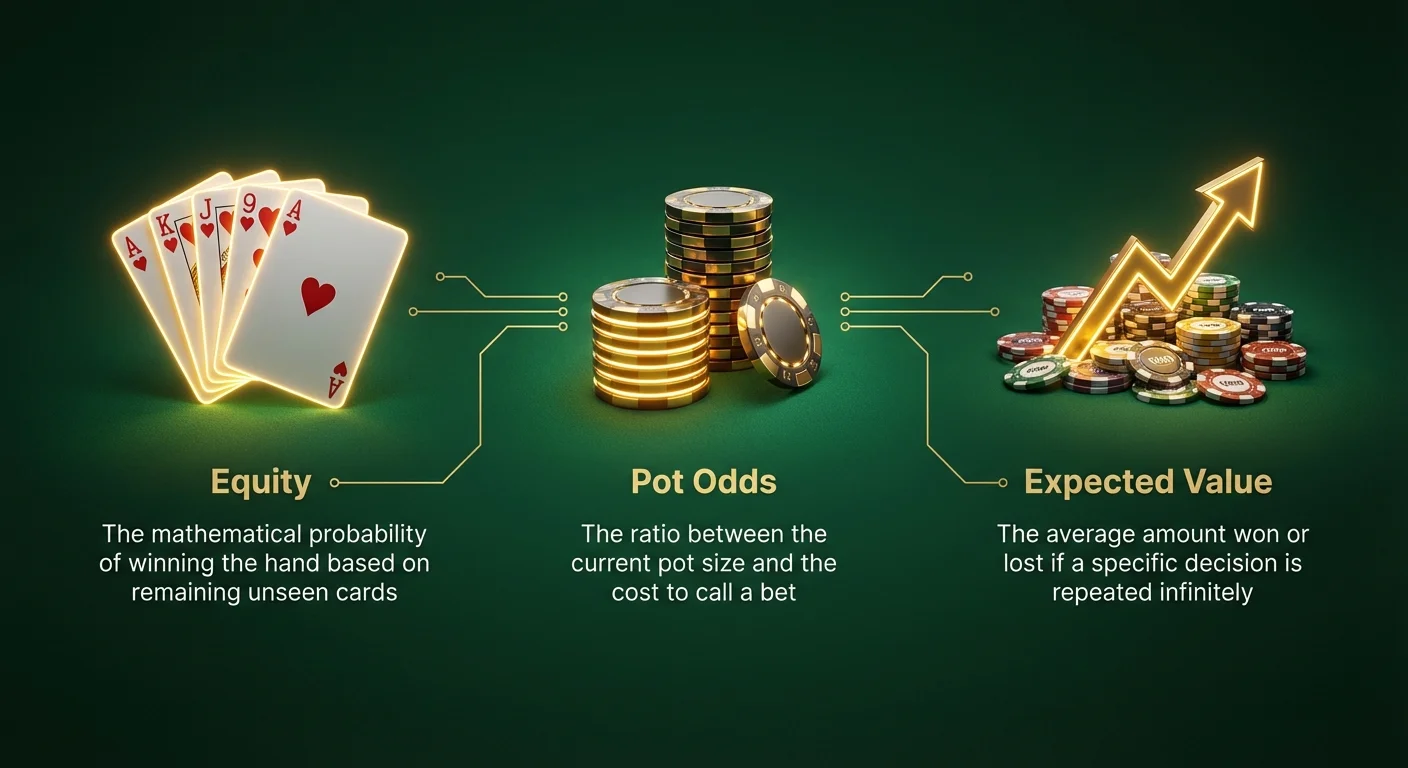
This percentage represents your Equity. Keep this number in mind; it is half of the equation.

Pot Odds: The Price of Admission
Pot odds represent the ratio between the size of the pot and the size of the bet you are facing. It is essentially the price you are being offered to stay in the hand.
To be a profitable player, the price you pay (Pot Odds) must be less than the chance you have of winning (Equity).
The Formula
There are two ways to visualize this: Ratio method and Percentage method. The percentage method is generally easier for comparing against your equity.
Formula:
Practical Scenario: The Flush Draw
You are playing No-Limit Hold'em on a crypto poker site. You hold A♥ K♥.
The board is J♥ 9♥ 2♠ 5♣.
You have the nut flush draw. You have 9 outs.
We are on the Turn, so we use the Rule of 2.
9 outs x 2 = 18% Equity.
The Situation:
- The Pot contains $100.
- Your Opponent bets $50.
- The Total Pot is now $150.
- You must call $50.
The Calculation:
You are paying $50 to try and win a total pot of $200 (The initial $100 + Villain's $50 + Your $50).
The Decision:
- Your Equity: 18%
- Pot Odds (Price): 25%
Since 18% is lower than 25%, this is a bad call. Mathematically, you will lose money in the long run if you make this call, because the cost to see the card is higher than the frequency with which you will hit the card.
However, poker is not static. This is where Implied Odds come into play.
Implied Odds: Predicting the Future
Basic pot odds assume the betting stops the moment you call. In No-Limit Hold'em, this is rarely true. If you hit your flush on the river, is your opponent likely to bet again? Can you raise them?
Implied Odds take into account the money that is not yet in the pot but expected to be won if you hit your hand.
When to Use Implied Odds
You can make a "loose" call (where immediate pot odds are bad) if the implied odds are huge. This usually happens when:
- Deep Stacks: You and your opponent both have lots of chips left behind.
- Hidden Hands: Your hand is disguised (e.g., a set), making it likely the opponent will pay you off.
- Aggressive Opponents: The opponent is likely to bluff or value bet the river even if the scare card hits.
The Formula (Mental Estimate)
Revisiting the Flush Draw Scenario:
- Equity: 18% (approx 4:1 odds against you).
- Cost: $50 into $150 (3:1 odds offered).
- Deficit: You are strictly losing money on this call.
However:
You see your opponent has $500 remaining in their stack. You believe that if a Heart hits the river, they will not fold top pair and might call a $100 bet from you.
If you include that future $100:
- Potential Total Win: $150 (current pot) + $100 (future bet) = $250.
- Cost: $50.
- Implied Ratio: 5:1.
Since the odds against you hitting are 4:1, but the implied payout is 5:1, the call becomes profitable.
The Danger: Reverse Implied Odds
Advanced players must also consider the inverse. Reverse Implied Odds exist when hitting your card might actually lose you more money.
- Example: You are drawing to the bottom end of a straight. If the straight card hits, it's possible your opponent has the higher end of the straight. If you hit, you might call a huge bet and lose your stack.
- Strategy: If you have poor reverse implied odds (weak draws), you need better immediate pot odds to call. Do not rely on implied odds for weak draws.
Expected Value (EV): The Holy Grail
Expected Value (EV) is the average amount of money you would win or lose if you played the exact same situation millions of times. Professional poker players do not care about the results of a single hand; they care about making +EV decisions.
The EV Formula
Let's apply this to an All-In scenario.
The Scenario:
You are playing a tournament. Blinds are 100/200.
- You have J♠ J♣.
- Opponent goes All-In for 1,000.
- Everyone else folds.
- Pot is roughly 1,300 (including blinds and ante).
- You have to call 1,000.
You estimate the opponent's range is Ace-King (AK) or Ace-Queen (AQ). Against this range, Pocket Jacks are roughly a 55% favorite.
Variables:
- % Win: 55% (0.55)
- $ Win: 1,300 (Pot + Opponent's stack)
- % Lose: 45% (0.45)
- $ Lose: 1,000 (The amount you call and risk)
Calculation:
- Win Scenario: 715$
- Lose Scenario: 450$
- EV = $715 - 450 = +$265
Result:
Calling is a +EV decision. On average, every time you make this call, you earn $265. Even if you lose this specific hand, the math dictates that calling is the only correct move.
Fold Equity: The Aggressor's Mathematics
Up to this point, we have discussed "Passive Odds" - calculating whether to call. But poker favors the aggressor. When you bet or raise, you have two ways to win:
- You have the best hand at showdown.
- Your opponent folds.
Fold Equity is the additional equity you gain from the likelihood that your opponent will fold to your bet.
Total Equity Formula
This concept transforms situations where you have bad pot odds into profitable plays. This is often called a Semi-Bluff.
Example:
You have a flush draw (18% Pot Equity on the turn).
If you check-call, you are relying entirely on that 18%.
If you check-raise All-In, you force the opponent to make a decision.
If you estimate there is a 30% chance the opponent will fold (because they only have a weak pair), your move becomes significantly more powerful. You aren't just playing the cards; you are playing the player.
Note: Fold equity is subjective. As noted in classic poker literature, you cannot calculate this precisely like pot odds. It requires reading the opponent's VPIP (Voluntarily Put Money In Pot) and PFR (Pre-Flop Raise) stats. If an opponent plays 70% of hands (a "loose" player), they have low fold equity (they like to call). If they play 10% of hands (a "nit"), they have high fold equity.
The Crypto Poker Advantage: Why Math Matters More Here
Crypto poker platforms (using Bitcoin, USDT, or Ethereum) offer distinct environments where understanding math is even more critical than in traditional fiat poker.
1. Game Speed and Volume
Crypto poker tables often run faster than traditional online poker. Deposits are instant, and HUDs (Heads-Up Displays) are common. The ability to calculate EV instantly allows you to multi-table effectively. If you are guessing on 4 tables simultaneously, you will bleed chips 4x faster.
2. Provably Fair and RNG
One anxiety players have regarding math is, "Is the game rigged?" If the game is rigged, the math doesn't work. Crypto gambling sites often utilize Provably Fair algorithms. This allows you to verify the Random Number Generator (RNG) on the blockchain. Knowing the deck is truly random means you can trust the probability math (the Rule of 4 and 2) implicitly.
3. Rakeback and Micro-Calculations
Many crypto sites offer high Rakeback (returning a percentage of the fees to you). Advanced math players include Rakeback in their EV calculations. A "break-even" call (0 EV) becomes a +EV call when you factor in the 30% Rakeback you receive just for putting money in the pot.
Cheat Sheet: Common Odds to Memorize
Stop calculating these every time. Memorize them.
| Scenario | Outs | Odds Against (Approx) | Equity % (Flop to River) |
|---|---|---|---|
| Gutshot Straight | 4 | 11 to 1 | ~16.5% |
| Two Overcards | 6 | 6.7 to 1 | ~24% |
| Open-Ended Straight | 8 | 5 to 1 | ~31.5% |
| Flush Draw | 9 | 4 to 1 | ~35% |
| Flush Draw + Gutshot | 12 | 3 to 1 | ~45% |
| Flush Draw + OESD | 15 | 2 to 1 | ~54% |
Pro Tip: If you have 14+ outs on the flop, you are statistically a favorite against Top Pair. You should usually be playing these hands aggressively (raising) rather than passively (calling), maximizing your Fold Equity.
5 Practical Tips for Mastering Poker Math
- Count Your Outs, Then Discount Them: Always look for outs that could give your opponent a better hand (e.g., your straight card also completing a flush). Subtract those from your total.
- Use the Percentage Method: While "3 to 1" is classic, modern poker software and training tools use percentages. Thinking in percentages (33%) makes it easier to compare against equity.
- Don't Forget Implied Odds on the Turn: Implied odds decrease drastically on the Turn because there is only one betting street left. They are most powerful on the Flop.
- Know Your Stack Sizes: You cannot have implied odds if your opponent is "short-stacked" (has very few chips). If they only have $20 left, you can't win $100 from them later.
- Review Hand Histories: Use the "Replay" feature common on crypto poker sites. Look at hands you lost. Calculate the pot odds after the game. Did you make the right mathematical call and just get unlucky? If so, don't change your strategy.
Summary
Poker is a war of mathematics fought with chips. While the short term is dictated by variance (luck), the long term is strictly dictated by Expected Value.
- Pot Odds tell you the price of the call.
- Equity tells you the quality of your product (hand).
- Implied Odds justify buying a product that is currently overpriced because of future value.
- Fold Equity allows you to win without having the best hand.
By mastering these four pillars, you stop being a gambler hoping for a lucky river card and become a shark executing a profitable long-term strategy. The cards will fall where they may, but if your math is solid, the chips will eventually move in your direction.