
Entering the world of crypto poker is like sitting down at a high-stakes table where the chips themselves are constantly changing value. For the modern grinder, skill at the felt is only half the battle. You might master pot odds, perfectly execute a squeeze play, and read your opponents like an open book, but if you cannot manage your capital, you will eventually go bust. This is the harsh reality of the game.
Bankroll management (BRM) is the CEO of your poker career. It decides when you can expand, when you need to downsize, and how much risk the company can tolerate. When you add cryptocurrencies - Bitcoin, Ethereum, or Tether - into the mix, you introduce a secondary layer of volatility that traditional fiat players never face.
This guide is designed for the intermediate poker player ready to transition into the crypto space or the crypto enthusiast looking to treat poker as a serious hustle rather than a slot machine. We will explore the mathematics of survival, the impact of game variance, and specific strategies to protect your digital assets.
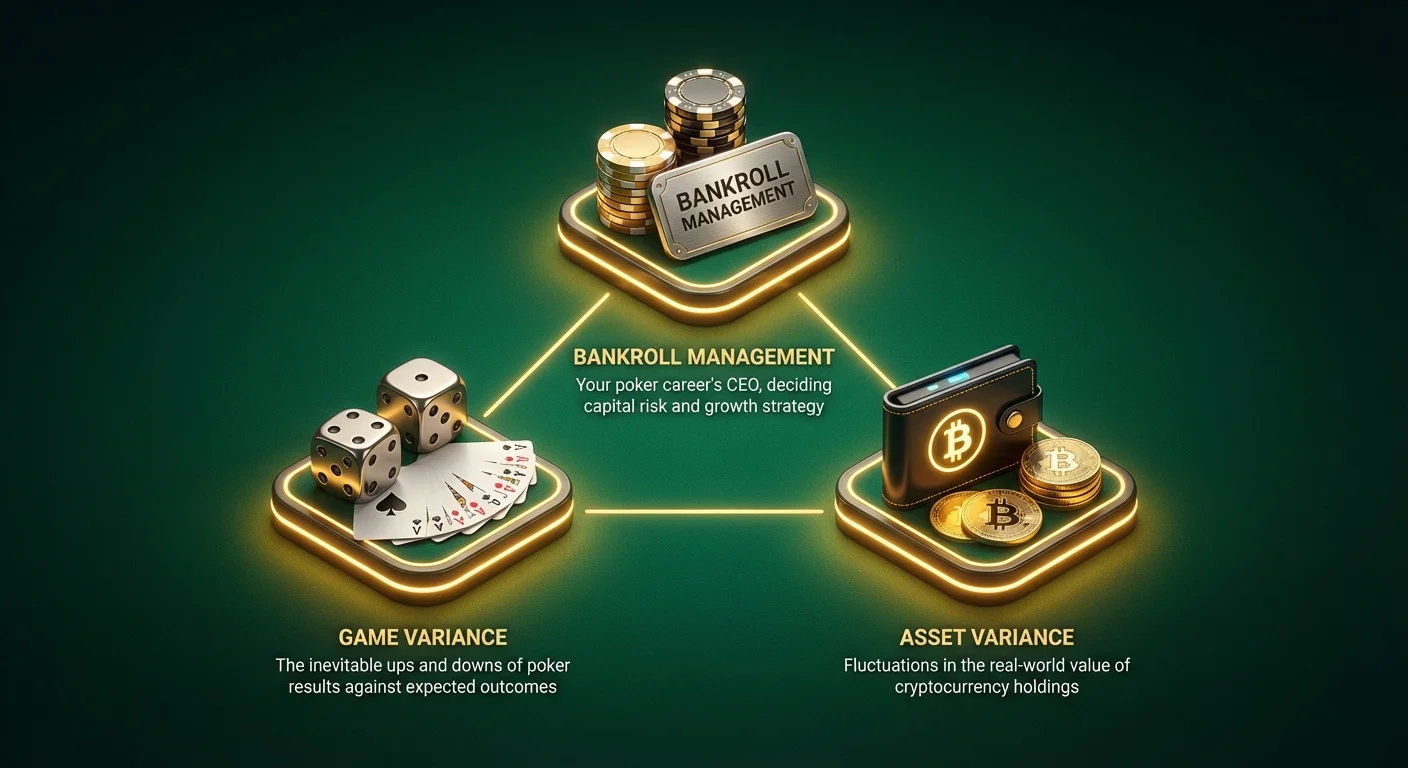
The Dual-Variance Threat
To understand why bankroll management is critical for a crypto grinder, you must first respect the concept of variance. In standard poker theory, variance measures the swings between your expected results and your actual results.
If you flip a coin for $100, and you are getting paid $200 for every Heads (a massive edge), you should take that bet every time. However, it is statistically possible to flip Tails ten times in a row. If you only had $1,000 to your name, you would be bankrupt before the law of averages swung back in your favor.
1. Game Variance
This is the standard up-and-down of poker. You get your money in good with AA vs. KK, but a King hits the flop. You make a correct bluff based on Fold Equity (the probability your opponent folds), but they make a hero call. Even the best players in the world endure downswings that last weeks or months.
2. Asset Variance
This is specific to the crypto grinder. Imagine you grind for a month and win 0.5 BTC. That is a fantastic win rate. However, if the price of Bitcoin drops by 20% against the dollar during that month, your real-world purchasing power has diminished despite your poker success. Conversely, a bull market can inflate your bankroll artificially, leading to overconfidence. behavioral finance traps applied to crypto.
Calculating Your Bankroll Requirements
The size of your bankroll depends on the game you play, your win rate (ROI), and your tolerance for risk. A "Buy-in" (BI) refers to the maximum amount of chips you can bring to a cash game table (usually 100 Big Blinds) or the entry fee for a tournament.
The general rule is simple: Never put more than a small percentage of your total bankroll on a single table.
Recommended Bankroll Depths
The following table outlines conservative and aggressive bankroll strategies for different crypto poker formats. Note that "Aggressive" implies a higher Risk of Ruin (going broke).
| Game Type | Aggressive BRM (Riskier) | Conservative BRM (Safer) | Why? |
|---|---|---|---|
| No Limit Hold'em (Cash) | 20-30 Buy-ins | 40-50 Buy-ins | Standard variance. |
| Pot Limit Omaha (Cash) | 50 Buy-ins | 80-100 Buy-ins | PLO has massive swing potential due to equity proximity. |
| Multi-Table Tournaments (MTT) | 100 Buy-ins | 200+ Buy-ins | High variance; you lose most tournaments you enter. |
| Sit & Go's (SNG) | 30 Buy-ins | 50-70 Buy-ins | Lower variance than MTTs, but requires volume. |
The "Crypto Premium"
If you are playing with volatile assets (BTC, ETH, LTC) rather than stablecoins (USDT, USDC), you should add a 20% buffer to the Conservative numbers above. This creates a cushion against market dips, ensuring you aren't forced to move down in stakes just because the coin price dipped.
Understanding Pot Odds and "Good Bets"
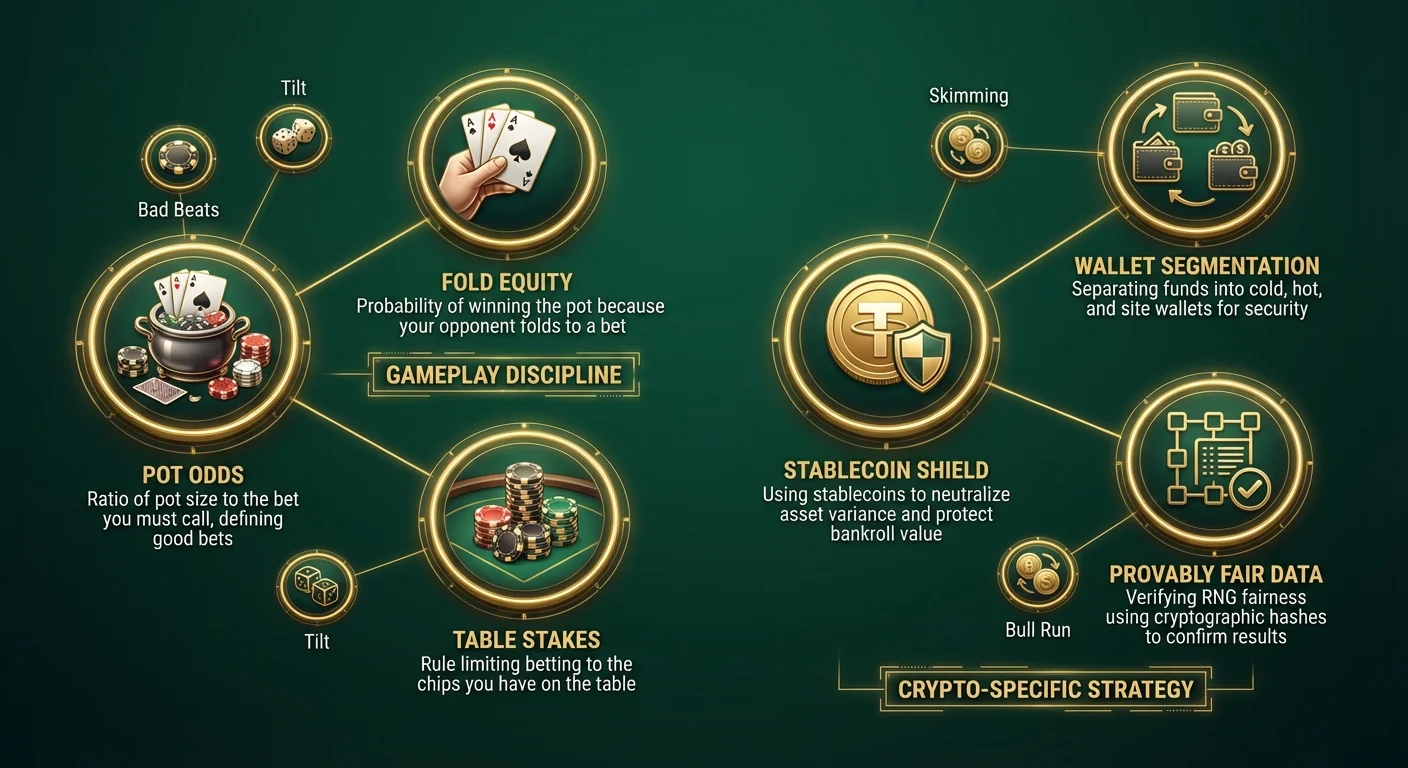
Bankroll management is futile if you are consistently making bad bets. A "bad bet" is defined as putting money into the pot when the Pot Odds (the price you are getting) are worse than your Drawing Odds (your chance of winning).
As detailed in poker theory, pot odds are the ratio of the pot size to the bet you must call.
- Scenario: The pot is $100. Opponent bets $50. The total pot is $150. You must call $50.
- Math: $150:$50 = 3:1 odds.
- The Decision: You need to win 25% of the time (1 in 4) to break even.
If you are drawing to a flush on the turn, you have roughly an 18% chance (approx. 4:1 against) of hitting your card on the river. Calling a 3:1 bet with a 4:1 draw is a mathematical leak. Doing this repeatedly will drain your bankroll regardless of how disciplined you are with buy-ins.
Crypto Grinder Tip: Many crypto sites display values in mBTC or uBTC. Ensure you can mentally calculate these odds quickly without getting confused by the decimal places. If the math is fuzzy, switch the display to fiat currency (USD/EUR) in the settings if the site allows it.
Game Selection: Volatility Management
Not all poker variants treat your bankroll the same way. Choosing the right game is a crucial part of protecting your funds.
No Limit Hold'em vs. Omaha
Texas Hold'em is the standard, but Omaha Hi-Lo (Omaha 8-or-Better) and Pot Limit Omaha (PLO) are incredibly popular on crypto sites.
- In Omaha, you are dealt four cards. This creates significantly more hand combinations.
- In PLO, equities run much closer together. It is rare to be a massive favorite (like 80/20) pre-flop or on the flop.
- Impact on BRM: Because the edges are thinner and players hit big hands more often, the swings in Omaha are violent. You can play perfectly and lose 10 buy-ins in a session. If you choose to grind PLO, your bankroll must be significantly deeper than a Hold'em player's.
The Hidden Cost of Straddles
Many crypto cash games feature lively action, including the Straddle. A straddle is a voluntary blind bet made by the player to the left of the Big Blind before cards are dealt.
- The Trap: If you are playing a $1/$2 game, the standard buy-in is $200 (100 BB).
- The Straddle Effect: If a player straddles for $4, the stakes are effectively now $2/$4. Your $200 stack is no longer 100 Big Blinds deep; it is only 50 Big Blinds deep relative to the straddle.
- Adjustment: If you are at a table with frequent straddles, you are playing a higher stake level. Ensure your bankroll can support the effective stakes, not just the posted blinds.
Leveraging Fold Equity to Reduce Variance
While it sounds counter-intuitive, being aggressive can sometimes protect your bankroll better than being passive. This concept relies on Fold Equity - the percentage of the time you win the pot simply because your opponent folds.
When you play passively (calling bets), you can only win by having the best hand at showdown. When you play aggressively (betting or raising), you have two ways to win:
- Having the best hand.
- Your opponent folds.
By utilizing fold equity, you often end hands before the river, avoiding the "bingo" aspect of letting an opponent realize their equity. However, aggression requires chips. You cannot bully the table or apply maximum pressure if you are playing with "scared money" (a bankroll that is too small). This is why having 50+ buy-ins is vital - it gives you the psychological freedom to pull the trigger on a correct bluff without worrying about paying rent.
The "All-In" Psychology
The phrase "I'm All-In" is dramatized in movies, but for a grinder, it's just a tool. However, in No Limit games, the all-in moment is the point of infinite variance for that hand.
Shove/Fold Strategy
In tournament poker, once your stack drops below 15-20 big blinds, you enter a "Push/Fold" mode. You stop playing post-flop poker and strictly decide to go all-in or fold pre-flop.
- This is high variance. You will be called, and you will lose flips.
- BRM Implication: Because your tournament life often hinges on a coin flip (e.g., AK vs QQ), you need a massive volume of tournaments to realize your edge. Do not judge your success on 10 tournaments. Judge it on 500.
Table Stakes and Re-buys
In cash games, "Table Stakes" rules mean you can only bet what you have on the table. If you lose your stack, you must rebuy.
- The Trap: Chasing losses. If you lose two buy-ins quickly due to bad beats, the emotional urge to deposit more and play higher stakes to "win it back" is the death of a bankroll.
- The Rule: Set a Stop-Loss. If you lose 3-5 buy-ins in a single session, quit. Your mental state is likely compromised, and preserving your remaining capital is more important than fighting back today.
Practical Tips for the Crypto Grinder
Managing a crypto poker bankroll involves logistics that fiat players don't face. Here is a cheat sheet for operational success:
1. The Stablecoin Shield
Consider keeping your main poker bankroll in USDT, USDC, or DAI. This neutralizes the asset variance.
- Strategy: If you win 1000 USDT, it is always worth $1,000.
- Strategy: If you play in BTC, consider "skimming." If BTC goes on a bull run, sell a portion of your poker roll into stablecoins to lock in the real-world value increase.
2. Wallet Segmentation
Never play directly out of your main investment wallet or exchange account. This separation is crucial for OPSEC for high-risk activity.
- Cold Storage: Long-term crypto holdings (life savings).
- Hot Wallet: Intermediate funds.
- Site Balance: Only keep enough on the poker site for your active sessions (e.g., 10-15 buy-ins).
- Why? If a site gets hacked or freezes accounts, you don't lose your entire net worth. Crypto transactions are irreversible; you cannot chargeback a deposit.
3. Check Provably Fair Data
One advantage of crypto gambling is "Provably Fair" technology, which allows you to verify that the RNG (Random Number Generator) wasn't manipulated.
- If you go on a massive losing streak, check the hashes.
- Confirming the losses were mathematically fair (just bad luck) helps prevent Tilt. It stops you from thinking "the site is rigged" and helps you focus on fixing your strategy.
4. Moving Up and Down
- Moving Up: Only move up in stakes when you have 30-40 buy-ins for the new limit, NOT just when you feel confident.
- Moving Down: This is the hardest skill. If your bankroll drops below 20 buy-ins for your current stake, you must drop down to rebuild. It is not a failure; it is a strategic retreat to ensure survival.
5. Managing "Tilt"
As noted in expert cheat sheets, your emotions are your greatest enemy. "Tilt" is the state of emotional frustration that leads to bad decision-making.
- Signs of Tilt: Playing too many hands (high VPIP), calling light, or playing aggressive lines just to "get even."
- The Cure: Walk away. Crypto poker is available 24/7. The games will be there tomorrow. Your bankroll might not be if you stay.
Conclusion
Bankroll management for the crypto grinder is about discipline in two worlds: the mathematical world of poker and the economic world of cryptocurrency. You are not just managing chips; you are managing a volatile asset portfolio.
Be selective with your hands, be aggressive when the spot is right, and most importantly, treat your bankroll with the respect a business treats its cash flow. In the volatile seas of crypto poker, your bankroll is your lifeboat - keep it patched, keep it inflated, and it will carry you through the roughest storms.