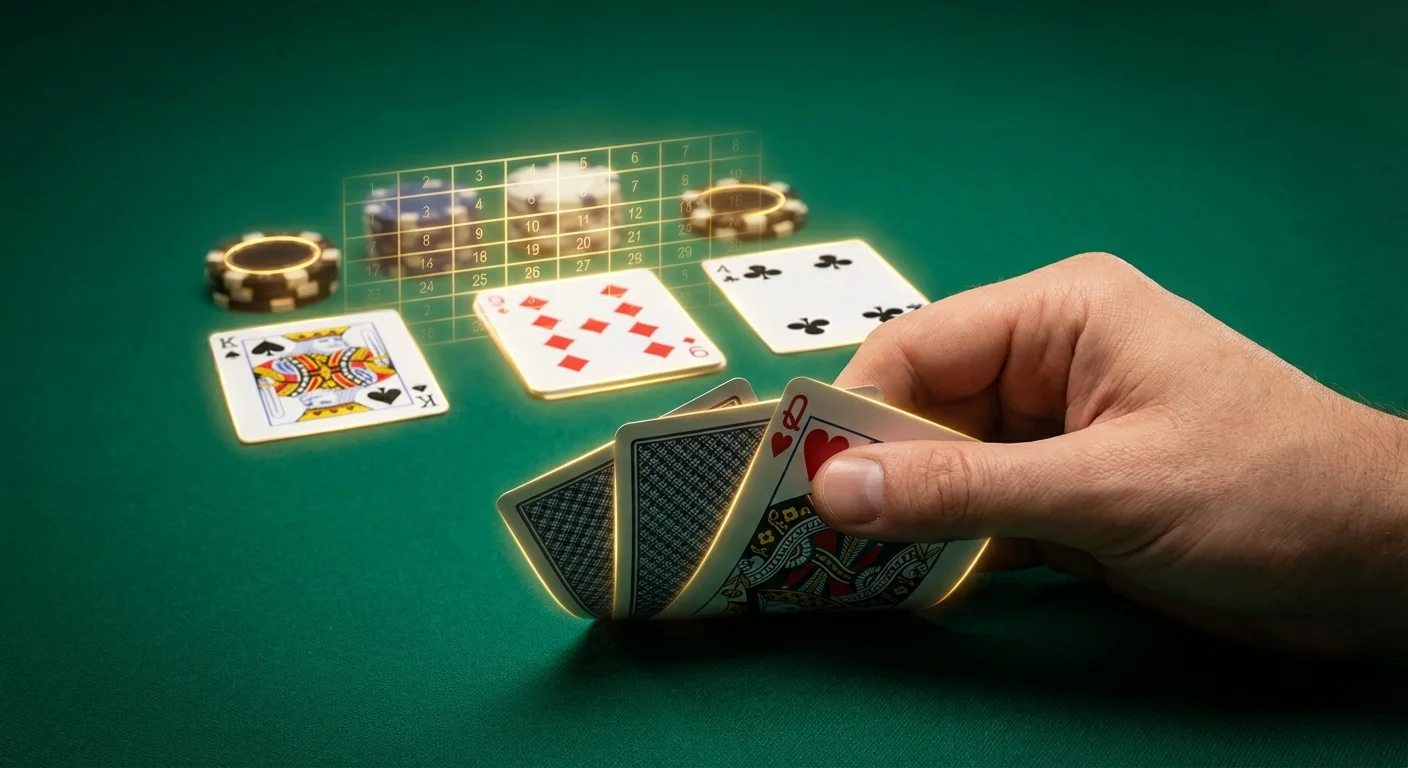
Before the poker world fell in love with the dramatic all-ins of No-Limit Texas Hold'em, the smoky backrooms of casinos and home games were dominated by a different beast: 7-Card Stud.
For decades, this was the game of professionals. It is a game that demands patience, observation, and, above all else, a razor-sharp memory. Unlike Hold'em, where community cards are shared and static, 7-Card Stud offers a dynamic puzzle of information. Every card dealt to an opponent, and subsequently folded, is a piece of data that can shift the odds in your favor.
In the modern era of crypto gambling, where players enjoy the speed of Bitcoin deposits and the security of provably fair algorithms, Stud is making a resurgence. It attracts players tired of the "bingo" variance of Hold'em who want a game where skill and memory provide a tangible mathematical edge.
This guide will take you from the basic mechanics to the intermediate strategies required to master the art of memory in 7-Card Stud.
The Foundation: How 7-Card Stud Works
If you are coming from a Texas Hold'em background, you need to reset your expectations. There are no community cards. There are no blinds (usually). Instead, the game relies on Antes and a Bring-in.
The Setup and The Deal
Most 7-Card Stud games are played as Fixed Limit. This means bets are made in fixed increments (e.g., a $10/$20 game).
- The Ante: Before the cards are dealt, every player puts in a small mandatory bet (the Ante). This builds the initial pot.
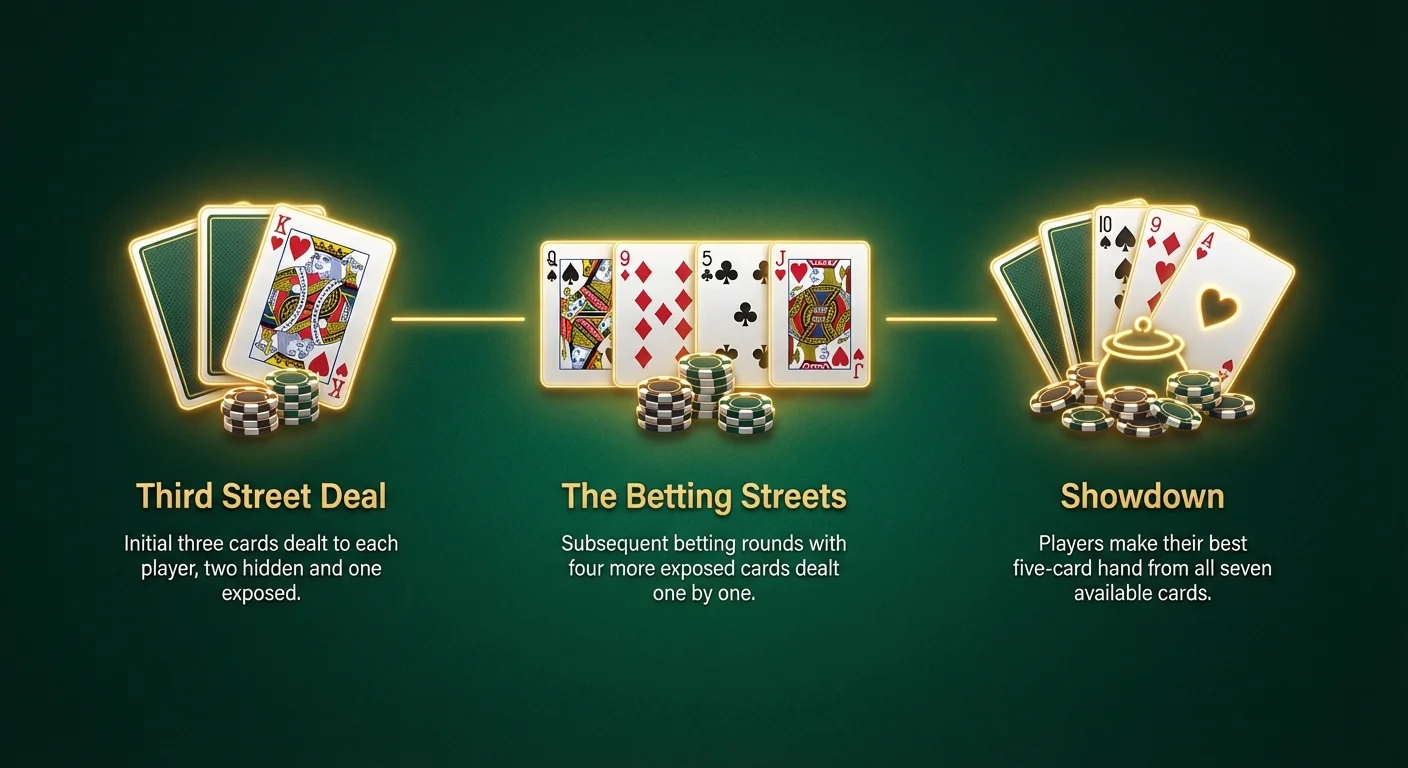
- Third Street (The Starting Hand): Each player is dealt three cards. Two are face-down (hole cards) and one is face-up (door card).
- The Bring-in: The player with the lowest-ranking door card is forced to pay the "Bring-in" (usually half the size of the small bet). They can also choose to "complete" the bet to the full limit.
- The Betting: Action continues clockwise.
The Progression of Streets
The game progresses through betting rounds known as "Streets."
- Fourth Street: Each active player receives another face-up card. From here on, the player with the highest poker value showing on their board acts first.
- Fifth Street: Another face-up card. (Note: In Fixed Limit games, the betting limit usually doubles here to the "Big Bet").
- Sixth Street: Another face-up card.
- Seventh Street (The River): The final card is dealt face-down.
At showdown, you have three hole cards and four exposed cards. You must make the best five-card poker hand.
The Art of Memory: Tracking Exposed Cards
This is the core of the article and the secret to winning at Stud. In Texas Hold'em, you calculate odds based on unknown variables. In Stud, you calculate odds based on disappearing variables.
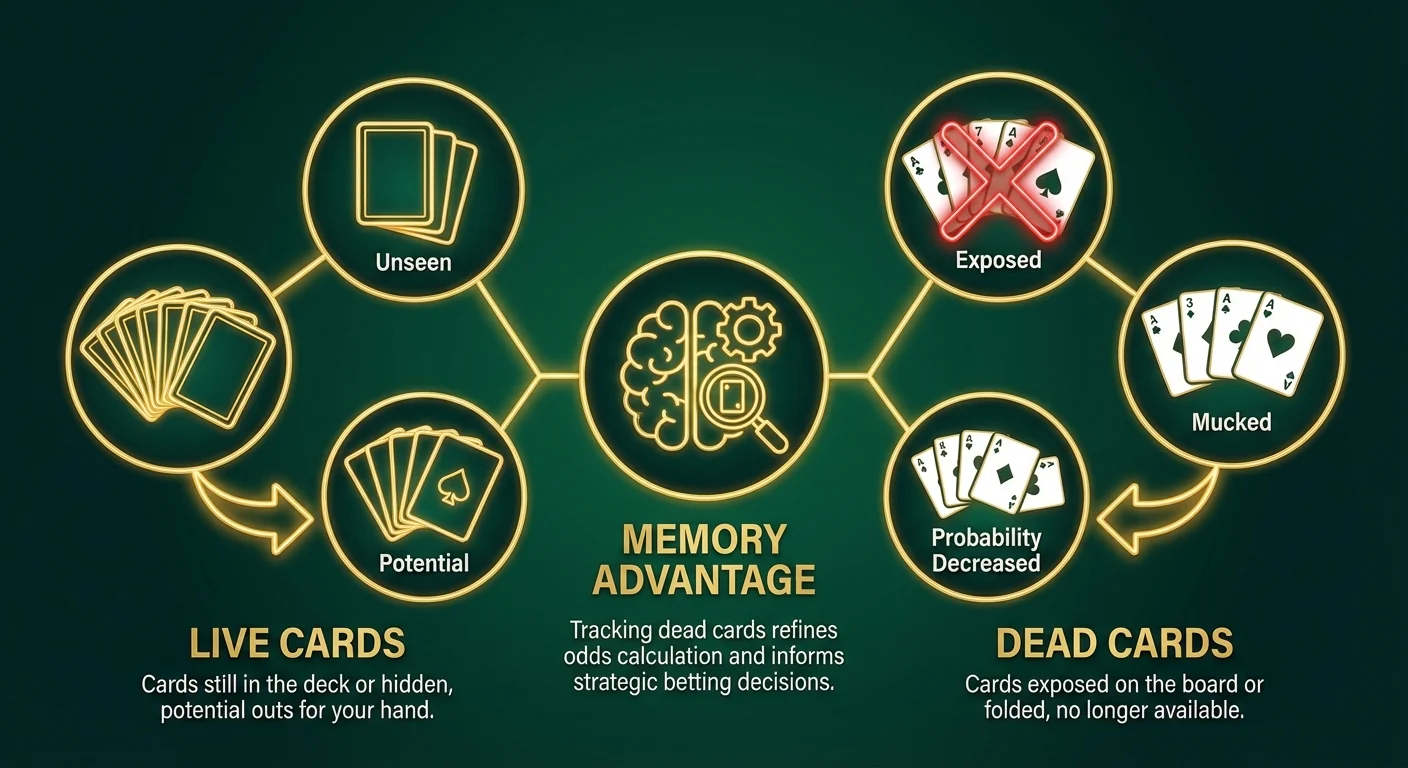
When a player folds on Third Street, their cards are mucked. If you didn't see what they were, you are playing blind. If you saw that a player folded the 7♥, and you are holding the 8♥ and 9♥, that information is important. It decreases your chances of hitting a flush, but it might increase your chances of pairing your high cards if no other similar ranks were folded.
The Concept of "Live" vs. "Dead" Hands
In Stud strategy, we talk about cards being "Live" or "Dead."
- Live Cards: Cards that have not yet been seen on the board. If you need a King to make a pair and no Kings have appeared on anyone's board, your outs are "live."
- Dead Cards: Cards that have been exposed and folded, or are currently sitting on an opponent's board.
Example Scenario:
You start with (J♠ J♦) 4♠. You have a pair of Jacks.
Opponent A shows a K♣.
Opponent B shows a J♣.
Opponent C shows a J♥.
Analysis: Your hand is technically a high pair, but it is effectively "dead." The other two Jacks are visible. You cannot improve to trips or quads. In this scenario, even though you have a pair, your hand has very little potential for improvement compared to a player holding a hidden pocket pair of Queens who hasn't seen any other Queens.
Memory Drills for Online Players
Playing at a crypto poker site gives you a slight advantage: you are likely at home, perhaps with fewer distractions than a noisy casino. However, relying on software tools is often banned. You must train your brain to recognize digital poker tells.
The "Suit and Rank" Scan:
Do not try to memorize "Player 1 had the 2 of clubs, Player 2 had the Ace of diamonds." It is too much data. Instead, as the cards are dealt, engage in a quick mental scan categorizing by suits and high ranks.
- Look for your outs immediately. If you have a flush draw, scan strictly for that suit. Count them: "Three spades are dead."
- Look for High Cards. Count the Aces and Kings. "Two Aces are gone."
- Ignore the trash. You rarely need to memorize that someone folded a low, unconnected rainbow card unless you are playing a specific lowball variant (Razz).
Strategic Betting: Using Information as a Weapon
Once you have mastered the ability to track dead cards, you must apply this to your betting strategy. This connects to the concept of Fold Equity and Pot Odds.
Calculating Pot Odds with Dead Cards
Source 7 explains that Pot Odds are the ratio of the pot size to the bet you must call. In Stud, your accuracy in calculating these odds is superior to Hold'em because you have more information.
The Formula:
In Hold'em, the "Unseen Cards" are always roughly the same (52 minus cards in play). In Stud, by Fifth Street, there might be 12 to 15 cards visible on the table.
| Game State | Total Cards in Deck | Cards You See (Example) | Unseen Cards | Effect on Math |
|---|---|---|---|---|
| Hold'em Turn | 52 | 2 (Hand) + 4 (Board) | 46 | Outs are estimates. |
| Stud 5th Street | 52 | 3 (Hand) + 2 (Board) + 8 (Opponents) | 39 | Outs are precise. |
Practical Tip: If you are chasing a flush on Fifth Street, and you have seen 6 other cards of your suit folded or on board, fold immediately. The math dictates that the deck is "dry" of your suit. A novice will call because they "feel lucky." An expert folds because they counted the cards.
Using Fold Equity on "Scary Boards"
As discussed in our reference material on Fold Equity (Source 1), this concept is the percentage of the time you win the pot because your opponent folds. In 7-Card Stud, you manufacture Fold Equity based on your exposed cards (your board).
The Bluff of the Board:
Imagine you have (Trash, Trash) A♠ K♠ T♠.
Your hole cards are garbage. You have absolutely nothing. However, to your opponent, you have three high spades showing. You look like you have a Flush or a High Straight.
If your opponent has a modest pair, they are terrified of your board. You can bet aggressively here (representing the Flush). Because you have been tracking the cards, if you know that many spades are already dead, you know you can't have the flush, but your opponent might not know that. You are playing the player, using the "story" your face-up cards are telling.
Starting Hand Selection: The Three Tiers
Intermediate players often lose money by playing too many hands on Third Street. In Crypto Stud games, where aggression can be higher, patience is your bankroll's best friend.
Tier 1: Rolled-Up Trips
(e.g., (7, 7) / 7)
This is the holy grail of Stud hands. It happens rarely (1 in 425 hands). If you get this, your goal is to build the pot. Do not scare players away too early. You are a massive favorite against almost anything.
Tier 2: Big Pairs and Wired Pairs
(e.g., (K, K) / 5 or (A, Q) / A)
Big pairs are powerful, but they are vulnerable.
- Split Pair: One in the hole, one up. This disguises your hand well.
- Wired Pair: Both in the hole. This is excellent for deception.
- Strategy: You must play these fast. You want to thin the field. You do not want a drawing hand seeing Fourth or Fifth street cheaply. Check the dead cards immediately; if your pair is "live" (no other Aces showing), raise. If two Aces are dead, consider folding a pair of Aces if the action gets heavy.
Tier 3: Live Drawing Hands
(e.g., (J♥, T♥) / 9♥)
Three-to-a-flush or three-to-a-straight.
- The Golden Rule: These hands are only playable if your outs are live.
- If you have three hearts, but you see four hearts in other players' door cards, muck the hand. Your flush draw is already statistically crippled.
- If no hearts are showing, this is a premium drawing hand.
The Crypto Advantage in 7-Card Stud
Why play Stud on a crypto gambling platform?
- Game Integrity (Provably Fair): In Stud, the shuffling of the deck is essential. In a brick-and-mortar casino, mechanical shufflers are trusted. Online, you need to trust the Random Number Generator (RNG). Many crypto sites use "Provably Fair" technology, allowing you to cryptographically verify that the deck order wasn't manipulated after the bets were placed.
- Lower Rake/Fees: 7-Card Stud is a "rake trap" in traditional casinos because there are many betting rounds (up to 5 streets of betting), and the game is slower. Crypto sites often have lower overhead and cap the rake, making the game more beatable.
- Speed: Stud is naturally a slower game than Hold'em. Crypto platforms offer faster deal speeds and instant deposits/withdrawals, streamlining the experience.
Advanced Strategy: The "Ante Steal"
In the later stages of a tournament or in high-stakes cash games, the Antes become significant. If you are the player with the highest door card on Third Street, and the action folds to you, you should often raise regardless of your hole cards.
This is a pure Fold Equity play. You are attacking the Bring-in (the forced low bet). Unless the Bring-in player has a monster hidden hand, they will likely fold, and you scoop the Antes and the Bring-in.
Caution: Do not attempt this if your "up card" is a low or middle card. You need a high card (King or Ace) door card to make the threat credible.
Summary: A Cheat Sheet for the Aspiring Stud Pro
To summarize the transition from Hold'em to Stud, keep this cheat sheet in mind (inspired by Source 6).
| Feature | Texas Hold'em | 7-Card Stud |
|---|---|---|
| Blinds | Small/Big Blind | Ante + Bring-in |
| Community Cards | 5 Shared Cards | None (Each player has their own board) |
| Betting Structure | Usually No-Limit | Usually Fixed Limit |
| Position | Fixed (Button rotates) | Variable (High hand acts first on later streets) |
| Key Skill | Assessing Ranges | Memory & Tracking Dead Cards |
| All-Ins | Frequent | Rare (Only if short stacked in Limit) |
Top 5 Tips for Your Next Session
- Fold Early: If your first three cards don't work together (no pair, no 3-straight, no 3-flush), fold.
- Watch the Folders: Do not look at your phone when you aren't in the hand. Watch what cards are being mucked.
- Beware the Paired Door Card: If an opponent shows a pair on their board (e.g., they have a 5 showing, and catch another 5), assume they have Trips. In Fixed Limit, this also usually allows them to make a double-sized bet.
- Don't Chase Dead Draws: Never draw to a straight or flush if key cards are already visible on the table.
- Bankroll Management: Stud is a high-variance game due to the extra betting rounds. Ensure your crypto bankroll can sustain the swings.
Conclusion
7-Card Stud is not a game for the lazy gambler. It is a game for the grinder, the observer, and the strategist. While the flash and bang of No-Limit Hold'em dominates TV, Stud remains the game where the edge for a skilled player is most pronounced.
By mastering the art of memory, tracking live and dead cards, you stop gambling and start calculating. You move from hoping for a card to knowing the probability of its arrival. Load up your wallet, find a table, and remember: in Stud, the cards you don't see are just as important as the ones you do.