
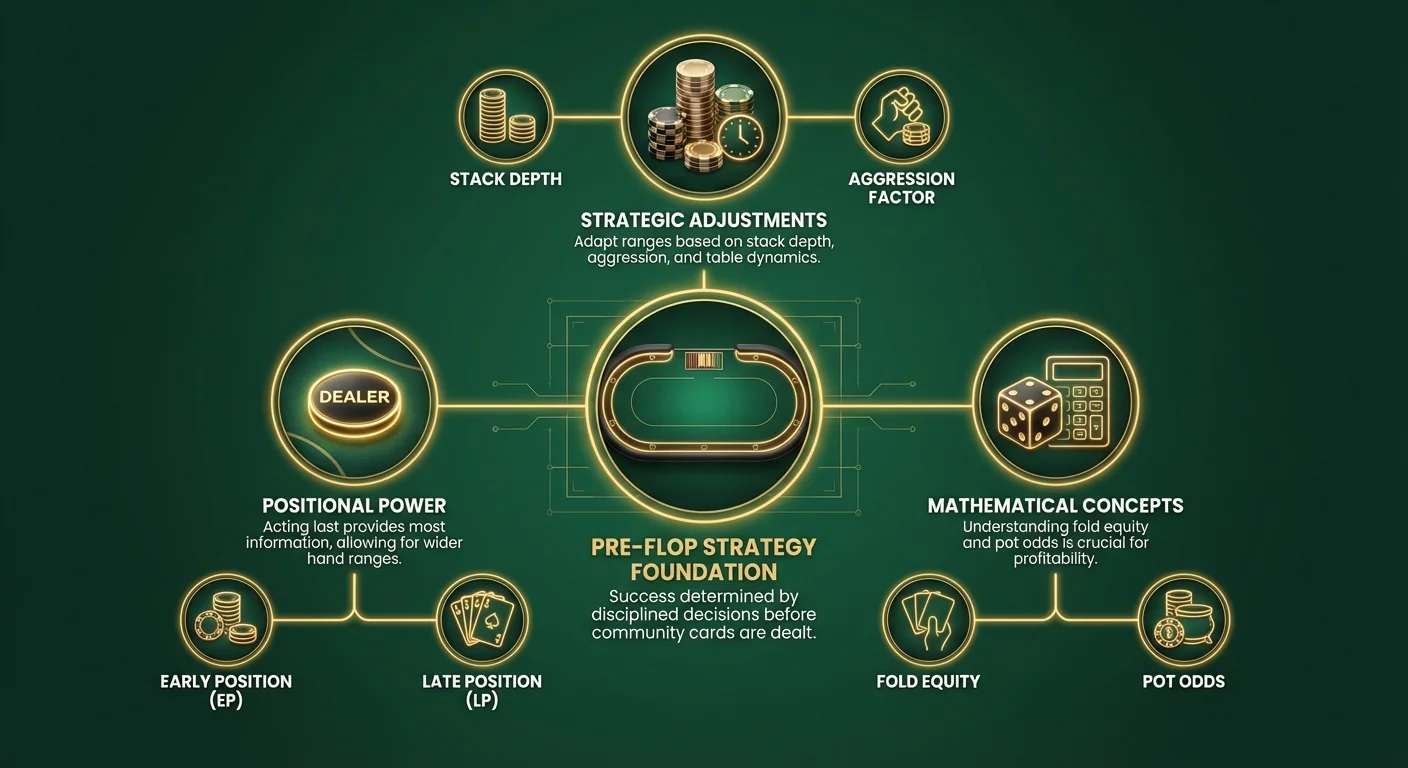
Success in poker isn't just about how you play your cards after the flop; it is fundamentally determined by the decisions you make before the community cards ever hit the felt. If you are bleeding chips in your crypto poker sessions, the leak often stems from a lack of discipline in your pre-flop hand ranges.
Many intermediate players fall into the trap of playing "feel" poker - entering pots with marginal hands because they are bored, tilting, or simply "feeling lucky." In the fast-paced world of Bitcoin and Ethereum poker sites, this is a recipe for disaster. The foundation of a profitable strategy lies in understanding positional play: knowing exactly which hands to open, which to fold, and which to 3-bet based on where you are seated relative to the dealer button.
This guide will move you beyond guessing. We will construct solid opening ranges for every position, explain the mathematics of "fold equity" and "pot odds," and show you how to adjust these ranges for the dynamic, aggressive nature of cryptocurrency poker games.
The Golden Rule: Position is Power
Before discussing specific cards, we must establish why position dictates your range. In poker, information is the most valuable currency - even more than the Bitcoin in your stack.
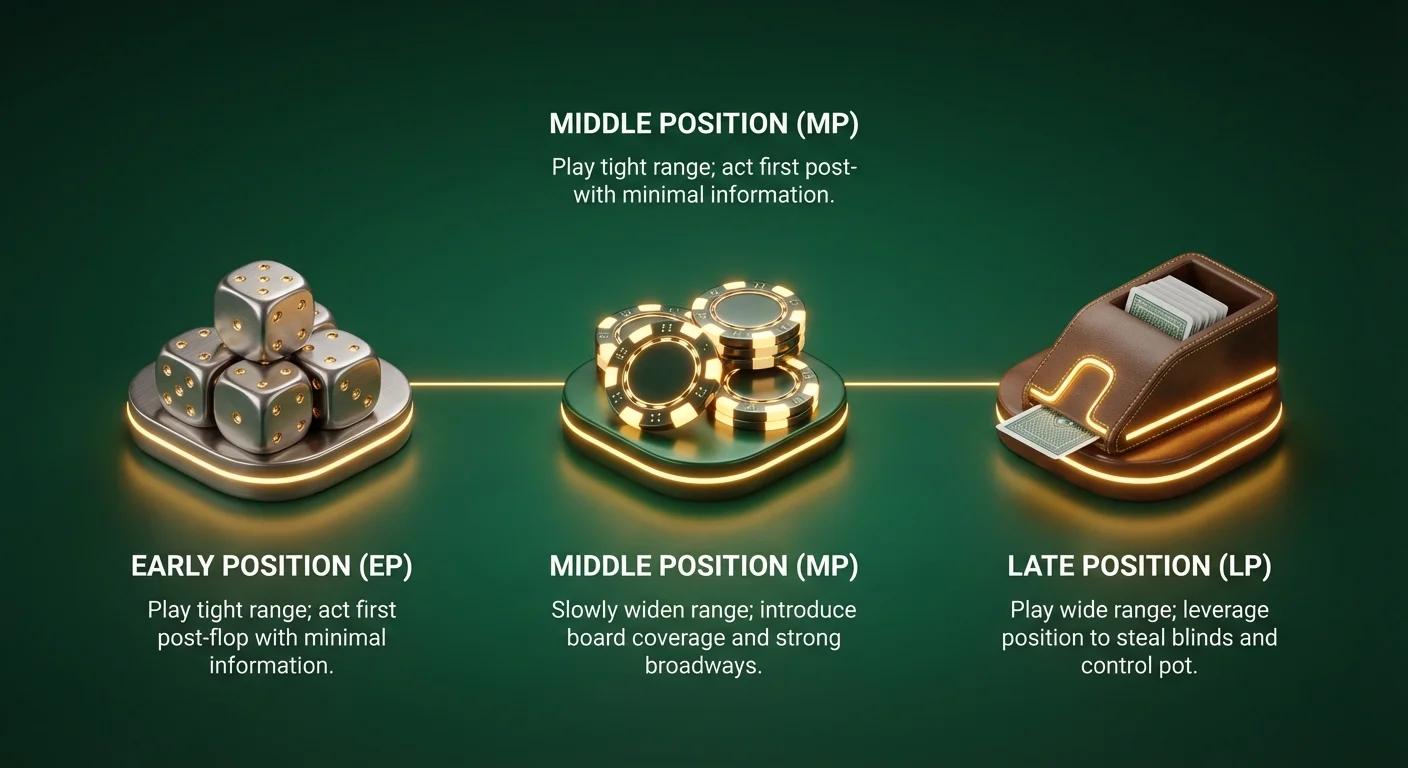
When you act last (Late Position), you have the most information because you've seen everyone else's actions. When you act first (Early Position), you are flying blind.
- Early Position (EP): You must play a tight range. You have to act first on every post-flop betting round, making you vulnerable to bluffs and traps.
- Late Position (LP): You can play a wide range. You can put pressure on opponents, control the pot size, and extract value more easily.
To play profitably, your pre-flop strategy must be elastic. A hand that is an instant fold Under the Gun (UTG) might be a mandatory raise from the Button (BTN).
Visualizing the Table: The Zones
For this guide, we will focus on a standard 6-Max or 9-Handed table structure, as these are the most common formats on crypto gambling platforms.
| Position Group | Specific Seats | Strategy Overview |
|---|---|---|
| Early Position (EP) | UTG, UTG+1, UTG+2 | The Iron Zone: Play only premium hands. Minimize risk. |
| Middle Position (MP) | LoJack (LJ), HiJack (HJ) | The Pivot Zone: Slowly expand to include strong broadways and pocket pairs. |
| Late Position (LP) | Cutoff (CO), Button (BTN) | The Profit Zone: Steal blinds aggressively. Play suited connectors and gappers. |
| The Blinds | Small Blind (SB), Big Blind (BB) | The Defense Zone: Protect your equity, but don't bleed chips defending trash. |
Early Position (UTG): The Sniper Strategy
Under the Gun (UTG) is the player immediately to the left of the Big Blind. This is the most dangerous seat at the table. If you raise here, you have 5 to 8 players left to act behind you. The likelihood that one of them has a monster hand (AA, KK, AK) is statistically significant.
The UTG Opening Range
In crypto poker games, which often feature loose-aggressive play, opening loose from UTG is lighting money on fire. Your goal here is strength and deception.
Open Raise (RFI - Raise First In):
- Pocket Pairs: 77 through AA. (Fold 22-66 in full ring; mixed open in 6-max).
- Suited Broadways: AKs, AQs, AJs, KQs.
- Offsuit Broadways: AKo, AQo.
- Suited Connectors: T9s+ (Only at aggressive, skilled tables to balance coverage).
What to Fold:
Do not fall in love with "trouble hands" like KJ offsuit, QT offsuit, or A-10 offsuit. These hands are dominated by the ranges of players who will call you. If you raise A-10 offsuit from UTG and get called, you are usually kicking against A-J, A-Q, or A-K. You are "dominated," meaning you have very little equity (around 25-30%) against their range.
Pro Tip: If you are unsure, fold. Tight is right in early position.
Middle Position (MP): shifting Gears
As you move a few seats to the left (LoJack and HiJack), the number of players remaining behind you decreases. This reduces the probability that someone holds a premium hand, allowing you to widen your range slightly.
The MP Opening Range
You are still vulnerable to the Button and Cutoff, so don't go crazy. However, you can start adding hands that have good post-flop playability.
Add these to your UTG range:
- Pocket Pairs: 55, 66.
- Suited Aces: ATs, A9s, A8s (These act as flush blockers and have nut potential).
- Suited Connectors: JTs, T9s, 98s.
- Offsuit Broadways: KQo, AJo.
The Concept of Board Coverage
In Middle Position, we introduce "board coverage." If you only play high cards, observant opponents know that on a board of 4-5-6, you missed completely. By mixing in hands like 89s or 66, you become harder to exploit because you could have hit that low flop.
Late Position (CO & BTN): The Aggressor
The Cutoff (CO) and the Button (BTN) are where professional poker players make the majority of their money. From the Button, you are guaranteed to act last on the Flop, Turn, and River. This positional advantage is so massive that you can profitably play nearly 40-50% of the deck if the action folds to you.
Leveraging Fold Equity
This is the perfect time to utilize the concept of Fold Equity. As noted in general poker theory, fold equity is the percentage of the time you win the pot simply because your opponent folds to your bet.
When you raise from the Button, you aren't just betting on your card strength; you are betting on the likelihood that the Small Blind and Big Blind have garbage hands and will simply give up.
The Button Opening Range (Stealing)
If it is folded to you on the Button, you should be raising (stealing) with a very wide range:
- All Pocket Pairs: 22+
- All Suited Aces: A2s+
- Most Suited Kings/Queens: K5s+, Q8s+
- Offsuit Aces: A2o+ (depending on how tight the blinds are)
- Suited Connectors & Gappers: 54s+, 64s+, J9s, etc.
- Offsuit Broadways: Any two cards T+ (e.g., QTo, JTo).
Strategic Adjustment: If the players in the blinds are extremely aggressive "3-bettors" (players who re-raise frequently), you must tighten this range back up. If the blinds are passive or "nitty," you can open nearly any two cards.
The Blinds: Defense and Math
Playing the blinds is the most complex part of pre-flop strategy.
The Small Blind (SB)
The SB is the worst position in poker. You have to pay money (0.5 BB) to see cards, but you act first post-flop.
- Strategy: DO NOT LIMP. Many intermediate players "complete" the blind (limp) with weak hands. This is a mistake.
- Action: Either raise (3-bet) or fold.
- Range: Play a tight-aggressive strategy similar to the Cutoff/Hijack range. If you just call, the Big Blind can squeeze you, or you play a bloated pot out of position.
The Big Blind (BB)
The BB has a unique advantage: Pot Odds.Because you have already put 1 Big Blind into the pot, it is cheaper for you to call a raise than anyone else.
Example of Pot Odds:
- Blinds are $1/$2.
- Button raises to $6.
- SB folds.
- Pot is now $9 ($1 SB + $2 BB + $6 Raise).
- You (BB) need to call $4 more to win a total pot of $13.
- Your odds are roughly 3.25 to 1. You only need about 23% equity to break even.
Because of this math, you can "defend" (call) the Big Blind with a very wide range, including hands like T8o or 45s, specifically against a Late Position raise. However, against an Early Position raise, respect their strength and fold your marginal holdings.
Adjusting for Table Dynamics and Stack Sizes
Static charts are great, but profitable poker requires adaptation. In the crypto environment, where you might be playing with Bitcoin or USDT, the player pool can vary wildly from highly skilled grinders to "crypto whales" gambling for fun.
1. Stack Depth
The standard buy-in is 100 Big Blinds (BB).
- Short Stack (<30 BB): Speculative hands like suited connectors (
78s) lose value because you don't have enough money behind to win a big pot (Implied Odds). Stick to high cards (AK,AQ,JJ+) and move All-In pre-flop more frequently. - Deep Stack (>150 BB): Speculative hands go up in value. If you hit a straight against an opponent's set, you can win a massive pile of crypto. You can widen your range to include more suited connectors and small pairs.
2. The "3-Bet" Factor
If you open-raise and get re-raised (3-bet), you need to construct a defense range.
- Out of Position (You raised UTG, Button 3-bets): Call very tight. You will be playing a big pot with no positional advantage. 4-bet (re-raise again) with AA/KK/AK, call with QQ/JJ, fold almost everything else.
- In Position (You raised Button, Blind 3-bets): You can call wider because you act last. You can call with suited connectors and broadways to try and outplay them post-flop.
3. Straddles
As mentioned in poker guides regarding blinds, many games feature a Straddle (an optional third blind). If a game has a straddle, the effective stacks are halved.
- Example: In a $1/$2 game with $200 stacks (100 BB), a $4 straddle makes the effective stack only 50 BB.
- Adjustment: Tighten up. Lower Stack-to-Pot ratios (SPR) reduce the skill edge of post-flop maneuvering and increase the value of raw pre-flop power (High cards/Pairs).
Crypto-Specific Considerations
When applying these ranges on platforms like CryptoGambling.com recommended sites, keep two factors in mind:
The Aggression Factor
Crypto poker tables tend to be more aggressive than traditional fiat sites. You will see more "spazz" bluffs and huge overbets.
- Impact on Range: Be willing to call down lighter with top-pair hands, but tighten your pre-flop opening range slightly so you always enter the battle with superior firepower.
Speed and Provably Fair
Many crypto poker games (especially "Video Poker" variants or specialized RNG table games) use Provably Fair technology. While this guarantees the shuffle is random, it does not change the odds. Don't fall for the "Gambler's Fallacy" thinking a hand is "due." Stick to the math. In peer-to-peer crypto poker, the randomness mimics a real deck - variance is real, so volume is key to realizing your equity.
Summary: Your Pre-Flop Checklist
Before you click "Raise" or "Call" in your next session, run through this mental checklist:
- Where am I? (Early, Middle, or Late Position?)
- Who raised? (Did the tight player in UTG raise, or the maniac on the Button?)
- What is my stack depth? (Do I have room to maneuver, or am I committed?)
- What are the Pot Odds? (Am I getting a discount to call in the Big Blind?)
Quick Reference Cheat Sheet
| Hand Category | UTG (Early) | MP (Middle) | BTN (Late) |
|---|---|---|---|
| AA - JJ | Raise/4-Bet | Raise/4-Bet | Raise/4-Bet |
| 22 - 99 | Fold (mostly) | Mix Fold/Raise | Raise |
| AK, AQ | Raise | Raise | Raise |
| AJ, KQ | Fold | Raise | Raise |
| Suited Connectors | Fold | Fold/Mix | Raise |
| Trash (K7o, Q4s) | Fold | Fold | Fold (Steal occasionally) |
Conclusion
Building a profitable pre-flop range is the architectural foundation of your poker game. If your foundation is weak - playing too many hands from early position or failing to defend your big blind correctly - the rest of your strategy will collapse.
By adhering to strict positional discipline, understanding the power of fold equity, and calculating your pot odds, you stop gambling and start investing. In the high-stakes, fast-moving world of crypto poker, this discipline is the defining line between the "fish" who deposit and the sharks who withdraw.
Ready to test your new ranges? Check out our top-rated crypto poker rooms and start grinding with an edge today.