
The flop has been dealt. You were the pre-flop aggressor, raising with intention, and now the action is on you (or checking to you). This specific moment is the most frequent decision point in No-Limit Hold'em: the opportunity to make a Continuation Bet (C-Bet).
For beginners, the C-bet is often an automatic reflex - "I raised before, so I bet now." For professionals, it is a nuanced weapon used to deny equity, extract value, and balance ranges. Transitioning from a reflexive bettor to a strategic one is the hallmark of an intermediate player.
In the fast-paced world of crypto poker, where anonymity and Bitcoin-fueled bankrolls often lead to aggressive dynamics, mastering the art of the C-bet is essential. Whether you are grinding micro-stakes on a decentralized platform or playing high-stakes tables with Ethereum's DeFi utility, understanding board textures and range advantages will define your win rate.
What is a Continuation Bet?
A continuation bet occurs when the player who made the last aggressive action pre-flop (the raiser) bets on the flop. The logic is grounded in the "story" you are telling. By raising pre-flop, you represented a strong hand (big pairs, high cards). Even if you missed the flop - which happens roughly two-thirds of the time with unpaired hands - your opponent likely missed it too.
By betting, you continue the narrative of strength. However, the days of C-betting 100% of flops are over. Modern opponents, especially in the competitive crypto gambling scene, will exploit blind aggression. The art lies in knowing when to fire and when to check.
The Three Pillars of C-Betting
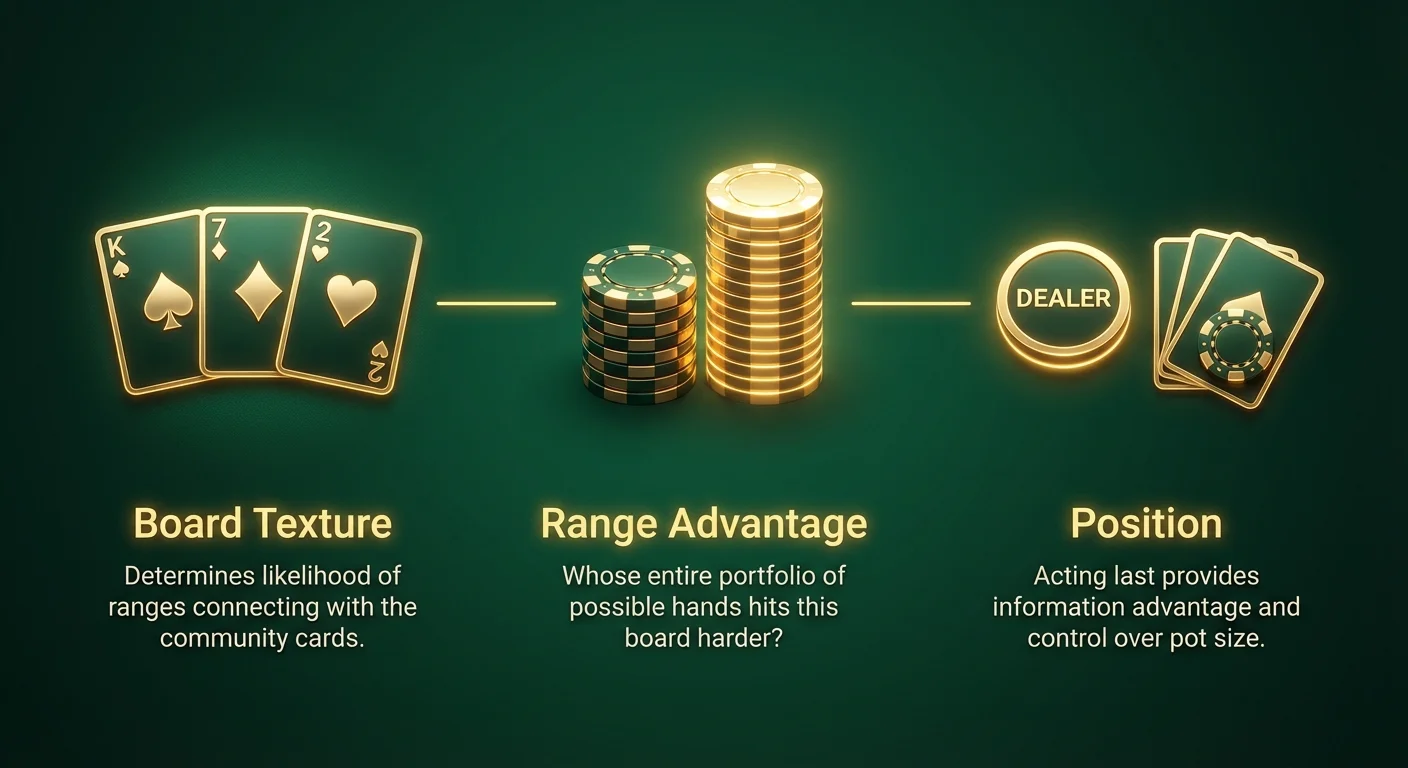
Before deciding to slide those digital chips into the pot, you must evaluate three critical factors: Board Texture, Range Advantage, and Position.
1. Analyzing Board Texture
The texture of the flop determines how likely it is that your pre-flop range connects vs. how likely it is your opponent connects.
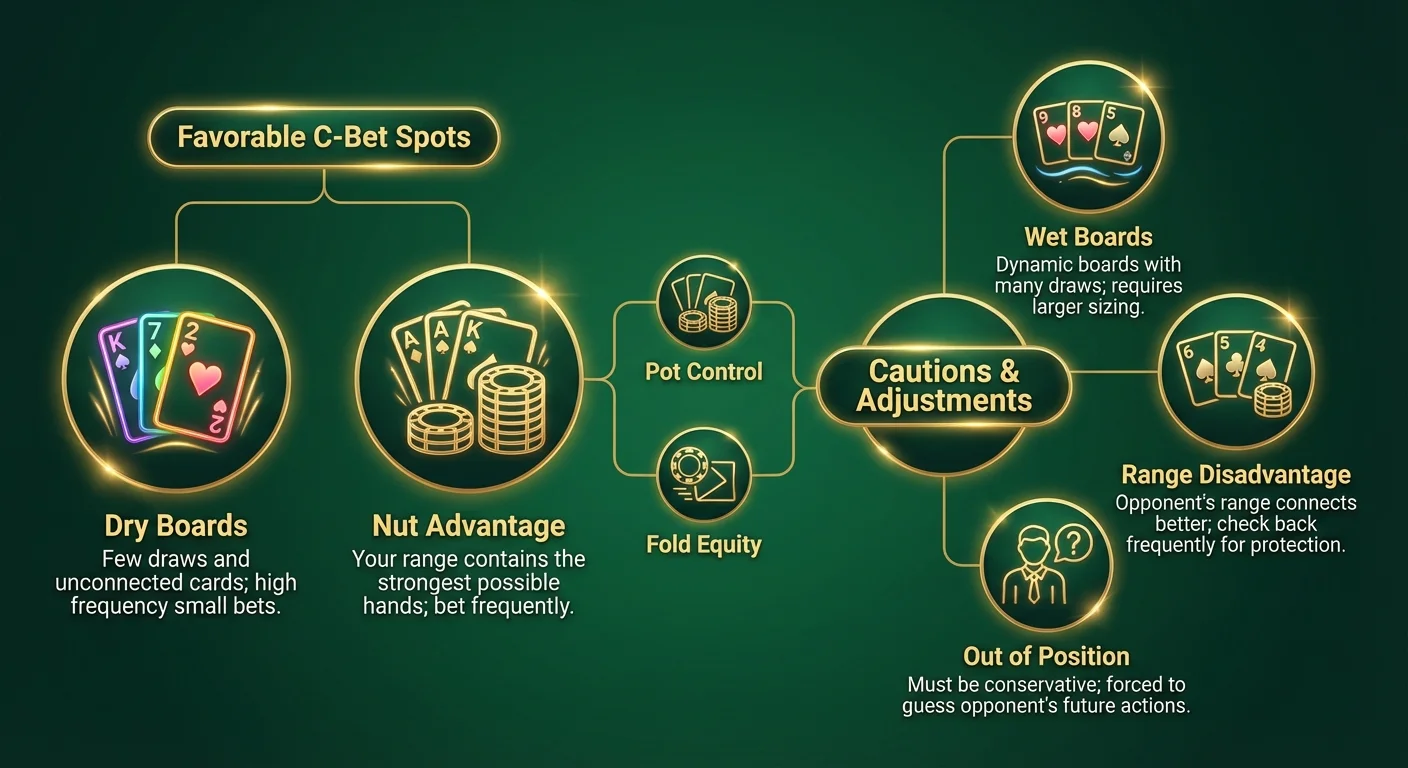
- Dry Boards (Static): These boards have few draws and unconnected cards (e.g., K♠ 7♦ 2♥). On dry boards, hand values rarely change on the turn.
- Strategy: You can C-bet these with a high frequency (often small sizing) because it is difficult for a caller to have connected with this board unless they have a King or a set.
- Wet Boards (Dynamic): These boards are coordinated and offer many straight or flush possibilities (e.g., J♥ T♥ 9♠).
- Strategy: You should C-bet less frequently. If you do bet, you generally need a larger size to charge draws. If you have air (a complete bluff), this is often a spot to give up or check-raise later, as the opponent likely connected with a piece of this board.
2. Range Advantage
Range advantage asks: "Whose entire portfolio of possible hands hits this board harder?"
If you raised Early Position (UTG) and the Big Blind called, your range is full of Aces, Kings, Queens, and big pairs. The Big Blind's range is "capped" - they likely would have 3-bet (re-raised) you pre-flop if they had AA, KK, or AK.
- Flop comes A-K-5: You have a massive Nut Advantage. You can bet almost 100% of your range here because you have all the strongest hands, and the opponent does not.
- Flop comes 6-5-4: The Big Blind has more combinations of 65, 54, 76, and sets of 4s or 5s. You are at a Range Disadvantage. You should check back frequently, even with overpairs like AA, to protect your hand.
3. Position: The Ultimate Tie-Breaker
Everything is easier In Position (IP). When you act last, you have more information. You can C-bet with a wider range because if called, you can choose to check back the turn for a free river card.
Out of Position (OOP), you must be more conservative. If you C-bet a marginal hand and get called, you are forced to play the turn and river guessing what the opponent will do. As a general rule, check more often when OOP.
Optimal Sizing: The Mathematics of the C-Bet
Gone are the days of simply betting half-pot on every hand. Your bet size should correlate with the board texture and your range.
| Board Texture | Recommended Size | Reasoning | Example Hand |
|---|---|---|---|
| Dry / Disconnected | 25% - 33% Pot | You want to force folds from weak hands while risking very little. You can bet your whole range here. | Board: Q-7-2 rainbow Hand: 9-8 suited |
| Neutral | 50% - 66% Pot | Standard value extraction. Balances bluffs with value hands. | Board: K-J-4 Hand: A-K |
| Wet / Dynamic | 66% - 100% Pot | You must charge draws heavily. "pricing them out" implies giving them bad pot odds to call. | Board: 9-8-5 (two hearts) Hand: Overpair (QQ) |
Fold Equity and Profitability
Understanding Fold Equity is vital. As noted in general poker statistics guides, fold equity is the likelihood your opponent folds to your bet.
If you bet 33% of the pot (a small C-bet), your bluff only needs to work 25% of the time to break even immediately.
- Math: Bet 1 chip to win 3 chips. Total pot becomes 4. 1/4 = 25%.
If you bet 75% of the pot, your bluff needs to work 42.8% of the time.
- Math: Bet 3 chips to win 4 chips. Total pot becomes 7. 3/7 = 42.8%.
This is why small bets on dry boards are so powerful in crypto poker games. They generate immense profit simply because opponents cannot defend enough hands mathematically to stop you.
When to Check: The Power of Restraint
Many intermediate players view checking as a sign of weakness or "giving up." In reality, checking is a strategic tool used to protect your range and control the pot size.
1. Pot Control with Medium Strength Hands
Imagine you raise with A♠ T♠ and the flop comes A♦ 9♣ 8♣. You have top pair, but your kicker is mediocre, and the board is dangerous (wet).
- If you bet and get raised, you are in a miserable spot. You likely have to fold.
- If you check, you control the size of the pot. You can easily call a bet on the turn. This is known as "pot control." You keep the pot small for a hand that is good, but not great.
2. Protecting Your Checking Range
If you only check when you have garbage, observant opponents will bet 100% of the time you check. To prevent this, you must occasionally check with monster hands.
- Scenario: You have K♣ K♦ on a 7♠ 7♦ 2♥ board.
- Action: Consider checking back. You are crushing everything. By checking, you allow your opponent to try to bluff the turn. You also prove to the opponent that "Just because I checked, doesn't mean I'm weak."
3. Giving Up (The "Shutdown")
Sometimes, you just miss, and the board smashes the opponent.
- Hand: 3♠ 3♦
- Board: Q♠ J♠ T♥
- Action: Check and fold to any aggression. There is zero point in burning chips (or Satoshis) on a board that connects perfectly with a caller's range.
Delayed C-Betting
A sophisticated alternative to the standard flop C-bet is the Delayed C-bet. This involves checking the flop and betting the turn.
Why do this?
- Deception: It looks like you gave up, inducing the opponent to call light or bluff.
- Information: If the opponent checks the flop and checks the turn again, their hand is likely very weak.
- Dodging Traps: If you check back a wet flop and the opponent bombs the turn, you saved yourself a bet.
Strategy for Crypto Poker Ecosystems
When playing on platforms like those reviewed on CryptoGambling.com, specific factors influence C-betting:
- HUDs vs. Anonymity: Some crypto sites allow Heads-Up Displays (HUDs), while others are anonymous. If you have a HUD, look at the "Fold to Flop C-Bet" stat. If it's over 60%, bet virtually any two cards. If playing anonymously, assume the average player is slightly looser and stick to GTO (Game Theory Optimal) frequencies.
- The "Provably Fair" Factor: Crypto poker often utilizes "Provably Fair" algorithms to shuffle cards. While this ensures fairness, it doesn't change the odds. Don't fall into the gambler's fallacy of thinking the algorithm is "due" to deal a specific runout. Stick to the math.
- Volatility and Bankroll: Aggressive C-betting increases variance. Ensure your crypto bankroll (whether in BTC, USDT, or ETH) is sufficient to handle the swings. A standard recommendation is 30-50 buy-ins for cash games.
Practical Checklist: To Fire or Not to Fire?
Before you click that bet button, run through this rapid mental checklist:
- Did I raise pre-flop? (Yes = Proceed).
- Is the board Dry or Wet? (Dry = Lean toward betting; Wet = Lean toward checking unless strong).
- Who has the Range Advantage? (Do I have more nuts than him? Yes = Bet).
- Am I In Position? (Yes = Bet more frequently; No = Check more frequently).
- What is my hand strength?
- Strong Value: Bet (usually).
- Top Pair/Weak Kicker: Check (Pot Control).
- Draw: Bet (Semi-bluff).
- Total Air: Bet small if dry, Give up if wet.
Conclusion
The C-bet is the bridge between pre-flop aggression and post-flop profit. It is not a move to be made on autopilot. By analyzing board texture, respecting range advantages, and mastering the mathematics of fold equity, you transform your C-bet from a simple "continuation" into a calculated assault on the pot.
Remember, in poker, every chip you save by checking when you're beat is just as valuable as every chip you win by betting when you're ahead. Balance your aggression with prudence, and you will see your crypto stack grow.
Frequently Asked Questions
What is a good C-bet frequency?
Ideally, you should be C-betting between 50% and 70% of the time. If you bet 100%, you are bluffing too much. If you bet 30%, you are too passive and easy to read.
Should I C-bet multi-way pots (3+ players)?
Be very careful. The likelihood of someone hitting the flop increases drastically with every extra player. In multi-way pots, play "honest" poker: bet your strong hands and check your bluffs.
How does stack depth affect C-betting?
If you are short-stacked (less than 20 Big Blinds), you often cannot fold after betting. This forces you to be committed ("All-in") sooner. With deep stacks (100BB+), you have more room to maneuver, check-raise, and fire multiple barrels (betting flop, turn, and river).