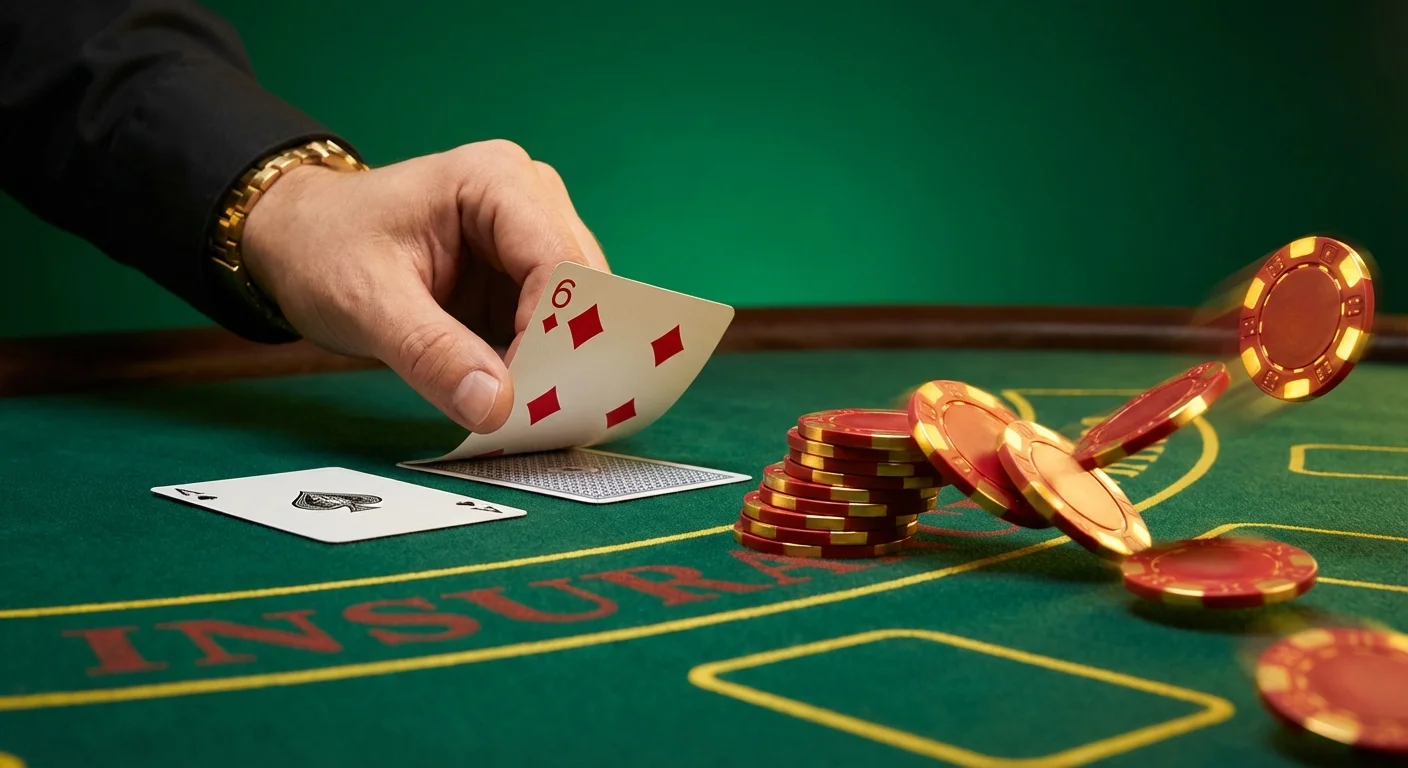
The dealer slides an Ace across the felt, face up. It's the most powerful card in the deck for the house. You look down at your hand - perhaps a decent 19, or maybe a struggling 14. Before play continues, the dealer pauses, sweeps their gaze across the table, and asks the most dangerous question in Blackjack:
"Insurance?"
It sounds like a safety net. In the real world, insurance is a responsible purchase - it protects your car, your home, and your health. But inside a casino, whether you are at a physical table in Las Vegas or playing with Bitcoin at a high-stakes crypto casino, "Insurance" is a misnomer. It isn't protection; it is a side bet designed to capitalize on your fear of losing.
For beginner players, declining insurance often feels risky. For professional players, taking insurance is a move reserved for very specific, mathematically calculated moments. For everyone else, it is simply a leak in your bankroll.
In this guide, we will dismantle the mathematics of the insurance bet, explain why "Even Money" is just a polite way of ripping you off, and reveal why the smartest players almost always say "no."
What Is the Insurance Bet?
Before we dive into the math, let's clarify exactly what is happening when you are offered insurance.
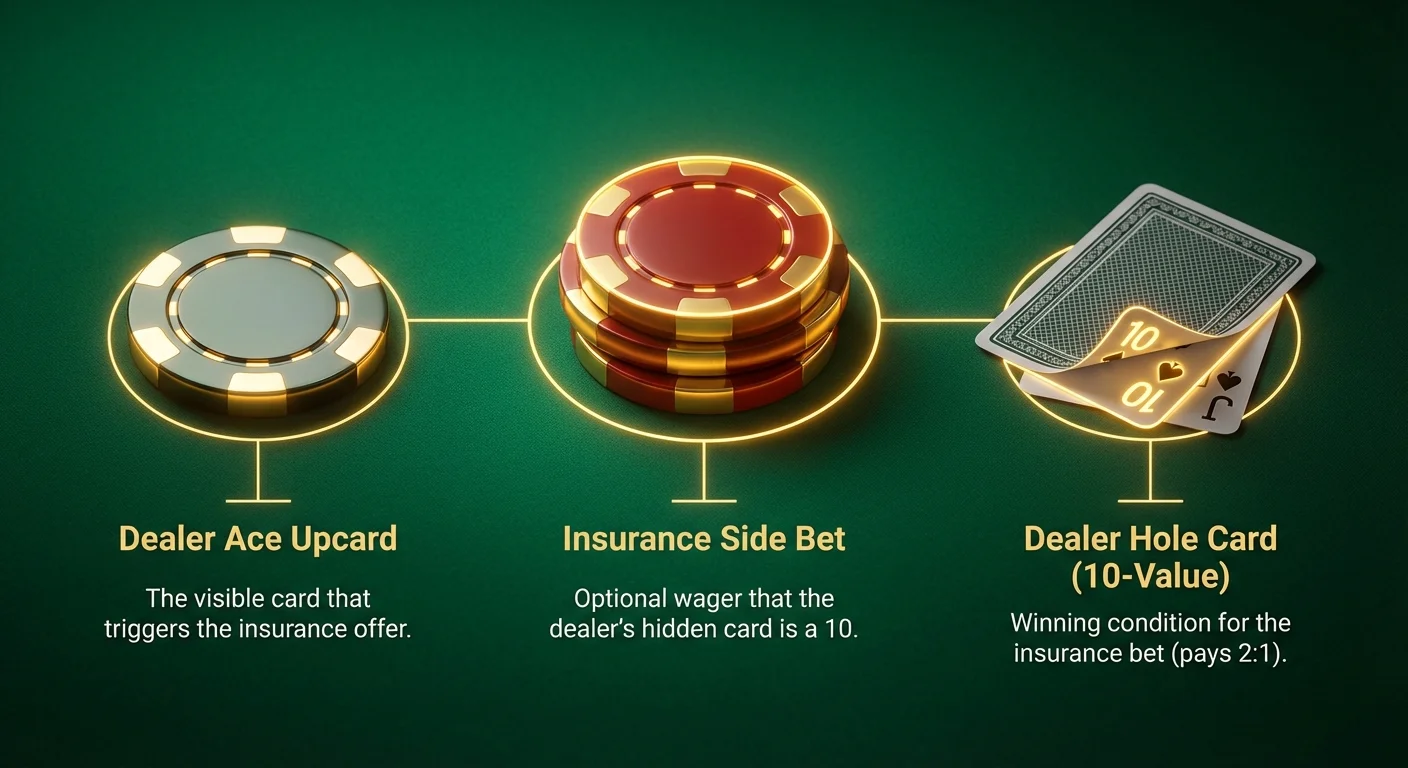
In a standard game of American Blackjack (the most common variant found at CryptoGambling.com recommended sites), the dealer receives two cards: one face-up (the Upcard) and one face-down (the Hole Card).
If the dealer's Upcard is an Ace, the casino allows players to make an Insurance Bet.
The Mechanics
- The Trigger: The dealer shows an Ace.
- The Cost: You can bet up to half of your original wager. (e.g., If you bet 1 mBTC, insurance costs 0.5 mBTC).
- The Bet: You are betting that the dealer's Hole Card is a 10-value card (10, Jack, Queen, or King).
- The Payout: If the dealer has Blackjack, the insurance bet pays 2:1.
If the dealer does have a Blackjack, you lose your main hand (unless you also have Blackjack), but you win the insurance bet. Because the insurance bet pays 2:1 and costs half your main bet, you break even on the hand.
If the dealer does not have a Blackjack, the dealer collects your insurance chips, and the hand continues as normal.
Key Takeaway: Insurance is not really insuring your hand. It is a completely separate side bet on whether the dealer has a 10 in the hole. You can have a terrible hand (like a 12) and win the insurance bet, or a great hand (like a 20) and lose the insurance bet.
The Mathematical Breakdown: Why It's a Trap
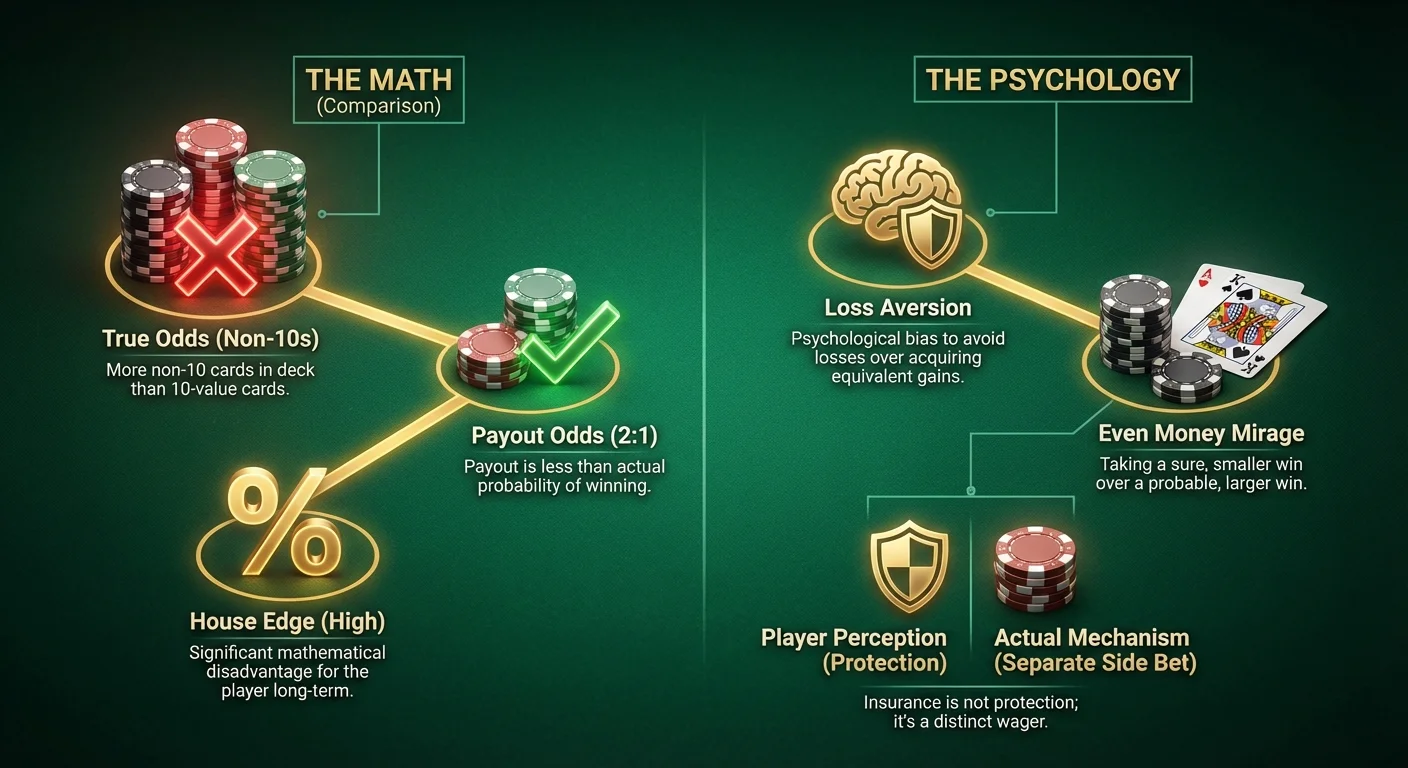
Casinos do not offer bets that favor the player. They offer bets where the payout is lower than the actual odds of winning. This difference is the House Edge. The insurance bet has one of the highest house edges in the entire game of Blackjack.
To understand why, we have to look at the deck.
The Ratio of Tens to Non-Tens
In a standard 52-card deck, there are:
- 16 Ten-Value Cards: (Four 10s, four Jacks, four Queens, four Kings).
- 36 Non-Ten-Value Cards: (2s through 9s, and Aces).
This means that if you took a blind guess on a card, you have a 30.7% chance of picking a 10, and a 69.3% chance of picking a non-10.
The Payout Discrepancy
The casino pays you 2 to 1 on insurance.
However, the actual odds against the dealer having a 10 are roughly 2.25 to 1.
Let's look at a simplified example using a single deck to make the math visible.
- Scenario: You sit at a table. You are dealt a 9 and a 7 (16). The dealer shows an Ace.
- Visible Cards: You see three cards total (your 9, your 7, and the dealer's Ace).
- Remaining Deck: There are 49 cards left in the deck.
- Ten-Count: Since you don't have a 10, all 16 ten-value cards are still in the deck.
- Non-Ten Count: There are 33 non-ten cards remaining (36 total minus the dealer's Ace and your two cards).
If you play this scenario 49 times for $10 insurance each time:
- You Win: 16 times (when the dealer has a 10).
- 16 wins x $20 profit = +$320
- You Lose: 33 times (when the dealer does not have a 10).
- 33 losses x $10 cost = -$330
Net Result: You have lost $10 over 49 hands.
This results in a house edge of roughly 5.9% on a single-deck game. In a 6-deck or 8-deck shoe (standard for most online crypto casinos), the house edge on insurance jumps even higher, hovering around 7.4%.
To put that in perspective, the house edge on standard Blackjack Basic Strategy is roughly 0.5%. By taking insurance, you are voluntarily moving from a game with excellent odds to a game with worse odds than Roulette or Slots.
House Edge Comparison Table
| Bet Type | House Edge (Approx.) | Verdict |
|---|---|---|
| Blackjack (Basic Strategy) | 0.5% | Excellent |
| Baccarat (Banker) | 1.06% | Good |
| Roulette (European) | 2.7% | Moderate |
| Insurance (Single Deck) | 5.9% | Bad |
| Insurance (6-Deck Shoe) | 7.4% | Terrible |
The "Even Money" Mirage
There is one scenario where declining insurance feels incredibly painful: when you have a Blackjack.
The Scenario:
- You bet 1 BTC.
- You are dealt an Ace and a King (Blackjack!).
- The dealer turns over an Ace.
The dealer will immediately ask, "Do you want even money?"
If you accept, the dealer pays you 1:1 on your bet instantly (1 BTC profit), and the hand is over. You don't have to wait to see if the dealer also has Blackjack.
If you decline, two things can happen:
- Dealer has Blackjack: It is a "Push" (Tie). You get your original bet back, but win nothing.
- Dealer does not have Blackjack: You win 3:2 (or 1.5 BTC).
Why "Even Money" is Just Insurance in Disguise
Taking "Even Money" is mathematically identical to making the insurance bet. Here is the proof:
- You have a Blackjack. You take insurance for 0.5 BTC.
- Outcome A (Dealer has Blackjack): Your main hand Pushes (you keep your 1 BTC). You win the insurance bet (pay 2:1 on 0.5 BTC = 1 BTC profit). Total profit: 1 BTC.
- Outcome B (Dealer has no Blackjack): You win your main hand 3:2 (1.5 BTC profit). You lose the insurance bet (0.5 BTC loss). Total profit: 1 BTC.
Regardless of the cards, taking insurance on a Blackjack guarantees a 1 unit win. This is why the casino calls it "Even Money."
Why You Should Decline Even Money
Your brain tells you: "Take the sure thing! Don't risk getting a Push!"
But remember the math. The dealer is more likely not to have a 10 than to have one.
- Most of the time (approx 70%), you will win 1.5 units.
- Some of the time (approx 30%), you will win 0 units (Push).
When you average that out over time, the value of holding a Blackjack against a dealer Ace is roughly 1.04 units. By taking even money, you are voluntarily accepting 1.00 units. You are giving the casino a 4% discount on your payout every time you say "yes."
Smart crypto players play for long-term mathematics, not short-term comfort. Never take even money.
The Psychology of the Trap
If the math is so clearly bad, why do so many players take insurance? It comes down to a psychological concept called Loss Aversion.
Human beings feel the pain of a loss twice as vividly as the pleasure of a gain.
- When you have a "Made Hand" (like a 20 or a Blackjack), you feel possessive of it. The idea that the dealer could snatch a win away with a Blackjack feels unfair.
- Insurance feels like you are paying a small fee to stop that bad feeling.
Casinos know this. They pitch insurance as a way to "break even" or "protect your investment." But in gambling, you cannot protect a bet that has already been made. You can only make the best statistical decision for the current situation.
The "Gut Feeling" Fallacy
You might think, "I have a feeling a ten is coming."
In a fair crypto casino using Provably Fair technology, the deck is shuffled via RNG (Random Number Generator). The computer does not have "moods," and the cards do not run in "streaks" based on karma. The distribution of cards is governed by probability. Trusting your gut over the math is exactly how the house maintains its edge.
The Exception: When Pros Actually Take Insurance
You may have heard that professional card counters take insurance. This is true, but it applies to a very specific set of circumstances that rarely apply to the average player, and almost never apply to online RNG games.
Card Counting and Insurance
Card counters track the ratio of high cards (10s, Aces) to low cards (2s through 6s) remaining in the shoe.
- When many low cards have been played, the remaining deck is "rich" in 10s.
- If the "True Count" (a metric used by counters) rises above +3, the probability of the dealer having a 10 in the hole rises above 33.3%.
- Once the probability crosses that threshold, the insurance bet actually flips to favor the player.
Why This Doesn't Apply to Most Crypto Blackjack
Most blackjack games at crypto casinos fall into two categories:
- RNG (Software) Blackjack: The deck is "shuffled" after every single hand. There is no memory. The count is always zero. You can never take insurance profitably here.
- Live Dealer Blackjack: These games use real shoes, but they often have "penetration" limits (they shuffle the shoe when half the cards are still left) to prevent card counting from being effective.
Unless you are an expert card counter playing at a live table with favorable deck penetration, Insurance is always a losing bet.
Better Strategies for Smart Players
If you want to protect your bankroll, stop looking at the Insurance line and start looking at these tools instead:
1. Master Basic Strategy
Before you worry about side bets, ensure you are playing your main hand perfectly. Basic strategy charts tell you exactly when to Hit, Stand, Split, or Double Down based on math. Following this reduces the house edge to ~0.5%.
2. Utilize Surrender (If Available)
Many players confuse Insurance with Surrender.
- Insurance: Betting the dealer has Blackjack. (Bad bet).
- Surrender: Giving up half your bet to fold a terrible hand before the dealer plays. (Good move).
If you have a hard 16 and the dealer shows a 10 or Ace (and the casino allows late surrender), you should Surrender. This saves you money in the long run. Insurance costs you money.
3. Check the Rules: 3:2 vs. 6:5
The biggest threat to your bankroll isn't declining insurance - it's playing at a table that pays 6:5 on Blackjack.
- 3:2 Payout: Bet $10, win $15 on Blackjack.
- 6:5 Payout: Bet $10, win $12 on Blackjack.
A 6:5 table increases the house edge by nearly 1.4%. Never play 6:5 Blackjack, even if the crypto casino offers flashy graphics. Always look for the "Blackjack pays 3 to 2" text on the felt.
Crypto-Specific Blackjack Tips
Playing with cryptocurrency offers distinct advantages, but it requires a disciplined approach to side bets like insurance.
- Speed of Play: Crypto blackjack, especially RNG versions, is incredibly fast. You can play 100 hands in the time it takes to play 20 at a physical casino. If you take insurance habitually, the speed of the game will drain your balance at an accelerated rate.
- Provably Fair: Use the "Provably Fair" verification tools provided by top crypto casinos. While this confirms the game isn't rigged, it also confirms that the shuffle is random - reinforcing the fact that card counting (and thus profitable insurance) is impossible.
- Bonus Clearing: If you are playing to clear a Welcome Bonus, stick to low-volatility gameplay. Taking high-variance side bets like Insurance or Perfect Pairs increases the swing of your bankroll and increases the risk of busting out before you unlock your bonus funds.
Summary: The Verdict on Insurance
The dealer's question is not a favor; it is a challenge to your math skills.
- Does Insurance protect your hand? No. It is a side bet on the dealer's hole card.
- Is the payout fair? No. You are paid 2:1 for an event that happens roughly once every 3.2 times.
- Should you take Even Money? No. It is mathematically identical to taking insurance.
- When should you take it? Only if you are an expert card counter who knows the deck is rich in tens. In all other cases - never.
The next time you are sitting at a virtual table at your favorite crypto casino and that Ace appears, don't hesitate. When the button pops up asking for "Insurance," click No.
You aren't leaving your hand unprotected; you are protecting your bankroll from the house's favorite trap.