
It is the classic sports bettor's dilemma: You have a five-leg parlay. The first four legs have hit, and you are staring at a potential payout of 5 BTC from a mere 0.1 BTC wager. The final game starts in an hour. Do you let it ride, risking everything for the maximum payout? Or do you place a bet on the opponent, guaranteeing a smaller but certain profit regardless of the outcome?
This is the art and science of hedging bets. While the concept seems simple - betting on the opposite outcome to secure a return - the execution separates the amateurs from the pros. In the high-stakes world of crypto sports betting, where volatility is already part of the currency, understanding risk management is paramount.
This guide will move beyond the basics, exploring the mathematical reality of hedging, why "cashing out" is often a trap, and how to use a manual hedge calculator strategy to optimize your bankroll management.
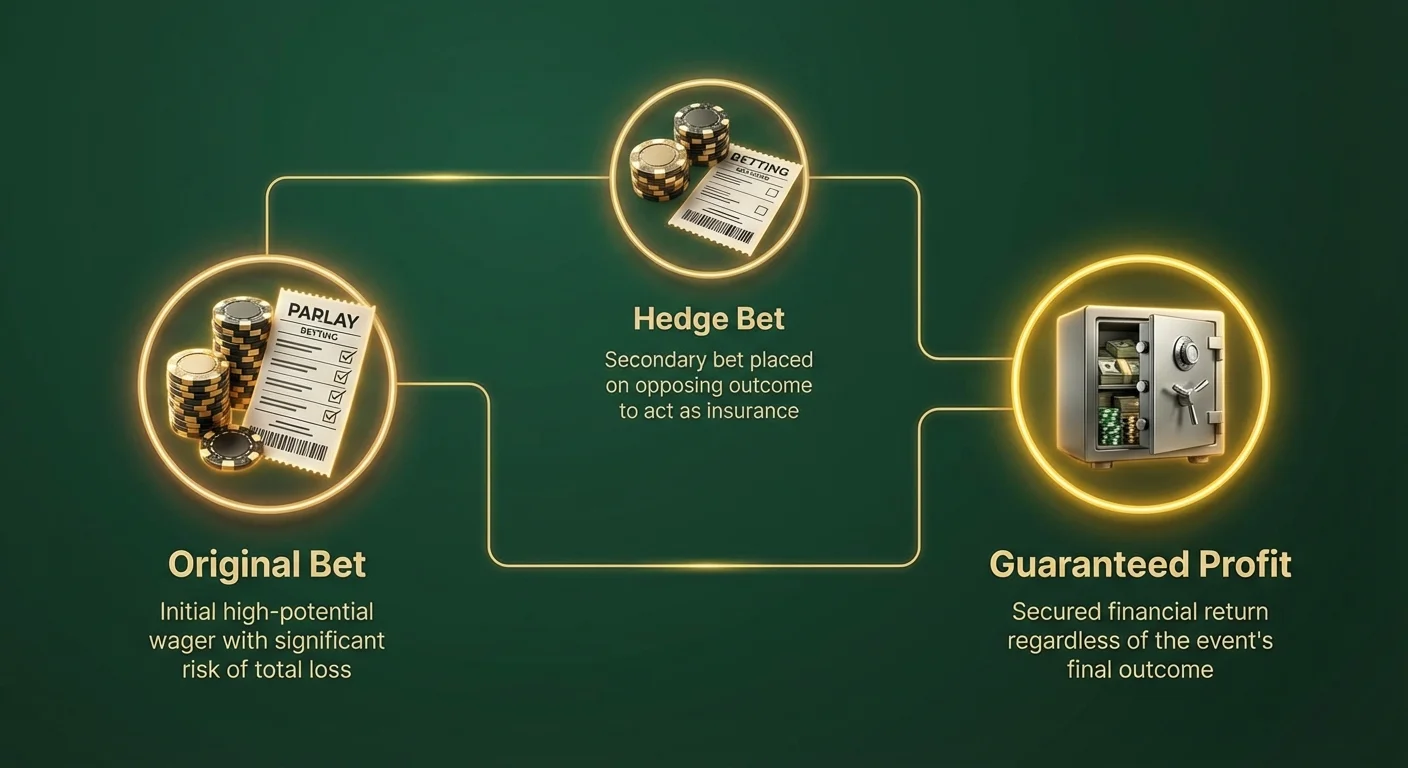
What is Hedging?
At its core, hedging bets involves placing a wager on a different outcome than your original bet to create a situation where you guarantee a profit or minimize a loss. It is an insurance policy. You are effectively buying your way out of risk.
Hedging is most commonly used in three scenarios:
- Futures: You bet on a team to win the championship at high odds, and they have made it to the final.
- Parlays: You have hit every leg of a multi-bet slip except the last one.
- Live Betting: The game flow has shifted, and you want to protect your pre-game position.
While the emotional relief of locking in a win is palpable, the math tells a more complicated story. To master hedging, you must understand the tug-of-war between Expected Value (EV) and Marginal Utility.
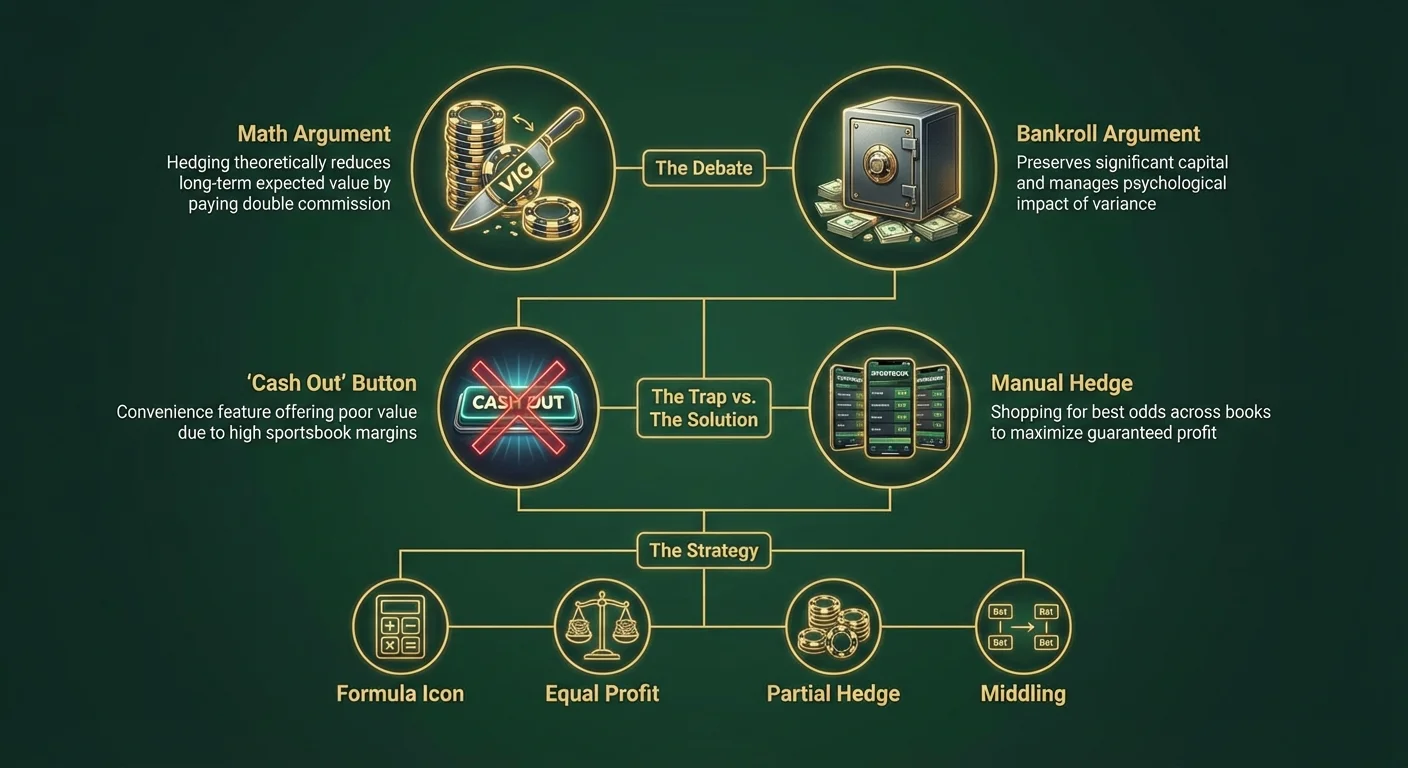
The Mathematical Argument Against Hedging
Before we discuss how to hedge, we must address the purist argument for why you shouldn't.
In a vacuum, hedging is mathematically "negative EV" (Expected Value). Every time you place a bet at a sportsbook, you pay a fee known as the vig or juice (the margin built into the odds). When you place your original bet, you pay the vig. When you place a hedge bet, you pay the vig again.
By hedging, you are essentially paying double the commission to the sportsbook to reduce your variance. Over an infinite number of bets, a player who never hedges will theoretically end up with more money than a player who always hedges, simply because the non-hedger pays less in fees.
The Cost of Certainty
Consider this simplified scenario:
- Original Bet: 100 USDT on Team A to win at 2.0 (+100).
- Team A takes a massive lead.
- Hedge Opportunity: You can bet on Team B live at 10.0 (+900).
If you bet on Team B to secure profit, you are paying the bookmaker's margin on that live bet. The "Sharp" bettor argues: If the original bet is now a statistical favorite, why dilute the value?
However, most of us do not have an infinite bankroll or an infinite timeline. This brings us to the psychological and practical case for hedging.
The Bankroll Argument For Hedging
While the math suggests letting it ride, utility theory suggests otherwise. The value of money is not linear.
The difference between having $0 and $1,000 is massive (it pays the rent). The difference between $100,000 and $101,000 is negligible. If a loss on the final leg of a parlay would devastate your bankroll or your morale, hedging is the correct move.
You should hedge when:
- Life-Changing Money: The potential payout represents a significant portion of your net worth or annual income.
- Bankroll Preservation: The guaranteed profit significantly boosts your betting bankroll, allowing you to size up future bets.
- Market Shifts: Information changes (e.g., a star player is injured during warmups), changing the actual probability of winning.
The "Cash Out" Button vs. Manual Hedging
Most modern crypto sportsbooks offer a "Cash Out" feature. With one click, the book buys back your bet for a guaranteed amount.
Rule #1 of Professional Betting: Never use the Cash Out button.
The Cash Out button is a convenience fee. Sportsbooks apply a massive margin to these offers, giving you significantly less than the true value of your position. Instead, you should manually hedge. This means going to a different sportsbook (or a betting exchange) and placing a bet on the opposing side.
Comparison: Cash Out vs. Manual Hedge
| Scenario | Cash Out Offer | Manual Hedge Profit | Why? |
|---|---|---|---|
| Parlay (Last Leg) | 0.8 BTC | 0.92 BTC | The manual hedge allows you to shop for the best odds on the opponent. |
| Futures Bet | 5,000 USDT | 5,800 USDT | Cash-out algorithms are programmed to be stingy; open markets are competitive. |
| Flexibility | None (All or nothing) | High | You can partial hedge manually (e.g., cover your stake but leave profit riding). |
How to Calculate a Hedge
To lock in profit effectively, you need to know exactly how much to bet on the opposing side. While you can find a hedge calculator online, it is vital to understand the math so you can do rough estimates on the fly.
The Formula for Equal Profit
If you want to make the exact same amount of profit regardless of who wins, use this formula:
Practical Example
Let's look at a concrete example involving a Futures bet.
The Setup:
Months ago, you bet 1,000 USDT on the Miami Dolphins to win the Super Bowl at odds of 11.0 (+1000).
- Potential Return: 11,000 USDT (10,000 Profit + 1,000 Stake).
The Situation:
The Dolphins are in the Super Bowl. Their opponent is the San Francisco 49ers. The 49ers are the favorites.
- Current Odds on 49ers: 1.50 (-200).
The Goal:
You want to walk away with a guaranteed profit, no matter who wins.
The Calculation:
- Total Potential Payout: 11,000 USDT.
- Hedge Odds (49ers): 1.50.
- Hedge Stake: $11,000 / 1.50 = 7,333.33 USDT$.
The Result:
- Scenario A (Dolphins Win): You win 11,000 from original bet. You lose 7,333.33 on hedge. Net Profit: +2,666.67 USDT.
- Scenario B (49ers Win): You lose 1,000 original bet. You win 3,666.67 profit on hedge (7,333 * 0.5). Net Profit: +2,666.67 USDT.
By risking a portion of your potential upside, you have turned a gamble into a guaranteed 2,666 USDT payday.
Advanced Strategies: Partial Hedging and Middling
You don't always have to lock in an equal profit. There are nuances to how you can approach this.
1. The Partial Hedge
This is for the bettor who wants to cover their initial stake but still wants a big sweat.
- Goal: Get your original 1,000 USDT back if you lose.
- Math: Bet enough on the 49ers (at 1.50) to win 1,000 USDT.
- Stake: $1,000 / 0.5 (fractional odds) = 2,000 USDT$.
- Outcome: If Dolphins win, you win big (minus the 2k hedge). If 49ers win, you break even.
2. The Middle (Middling)
This is the holy grail of sports betting, often easier to execute with the high liquidity of crypto sportsbooks. "Middling" occurs when you bet on both sides of a game at different lines, creating a window where both bets can win.
- Original Bet: Over 45.5 Points.
- Line Movement: The line moves to 49.5 Points.
- Hedge Bet: Under 49.5 Points.
The Middle: If the game lands on 46, 47, 48, or 49 points, you win BOTH bets. If it falls outside that range, you usually only lose the "vig" on one side. This is a low-risk, high-reward strategy often used by pros.
Hedging in the Crypto Era
Using cryptocurrency adds distinct advantages (and a few cautions) to the hedging process.
Advantages
- Speed of Movement: When hedging live, seconds matter. Crypto transactions (especially on networks like Solana or Lightning Network) allow you to move funds from your wallet to a sportsbook instantly to catch a drifting line.
- High Limits: If you hit a massive futures bet (e.g., 1 BTC payout), fiat books might limit how much you can bet on the hedge. Major crypto sportsbooks generally offer much higher ceilings, allowing you to hedge fully without needing multiple accounts.
- Stablecoin Usage: When hedging to lock in profit, consider using USDT or USDC for the hedge bet. This eliminates the risk of Bitcoin or Ethereum price volatility affecting your calculated "locked" profit.
The Exchange Factor
Crypto has popularized decentralized betting exchanges (like Betfair equivalents on blockchain). These are ideal for hedging because you can "Lay" (bet against) your own team often at better odds than a traditional sportsbook, as you are betting against other users, not the house.
5 Rules for Successful Hedging
If you decide to lock in profit, follow these strict guidelines to ensure you aren't destroying value unnecessarily.
- Don't Hedge for "Dinner Money": If your parlay payout is 50 USDT, let it ride. Over the long run, paying the extra vig on small bets will drain your bankroll. Only hedge when the sum is significant to you.
- Shop for Lines: Never assume the sportsbook holding your winning ticket offers the best hedge odds. Open a second or third crypto sportsbook account. A difference in odds from 1.50 to 1.55 can mean hundreds of dollars in difference.
- Check the Rules: Ensure your hedge bet includes Overtime (OT) if your original bet does. A classic mistake is backing a team "Moneyline" (includes OT) and hedging with a "Match Result" (regulation only). If the game draws, you could lose both.
- Avoid the "Panic Hedge": Do not hedge just because the other team scored a touchdown in the first quarter. Trust your initial analysis. Hedging is best reserved for pre-game adjustments or late-game security.
- Beware of Correlation: If hedging a player prop (e.g., betting Under on QB passing yards to hedge a Team Win), ensure they aren't too heavily correlated, or you might accidentally double down on risk rather than reducing it.
Conclusion
Hedging is a tool, not a rule. From a purely mathematical standpoint, it reduces your expected value over a lifetime of betting. However, we do not live in a mathematical simulation; we live in a world where bankroll variance can be stressful and dangerous.
Learning when and how to lock in profit allows you to stay in the game longer. It transforms gambling from a binary win/loss outcome into a managed investment portfolio.
Key Takeaway: Ignore the "Cash Out" button. If the money means something to you, grab your calculator, find the best odds on the opposing side, and manually engineer your own green book. In the volatile world of crypto betting, a guaranteed profit is the only asset that truly never fluctuates.