
If you ask the average sports fan how to make money betting, they will likely tell you: "You have to know who is going to win." They will talk about analyzing quarterbacks, checking injury reports, and predicting the final score.
They are wrong.
If you ask a professional sports bettor how to make money, they won't talk about winners. They will talk about price. They will talk about value.
Welcome to the concept of Value Betting. This is the dividing line between the recreational gambler who slowly bleeds their bankroll and the sharp bettor who treats sports betting as an investment class. Value betting is not a "get rich quick" scheme; it is a mathematical approach to exploiting inefficiencies in the market.
In this guide, we will move beyond simple prediction and delve into the mechanics of probability, Expected Value (EV), and how to identify when a sportsbook - whether traditional or a crypto-native platform - has made a mistake in your favor.
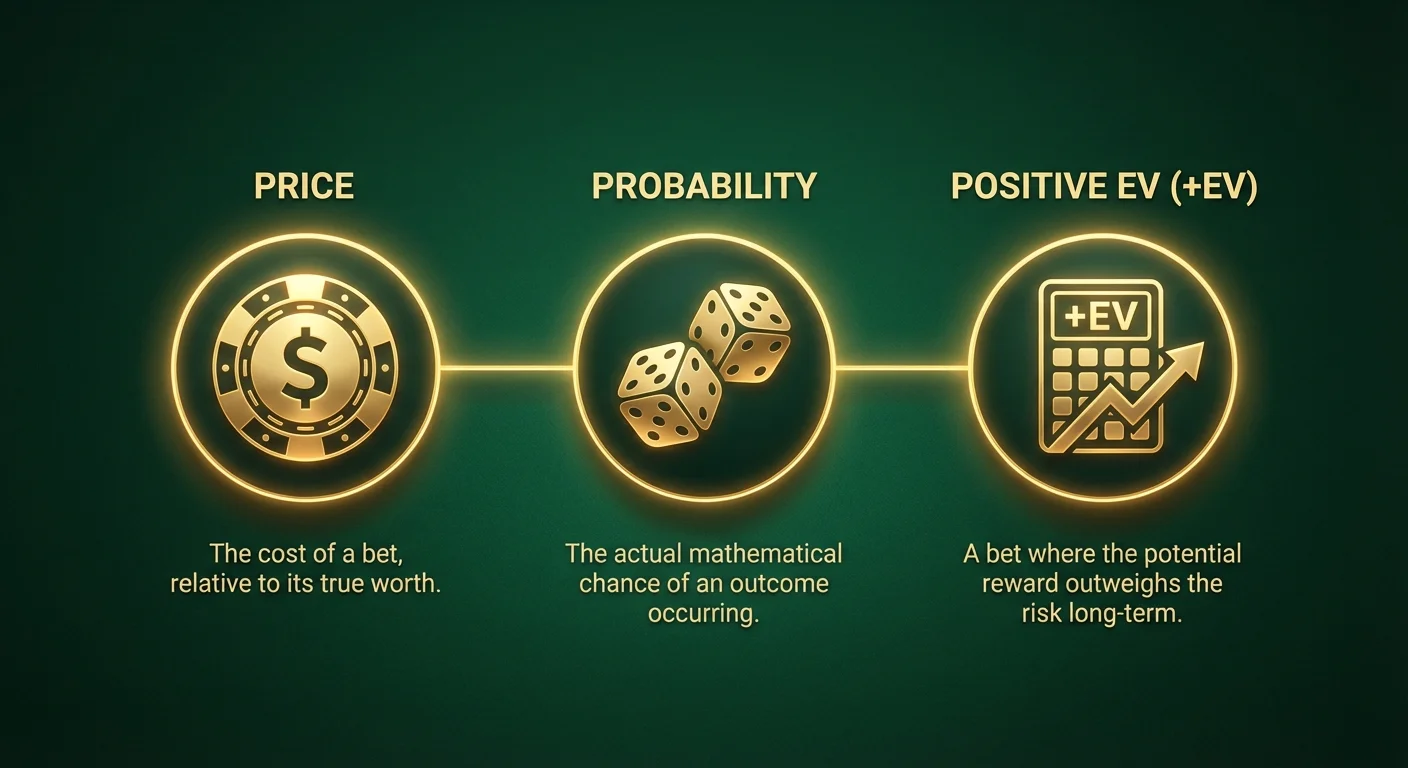
The Philosophy of Value: Price vs. Probability
To understand value betting, you must first dissociate the quality of the team from the quality of the bet.
Imagine you are walking through a market. You see a brand new iPhone for sale. Is it a good buy? You can't answer that question without knowing the price.
- At $2,000, it is a terrible buy.
- At $1,000, it is a standard buy.
- At $500, it is an incredible value.
The phone hasn't changed. The specs remain the same. The only variable is the price relative to the item's worth.
Sports betting works exactly the same way. Betting on the Kansas City Chiefs to win the Super Bowl might be a "sure thing" in terms of outcome, but if the odds are terrible, it is a losing investment long-term. Conversely, betting on an underdog might feel risky, but if the odds pay out significantly more than the actual risk implies, it is a profitable bet.
The Coin Toss Analogy
The easiest way to grasp this is the coin toss.
- True Probability: Heads = 50%, Tails = 50%.
- Fair Odds: 2.00 (Decimal) or +100 (American).
If you bet $10 on Heads at fair odds 1,000 times, statistically, you will break even.
Now, imagine a Crypto Sportsbook offers you odds of 2.10 (+110) on Heads.
- They are paying you as if Heads has a 47.6% chance of hitting, but we know it has a 50% chance.
- Every time you bet $10, you are mathematically destined to profit over the long run, even though you will still lose half the flips.
Value betting is simply identifying when the odds offered are higher than the true probability of the event occurring.
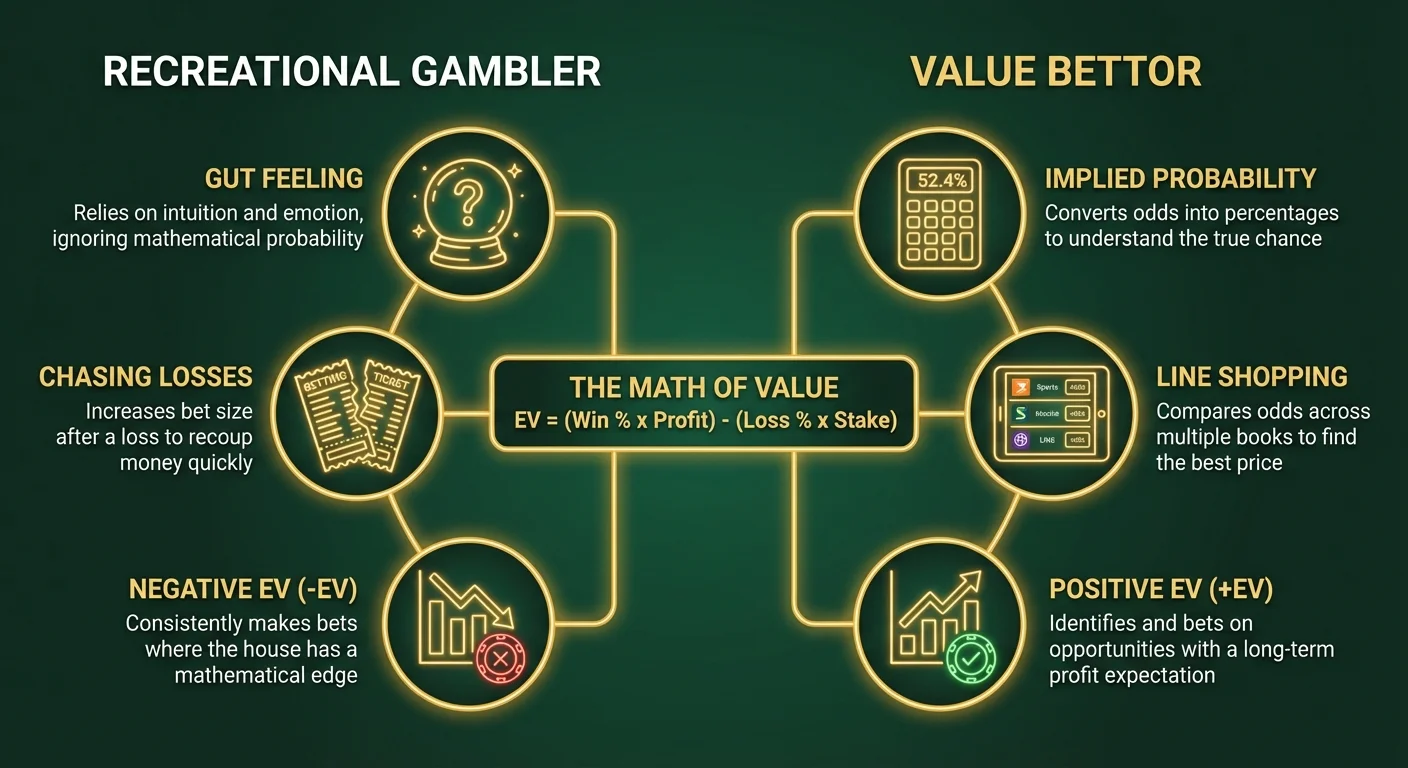
Implied Probability: The Bettor's Rosetta Stone
Before you can find value, you must be able to translate odds into percentages. This is called Implied Probability. It represents how often the bookmaker expects an outcome to happen (including their profit margin).
You cannot find an edge if you do not speak the language of probability. While American odds (+150, -110) are popular in the US, Decimal odds are vastly superior for calculating value.
Converting Odds to Probability
Here is how to calculate implied probability based on the odds format:
Decimal Odds:
American Odds (Positive):
American Odds (Negative):
Conversion Table
| Decimal Odds | American Odds | Implied Probability | Interpretation |
|---|---|---|---|
| 1.10 | -1000 | 90.9% | Huge Favorite |
| 1.50 | -200 | 66.7% | Strong Favorite |
| 2.00 | +100 | 50.0% | Toss-up (Even Money) |
| 2.50 | +150 | 40.0% | Slight Underdog |
| 5.00 | +400 | 20.0% | Longshot |
| 10.00 | +900 | 10.0% | Hail Mary |
Key Takeaway: If your personal handicapping model suggests a team has a 60% chance to win, but the implied probability of the odds is only 50% (2.00 odds), you have found massive value.
Calculating Positive Expected Value (+EV)
The "Holy Grail" of sports betting is +EV (Positive Expected Value explained). If a bet has positive expected value, it means that if you placed that same bet an infinite number of times, you would end up in profit.
The formula for EV is:
A Real-World Example
Let's look at an NBA game: Lakers vs. Warriors.
You want to bet on the Lakers.
- The Odds: A Bitcoin sportsbook is offering the Lakers at 2.20 (+120).
- The Potential: If you bet $100, you win $120 profit.
- Your Analysis: Based on your research (stats, injuries, form), you believe the Lakers have a 50% chance of winning.
Let's plug this into the EV formula:
- Probability of Winning: 0.50 (50%)
- Amount Won: $120
- Probability of Losing: 0.50 (50%)
- Amount Lost: $100
' in math mode at position 13: \text{EV} =̲10" style="color:#cc0000">\text{EV} = $10
The Verdict: This is a +EV bet. For every $100 you wager on this specific proposition, you expect to make an average of $10 profit over time.
Negative Expected Value (-EV)
Now, imagine the odds were only 1.80 (-125) on the Lakers, but you still think they have a 50% chance to win.
- Amount Won: $80
' in math mode at position 14: \text{EV} = -̲10" style="color:#cc0000">\text{EV} = -$10
The Verdict: This is a -EV bet. Even if the Lakers win this specific game, it is a bad bet. If you make bets like this consistently, you will eventually go bankrupt.
Strategies for Finding Value
Knowing the math is one thing; finding the opportunities is another. Bookmakers are smart, and their algorithms are sharp. However, they are not perfect. Here is how you find the edge.
1. Line Shopping (The Golden Rule)
This is the single most effective strategy for value betting. Not all sportsbooks post the same odds.
- Book A has Liverpool to win at 1.80.
- Book B has Liverpool to win at 1.95.
If you bet at Book A, you are voluntarily giving up value. In the crypto betting space, this is easier than ever. Because you can deposit and withdraw instantly using Bitcoin or USDT, you can move your bankroll to whichever site offers the best price for the game you want.
2. Market Disagreements
Often, "sharp" bookmakers (those with high limits and smart oddsmakers) will move their lines first when news breaks (e.g., a star player injury). "Soft" bookmakers (often recreational sites) may lag behind by 5 to 10 minutes.
- If the sharp book moves the line from -150 to -200, but the soft book is still at -150, the soft book is offering massive value. You are betting on old prices with new information.
3. Fading the Public
The general public loves favorites and overs (high scoring games). They bet with their hearts, not their heads. When too much money flows onto a popular team (like the Dallas Cowboys or Manchester United), bookmakers must lower the odds on that team to balance their risk.
- This artificially inflates the odds of the Underdog.
- The Underdog might not be "likely" to win, but their price might be so high that it becomes a +EV bet.
4. Specialized Knowledge
Bookmakers have to price thousands of markets every day, from NFL Super Bowl lines to 3rd division table tennis in Estonia. They cannot be experts on everything.
- If you specialize in a niche market (e.g., esports, MMA props, or lower-league soccer), you may have better information than the oddsmaker.
- If you know a League of Legends team has a substitute player before the books update their algorithm, you have an edge.
The Crypto Advantage in Value Betting
Why should you look for value specifically on crypto gambling sites? There are distinct structural advantages that traditional fiat sportsbooks cannot match.
Lower Margins (Reduced Juice)
Traditional bookmakers have high overheads (payment processing fees, regulation costs, physical shops). To pay for this, they charge a higher "vig" or margin. A standard line might be -110/-110.
Crypto sportsbooks, operating on the blockchain with automated payouts, often have lower overheads. You can frequently find lines at -105/-105.
- The Math: Betting into a -105 line requires a win rate of 51.2% to break even. Betting into -110 requires 52.4%. That 1.2% difference is often the entire profit margin of a pro bettor.
Instant Liquidity
Value is fleeting. If you see a mispriced line, it might vanish in 60 seconds.
- With fiat, if your money is stuck in a 3-day bank transfer, you miss the bet.
- With crypto, you can move funds between wallets and books in minutes, allowing you to snipe value lines immediately.
Anonymity and Account Limits
Traditional sportsbooks are notorious for banning or limiting winning players (a practice called "gubbing"). While crypto books still manage risk, many decentralized or "provably fair" platforms are more tolerant of sharp action because they operate on volume rather than trying to beat every individual player.
Bankroll Management: The Shield of the Value Bettor
You can find all the value in the world, but if you bet too much, variance will destroy you. Even a coin weighted 60% in your favor can land on the losing side 5 times in a row.
The Kelly Criterion
This is the standard formula used by pros to determine how much to bet on a +EV opportunity.
- f = fraction of bankroll to wager
- b = decimal odds - 1 (odds received)
- p = probability of winning (your estimated %)
- q = probability of losing (1 - p)
Warning: The Full Kelly can be volatile. Most bettors use Fractional Kelly (e.g., betting 1/4 or 1/2 of what the formula recommends) to reduce volatility while still growing the bankroll exponentially.
Variance is the Enemy
Value betting is a long-term game. You might identify great value on a 5.00 (+400) underdog. Even if that bet is +EV, you will still lose it 80% of the time.
- Do not chase losses.
- Trust the math.
- If your EV calculation is correct, the graph will go up eventually.
Practical Tips for Beginners
If you are ready to start value betting, follow this checklist:
- Create Your Own Probabilities: Before looking at the odds, write down what you think the odds should be. Compare them. If the book's odds are significantly higher than yours, investigate.
- Use Odds Comparison Sites: Never be loyal to one sportsbook. Loyalty is for losers. Use aggregators to find who has the best price.
- Stick to Singles: Parlays (accumulators) generally destroy value. When you combine bets, you are multiplying the bookmaker's margin against yourself. Stick to single bets to maintain your edge.
- Track Everything: You cannot improve what you do not measure. Use a spreadsheet or a tracking app. Record the Odds, the Closing Line, and your Estimated EV.
- Start with "Soft" Markets: It is very hard to find value on the NFL point spread 10 minutes before kickoff - the market is too efficient. Look for player props, halftime lines, or smaller leagues where bookmakers spend less time refining their odds.
Summary
Value betting is the transition from gambling to investing. It requires discipline to ignore "gut feelings" and rely on cold, hard math.
Here is the recap of how to build your edge:
- Understand Odds: View odds as implied probabilities, not just payout multipliers.
- Calculate EV: Only bet when the potential reward outweighs the risk based on the true probability.
- Shop Around: Use the speed of crypto to hit the best lines across different bookmakers.
- Manage Risk: Use the Kelly Criterion to protect your bankroll from inevitable losing streaks.
The next time you look at a betting board, don't ask "Who will win?" Ask yourself: "Is the price right?" That is the only question that matters.