
Tennis is widely considered the premier sport for algorithmic trading and live betting. Unlike football (soccer) or basketball, where action flows continuously and scoring can be sporadic or constant, tennis is segmented into neat, discrete units: points, games, and sets. This structure creates natural pauses - changeovers and set breaks - that allow sharp bettors to assess the state of play and execute wagers before the odds adjust.
However, the true edge in live tennis betting doesn't come from betting on who will win the match before it starts. It comes from understanding the psychology of an individual sport, recognizing momentum shifts before the bookmakers' algorithms catch up, and exploiting the unique dynamics of in-play tennis.
This guide is designed for intermediate bettors who understand the rules of tennis and the basics of sports betting but want to transition from casual pre-match wagers to the high-intensity world of in-play strategy. We will explore how to read body language, interpret serve statistics in real-time, and leverage the speed of cryptocurrency betting platforms to lock in value.
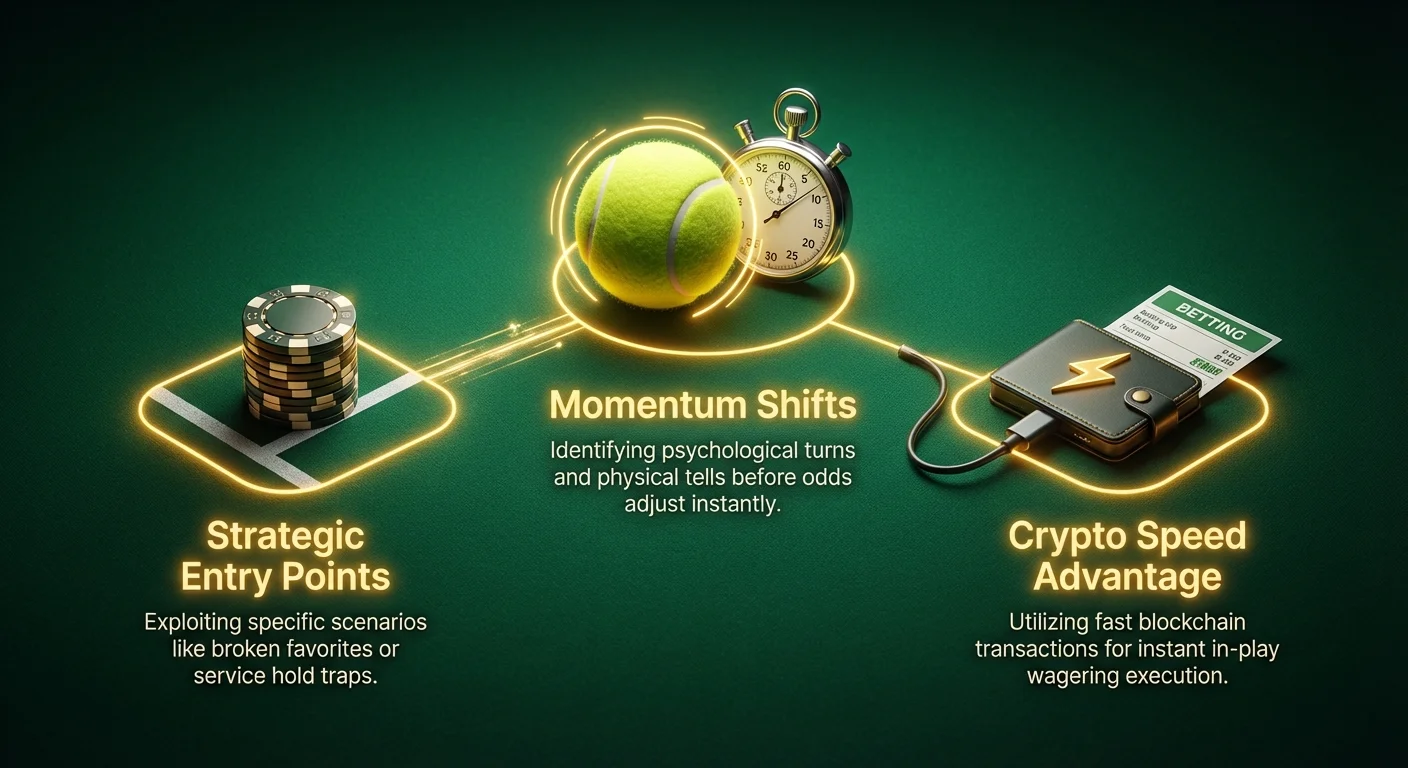
The Psychology of the Individual: Why Tennis Odds Swing Wildly
In team sports, a single player having a bad day can be masked by their teammates. In tennis, there is nowhere to hide. If a player's focus drifts, their unforced error count rises, or their first-serve percentage drops, the entire match dynamic changes instantly.
This vulnerability creates volatility, and volatility is where the value lies.
The "Mental collapse" Factor
Tennis is mentally grueling. A player can be leading by a set and a break, miss an easy overhead smash, and suddenly lose confidence. This is often referred to as "the choke." Algorithms rely on historical data and current scorelines; they cannot see that a player is visibly frustrated, shouting at their box, or shaking their head after every point. The application of algorithms rely on historical data and current scorelines; they cannot see that a player is visibly frustrated, shouting at their box, or shaking their head after every point.
Key takeaway: Live video feeds (or being courtside) provide a massive advantage over data feeds. If you spot emotional fragility before the score reflects it, you can bet against the drifter at favorable odds.

Identifying Momentum Shifts
Momentum betting is the art of wagering on a player who is statistically ascending in the match, regardless of the current score. Momentum in tennis is rarely a straight line; it oscillates. Recognizing the start of a swing is critical.
1. The "0-30" Catalyst
One of the most telling moments in a game is the 0-30 scoreline on a serve.
- The Server's Perspective: They are under immense pressure. One more mistake gives the opponent three break points.
- The Returner's Perspective: They smell blood. They will often play safer to force the server to beat them, rather than going for low-percentage winners.
Strategy: If a dominant server goes down 0-30, the live odds for them to hold serve will drift (increase). If you believe in their mental fortitude, this is a value spot to back the hold. Conversely, if the server has looked shaky on previous service games (even if they won them), 0-30 is the signal to back the break.
2. The "New Ball" Effect
New balls are introduced after the first seven games, and then every nine games thereafter. New balls travel faster and bounce higher.
- Impact: This generally favors the server and aggressive hitters.
- Strategy: If a server has been struggling to hold, check if new balls are coming into play. The added speed might be just enough to get them free points (aces/service winners), allowing them to hold easier.
3. Body Language and Physical Tells
Algorithms cannot track fatigue. Look for these signs during changeovers or between points:
- Hands on knees: Sign of physical exhaustion.
- Stretching: Possible cramping or injury.
- Passive footwork: If a player stops chasing balls they normally would reach, they may be "tanking" (giving up on) the set to conserve energy for the next one.
Strategic Entry Points: Exploiting Slow Lines
Bookmakers use automated feeds to update odds. While these are fast, they are reactive. You can be predictive. Here are three specific scenarios where in-play tennis lines often lag behind reality.
The "Broken Favorite" Bounce Back
This is a classic ATP strategy. Top-tier players (like Alcaraz, Djokovic, or Sinner) often start slow. If a heavy pre-match favorite is broken early in the first set, their live odds will jump significantly.
- The Play: Watch the favorite's demeanor. Are they injured, or just calibrating their range? If they are moving well but missing lines by inches, the break is likely a fluke.
- The Bet: Back the favorite to win the set (high risk/reward) or simply to win the match at much better odds than pre-match.
The "Service Hold" Trap
In men's tennis (ATP), holding serve is expected. In women's tennis (WTA), breaks are much more common due to slower serve speeds.
- ATP Strategy: Betting on a break of serve is high-risk. Focus on betting on "Total Games Over" or "Tie-break Yes" in matches featuring "serve-bots" (players like Hurkacz or Isner).
- WTA Strategy: If a player breaks serve to go up 5-4 and is serving for the set, the pressure is immense. The "break-back" is statistically very common in the WTA. Laying the server (betting against them) when serving for the set offers tremendous value.
The Surface Factor
Momentum shifts differently depending on the court surface.
| Surface | Characteristics | In-Play Strategy |
|---|---|---|
| Hard Court | Neutral bounce, favors all-rounders. | Momentum is steady. Breaks are valuable but recoverable. |
| Clay | Slow surface, high bounce. | Best for live betting. Matches are longer, and breaks of serve are very common. It is easier for a losing player to grind their way back into a match. Never count a clay-courter out. |
| Grass | Fast, low bounce. | Worst for comebacks. If a strong server gets broken on grass, the set is usually over. Bet on the leader to close out the set quickly. |
Advanced Markets: Beyond the Match Winner
To truly succeed at intermediate live betting, you must look beyond the simple "Match Winner" market.
Set Betting
If a favorite loses the first set, the odds for them to win 2-1 (in a best-of-three match) skyrocket. If you believe the momentum is shifting back to them early in the second set, betting on the exact score (2-1) offers higher payouts than just betting on the match win.
Game Winner & Point Betting
- Game Winner: Betting on who will win the current or next game. This is effective when a strong server is facing a weak returner. You can "scalp" small profits by backing the server to win their game.
- Point Betting: Betting on who will win the next point.
- Warning: This is highly volatile and essentially gambling rather than investing. However, betting on the server to win the first point of a game (15-0) is a viable strategy if they have a high first-serve percentage.
The Crypto Advantage in Live Tennis
When betting in-play, seconds matter. This is where using a crypto-focused sportsbook provides a distinct logistical edge over traditional fiat bookmakers.
1. Speed of Execution
Traditional banking methods can trigger security checks or delays when you try to re-deposit mid-match to double down on a strong position. Crypto transactions (especially Litecoin, Ripple, or USDT on Tron) are near-instant. You can top up your bankroll during a changeover and have the funds ready for the next game.
2. High Limits and Liquidity
Live tennis markets on major crypto sportsbooks often have higher liquidity. If you spot a massive momentum shift and want to place a sizable wager, crypto books are less likely to limit your stake size compared to soft fiat books that fear sharp bettors.
3. Automated Payouts
Smart contracts and automated withdrawal systems mean that if you win a bet on the first set, you can often withdraw those profits before the match is even over. This liquidity management is crucial for professional bettors.
Practical Tips for In-Play Success
To wrap up this guide, here is a checklist to follow before and during your live betting session.
1. Stick to One Match
Don't try to trade three matches simultaneously. You need to be "in the zone," watching every point, judging wind conditions, crowd noise, and player frustration. Multitasking dilutes your edge.
2. Know the Stats Before the Match
Live betting requires pre-match homework. You should know:
- Hold %: How often does this player hold serve?
- Break %: How often do they break opponents?
- Tie-break Record: Do they crumble under pressure or thrive?
- H2H (Head-to-Head): Does Player A have a mental block against Player B?
3. Beware the "Stream Delay"
This is the most dangerous pitfall. TV broadcasts and even "live" streams on betting sites often have a delay of 5 to 10 seconds.
- The Risk: You see a player serving at 30-30, but in reality, they have already lost the point and are down 30-40. The bookmaker knows this; you don't.
- The Fix: Never bet on "Next Point" unless you are courtside. Stick to "Game Winner" or "Set Winner" where a 5-second delay is less critical. Always assume the bookmaker has faster data than you.
4. Manage Your Bankroll Aggressively but Wisely
Live betting tempts you to chase losses.
- Rule: Divide your bankroll into units. Never bet more than 1-2 units on a live bet.
- Stop-Loss: If a match isn't going the way you read it, accept the loss. Do not keep doubling down on a player who is clearly having an "off" day. Momentum reading is about observation, not blind loyalty to a favorite.
Summary
Live tennis betting is a dynamic battleground that rewards quick thinking, deep knowledge of player psychology, and disciplined bankroll management. By moving beyond simple match-winner bets and focusing on momentum shifts, surface characteristics, and situational pressure points (like serving for the set), you can find significant value that static pre-match odds cannot offer.
Remember, the goal is not to predict the future, but to identify when the market's probability (the odds) is out of sync with the reality unfolding on the court. Use the speed of crypto to your advantage, watch the players closely, and strike when the momentum turns.