
In the world of sports betting, no single position influences the betting line as heavily as the starting pitcher in Major League Baseball. In the NFL, a quarterback is crucial, but a team can still cover the spread with a backup if the defense steps up. In the NBA, a star player resting shifts the line, but the team dynamic remains fluid. In baseball, however, the game begins and ends with the arm on the mound.
For intermediate bettors looking to sharpen their edge, understanding starting pitcher analysis is not just a skill - it is the prerequisite for long-term profitability. The starter dictates the pace, the probability of runs, and the psychological state of the opposing lineup. If you are betting on baseball without a deep dive into the starting rotation, you aren't handicapping; you are guessing.
This guide moves beyond basic win-loss records to explore the metrics that actually predict future performance. We will dissect how to evaluate matchups, why traditional stats can be deceptive, and how to use advanced MLB pitching stats to spot value before the sportsbooks adjust their lines.
The Starter Dictates the Market
Before diving into statistics, it is vital to understand the mechanics of how starting pitchers affect the betting market. When you open your crypto sportsbook of choice to look at the day's slate, you will notice that the odds are inextricably linked to the names listed next to the teams. This is where calculating your true chances comes into play.
"Listed Pitcher" vs. "Action"
In baseball betting, the identity of the pitcher is so fundamental that it changes the terms of the wager itself. You generally have two options when placing a moneyline bet:
- Listed Pitcher: Your bet is valid only if the specific pitchers listed at the time of the bet actually start the game. If a manager scratches an ace due to arm soreness five minutes before the first pitch, your bet is voided, and your crypto is returned to your wallet. This is the recommended setting for serious handicappers.
- Action: Your bet stands regardless of who starts. If the ace is scratched and a minor league call-up takes the mound, your bet remains active, usually at adjusted odds that are far worse than what you anticipated.
Strategy Tip: Always select "Listed Pitcher." If you handicapped a game based on Gerrit Cole starting, you do not want to have money risking on a bullpen game because he was scratched late.
Deceptive Stats: Why You Must Ignore the ERA
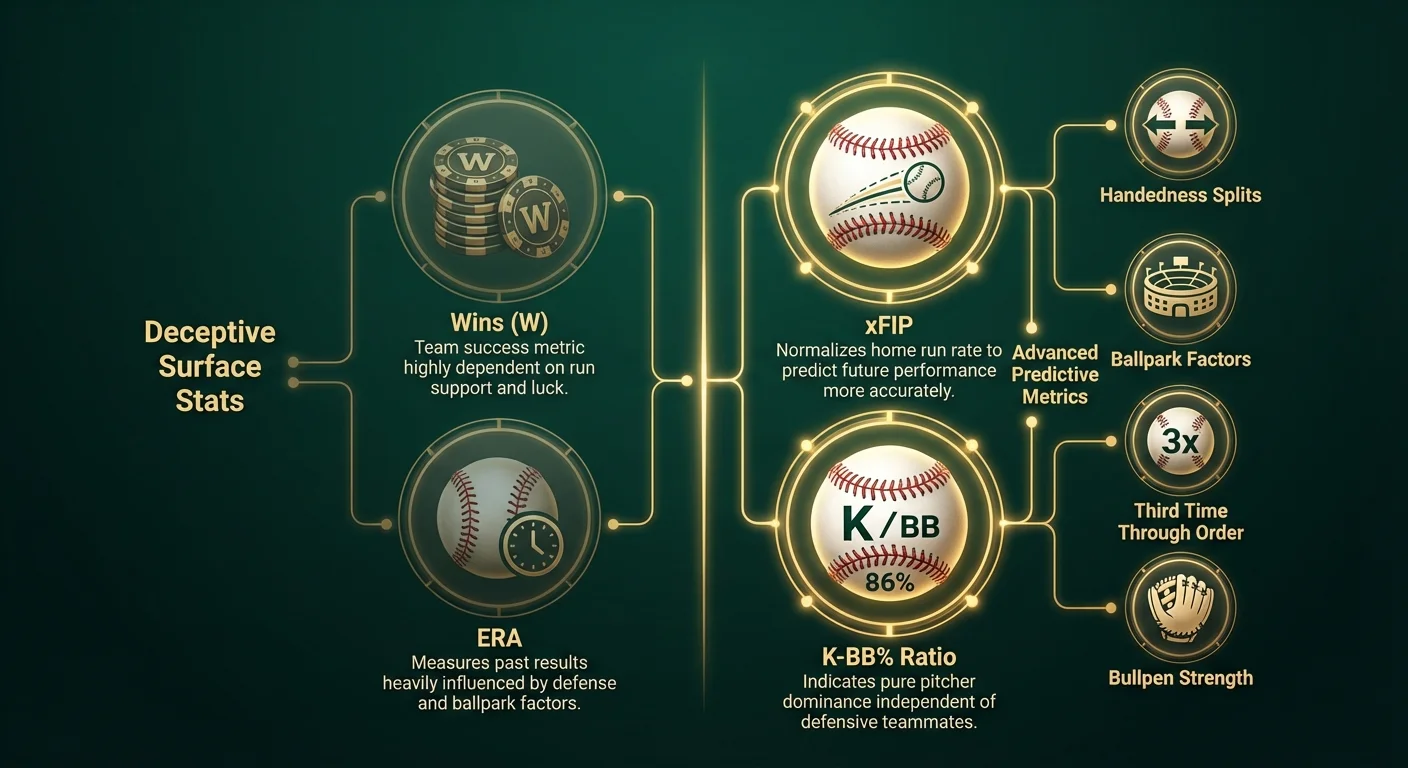
The most common mistake intermediate bettors make is relying on surface-level statistics. The "Back of the Baseball Card" stats - Wins, Losses, and Earned Run Average (ERA) - are history lessons, not predictive tools.
The Problem with ERA
ERA measures what has happened, not necessarily how well the pitcher performed. It is heavily influenced by:
- Defense: A pitcher with a Gold Glove shortstop will have a lower ERA than a pitcher with a sloppy infield, even if they throw the exact same pitches.
- Ballpark Factors: Giving up fly balls in spacious Oracle Park is safe; giving them up in Yankee Stadium is deadly. ERA doesn't contextualize this.
- Luck (Cluster Luck): Sometimes hard-hit balls go right to a fielder, and sometimes bloopers fall for hits.
To gain an edge, you must pivot to metrics that isolate the pitcher's performance from the variables he cannot control.
The Holy Trinity of Advanced Pitching Stats
To analyze a starting pitcher effectively, you need to look at what they control directly: Strikeouts, Walks, and Home Runs. The defense is not involved in any of these three outcomes.
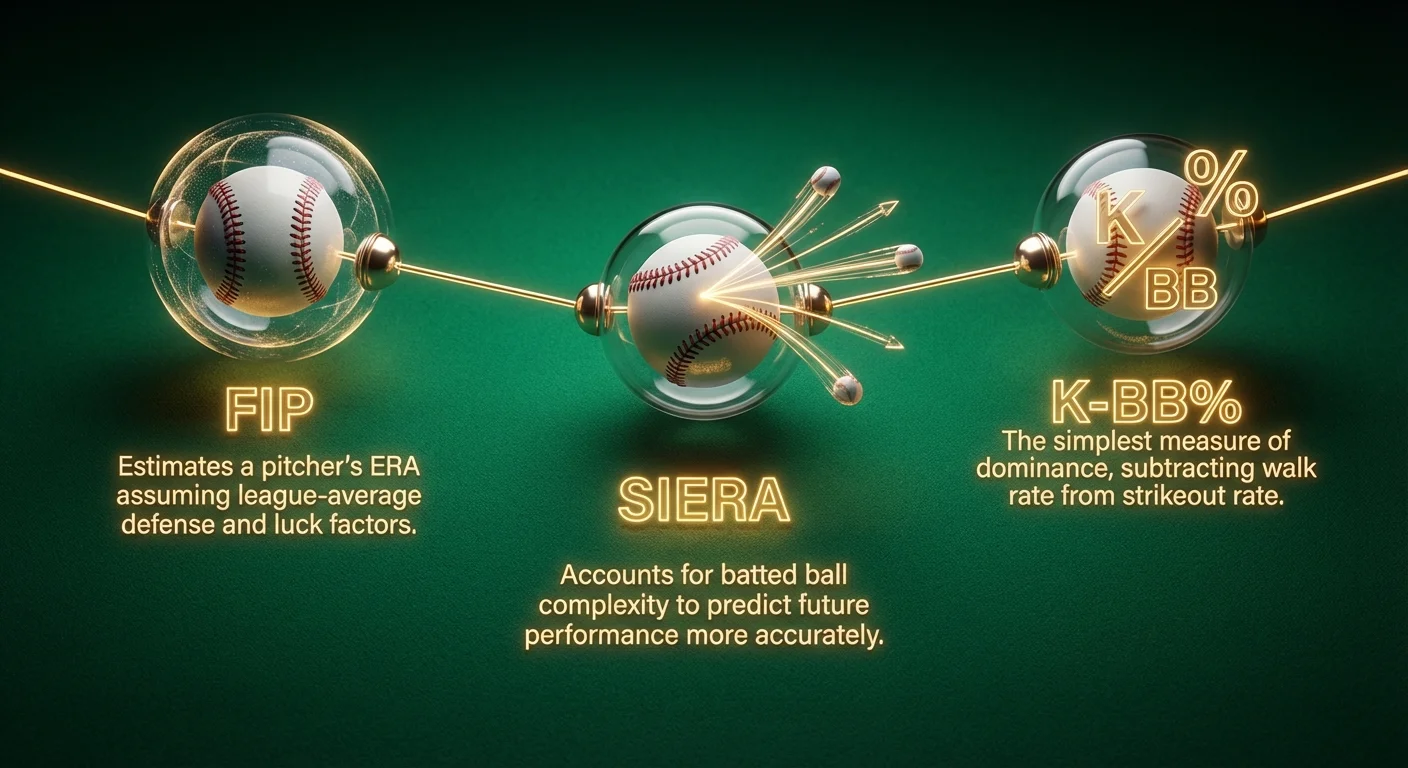
1. FIP (Fielding Independent Pitching)
FIP is the gold standard for pitcher analysis. It estimates what a pitcher's ERA should be if they had league-average defense and luck.
- The Formula: It weighs home runs, walks, hit-by-pitches, and strikeouts.
- How to Use It: Compare a pitcher's ERA to their FIP.
- ERA < FIP: The pitcher has been lucky. Expect regression (performance will get worse). Bet Against.
- ERA > FIP: The pitcher has been unlucky. Expect positive regression (performance will improve). Bet On.
2. xFIP and SIERA
While FIP is great, it assumes that the pitcher is responsible for the Home Run to Fly Ball ratio. xFIP (Expected FIP) normalizes the home run rate, assuming that over time, fly balls turn into home runs at a league-average rate.
SIERA (Skill-Interactive ERA) goes even deeper, accounting for the type of batted ball. It rewards pitchers who induce weak contact and high ground ball rates. SIERA is arguably the most predictive metric for future performance currently available to the public.
3. K-BB% (Strikeout minus Walk Percentage)
If you only have time to check one stat, check K-BB%. It is the simplest measure of dominance. It subtracts the percentage of batters walked from the percentage of batters struck out.
- Elite: > 20%
- Solid: 15% - 20%
- Average: 10% - 15%
- Poor: < 10%
A pitcher with a high K-BB% is not relying on his defense. He is controlling the game.
Comparison Table: Surface vs. Advanced Metrics
| Metric | Type | What it tells you | Usefulness for Betting |
|---|---|---|---|
| Wins (W) | Traditional | Team success, luck, and run support. | Zero. Ignore completely. |
| ERA | Traditional | How many runs scored previously. | Low. Too dependent on luck/defense. |
| WHIP | Hybrid | Base runners allowed per inning. | Medium. Good for measuring traffic. |
| FIP | Advanced | Performance independent of defense. | High. Predicts regression. |
| SIERA | Advanced | Complexity of batted balls + K/BB. | Very High. The sharpest predictive tool. |
| K-BB% | Advanced | Pure dominance. | Very High. Shows control of the game. |
Analyzing the Matchup: Styles Make Fights
Once you have evaluated the pitcher's standalone metrics, you must contextualize them against the opposing lineup. A great pitcher can struggle in a bad stylistic matchup.
1. Handedness Splits
This is Baseball 101, but it is often overlooked. Some pitchers are "reverse split" guys, meaning a right-handed pitcher might actually struggle against right-handed batters.
- Check the pitcher's career wOBA (Weighted On-Base Average) allowed to Lefties vs. Righties.
- Compare this to the opposing lineup. If the pitcher struggles against lefties and the opponent is stacking a lineup with 6 left-handed hitters, the pitcher's overall stats are irrelevant - he is in trouble today.
2. Fly Ball vs. Ground Ball Pitchers
You must analyze where the game is being played.
- Fly Ball Pitchers: High spin rate guys who live at the top of the zone. They are dangerous in small parks (Cincinnati, Philadelphia, Yankee Stadium) or windy days blowing out. They are excellent in big parks with heavy air.
- Ground Ball Pitchers: Rely on sinking action. They are the safest bets in hitter-friendly parks (Coors Field) because the ball stays on the ground, negating the altitude advantage.
3. The Third Time Through the Order
Modern analytics have shown that starting pitchers lose effectiveness drastically the third time they face a batting order (usually around the 5th or 6th inning).
- Handicapping Tip: Look for managers with a "quick hook." If a manager leaves a struggling starter in to face the heart of the order for a third time, live betting against that pitcher (or betting the "Over") is a highly profitable strategy.
The "First 5 Innings" (F5) Strategy
For bettors who specialize in starting pitcher betting, the full-game moneyline can be frustrating. You can handicap the matchup perfectly, your starter throws 7 shutout innings, and then the bullpen blows the lead in the 9th.
To mitigate this, sophisticated bettors focus on the First 5 Innings (F5) market.
Why Bet F5?
- Purity: The bet settles after 5 innings. It essentially removes the bullpens from the equation.
- Correlation: It is a direct bet on the starting pitcher analysis you just performed.
- Value: Often, a team with a great starter but a terrible bullpen will have better odds on the F5 line than the full game line because the books know the bullpen is a liability.
If your analysis says, "Pitcher A is vastly superior to Pitcher B," bet the F5. Do not let a shaky closer ruin your research.
Crypto Betting Advantages for Baseball
When applying these strategies, the platform you use matters. Baseball offers the highest volume of games of any major sport (2,430 regular-season games). This volume aligns perfectly with the advantages of crypto gambling sites.
1. High Volume and Speed
In MLB, lines for the next day often pop up immediately after the previous game ends. Because you are betting daily, cash flow is critical. Traditional sportsbooks can take 3-5 days to process bank withdrawals. Crypto sportsbooks utilizing Bitcoin, Litecoin, or USDT offer near-instant payouts. This allows you to win on Tuesday afternoon and re-stake that capital on Tuesday night games.
2. Limits and "Sharps"
If you are consistently beating the closing line using advanced pitcher analysis, traditional "soft" books may limit your account. Crypto-focused sportsbooks generally offer higher betting limits and are more tolerant of sharp action because their business model relies on high volume and low margins.
3. Provable Fairness in Props
While not applicable to the live game outcomes, many crypto sites offer side games or specialized prop builders. The transparency of blockchain technology ensures that payouts on these platforms are executed exactly according to the smart contract, removing the worry of "voided" wins due to obscure terms and conditions.
Practical Workflow: A Daily Routine
To effectively bet on starting pitchers, establish a routine. Do not just look at the odds screen and pick a favorite. Follow this checklist:
- Identify the Probable Pitchers: Ensure they are confirmed.
- Check the Weather: Is the wind blowing out at Wrigley? Is the roof closed in Toronto?
- Scan for Regression: Look for the disparity between ERA and FIP/SIERA. Find the pitcher who is "overvalued" by the public because of a low ERA that isn't supported by peripherals.
- Analyze the Lineup Fit: Does the opposing lineup strike out a lot? If you have a high K-rate pitcher against a high K-rate lineup, consider the "Pitcher Strikeouts Over" prop.
- Shop the Line: Check your crypto sportsbooks. One might have the Dodgers at -140, another at -135. In baseball, saving 5 cents on the line is the difference between profit and loss over a 162-game season.
- Decide: F5 or Full Game? If the team has a bottom-5 bullpen ERA, stick to the F5 bet.
Summary
The arm on the mound is the sun around which the baseball betting universe orbits. While the public is easily swayed by a pitcher's Win-Loss record or a lucky streak of low-ERA starts, the smart money looks deeper.
By utilizing predictive stats like SIERA and K-BB%, understanding the impact of park factors, and isolating the starter through F5 betting markets, you move from gambling to investing.
Remember, in baseball betting, the past (ERA) is interesting, but the underlying metrics (FIP) are the truth. Use the speed of crypto transactions to keep your bankroll fluid, treat every game as a data point, and trust the numbers over the narrative.