
If you have ever stared at a sportsbook interface, baffled by the sea of numbers, plus signs, minus signs, and decimals, you are not alone. For the uninitiated, betting odds can look like a foreign language. However, to the seasoned bettor, these numbers represent something much more straightforward: a price.
Most beginners treat sports betting as a prediction game. They ask themselves, "Who is going to win?" and put their Bitcoin on that team. Professional bettors, however, play a different game entirely. They play a game of math. They ask, "Does the price offered represent a probability lower than the actual chance of winning?"
To make that leap from recreational punter to sharp bettor, you must master one fundamental skill: converting odds into implied probability.
This guide will strip away the confusion surrounding odds formats. We will look at how to translate American, Decimal, and Fractional odds into a simple percentage. By the end of this article, you will understand how to calculate the bookmaker's edge, how to spot value in the crypto betting markets, and why thinking in percentages is the secret to long-term profitability.
What is Implied Probability?
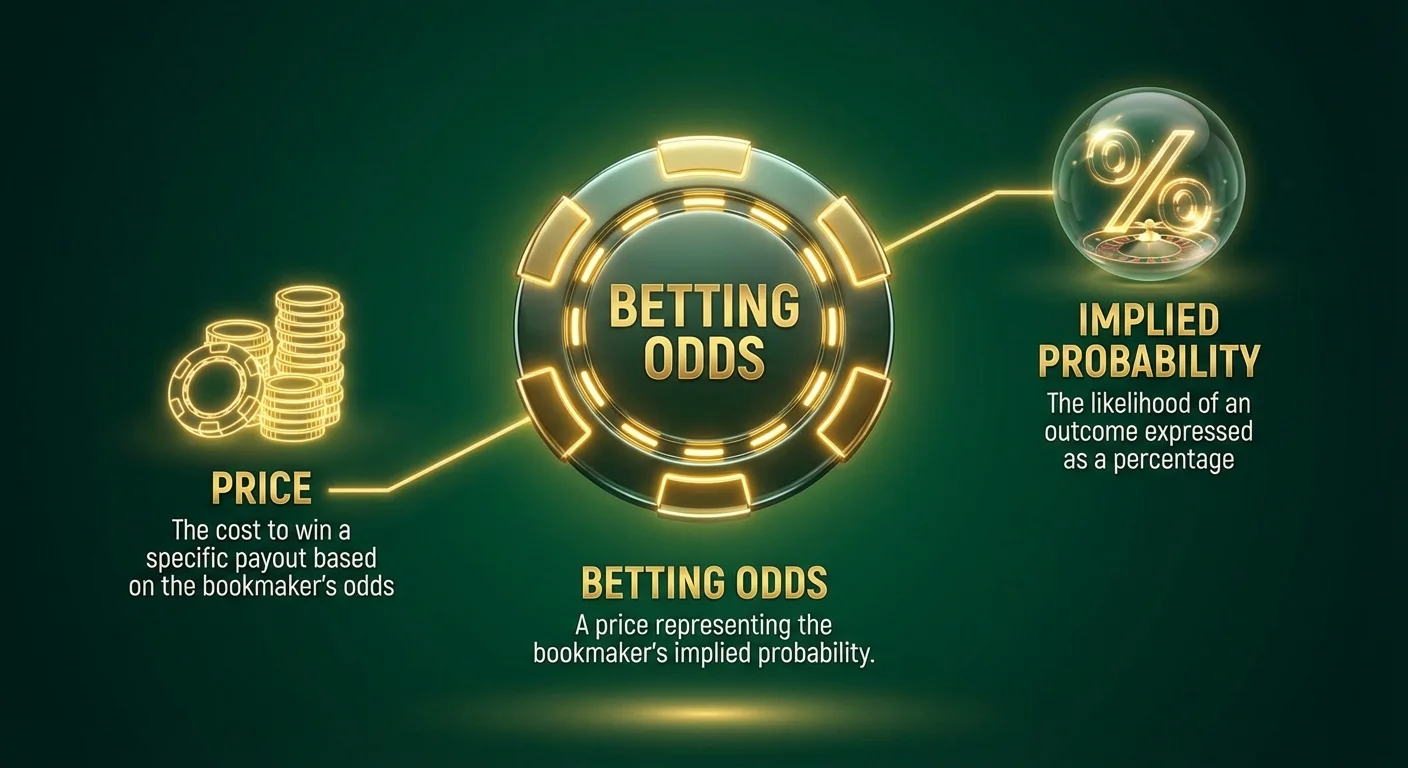
Before we dive into the math, we need to define the concept. Implied probability is the conversion of betting odds into a percentage. It represents the likelihood of an outcome happening as suggested by the bookmaker's odds.
When a crypto sportsbook sets a line, they aren't just guessing the score. They are assigning a probability to an event and then pricing it.
- Example: If you flip a coin, there is a 50% chance it lands on heads.
- The Odds: If a bookmaker offered "true" odds on that coin flip, they would offer you a doubling of your money (Decimal 2.00 or American +100).
However, if the bookmaker's odds imply a 60% chance of something happening, but you know through your research that the reality is only 40%, that is a bad bet. Conversely, if the odds imply a 40% chance, but you know the team wins that matchup 60% of the time, you have found value.
Understanding this conversion is the only way to determine if a bet is "expensive" or "cheap."
Decoding the Formats: How to Convert Odds
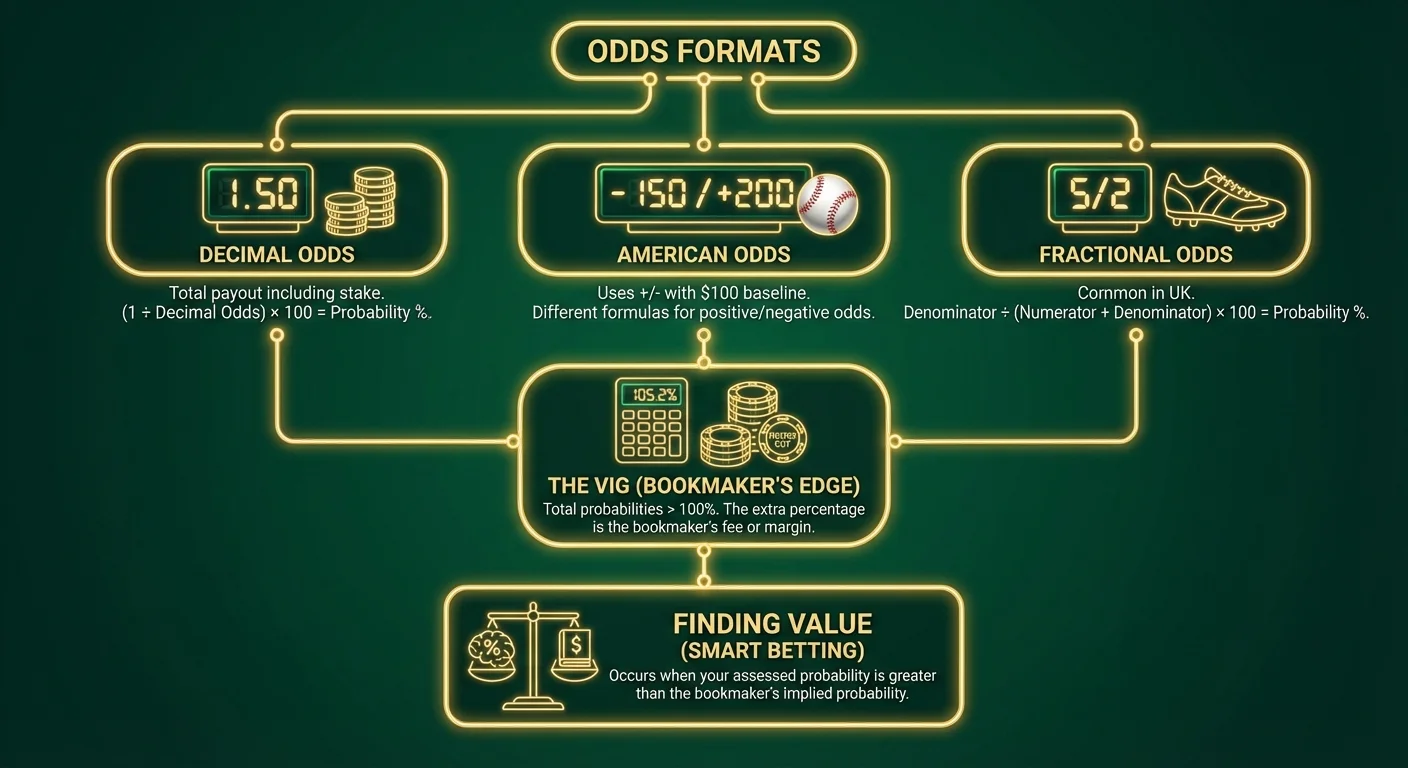
In the world of online crypto gambling, you will encounter three main odds formats depending on the region of the sportsbook or your personal settings. Regardless of the format, they all mean the same thing. Here is how to convert them into a usable percentage.
1. Decimal Odds (European Format)
This is the standard format for most international crypto sportsbooks and exchanges. It is widely considered the easiest to understand because the number represents the total payout (stake included) rather than just the profit.
The Formula:
(1 \div \text{Decimal Odds}) \times 100 = \text{Implied Probability %}
Practical Example:
Let's say you are looking at a Premier League match on a site like Stake or Sportsbet.io.
- Manchester City to win: 1.50
- Calculation:
What this means: The bookmaker is saying Manchester City has roughly a 66.7% chance of winning this game. If you bet 1 mBTC, you get back 1.5 mBTC total.
2. American Odds (Moneyline)
Common in the US and on US-facing offshore crypto sites, these odds use plus (+) and minus (-) signs based on a baseline of $100. This format is often the most confusing for beginners.
- Negative Odds (-): Shows how much you must bet to win $100. (The favorite).
- Positive Odds (+): Shows how much you win if you bet $100. (The underdog).
The Formula for Negative Odds (-):
\text{Odds} \div (\text{Odds} + 100) \times 100 = \text{Implied Probability %}
(Note: Drop the negative sign for the calculation)
Example:
- Odds: -150
- Calculation:
- Result: 60% Implied Probability.
The Formula for Positive Odds (+):
100 \div (\text{Odds} + 100) \times 100 = \text{Implied Probability %}
Example:
- Odds: +200
- Calculation:
- Result: 33.3% Implied Probability.
3. Fractional Odds (UK Format)
You will mostly see these on British or Irish betting sites. They are displayed as a fraction, such as 5/1 or 10/3.
The Formula:
\text{Denominator} \div (\text{Numerator} + \text{Denominator}) \times 100 = \text{Implied Probability %}
Example:
- Odds: 5/2 (Five to Two)
- Calculation:
- Result: 28.6% Implied Probability.
Quick Reference Conversion Table
To help visualize how these formats align, here is a comparison table for common odds:
| Implied Probability | Decimal Odds | American Odds | Fractional Odds |
|---|---|---|---|
| 75.0% | 1.33 | -300 | 1/3 |
| 66.7% | 1.50 | -200 | 1/2 |
| 50.0% | 2.00 | +100 (Even) | 1/1 |
| 33.3% | 3.00 | +200 | 2/1 |
| 25.0% | 4.00 | +300 | 3/1 |
| 10.0% | 10.00 | +900 | 9/1 |
The "Vig": Why Probabilities Don't Add Up to 100%
Now that you can convert odds, you might notice something strange. If you take the implied probability of every possible outcome in a game and add them together, the total will be over 100%.
This is not a math error. This is how bookmakers make money.
The amount over 100% is known as the Vig (Vigorish), Juice, Margin, or Overround. It represents the fee the bookmaker charges for taking your bet.
Example: An NBA Game
Let's say a crypto sportsbook offers the following line on a basketball game with no draw possible:
- Lakers: 1.90 (-110)
- Celtics: 1.90 (-110)
Let's convert both to implied probability:
- Lakers (1.90) = $52.6%$
- Celtics (1.90) = $52.6%$
Total: $52.6% + 52.6% = 105.2%$
The true probability of all outcomes in any event is always exactly 100%. The extra 5.2% is the bookmaker's margin.
Why This Matters for Crypto Bettors
This is where using cryptocurrency can give you a distinct advantage. Traditional fiat sportsbooks often have high overhead costs (payment processing fees, regulation costs, physical shops), leading them to charge margins of 5% to 8% (sometimes higher on props).
Crypto sportsbooks, specifically those operating on lean blockchain infrastructure, often offer reduced juice. You might find margins as low as 2% or 3%.
- High Margin Book: Lakers @ 1.83 (-120) / Celtics @ 1.83 (-120) = ~9% vig.
- Low Margin Crypto Book: Lakers @ 1.95 (-105) / Celtics @ 1.95 (-105) = ~2.5% vig.
By understanding implied probability, you can instantly calculate the "tax" you are paying on your bets. Always aim for the lowest margin possible.
Probability Betting: The Strategy of Finding Value
You now know how to convert odds and how to spot the bookmaker's fee. The final step is applying this to Value Betting. This is the holy grail of sports gambling.
Value exists when:
\text{Your Assessed Probability} > \text{The Bookmaker's Implied Probability}
Step-by-Step Value Calculation
- Assess the Match: You analyze a UFC fight. Based on style matchups, past performance, and camp news, you believe Fighter A has a 60% chance of winning.
- Check the Odds: The sportsbook lists Fighter A at 2.20 (+120).
- Convert the Odds: .
- Compare:
- Your Probability: 60%
- Implied Probability: 45.45%
- Conclusion: This is a massive Value Bet. The bookmaker thinks he loses more than half the time; you think he wins the majority of the time. The price pays out more than the risk warrants.
The Value Formula (Expected Value - EV)
To be mathematically precise, you can calculate the Expected Value (EV).
To be mathematically precise, you can calculate the Expected Value (EV).
Using the UFC example above with a $100 bet:
- Win Amount: $120 (Profit on 2.20 odds)
- Loss Amount: $100
- Your Probability of Winning: 60% (0.60)
- Your Probability of Losing: 40% (0.40)
' in math mode at position 14: \text{EV} = +̲32" style="color:#cc0000">\text{EV} = +$32
For every $100 you bet on this specific scenario over the long run, you would expect to profit $32.
Note: If the EV calculation results in a negative number, it is a bad bet, regardless of whether you "feel" the team will win.
Practical Tips for Using Probability in Crypto Betting
Transitioning from "gut feeling" betting to probability betting takes discipline. Here are actionable tips to help you apply these concepts.
1. Shop for Lines Using Stablecoins
In the volatile world of crypto, the value of Bitcoin or Ethereum fluctuates. However, the odds fluctuate too. Because crypto withdrawals are often instant, you can keep your bankroll in a central wallet or use stablecoins (USDT/USDC) to move funds quickly between books.
- Tip: If Book A offers 2.00 and Book B offers 2.10, taking the 2.10 reduces the implied probability you need to overcome to break even. Over 1,000 bets, this difference is the difference between profit and bankruptcy.
2. Don't Ignore the Draw
In sports like Soccer (Football), beginners often bet on "Team A to Win" or "Team B to Win," forgetting the Draw option.
- Probability Check: In the Premier League, roughly 25-28% of games end in a draw. If you are calculating probabilities for a 3-way moneyline, ensure your percentages for Home/Draw/Away sum up to 100% (plus the vig). If you ignore the draw, your math will be flawed.
3. Use Provably Fair Mechanics for Non-Sports
While this guide focuses on sports, the concept of implied probability applies to crypto casino games (Dice, Crash, Plinko).
- Provably Fair: In crypto gambling, you can check the "House Edge." If a game has a 1% house edge, the Return to Player (RTP) is 99%.
- The Math: If you are playing a Dice game and set the "Win Chance" to 50%, the payout should be 2.00x. However, the site will likely offer 1.98x. That 0.02 is the implied probability gap (the fee). Always check this gap before playing.
4. Create Your Own Lines First
Before you look at the odds on the screen, write down what you think the odds should be.
- If you think the Packers have a 70% chance to win, the odds should be roughly 1.43.
- If you open the sportsbook and see the Packers at 1.60 (62.5% implied probability), you instantly know there is value.
- If you see the Packers at 1.30 (76.9% implied probability), you know to stay away.
5. Beware of the "Longshot" Trap
Beginners love high odds (e.g., +1000 or 11.00).
- Implied Probability: 9.09%.
- While the payout is high, the probability is incredibly low. Crypto bettors often chase these "moonshots" similar to how they chase meme coins. While they can hit, consistent value betting usually comes from lines closer to even money (1.80 to 2.20) where variance is lower.
Summary: The Bettor's Checklist
To summarize, winning at sports betting isn't about knowing sports; it's about knowing numbers. The best team doesn't always win, but the best price always wins over the long haul.
Use this checklist before placing your next wager:
- Identify the Odds: Read the line in your preferred format (Decimal is recommended for math).
- Convert to Percentage: Calculate the implied probability using the formulas provided.
- Check the Vig: Sum the probabilities of all outcomes. Is the juice under 5%? If it's over 7-8%, find a different crypto book.
- Estimate True Probability: Based on your research/stats model, what is the actual chance of the event occurring?
- Calculate Value: Is your percentage higher than the bookie's implied percentage?
- Yes: Place the bet.
- No: Skip the bet, even if you think the team will win.
By viewing odds as probabilities rather than predictions, you stop gambling against the house and start trading in a market. In the fast-paced world of crypto betting, where margins are lower and payouts are faster, this mathematical edge is your most powerful tool.