
There is a specific allure to the little number positioned next to a college football team's name on the scoreboard. That number - the AP Top 25 ranking or the College Football Playoff (CFP) ranking - tells a story of dominance, prestige, and public trust. For the casual sports bettor, that number is often the primary justification for placing a wager. They see the #5 team in the country playing an unranked conference rival, check the spread, and instinctively reach for their wallet to back the favorite.
However, in the world of intermediate and sharp sports betting, blindly betting on ranked teams is one of the fastest ways to deplete a bankroll. The rankings are compiled by journalists and committee members, not oddsmakers. While rankings reflect past resumes, betting lines reflect future probabilities.
Successfully navigating ranked teams betting requires a shift in mindset. You must learn to separate the "brand name" from the on-field reality. This guide will explore the nuances of top 25 betting, explaining why the "Chalk" (the favorite/ranked team) is often overvalued, identifying the specific scenarios where ranked teams consistently cover, and teaching you when to fade the public perception for profit.
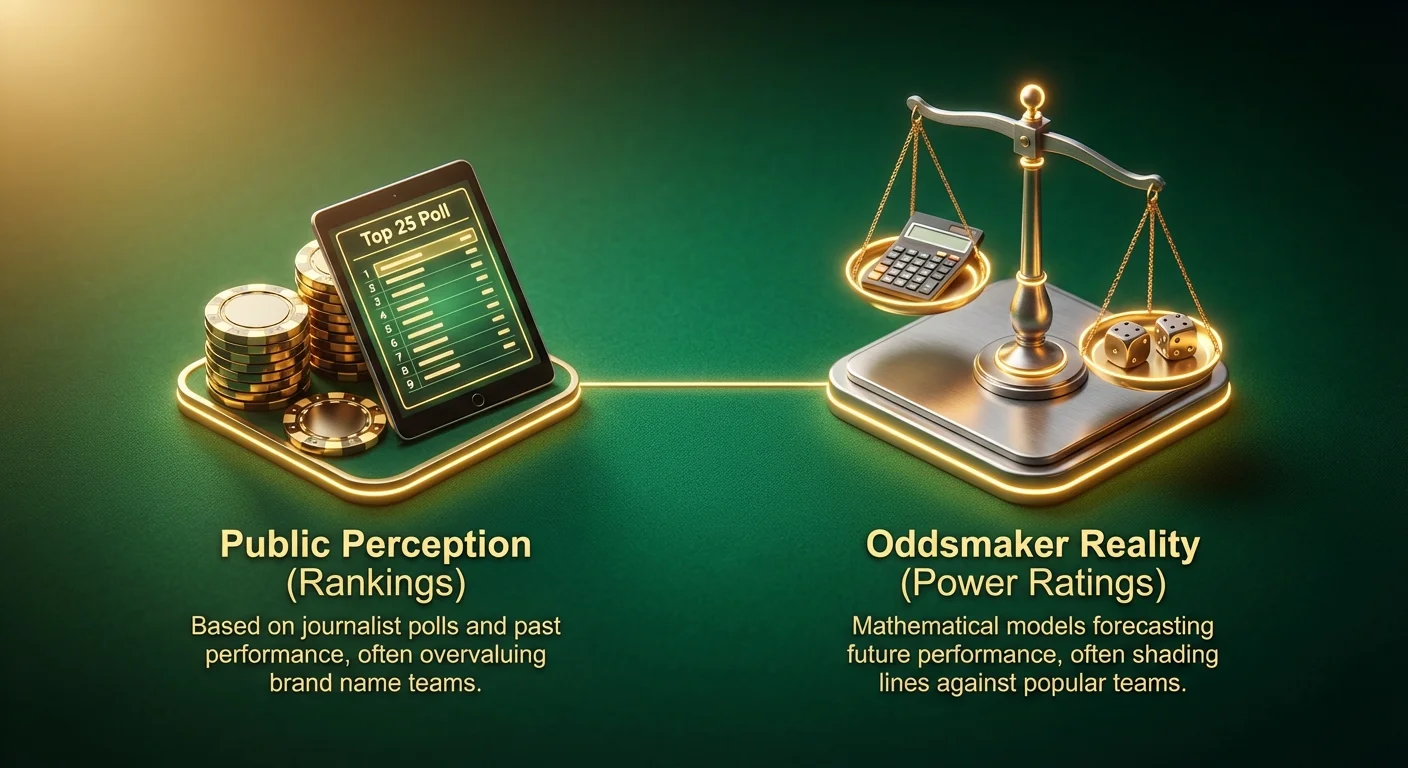
The Psychology of the Polls and the Line
To understand how to bet on or against ranked teams, you first need to understand how the point spread is derived in relation to public perception.
The AP Poll is a subjective list created by sportswriters. It is reactionary. If Team A beats a top-tier opponent, they jump up the rankings. If they lose, they drop. The betting market, however, relies on Power Ratings - mathematical models that assign a point value to every team relative to an average opponent.
The "Ranked Tax"
Sportsbooks are in the business of balancing their books and exploiting public bias. They know that the general betting public loves to bet on winners. When a casual bettor sees #3 Georgia playing unranked Kentucky, they assume Georgia will dominate.
Because the books know the public will heavily back the ranked team, they often shade the line. This is known as the "Ranked Tax." If the mathematical power ratings suggest Georgia should be a -10 favorite, the bookmakers might open the line at -12.5 or -13. They do this because they know the public will bet the "Chalk" regardless of the price. This practice is part of how sportsbooks set betting lines.
Key Takeaway: When you bet on popular, highly-ranked teams, you are often paying a premium for that little number next to their name.
The Golden Rule: Unranked Favorites vs. Ranked Underdogs
If there is one strategy that bridges the gap between intermediate and expert college football betting, it is this: Beware the Unranked Favorite.
Every Saturday, you will scan the board and see a game that looks like a mistake. You might see the #19 ranked team in the country visiting an unranked opponent with a mediocre 4-4 record. Yet, when you look at the spread, the unranked team is favored by 3 points.
The novice bettor screams, "Trap!" and hammers the ranked underdog, believing the bookmakers made an error. The sharp bettor asks, "Why?"
Why Unranked Teams Are Favored
When an unranked team is favored over a ranked opponent, it is usually because the oddsmakers' power ratings (and the sharp money) respect the unranked team more than the AP voters do.
- Home Field Advantage: College football has the most significant home-field advantage of any major sport. An unranked team at home at night can play 3 to 6 points better than they do on the road.
- Injuries and Matchups: The ranking reflects the season's resume, but the spread reflects the roster playing today. If the ranked team's star QB is questionable, the line will move toward the unranked squad.
- Fraudulent Rankings: Sometimes, a team is ranked simply because they haven't played anyone tough yet. They might be 6-0 against weak competition, while the unranked team is 3-3 but has played the three best teams in the country.
The Strategy: Historically, unranked home favorites cover the point spread at a higher rate than the ranked road dogs. Don't be afraid to lay the points with the team that has no number next to its name.
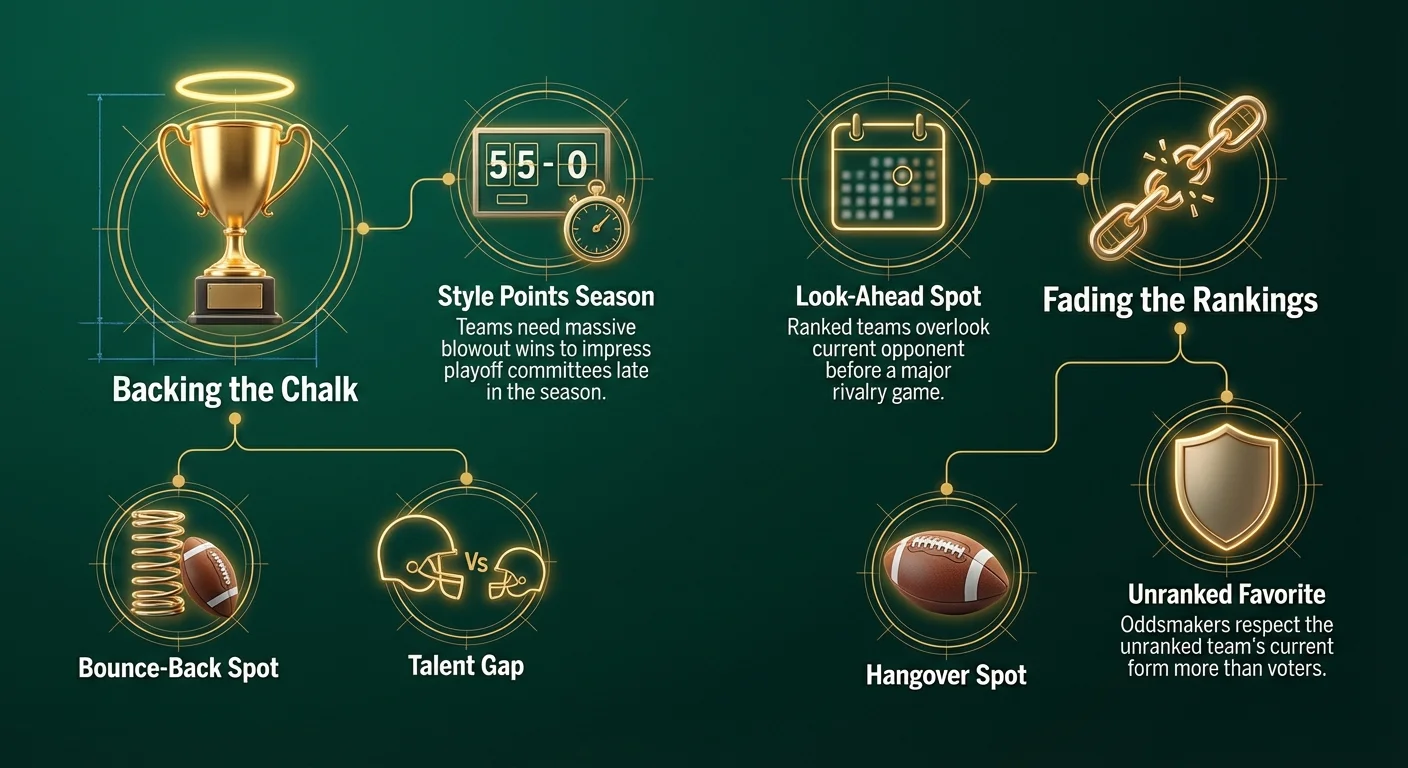
When to Back the Chalk (Betting On Ranked Teams)
While fading the public is a profitable long-term strategy, there are specific scenarios where betting on the heavy favorite (the Chalk) is the right move. Elite teams are elite for a reason - they have depth, talent, and coaching that unranked teams cannot match.
1. The "Style Points" Season
In the modern College Football Playoff (CFP) era, winning isn't always enough. Teams fighting for a top-4 (or top-12) seed need to impress the committee. This phenomenon usually kicks in during November.
If a team is ranked #5 and is on the bubble of the playoff, and they are playing a 2-8 team, they have no incentive to take their foot off the gas. They need to win by 40 to improve their metrics. In these late-season matchups, top-tier teams often cover massive spreads because they keep their starters in longer to pad the stats.
2. The Bounce-Back Spot
Elite programs (like Alabama, Ohio State, or Georgia) rarely lose two games in a row. When a top-5 team suffers an embarrassing upset loss, the public often overreacts and sells their stock on that team.
However, the coaching staff of an elite program uses that loss to refocus the team. The following week, they usually play with a level of aggression and discipline that is terrifying for their opponent. Betting on a top-ranked team coming off a loss is often a high-value play.
3. The Talent Gap (mismatches in the trenches)
There is a difference between being ranked #20 and being ranked #2. The top few teams in the country recruit at a level that the rest of the league cannot compete with.
When analyzing chalk vs fades, look at the line of scrimmage. If a ranked team has an offensive line full of future NFL draft picks and they are playing a team with an undersized defensive line, the ranked team will likely cover simply by wearing the opponent down. The game might be close in the first quarter, but the "body blows" accumulate, and the favorite often pulls away to cover late in the 4th quarter.
When to Fade the Rankings (Betting Against Top 25)
"Fading" means betting against a specific side. Fading ranked teams is scary because it requires you to bet on "bad" teams against "good" teams. However, this is where the value lies.
1. The Look-Ahead Spot
College athletes are human. If the #10 team has a "Game of the Century" matchup against the #1 team next week, but they have to play an unranked conference foe this week, they are vulnerable.
This is called a "Look-Ahead Spot." The ranked team is likely preparing for next week's big game, overlooking the current opponent. They might come out flat, play vanilla play-calling to hide strategies, and allow the underdog to keep it within the spread.
2. The Hangover Spot
This is the inverse of the Look-Ahead. If a ranked team just won a massive, emotional game (e.g., storming the field, rivalry trophy), they are ripe for a letdown the following week. Even if they are the better team, their emotional tank is empty. They are likely to start slow, allowing an unranked underdog to cover the spread, a key example of situational factors in betting.
3. Ranked vs. Ranked Matchups
When two ranked teams play each other, the public usually gravitates toward the team with the higher ranking (lower number). If #6 plays #12, the public backs #6.
However, once you get inside the top 25, the margins between teams are slim. In these matchups, the underdog - especially the home underdog - often holds significant value. The home crowd is raucous, and the team feels disrespected by being the underdog despite being ranked.
Comparison: When to Bet Chalk vs. When to Fade
| Scenario | Strategy | Reasoning |
|---|---|---|
| Ranked Team off a Loss | Back the Chalk | Elite teams refocus and punish the next opponent. |
| Unranked Favorite vs. Ranked Dog | Fade the Ranking | Vegas knows the unranked team is statistically better. |
| Late Season "Style Points" | Back the Chalk | CFP contenders need blowouts to impress the committee. |
| Sandwich Spot (Look-ahead/Hangover) | Fade the Ranking | Emotional fatigue or lack of focus leads to close games. |
| Ranked Road Team in Primetime | Fade (Cautiously) | Home field advantage is amplified in night games. |
The Crypto Advantage in CFB Betting
For the intermediate bettor looking to take these strategies seriously, using a crypto-based sportsbook offers distinct advantages over traditional fiat books, particularly when betting on college football volatility.
1. Beating the Line Movement
In ranked teams betting, lines move fast. When news breaks that a star quarterback is out, or when sharp money hits an unranked favorite, the line can shift 2 or 3 points in minutes. Crypto deposits (Bitcoin, Ethereum, USDT) are generally instant. If you spot a "Ranked Underdog" trap line that is closing fast, you can deposit and bet within minutes, whereas bank transfers or credit cards can sometimes trigger fraud alerts or delays.
2. High Limits for Big Games
If you are betting on major Top 25 matchups, you might want to place larger wagers. Crypto sportsbooks typically offer significantly higher betting limits than traditional books. Furthermore, the payouts are massive and swift. If you hit a big parlay fading the public, you can withdraw your winnings to your wallet usually within the hour.
3. Privacy and Provable Fairness
While sports betting outcomes rely on the game, using crypto platforms adds a layer of financial privacy. Your bank statement won't show transactions to gambling sites, which is beneficial for securing loans or mortgages in the future. Additionally, many crypto-native casinos and books operate on transparent platforms, ensuring your funds are secure.
Analyzing Market Perception: Public % vs. Money %
One of the most powerful tools for deciding when to fade a ranked team is analyzing the betting percentages.
Most major sports betting information sites track two things:
- Ticket Percentage: The percentage of total bets placed on a team.
- Money Percentage (Handle): The percentage of total dollars wagered on a team.
The "Sharp" Signal:
If you see that #8 Michigan has 75% of the tickets (public bets) but only 50% of the money, that is a major indicator. It means the average Joe is betting $20 on Michigan, but the "Whales" and sharps are betting $5,000 on the opponent.
When the ticket count is high on a ranked team, but the money count is low (or the line is moving against them), it is a prime signal to fade the ranked team.
Practical Tips for Betting the Top 25
To wrap up, here is a checklist to run through before placing your Saturday wagers.
- Ignore the AP Poll until October: Early season rankings are based on hype, not performance. A team ranked #10 in Week 2 might finish the season unranked. Rely on performance metrics, not the number next to the name.
- Check the Weather: Ranked teams often rely on high-powered passing offenses. If a top-tier passing team travels to a windy, rainy environment, their advantage diminishes. This favors the underdog and the "Under."
- Buy the Hook: In chalk vs fades, half-points matter. If a ranked favorite is -7.5, consider buying the half-point to get them at -7. If an unranked underdog is +6.5, buy it to +7.
- Conference Road Games are Different: Blowing out a non-conference cupcake at home is easy. Winning on the road in the SEC or Big Ten is hard. Always undervalue ranked teams when they play conference games on the road.
- Don't Chase Losses: If the noon slate of ranked teams kills your bankroll, do not double down on the night games just to break even. Stick to your process.
Summary
Betting on ranked teams is a battle between perception and reality. The public bets on the ranking (the brand), while the sharps bet on the matchup (the math).
To succeed in top 25 betting, you must be willing to feel uncomfortable. You have to be willing to bet on an unranked team that just lost, simply because the situational spot is right. You have to be willing to fade the #1 team in the country if they are in a look-ahead spot on the road.
Remember: The goal isn't to predict who wins the game; the goal is to predict who covers the spread. Sometimes, the best bet is the ugly unranked underdog that the rest of the public is laughing at. Use crypto sportsbooks to get the best lines and fastest payouts, stick to your bankroll management, and trust the spot over the ranking.