
Soccer is a sport defined by low-scoring affairs and frequent stalemates. Unlike basketball or baseball, where a winner is eventually declared, soccer bettors constantly wrestle with the "Three-Way Moneyline" (1X2), where the Draw is a distinct and often frustrating outcome. There is nothing worse in sports betting than backing a dominant team, watching them concede a clumsy 90th-minute equalizer, and losing your entire stake.
This is where Draw No Bet (DNB) and Double Chance (DC) come into play. These markets are essential risk management tools for any intermediate to advanced bettor. They allow you to manipulate the probability of the event, reducing the outcomes from three to two. However, safety comes at a price.
In this guide for CryptoGambling.com, we will dissect the mechanics of these two popular markets, analyze the mathematics behind them, and teach you how to determine when you are buying valuable insurance and when you are simply paying too much juice to the sportsbook.
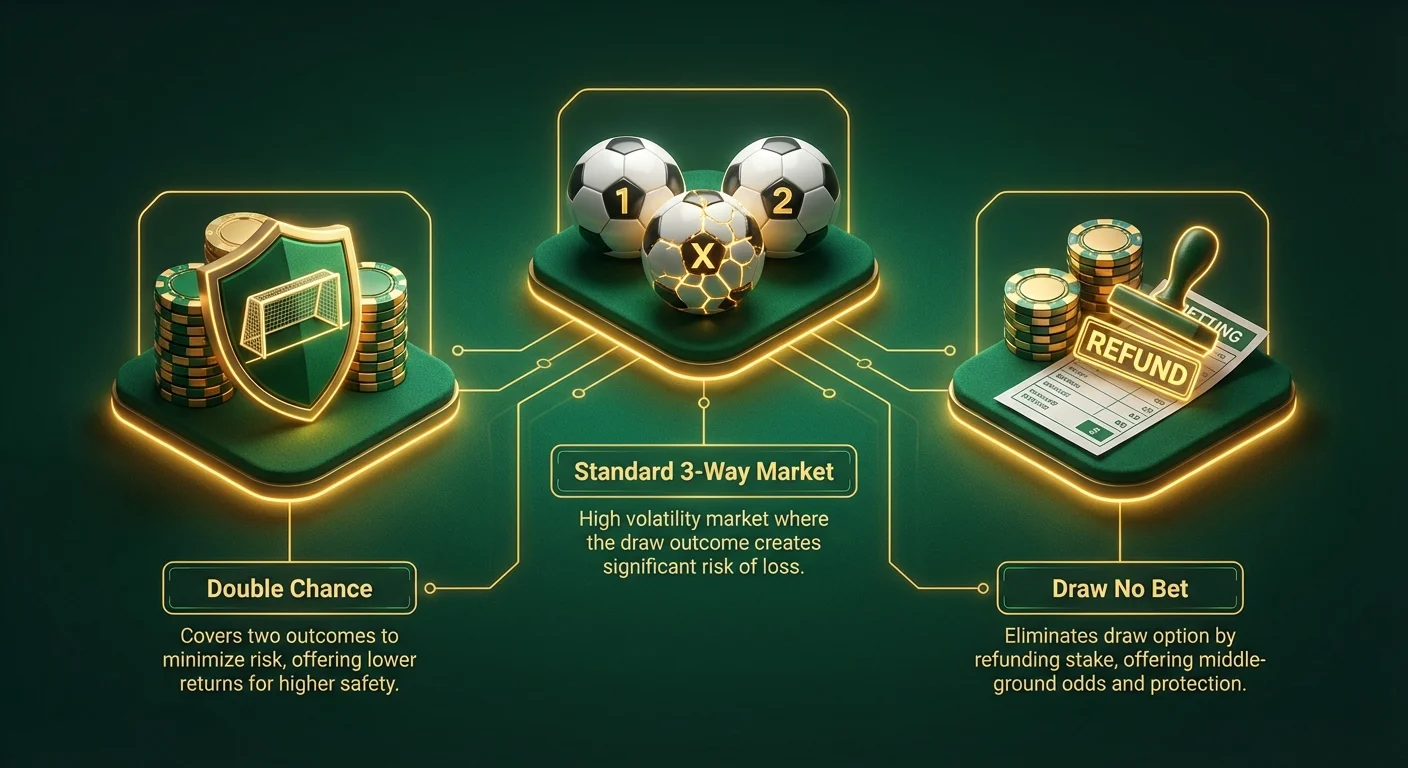
The Problem with the 1X2 Market
To understand the value of DNB and DC, you must first respect the volatility of the standard match result market. In soccer, the probability is split three ways:
- Home Win (1)
- Draw (X)
- Away Win (2)
In a standard market, if you bet on the Home team to win and the game ends 1-1, you lose. The bookmaker has a mathematical edge because the draw consumes a significant percentage of the probability pie.
Draw No Bet and Double Chance are technically "derivative markets". They take the standard 1X2 prices and adjust them to remove specific risk factors. By using them, you are essentially trading potential profit (lower odds) for a higher strike rate (win percentage).
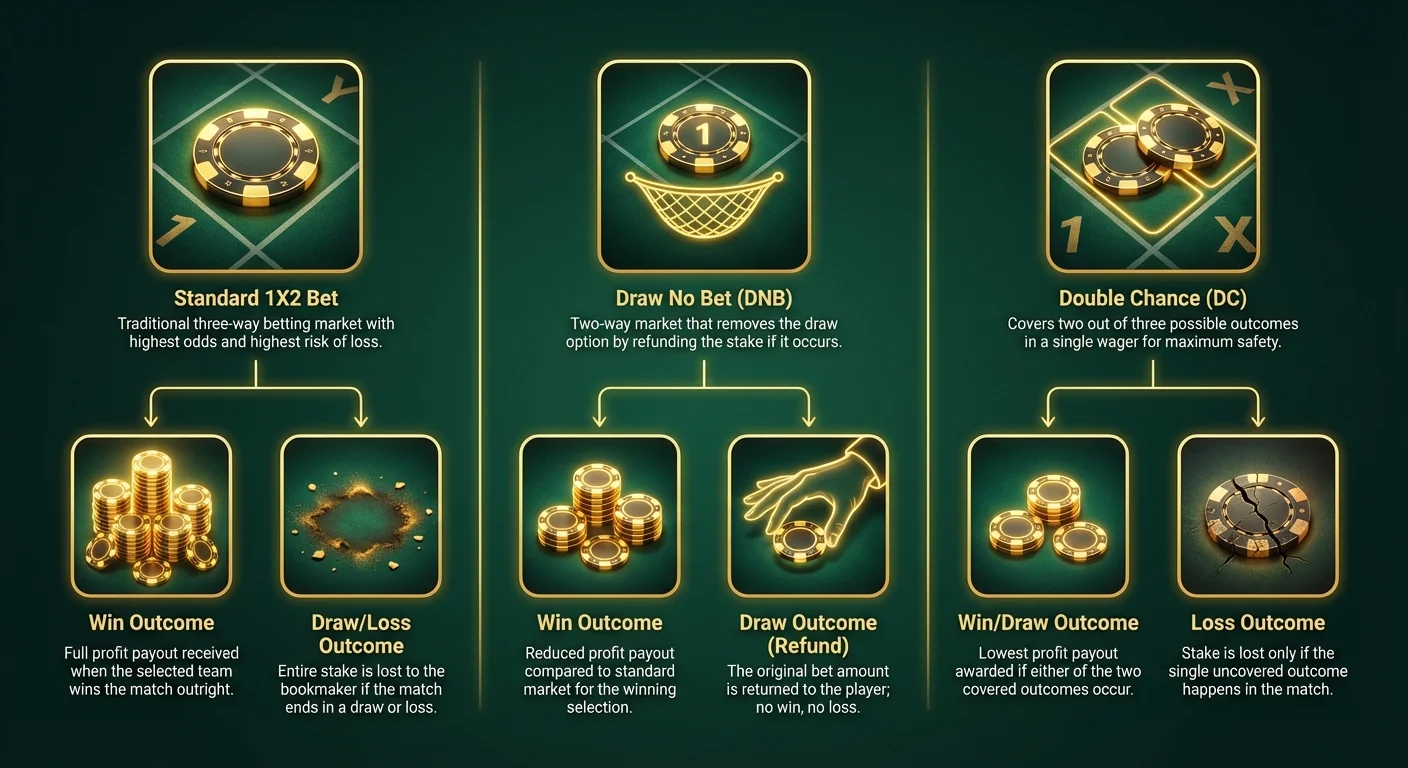
Deep Dive: Double Chance (DC)
Double Chance is the most conservative approach to soccer betting. As the name suggests, it allows you to cover two of the three possible outcomes with a single bet. If either of your two selected outcomes occurs, your bet wins.
The Three Options
There are three specific combinations in the Double Chance market:
- 1X (Home Win or Draw): You win if the home team wins or the match ends in a draw. You only lose if the away team wins.
- X2 (Away Win or Draw): You win if the away team wins or the match ends in a draw. You only lose if the home team wins.
- 12 (Home Win or Away Win): You win if either side wins. You lose only if the match ends in a draw.
When to Use Double Chance
Double Chance is rarely used when backing a heavy favorite because the odds become unbettable (e.g., 1.05 or -2000). Instead, DC shines in the following scenarios:
1. Backing the Underdog:
This is the most common strategy. If a mid-table team is playing a "Big Six" team that is suffering from injuries or fatigue, you might not be brave enough to bet the underdog to win outright. However, betting X2 (Away/Draw) allows you to profit if the underdog manages to scrape a 0-0 draw or steal a 1-0 win.
2. The "Must Not Lose" Scenario:
In tournament play (like the World Cup or Champions League group stages), teams often enter a match knowing a draw is sufficient to qualify. In these scenarios, teams play conservatively. Betting 1X or X2 aligns your financial incentive with the team's tactical incentive.
3. Parlay (Accumulator) Builders:Because DC odds are low, many crypto bettors use them as "anchors" in a parlay. Stringing together three or four "Home or Draw" picks on strong home teams can build respectable odds with theoretically lower variance than a straight win parlay.
Deep Dive: Draw No Bet (DNB)
Draw No Bet is the middle ground between the high risk of the 1X2 market and the low returns of Double Chance.
How It Works
When you place a Draw No Bet wager, you are backing a specific team to win.
- If your team wins: You win the bet (at reduced odds compared to the standard moneyline).
- If the match ends in a draw: The bookmaker refunds your stake. It is a "push."
- If your team loses: You lose the bet.
Basically, DNB eliminates the draw option from the equation. It turns a 3-way market into a 2-way market (Team A vs. Team B), similar to an NFL point spread or MLB moneyline.
When to Use Draw No Bet
DNB offers significantly better odds than Double Chance. It is best used when you believe a team is the superior side, but you are wary of their inability to finish chances or their tendency to concede late goals.
The "Protective" Strategy:
Imagine Liverpool playing away at Chelsea. You think Liverpool is the better team and should win, but playing at Stamford Bridge is difficult.
- Liverpool to Win: 2.40 odds (High risk if it ends 1-1).
- Liverpool DNB: 1.72 odds.
If Liverpool wins, you make a decent profit. If they draw, you get your Bitcoin back to fight another day. You are essentially buying insurance against the stalemate.
Head-to-Head: DNB vs. Double Chance
Intermediate bettors often confuse which option provides better value. The rule of thumb is simple: Double Chance is for when you think the Draw is a likely positive outcome; DNB is for when you think the Win is the likely outcome, and the Draw is merely a safety net.
Here is a breakdown of how the payouts differ based on a hypothetical match:
| Bet Type | Selection | Odds (Decimal) | Result: Win | Result: Draw | Result: Loss |
|---|---|---|---|---|---|
| Standard 1X2 | Home Win | 2.00 | Profit | Loss | Loss |
| Draw No Bet | Home DNB | 1.50 | Profit (Lower) | Refund | Loss |
| Double Chance | 1X (Home/Draw) | 1.30 | Profit (Lowest) | Profit (Lowest) | Loss |
Key Takeaway:
- Choose Double Chance if you want to get paid on the draw.
- Choose Draw No Bet if you just want your money back on the draw.
The Mathematics of Value: Calculating Your Own DNB
One of the secrets of professional sports betting is that you don't always have to take the line the bookmaker gives you. Sometimes, the odds offered on the specific "Draw No Bet" market are poor value compared to creating your own DNB manually using the 1X2 market.
This is often called "Dutching."
How to Create a Manual DNB
Let's say you want to bet 1 Unit (e.g., 0.01 BTC) on Team A Draw No Bet.
The bookmaker offers Team A DNB at 1.50.
However, looking at the 1X2 market, you see:
- Team A Win: 2.10
- Draw: 3.40
You can manipulate your stake allocation to replicate the DNB logic: ensuring that if a Draw occurs, your net profit/loss is zero.
The Formula:
- Calculate Stake on Draw: 1 Unit / 3.40 = 0.294 Units.
- Calculate Stake on Win: 1 Unit - 0.294 = 0.706 Units.
The Outcome:
- If Draw happens: You bet 0.294 on the Draw at 3.40 odds. Returns = 1.00 Unit. (You break even/Refund).
- If Team A Wins: You bet 0.706 on Team A at 2.10 odds. Returns = 1.48 Units.
Comparison:
- Official DNB Odds: 1.50 (Profit of 0.50u)
- Manual DNB Odds: 1.48 (Profit of 0.48u)
In this specific example, the Official DNB is better. However, frequently - especially in lower-tier leagues available on crypto sportsbooks - the manual calculation yields higher effective odds (e.g., 1.55 vs 1.50) because bookmakers add extra margin (vigorish) to derivative markets like DNB. Always check the math before clicking "Bet."
Strategy: When to Buy Safety and When to Risk It
The biggest mistake intermediate bettors make is over-using these markets. Safety is expensive. If you constantly bet Double Chance on favorites, you might hit an 85% win rate but still lose money long-term because the odds (1.15, 1.20) don't cover the inevitable upsets.
1. The "Away Underdog" DNB Strategy
Home field advantage is real, but often overvalued by the public. When a solid mid-table team travels to a slightly stronger team, the home team is often favored heavily.
- Scenario: Aston Villa (Home) vs. Newcastle (Away).
- If the market heavily favors Villa, Newcastle DNB might offer odds of 2.10 or higher. This is huge value. You are getting better than even money on a quality team, with the safety net of a draw.
2. The "Low Total" Indicator
Before placing a 1X2 bet, look at the Over/Under 2.5 Goals market.
- If the market expects a high-scoring game (Over 2.5 is favored), the Draw is statistically less likely. Risk the straight Win.
- If the market expects a low-scoring grind (Under 2.5 is favored), the Draw probability spikes significantly. Use DNB or Double Chance. Low-scoring games are volatile; one lucky bounce changes the result. You need the insurance here.
3. In-Play Crypto Betting
Crypto sportsbooks are renowned for their speed and live betting interfaces. DNB is a powerful tool for in-play betting.
- Scenario: The heavy favorite goes down 0-1 early. Their live odds skyrocket.
- Betting them on the Double Chance immediately after they concede can offer excellent value. They rarely lose at home, and now they will push aggressively for at least an equalizer. You can grab X2 or 1X at close to even money, banking on their superior quality to salvage at least a point.
The Crypto Advantage in Derivative Markets
Why bet DNB or DC using cryptocurrency? There are distinct advantages inherent to blockchain-based betting platforms that apply specifically to these strategies.
- Micro-Stakes and Precision: When "Dutching" (creating your own DNB manually), you might need to bet very specific amounts (e.g., 0.00342 BTC) to perfectly balance the math. Crypto allows for high decimal precision that traditional fiat books (restricted to $1 or $0.50 increments) often struggle with.
- Arbitrage Opportunities: Because crypto sportsbooks often operate with different liquidity providers than mainstream fiat books, their DNB lines can sometimes lag. You might find a Double Chance price on a crypto site that is higher than the standard market, offering positive Expected Value (+EV).
- No Limits for Winners: Successful DNB bettors are often "grinders" - they win small amounts consistently. Fiat books hate this and often limit these accounts. Decentralized or crypto-focused books generally offer higher limits and do not penalize winning strategies as aggressively.
Common Pitfalls to Avoid
Even with safer bet types, you can drain your bankroll if you aren't careful. Avoid these common errors:
- The "Acca" Trap: Do not put 10 Double Chance selections into a single parlay just because "it looks safe." The compound house edge (vig) on 10 bets will eat you alive. Keep parlays to 3-4 legs maximum.
- Ignoring Team Motivation: A Double Chance bet on a team that has nothing to play for (end of season) is dangerous. Even if they are the better team, if they are already safe from relegation and can't reach Europe, they may not fight for the draw if they go behind.
- Blindly Backing Favorites: Betting Real Madrid "Double Chance" against a bottom-tier team at odds of 1.03 is pointless. You are risking a dollar to win three cents. One freak result destroys months of grinding.
Summary: Which Bet Type is Right for You?
To wrap up, here is your quick decision matrix for the next match day:
Choose Double Chance (DC) if:
- You are betting on a massive underdog to survive.
- You are building a parlay and want to increase the hit rate.
- You believe the game will be very low scoring (0-0 or 1-1).
Choose Draw No Bet (DNB) if:
- You believe the team will win, but they are playing away from home.
- You want better odds than DC, but the 1X2 market feels too risky.
- The team has a strong defense but a weak attack (high chance of 0-0).
Choose Standard Win (1X2) if:
- The team is a heavy favorite at home.
- The game is expected to be high-scoring (less chance of a draw).
- The value of the odds justifies the risk of the draw.
Reducing variance is the key to becoming a profitable long-term bettor. By mastering Draw No Bet and Double Chance, you stop gambling on coin flips and start investing in probabilities. Remember to check the "juice," use your crypto wallet for precision staking, and never pay for insurance you don't need.