In the world of Mixed Martial Arts (MMA) betting, the Moneyline - simply picking who will win - is often the least efficient way to grow a bankroll. When a dominant champion enters the octagon as a -600 favorite, the risk-to-reward ratio on a straight win bet becomes unappealing for serious handicappers. This is where the deeper waters of MMA props come into play.
By focusing on how a fight finishes or when it ends, bettors can find significant value, turning heavy favorites into playable odds or finding mispriced lines in close matchups. This guide serves as a deep dive into Method of Victory and Round Betting, designed to move you from casual guessing to intermediate strategic handicapping using the speed and flexibility of crypto sportsbooks.
Beyond the Moneyline: Why Play Props?
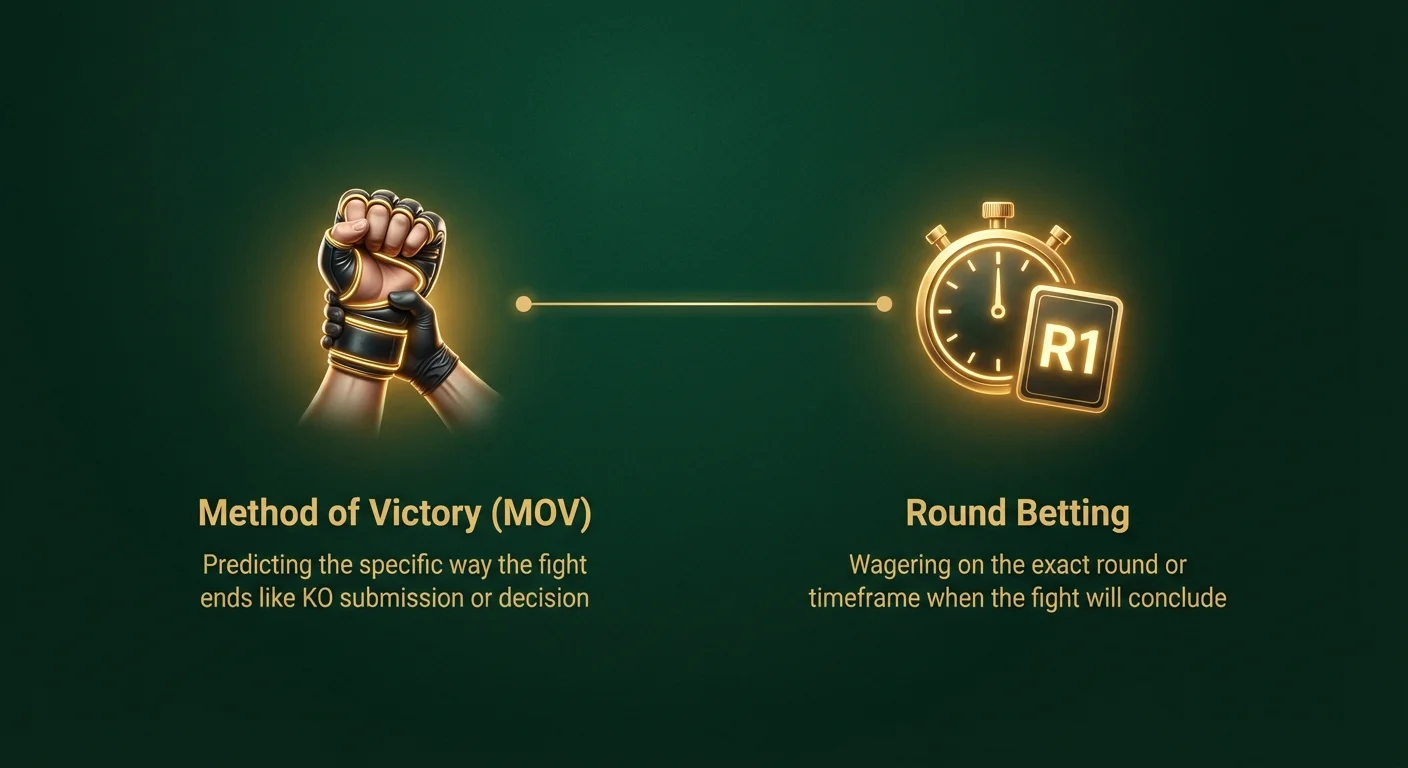
The concept of "prop" (proposition) betting in MMA revolves around predicting specific scenarios rather than just the final result. In a sport with as much variance as MMA - where 4-ounce gloves mean one punch can change everything - props allow you to leverage specific stylistic matchups.
For example, if a Brazilian Jiu-Jitsu ace is fighting a pure striker with poor takedown defense, the grappler might be a -250 favorite to win. However, the odds of them winning by Submission might be +110. If you are confident they win by grappling, the method of victory market offers a significantly higher return for predicting the specific path to victory.
The Crypto Advantage in Prop Markets
Before dissecting the strategies, it is worth noting why seasoned bettors are migrating to crypto betting sites for these markets. Why Go Crypto.
- Reduced Juice: Crypto books often operate with lower overhead, offering tighter margins on prop markets compared to traditional fiat sportsbooks.
- Instant Settlement: In MMA, funds from a fight that ends in Round 1 are often settled instantly via blockchain technology, allowing you to re-wager those winnings on the next fight on the card.
- High Limits: Prop markets usually have lower betting limits than moneylines. Crypto operators generally offer higher ceilings for these specific bets.
Method of Victory: The Art of Prediction
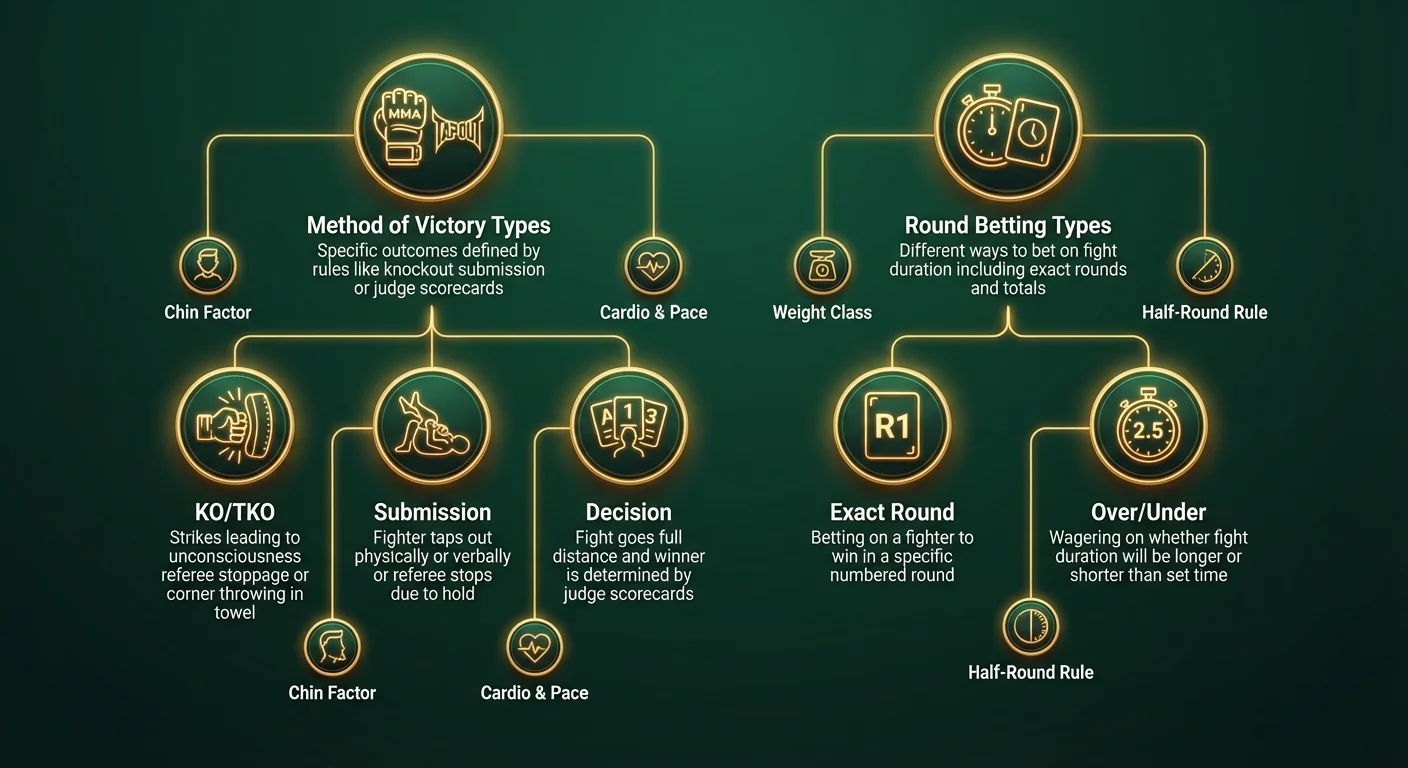
Method of Victory (MOV) asks you to predict the winner and the specific way the referee or judges declare the end of the bout. Understanding the official rules is vital here.
The Three Main Methods
| Method | Official Definition | Strategic Context |
|---|---|---|
| KO/TKO | Knockout (unconscious), Technical Knockout (referee stoppage due to strikes), or Corner Stoppage. | Look for high-volume strikers vs. fading veterans, or power punchers vs. "chinny" opponents. |
| Submission | Tap out (physical or verbal) or Technical Submission (referee stoppage due to unconsciousness/injury from a hold). | Ideal for high-level grapplers vs. strikers with low takedown defense rates. |
| Decision | The fight goes the full distance and scorecards are read (Unanimous, Split, or Majority). | Best for two durable fighters, or wrestlers who prefer "lay and pray" control over finishing. |
Analyzing Method of Victory
To bet this market successfully, you must ignore the hype and look at the data.
1. The "Chin" Factor
In method of victory betting, durability is as important as offense. A fighter might be a knockout artist, but if their opponent has never been knocked out in 30 fights (an "iron chin"), betting the KO prop is a negative EV (Expected Value) play. Conversely, if a fighter has suffered three knockout losses in their last five fights, their durability is compromised.
2. Defensive Grappling Statistics
Don't just look at a fighter's submission wins; look at their opponent's takedown defense percentage. If Fighter A has a generic submission game but Fighter B has 100% takedown defense, the fight likely stays standing, killing the value of the submission prop.
3. Cardio and PaceDecision props are often undervalued. If two high-level fighters are matched up, and both possess excellent cardio and durability, the "Win by Decision" prop is often a safer play than chasing a finish. This is common in lower weight classes (Flyweight/Bantamweight), offering solid value betting opportunities.
Round Betting UFC and MMA: Timing is Everything
Round betting is widely considered the most volatile market, but it offers the highest payouts. This market asks you to predict exactly when the fight will end, requiring a deep understanding of variance in betting.
Types of Round Bets
- Exact Round: You bet on Fighter A to win in Round 1. If they win in Round 2, you lose. If they win by Decision, you lose.
- Grouped Rounds: A safer intermediate strategy. You bet on Fighter A to win in "Round 1 or 2." This lowers the odds but provides insurance against a fight dragging on slightly longer than expected.
- Over/Under Rounds: You are not picking a winner, only the duration. The standard line is usually 1.5 or 2.5 rounds.
The "Half-Round" Rule Explained
This is the most common point of confusion for casual bettors. In MMA betting, the ".5" signifies the exact halfway point of the round.
- A round is 5 minutes long.
- Half a round is 2 minutes and 30 seconds.
If you bet Over 2.5 Rounds:
- The fight must go past the 2:30 mark of Round 3.
- If the fight ends at 2:29 of Round 3, you lose.
- If the fight ends at 2:31 of Round 3, you win.
Weight Class Correlation
One of the strongest statistical correlations in round betting UFC markets is the weight class. Physics plays a massive role: bigger fighters hit harder, and smaller fighters move faster and endure more.
| Weight Class | Likelihood of Finish | Round Betting Strategy |
|---|---|---|
| Heavyweight (265 lbs) | Extremely High | Lean toward Under 1.5 or Round 1 KO. Fights rarely go the distance. |
| Middleweight (185 lbs) | Moderate | A mix. Analyze individual power vs. durability. |
| Flyweight (125 lbs) | Low | Lean toward Over 2.5 or Go the Distance. Speed and cardio usually trump power. |
The "Fight to Go the Distance" (FTGTD)
This is a binary "Yes/No" market. Does the fight reach the final bell? It doesn't matter who wins or what the scorecards say.
When to Bet "Yes" (Go the Distance)
- The "Sparring Match": Two technical counter-strikers often respect each other too much, leading to a low-output chess match (e.g., Israel Adesanya vs. Yoel Romero).
- The Wrestler vs. Wrestler: When two elite wrestlers fight, they often cancel out the grappling and engage in a sloppy kickboxing match where neither has the power to finish the other.
- Altitude: Interestingly, extreme altitude (like fights in Salt Lake City or Mexico City) can cut both ways. It can lead to sloppy finishes due to exhaustion, but often leads to a slow-paced "slog" where fighters are too tired to generate finishing power.
When to Bet "No" (Inside the Distance)
- The Mismatched Finisher: An elite finisher vs. a fighter stepping in on short notice.
- Bad Blood: While anger can lead to mistakes, genuine hatred often results in fighters taking risks to secure a humiliation, leading to a finish (for one side or the other).
- The Glass Cannon: A fighter with immense power but a terrible chin. The fight will end early; the only question is who falls first.
Where Casual Bettors Go Wrong
Intermediate betting is about eliminating the mistakes that drain the bankrolls of recreational players. Here are the most common errors in MMA props.
1. The "First Round KO" Addiction
Casual bettors love betting on a Round 1 KO because it offers instant gratification. Sportsbooks know this and often shade the lines (lower the payouts) on Round 1 props for popular knockout artists.
- Correction: Check the fighter's average fight time. Even aggressive fighters often take a round to download their opponent's timing. Round 2 props often offer double the value for a more likely outcome.
2. Ignoring the Referee
Referees have tendencies. Some are notorious for stopping fights the moment a fighter turtles up (favoring TKO props). Others let fighters take significant damage to give them a chance to recover (favoring Over/Distance props).
- Correction: Check who is officiating the main event. A quick-trigger ref boosts the value of the "Under" props.
3. Parlaying Method of Victory
Bettors often try to create a lottery ticket by parlaying three fighters to all win by "Round 1 KO." The variance in MMA is too high for this to be profitable long-term.
- Correction: If you must parlay, stick to Moneyline or simple "Fight to Go the Distance" props. Keep high-variance MOV bets as singles.
4. Overvaluing Recent Bias
Just because a fighter scored a highlight-reel knockout in their last fight doesn't mean they are a knockout artist. It might have been a lucky shot or a terrible opponent.
- Correction: Look at their career finish rate, not just their last highlight.
Advanced Strategy: Stacking Props (The Waterfall Method)
For intermediate bettors, "stacking" or "laddering" is a valid strategy to cover multiple outcomes while aiming for high upside.
Scenario:
You believe Fighter A will knock out Fighter B, likely early, but you want to be safe.
- Bet 1 (Safety): Fighter A to win Inside the Distance (ITD). Odds: -150. (Larger Unit)
- Bet 2 (Value): Fighter A to win by KO/TKO. Odds: +110. (Medium Unit)
- Bet 3 (High Variance): Fighter A to win in Round 1. Odds: +350. (Small Unit)
If they win by Submission in Round 3, you win Bet 1. If they win by KO in Round 2, you win Bets 1 and 2. If they win by KO in Round 1, you sweep the board. This manages risk better than dumping your whole bankroll on the Round 1 prop alone.
Summary: Key Takeaways for Prop Success
Mastering method of victory and round betting requires moving past fan sentiment and embracing cold analysis.
- Styles Make Fights: Match the method of victory to the stylistic clash (e.g., Grappler vs. Striker = Sub or KO).
- Respect the Weight: Heavyweights finish fights; Flyweights go to decisions. Bet accordingly.
- Mind the Clock: Remember that Over 2.5 rounds means passing the 2:30 mark of the third round.
- Shop for Lines: Crypto sportsbooks can have vastly different odds on specific round props. A +500 vs. a +600 difference adds up significantly over time.
- Durability > Power: When betting on a finish, the loser's lack of durability is often more predictive than the winner's power.
By utilizing the transparency and speed of crypto betting platforms, you can attack these markets with efficiency. Stop betting on who wins, and start profiting from how they win, leveraging the speed of crypto.