
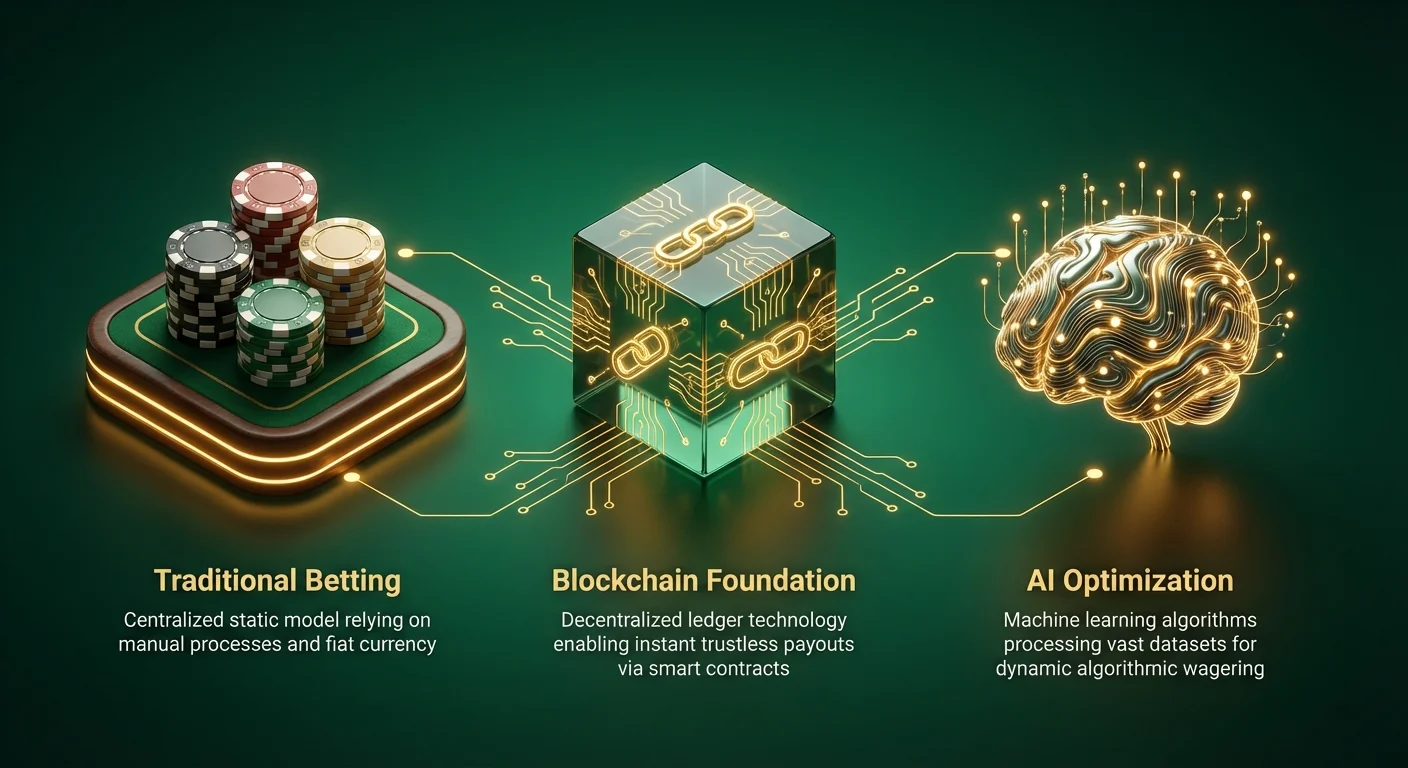
The sports betting landscape is currently undergoing its most significant transformation since the internet first allowed wagers to be placed online. For years, the industry operated on a static model: a centralized bookmaker set the lines, you placed a wager using fiat currency, and you waited - sometimes days - for a payout.
That model is rapidly becoming obsolete. We are moving toward a decentralized, data-driven ecosystem where the lines between the bettor, the bookmaker, and the technology blur. For the crypto bettor, this isn't just about faster Bitcoin deposits; it is about a fundamental shift in how markets are made, how trust is established, and how winners are predicted.
This guide explores the future of betting, dissecting the convergence of blockchain technology and artificial intelligence. We will look past the buzzwords to understand how these tools are changing the mathematics of sports betting and what you need to do to adapt your strategy for the next generation of sportsbooks.
The Blockchain Revolution: Beyond Simple Payments
Most intermediate crypto bettors are already familiar with the transactional benefits of blockchain: instant deposits, low fees, and the ability to use Bitcoin, Ethereum, or stablecoins like USDT. However, the future utilizes blockchain for infrastructure, not just currency.
1. Smart Contracts and Automated Payouts
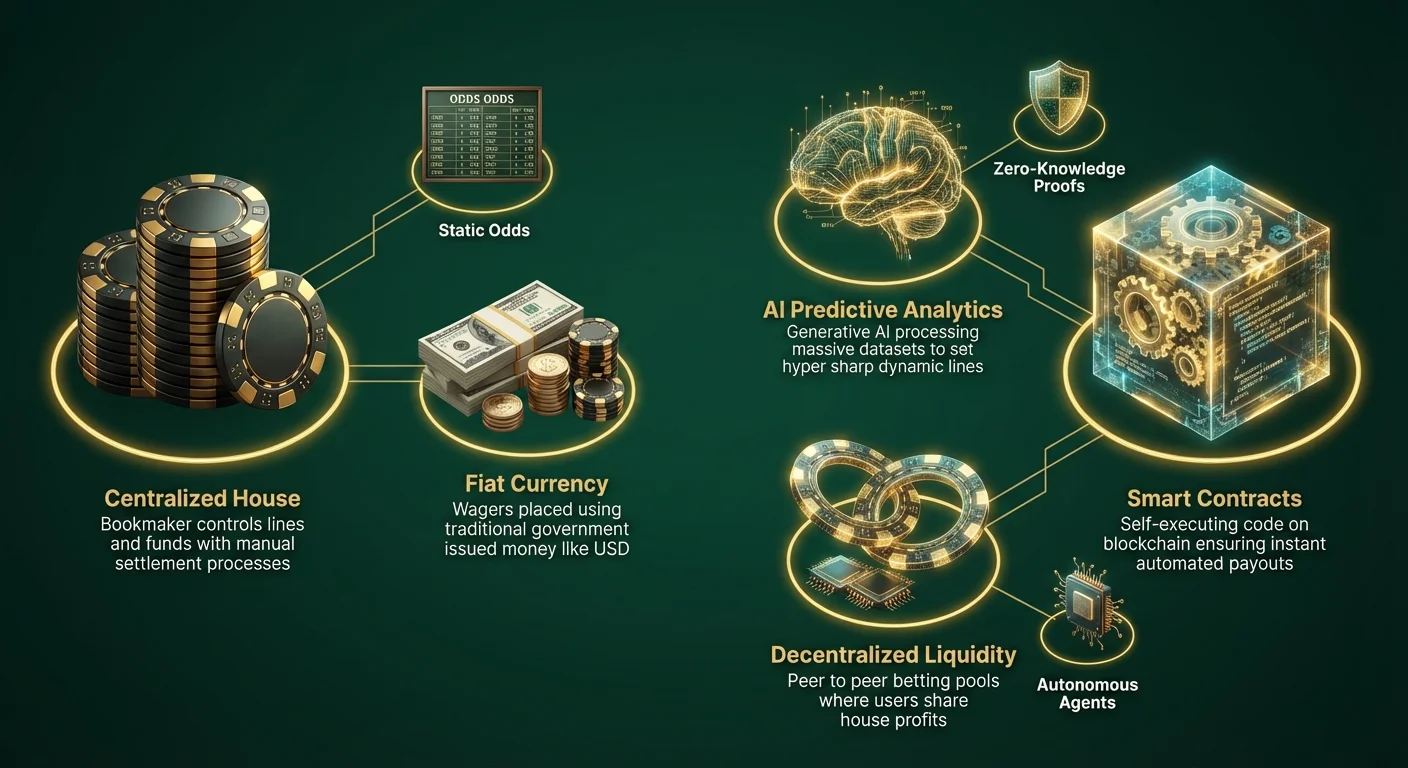
In the near future, the manual "withdrawal approval" process will be a relic of the past. The integration of Smart Contracts - self-executing code stored on a blockchain - removes the human element from settlement.
How it works:
- You place a bet on the New York Yankees to win.
- The funds are locked in a smart contract (an escrow on the blockchain).
- An "Oracle" (a trusted data feed, like Chainlink) verifies the game result from official sources.
- If the Yankees win, the smart contract automatically releases the funds to your wallet immediately.
Strategic Advantage: This eliminates counterparty risk. You no longer have to worry if a sportsbook has the liquidity to pay you or if they will delay your withdrawal due to "verification checks." If the contract accepts the bet, the funds are guaranteed.
2. Decentralized Sportsbooks (DeFi Betting)
We are seeing the rise of Decentralized Finance (DeFi) applied to betting. In a traditional model, the "House" takes a vigorish (vig) to facilitate the bet. In a decentralized model, the "House" is a liquidity pool funded by users.
- Peer-to-Peer (P2P): You can bet directly against another user. You want the Lakers at +150; someone else wants the Celtics at -150. The blockchain matches you.
- Be the House: You can provide liquidity to a betting pool (e.g., a USDT sports pool) and earn a share of the fees lost by losing bettors. This allows you to hedge your active bets by earning passive yield on the platform's volume.
3. Transparency and Immutable Ledgers
For years, bettors have suspected bookmakers of shading lines or manipulating outcomes in virtual sports. Blockchain introduces the concept of an immutable ledger. Every transaction, every line movement, and every payout is recorded publicly.
This is the evolution of Provably Fair gaming. While currently popular in crypto casino games (like Dice or Crash), this technology is moving toward sports betting to prove that dynamic odds were not manipulated after a bet was placed.
AI Sports Betting: The Era of Algorithmic Wagering
If blockchain is the engine of the future, Artificial Intelligence (AI) is the navigator. AI is transforming betting from a game of intuition into a game of high-frequency data science.
The Bookmaker's Advantage: Dynamic Odds
Sportsbooks are using machine learning to set sharper lines than ever before.
- Micro-Betting: AI can calculate the odds of the next pitch in baseball or the next drive in football in milliseconds. This opens up markets for instant gratification betting.
- Personalized Limits: AI analyzes your betting patterns. If the system detects you are a sharp bettor (consistently beating the closing line), it may dynamically adjust the vig or limits specifically for your account.
The Bettor's Counter-Strike: AI Tools for Players
The playing field is leveling. Tools that were once proprietary to Las Vegas syndicates are becoming accessible to intermediate bettors.
Predictive Analytics:
Generative AI and machine learning models can process vast datasets that a human cannot. Instead of looking at "Last 5 Games," an AI model can analyze weather conditions, player travel fatigue, social media sentiment, and injury recovery rates to predict outcomes.
Automated Arbitrage:
AI bots can scan hundreds of crypto sportsbooks simultaneously to identify discrepancies in odds (arbitrage opportunities). If Bookmaker A has Bitcoin priced at 1.90 and Bookmaker B has it at 2.10, the bot can execute simultaneous trades to guarantee a profit regardless of the outcome.
Pro Tip: As AI makes lines sharper, "value" becomes harder to find in major markets (NFL, NBA spreads). The future strategy lies in Derivative Markets (player props, 3rd quarter totals) where AI models often have less historical data and are slower to adjust.
The Convergence: Where AI Meets Crypto
The most exciting developments occur where betting technology merges AI and Blockchain.
1. Zero-Knowledge Proofs (ZKPs) for KYC
One of the biggest friction points in betting is Identity Verification (KYC). Players want privacy; regulators want compliance.
The Solution: Zero-Knowledge Proofs allow you to prove a statement is true without revealing the underlying data.
- Scenario: You need to prove you are over 18 and not located in a restricted jurisdiction.
- The Future: Your crypto wallet generates a cryptographic proof derived from your ID. The sportsbook receives a "Pass" signal. They know you are legal to play, but they never see your name, address, or ID photo. This maintains total privacy while satisfying regulatory requirements.
2. Autonomous Betting Agents
Imagine a scenario where you authorize an AI agent to manage a portion of your bankroll.
- You set the parameters: "Bet on home underdogs in the EPL when the rain probability is >50% and the odds are above 2.50."
- You fund a smart contract with 1 ETH.
- The AI agent monitors the data feeds. When conditions are met, it executes the transaction on the blockchain automatically.
- This removes emotion (tilt) from your betting entirely.
Comparing the Ecosystems: Traditional vs. Future-Tech
To understand the shift, we can compare the current standard against the emerging "Future-Ready" model.
| Feature | Traditional Fiat Sportsbook | Future Crypto-AI Sportsbook |
|---|---|---|
| Currency | Fiat (USD, EUR, GBP) | Crypto (BTC, ETH, Stablecoins) |
| Settlement Speed | 1-5 Business Days | Instant / Block confirmation time |
| Trust Model | Trust the Company (Centralized) | Trust the Code (Smart Contracts) |
| Odds Setting | Manual Traders + Basic Algos | Deep Learning AI + Oracle Feeds |
| Account Limits | Winners are often banned/limited | Liquidity-based (DeFi) / High limits |
| Privacy | Invasive KYC (Docs required) | Web3 Connect / Zero-Knowledge Proofs |
| Experience | Static Web Interface | Immersive / Metaverse Integration |
Strategic Adaptation: How to bet in the Future
The technology is changing, and so must your approach. If you stick to "gut feeling" bets in an AI-dominated market, you will lose long-term. Here is how to future-proof your betting strategy.
1. Embrace Data, Abandon Loyalty
In the future, brand loyalty to a single sportsbook is a financial leak. You must utilize odds aggregator sites or API tools that compare lines across the blockchain ecosystem.
- Strategy: Keep your bankroll fragmented across a non-custodial wallet (like MetaMask or Exodus). Connect to Decentralized Exchanges (DEXs) or crypto sportsbooks only when you identify the best price. Move funds, place the bet, win, and disconnect.
2. Audit the Algorithms
If you are using a site that claims "AI-powered tips" or "Provably Fair" odds, you need to verify it.
- Check if the platform is open-source.
- Look for "Chainlink VRF" (Verifiable Random Function) integration for any virtual sports or random outcomes.
- Don't trust "black box" AI prediction bots sold on social media. True AI betting tools should offer transparent win/loss records recorded on a ledger.
3. Hedging with Stablecoins
Crypto volatility is a risk factor for bettors. You might win your bet in Bitcoin, but if Bitcoin drops 10% the next day, you've lost your profit.
- The Fix: Utilize stablecoins (USDT, USDC) for your working bankroll.
- Advanced Move: Use DeFi protocols to earn yield on your bankroll when you aren't betting. If you have $5,000 sitting in a betting wallet, stake it in a flexible savings protocol to earn 3-5% APY between match days.
4. Specialization is Key
AI models are excellent at general data. They are less effective at nuanced, breaking news that hasn't hit the data feed yet.
- The Human Edge: AI might know a player's shooting percentage, but it might not know that the player was seen limping at a nightclub at 2 AM.
- Focus on niche leagues or specific player props where human intuition and "soft information" still hold an edge over hard data processing.
The Immersive Future: VR and the Metaverse
While AI handles the math and Blockchain handles the money, Extended Reality (XR) will handle the experience.
We are moving toward a "Watch and Bet" environment. Instead of looking at a spreadsheet of odds, you might enter a Virtual Reality (VR) stadium.
- Overlay Betting: As you watch the game in VR, live odds for the next play appear as an overlay on the field. You gesture to place a bet instantly.
- Social Betting Lounges: Meet with friends in a digital suite to watch the game, pooling your crypto to place a syndicate bet together via a multi-signature wallet.
Risks and Regulatory Challenges
The future is bright, but not without pitfalls.
- Smart Contract Bugs: If the code governing the bet has a flaw, hackers can exploit it. Always check if a DeFi betting platform has been audited by firms like CertiK or Hacken.
- Regulatory Lag: Governments move slower than code. Some regions may attempt to ban decentralized betting interfaces. The use of VPNs and decentralized front-ends (hosting the website on IPFS) will likely become standard practice for accessing these markets.
Summary: Your Checklist for the Next Era
The transition to AI and blockchain-based betting won't happen overnight, but the early adopters are already profiting. To stay ahead of the curve:
- Get Comfortable with Web3: Learn to use non-custodial wallets and interact with smart contracts.
- Use Tools, Not Just Gut: Incorporate data analytics or AI prediction models into your handicapping.
- Value Privacy: Seek out platforms implementing Zero-Knowledge Proofs or minimal KYC for enhanced security.
- Demand Instant Payouts: Stop accepting delays. If a bookmaker can't pay in minutes, they are using outdated tech.
The future of betting isn't just about gambling; it's about engaging with a sophisticated, transparent, and high-speed financial market. By mastering the technology today, you ensure you aren't just a participant in the future of betting - you're a winner.