
While the general betting public obsesses over spreads - agonizing over whether the Lakers will cover the -5.5 or if the Celtics can win by double digits - sharp bettors know that some of the most consistent value in NBA betting lies in the Totals market.
Betting the Over/Under in basketball is less about team loyalty or narrative and more about pure mathematics. It is a game of possessions, efficiency, and tempo. Unlike football or baseball, where a single fluke play can ruin a total, NBA scoring is the result of roughly 100 distinct events (possessions) per team, per game. This high volume of events allows for statistical modeling that is often more reliable than predicting a winner.
This guide moves beyond the basics of "rooting for points." We will dive deep into Pace Betting, efficiency metrics, and the situational factors that drive NBA totals, helping you leverage crypto sportsbooks to maximize your edge.
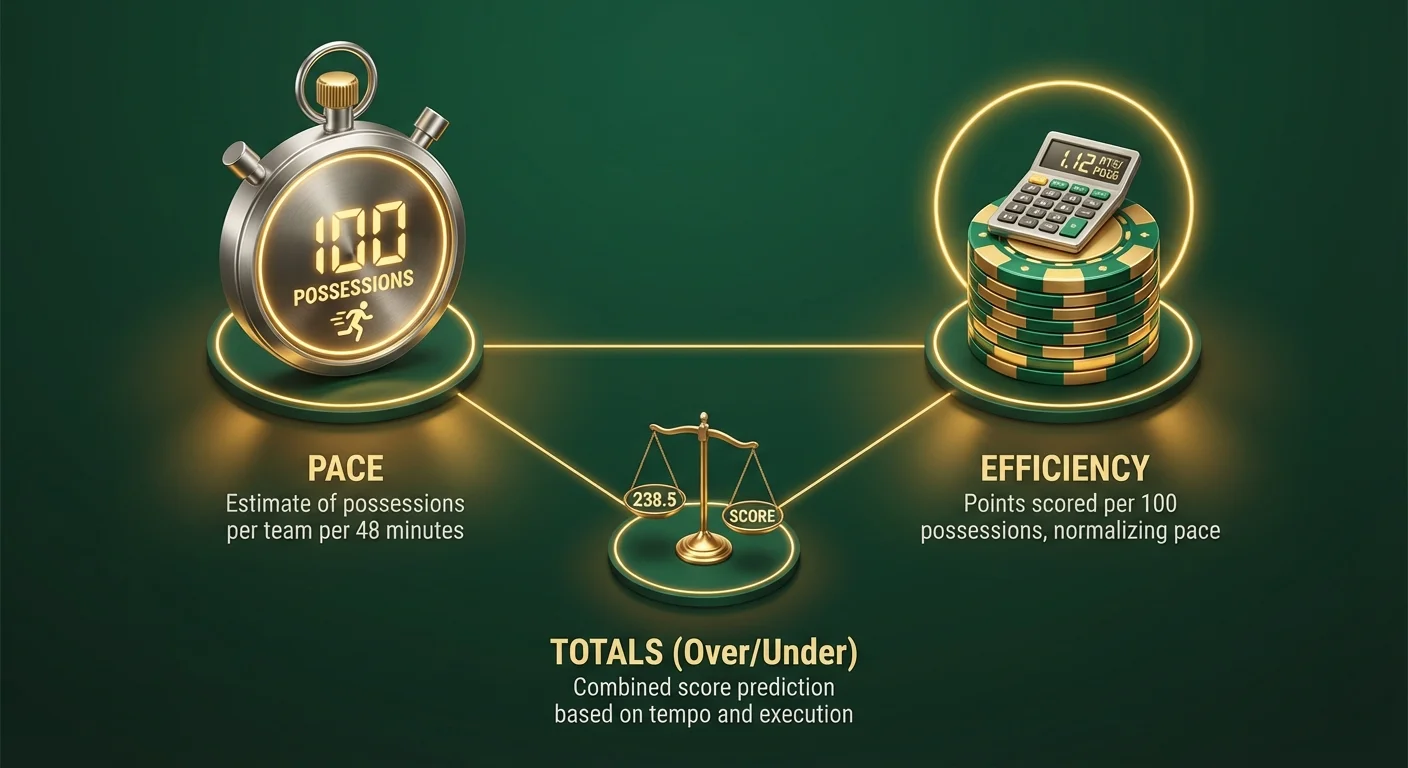
Understanding the NBA Total (Over/Under)
Before dissecting the metrics, let's establish the baseline. An NBA total is a prediction of the combined score of both teams at the end of regulation (plus overtime).
If the Golden State Warriors are playing the Sacramento Kings, the oddsmakers might set the total at 238.5.
- Over: You win if the combined score is 239 or higher.
- Under: You win if the combined score is 238 or lower.
While the concept is simple, the number generation is complex. Oddsmakers use algorithms that factor in recent scoring trends, head-to-head history, and public perception. To beat them, you need to understand the two pillars of basketball scoring: Pace and Efficiency.
The Engine of Scoring: Pace of Play
The single most important metric for NBA totals is Pace. Simply put, Pace is an estimate of the number of possessions a team uses per 48 minutes.
You cannot score points without the ball. Therefore, the more possessions in a game, the higher the "ceiling" for the total score.
How Pace is Calculated
A "possession" ends when a team scores, turns the ball over, or misses a shot that is rebounded by the defense.
- Fast Pace (High Tempo): Teams that run in transition, shoot early in the shot clock, and force turnovers (creating more possessions).
- Slow Pace (Low Tempo): Teams that walk the ball up, utilize the full 24-second shot clock, and limit turnovers.
The Pace Equation in Matchups
When analyzing a matchup, you must average the pace of both teams to project the game's tempo.
Example A (Track Meet):
- Team A Pace: 104.5 (League High)
- Team B Pace: 103.0 (Top 5)
- Projected Game Pace: ~103.75 possessions.
- Strategy: This screams OVER, provided efficiency isn't terrible.
Example B (The Grind):
- Team C Pace: 96.5 (League Low)
- Team D Pace: 97.0 (Bottom 5)
- Projected Game Pace: ~96.75 possessions.
- Strategy: This screams UNDER.
Pro Tip: Be wary of the "Clash of Styles." When the fastest team plays the slowest team, the slow team usually dictates the tempo. It is easier to slow a game down (by fouling, using the clock, and not running back) than it is to force a slow team to run.
The Quality of Scoring: Offensive & Defensive Efficiency
Pace tells you how many chances a team gets. Efficiency tells you what they do with those chances. A game can have 110 possessions per team, but if both teams are shooting 38% from the field, the Under will still cash.
We use Offensive Rating (ORtg) and Defensive Rating (DRtg) to measure this.
- ORtg: Points scored per 100 possessions.
- DRtg: Points allowed per 100 possessions.
These metrics normalize the data, removing pace from the equation so you can see how good a team actually is at scoring or defending.
The Totals Matrix
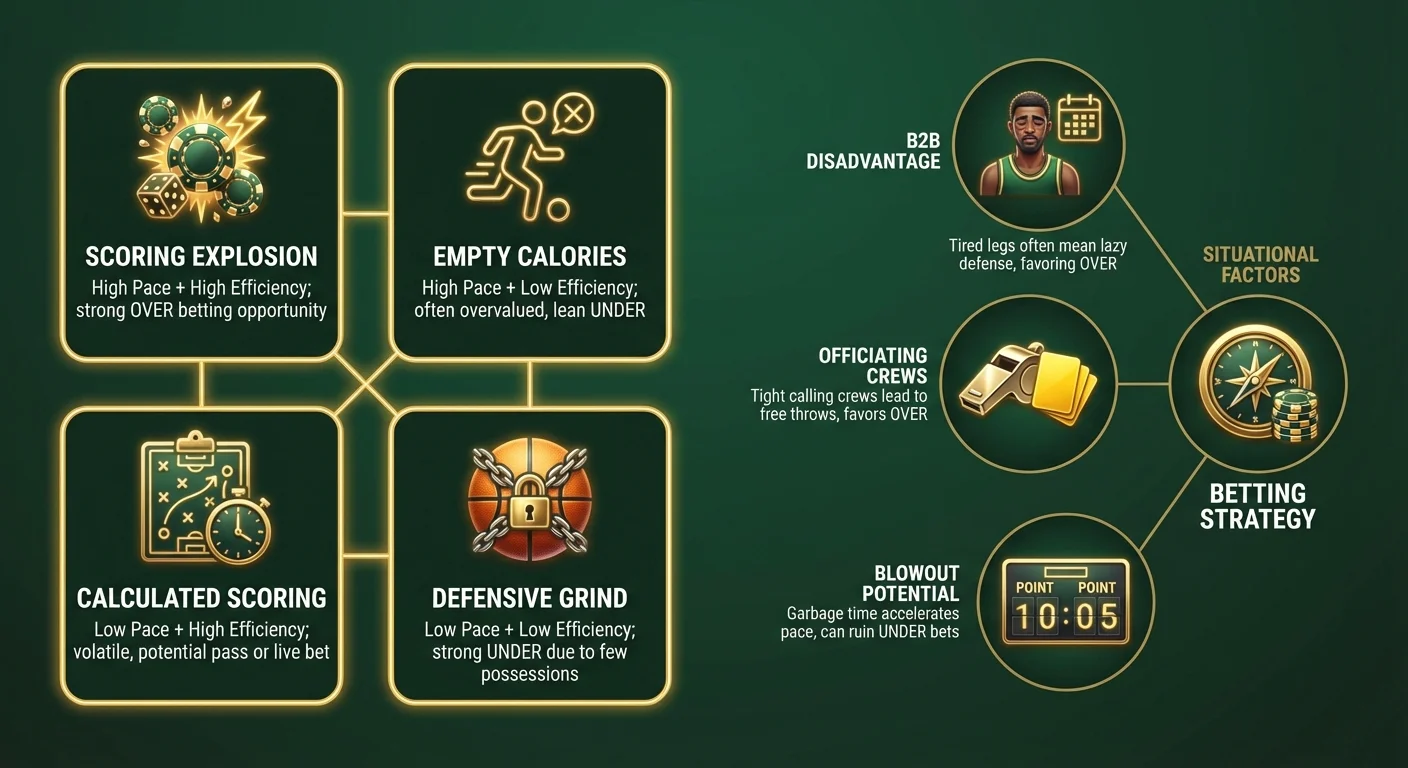
To find value, you must cross-reference Pace with Efficiency. Use this matrix to identify potential plays:
| Metric Combination | Likely Outcome | Betting Strategy |
|---|---|---|
| High Pace + High Efficiency | Scoring Explosion | Strong Over. This is the "perfect storm" for points. |
| High Pace + Low Efficiency | "Empty Calories" | Lean Under. Often overvalued by the public because the teams "run," but they miss too many shots. |
| Low Pace + High Efficiency | Calculated Scoring | Pass / Live Bet. These games are volatile. A few missed shots kill the Over because there aren't enough possessions to recover. |
| Low Pace + Low Efficiency | Defensive Grind | Strong Under. Neither team wants to run, and neither can shoot. |
| Bad Defense + Fast Pace | One-Way Traffic | Team Total Over. Look at the specific team facing the bad defense, rather than the game total. |
Situational Factors Affecting Totals
Math provides the framework, but situational spots provide the context. NBA players are human; they get tired, they get injured, and they lose motivation.
1. The "Rest Disadvantage" and B2Bs
Back-to-back (B2B) games - playing two games in two nights - drastically impact totals, but not always in the way you expect.
- Conventional Wisdom: Tired legs mean missed jump shots (Bet Under).
- Sharp Reality: Tired legs often mean lazy defense (Bet Over).
If a team is on the second night of a back-to-back and traveled overnight (e.g., played in Denver, flew to Utah), the defense usually suffers first. Players stop closing out on three-point shooters and stop running back in transition.
2. Officiating Crews
In the NBA, referees have distinct tendencies. Some crews call "tight" games with many fouls, while others "let them play."
- Many Fouls: Stops the clock and awards free throws (which are high-efficiency points). Favors Over.
- Few Fouls: The clock runs continuously. Favors Under.
Many sharp bettors keep a database of "Over Refs" and "Under Refs." If you see a crew known for blowing the whistle paired with two aggressive teams, the Over gains value.
3. Blowout Potential (The "Garbage Time" Factor)
Garbage time - the final 4-6 minutes of a game decided by 20+ points - is the enemy of the Under and the best friend of the Over.
- When starters sit, defense disappears.
- Bench players are hungry to score to earn minutes.
- The pace often accelerates wildly in the final minutes of a blowout.
If you are betting an Under, avoid matchups with a massive spread (e.g., -14.5), as a blowout could lead to a 4th quarter scoring barrage that ruins your ticket.
Crypto Betting Advantages for NBA Totals
Using cryptocurrency for NBA betting offers specific strategic advantages, particularly for totals bettors who rely on timing and volume.
1. Instant Settlement for Live Turnover
NBA totals are volatile. If you win an "Over" bet in the early game (7:00 PM ET), you might want to roll those winnings into a late game (10:30 PM ET). Traditional fiat sportsbooks can be slow to grade bets or process withdrawals. Crypto sportsbooks typically offer automated, instant settlements, allowing you to compound your bankroll in a single night.
2. High Limits and Privacy
Totals markets are often where the "sharps" play. Consequently, traditional books limit winning players quickly. Crypto sportsbooks (especially decentralized ones or major offshore operators) generally offer higher betting limits and do not limit accounts as aggressively for winning on totals.
3. Provably Fair and Transparency
While more common in casino games, the "provably fair" concept in crypto sports betting ensures that the odds you accepted were locked in at that exact moment on the blockchain. This prevents "past-posting" accusations or disputes regarding line movement timing.
Advanced Strategy: Correlated Parlays
In NBA betting, the Spread and the Total are often correlated. Understanding this relationship allows you to build profitable correlated parlays.
The Favorite/Over Correlation
If a massive favorite (e.g., Bucks -12) is going to cover the spread, they usually need to score a lot of points. It is rare for a team to win by 15 points in a game that ends 90-75.
- Strategy: If you love a heavy favorite, consider parlaying Favorite Spread + Over.
The Underdog/Under Correlation
If a heavy underdog covers the spread (or wins outright), it is often because they "mucked up" the game, slowed the pace, and made it ugly.
- Strategy: If you like a big underdog (e.g., +10.5), consider parlaying Underdog Spread + Under.
Live Betting Totals: Capitalizing on Variance
The pre-game number is efficient. The live number is reactionary. This is where pace analysis shines.
The "Pace Illusion"
Sometimes, a game starts with a blistering 1st quarter where both teams shoot 65%. The live total will skyrocket (e.g., from 225.5 to 245.5).
- The Play: Bet the Live Under.
- Why: Shooting 65% is unsustainable. Teams will regress to their average efficiency, and players will fatigue, naturally slowing the pace.
The "Lid on the Rim"
Conversely, if two high-pace teams start the game shooting 20% in the first quarter, the live total will crash.
- The Play: Bet the Live Over.
- Why: The pace (possessions) is likely still high, but the shots aren't falling. Once the shots start dropping (regression to the mean), the score will catch up to the pace.
Step-by-Step Guide to Handicapping an NBA Total
If you are ready to place a wager using your Bitcoin, Ethereum, or USDT, follow this checklist before confirming the bet:
- Check the Pace: Look up the "Pace" stat for both teams over the last 10 games (recent form matters more than season average). Average them together.
- Check Efficiency: Are these teams efficient scorers (High ORtg) or efficient defenders (High DRtg)?
- Injury Report: Is the team's primary rim protector out? (Boost to Over). Is the team's primary point guard/playmaker out? (Boost to Under).
- Schedule Spot: Is this a "3 games in 4 nights" situation? Look for tired legs or lack of defensive effort.
- Shop the Line: In totals betting, a half-point is massive. If one crypto book has 224.5 and another has 224.0, and you like the Over, taking the 224.0 is mandatory.
- Confirm the Buy-in: Ensure your crypto wallet is connected and you are betting within your bankroll management strategy (usually 1-3% per unit).
Common Mistakes to Avoid
- Recency Bias: Just because the Knicks scored 140 points last night doesn't mean they will do it again tonight. In fact, regression is likely.
- Ignoring Key Defensive Injuries: Bettors focus on star scorers (e.g., "LeBron is out, bet Under"). However, if a team's best defensive center (e.g., Rudy Gobert) is out, the opposing team might score at will in the paint, pushing the game Over.
- Betting on "Feel": Never bet an Over just because you want to watch an exciting game. Your crypto bankroll doesn't care about entertainment; it cares about winning.
Conclusion: Trust the Metrics
Betting NBA totals is one of the most beatable markets in sports gambling because it relies heavily on data that is consistent and predictable over large sample sizes. By mastering Pace and Efficiency, you stop guessing and start forecasting.
Remember, the oddsmakers are good, but they have to set lines for every game on the slate. You only have to pick the one or two games where the math suggests they made a mistake. Use the speed of crypto transactions to catch lines before they move, stay disciplined with your bankroll, and let the law of averages work in your favor.
Disclaimer: Gambling involves risk. Please gamble responsibly. Strategies discussed in this article are for educational purposes and do not guarantee profit.